
Tag Archives: Atheism

Is Sam Harris successful at rationally grounding objective moral values and duties?

I have a key that will unlock a puzzling mystery

I just wanted to put out a few snips from this layperson-level article on the Reasonable Faith web site. The article is about atheist scholar Sam Harris, and his attempt to provide a basis for morality on atheism.

Here’s the Harris project:

The question then is, what is the best foundation for the existence of objective moral values and duties? What grounds them? What makes certain actions good or evil, right or wrong? Traditionally, God has been the highest Good (summum bonum) and His commandments constitutive of our moral duties. But if God does not exist, what foundation remains for objective moral values and duties?

Dr. Craig is able to show why Harris’ attempt to ground the objective moral value of humans in “human flourishing” fails, by using the law of identity to show that Harris’ rule doesn’t account for the possibility that those who do evil could possibly flourish and be happy. If Harris is right that objective morality is identical to human flourishing, then it cannot even be possible that this be the case. This can be a bit confusing to non-philosophers, though, so I’ll focus on Dr. Craig’s argument against Harris’ attempt to ground objective moral duties.

Dr. Craig writes:

That takes us to a second question: Does atheism provide a sound foundation for objective moral duties? Duty has to do with moral obligation and prohibition, what I ought or ought not to do. Here reviewers of The Moral Landscape have been merciless in pounding Harris’ attempt to provide a naturalistic account of moral obligation. Two problems stand out.

First: Natural science tells us only what is, not what ought to be, the case. As philosopher Jerry Fodor has written, “Science is about facts, not norms; it might tell us how we are, but it wouldn’t tell us what is wrong with how we are.” In particular it cannot tell us that we have a moral obligation to take actions that are conducive to human flourishing.

So if there is no God, what foundation remains for objective moral duties? On the naturalistic view, human beings are just animals, and animals have no moral obligations to one another. When a lion kills a zebra, it kills the zebra, but it does not murder the zebra. When a great white shark forcibly copulates with a female, it forcibly copulates with her but it does not rape her — for there is no moral dimension to these actions. They are neither prohibited nor obligatory.

So if God does not exist, why think we have any moral obligations to do anything? Who or what imposes these moral duties on us? Where do they come from? It is hard to see why they would be anything more than a subjective impression ingrained into us by societal and parental conditioning.

So we might feel morally obligated to do something, maybe what our herd expects of us in this time and place we live in. But on atheism those feelings are arbitrary. After all, societies have evolved where feelings of obligation are felt by people to perform suicide bombings against civilians. On atheism, those feelings are as valid and grounded as any other “duties” because they emerge from the same process in other times and places. Obligations change between time and place – they are not objectively real. But that means that our moral duties are not objective, they are arbitrary – if atheism is true. The same “socio-biological evolution” is generating opposite moral duties in different times and places. This is not “objective”.

And the second objection is even more lethal:

Second: “ought” implies “can.” A person is not morally responsible for an action he is unable to avoid. For example, if somebody shoves you into another person, you are not to blame for bumping into this person. You had no choice. But Harris believes that all of our actions are causally determined and that there is no free will. Harris rejects not only libertarian accounts of freedom but also compatibilistic accounts of freedom. But if there is no free will, no one is morally responsible for anything. In the end, Harris admits this, though it’s tucked away in his endnotes. Moral responsibility, he says, “is a social construct,” not an objective reality: “in neuroscientific terms no person is more or less responsible than any other” for the actions they perform. His thoroughgoing determinism spells the end of any hope or possibility of objective moral duties on his worldview because we have no control over what we do.

Harris recognizes that “determinism really does threaten free will and responsibility as we intuitively understand them.” But not to worry! “The illusion of free will is itself an illusion.” The point, I take it, is that we do not really have the illusion of free will. Not only is such a claim patently false phenomenologically, as any of us can attest, but it is also irrelevant. The fact remains that whether we experience the illusion of free will or not, on Harris’ view we are thoroughly determined in all that we think and do and can therefore have no moral responsibilities.

On Harris’ view, human beings are computers made out of meat. But if you cannot freely make moral choices, then you cannot choose to perform moral duties or not. What is amazing to me is why he wants to deny free will in the first place. He is surely very well aware of his own experience of free will, and his own consciousness, for that matter. Before we even start to look at scientific evidences against atheism like the origin of the universe, the cosmic fine-tuning, the origin of life, the Cambrian explosion, etc. we already have evidence within ourselves that naturalism is false.

Just in passing, my friend Micah sent me this article about Sam Harris’ academic credentials. Although Harris has a PhD in neuroscience, the underlying reality is a bit more complicated. When I watched him debate William Lane Craig, he seemed to be ignorant of simple problems with his utilitarian moral views, and his inability to ground libertarian free will. The problems with utilitarianism have been known for hundreds of years. You can watch the debate yourself and see if you think he was prepared or not.
Is the presupposition of naturalism in science good for the pursuit of truth?

I have a key that will unlock a puzzling mystery

This topic came up recently in a discussion, and I wanted to be sure that all my readers were aware of how to think about the work that the presupposition of naturalism does in supporting naturalistic views of science. When I was little, way back in the 1990s, Phillip E. Johnson’s work on the definitions of science, evolution and creation were very important stuff. He was everywhere, doing lectures on university campuses and debates on the radio with Eugenie Scott. I was able to get a bunch of this audio from Access Research Network on AUDIO CASSETTES, but now that’s all obsolete.

Thankfully, I was able to find an old column written by Johnson in the Wall Street Journal, and preserved by Access Research Network.

Excerpt:

A Chinese paleontologist lectures around the world saying that recent fossil finds in his country are inconsistent with the Darwinian theory of evolution. His reason: The major animal groups appear abruptly in the rocks over a relatively short time, rather than evolving gradually from a common ancestor as Darwin’s theory predicts. When this conclusion upsets American scientists, he wryly comments: “In China we can criticize Darwin but not the government. In America you can criticize the government but not Darwin.”

That point was illustrated last week by the media firestorm that followed the Kansas Board of Education’s vote to omit macro-evolution from the list of science topics which all students are expected to master. Frantic scientists and educators warned that Kansas students would no longer be able to succeed in college or graduate school, and that the future of science itself was in danger. The New York Times called for a vigorous counteroffensive, and the lawyers prepared their lawsuits. Obviously, the cognitive elites are worried about something a lot more important to themselves than the career prospects of Kansas high school graduates.

The root of the problem is that “science” has two distinct definitions in our culture. On the one hand, science refers to a method of investigation involving things like careful measurements, repeatable experiments, and especially a skeptical, open-minded attitude that insists that all claims be carefully tested. Science also has become identified with a philosophy known as materialism or scientific naturalism. This philosophy insists that nature is all there is, or at least the only thing about which we can have any knowledge. It follows that nature had to do its own creating, and that the means of creation must not have included any role for God. Students are not supposed to approach this philosophy with open-minded skepticism, but to believe it on faith.

[…]All the most prominent Darwinists proclaim naturalistic philosophy when they think it safe to do so. Carl Sagan had nothing but contempt for those who deny that humans and all other species “arose by blind physical and chemical forces over eons from slime.” Richard Dawkins exults that Darwin “made it possible to be an intellectually fulfilled atheist,” and Richard Lewontin has written that scientists must stick to philosophical materialism regardless of the evidence, because “we cannot allow a Divine Foot in the door.”

So, if you’re having a discussion with a person who believes in naturalism – that everything in nature can be explained by material forces alone – then they will give you a stock response to all of your evidence for something outside of nature.

  • Origin of the universe? That’s not science
  • Cosmic fine-tuning? That’s not science
  • Origin of life? That’s not science
  • Cambrian explosion? That’s not science
  • Habitability-discoverability? That’s not science

It’s not that the people who did the science around these discoveries invoked God, and that’s why it’s not science. On the contrary, the mainstream scientists who made these discoveries scrupulously left God out of their microscopes and telescopes. These discoveries – which have only gotten worse for the naturalists as more details emerge – do not have easy naturalistic explanations. If you ask the naturalist for an explanation, they will resort to various sorts of speculations:

  • future science will undermine all our current knowledge
  • we are in an unobservable multiverse that exists eternally
  • aliens seeded the Earth with life, and THEY evolved
  • there are lots of fossils we haven’t discovered yet
  • there are lots of stars and planets we haven’t discovered yet

What’s the answer to this arguing from ignorance?

I think ridicule is best. You need to start by telling the full story about how these discoveries were made. Name the scientists, state the dates. Tell the whole story of how the science was done. Do this for each discovery. Then, at the end, ask them which of these scientific discoveries they deny. Ask them for naturalistic explanations of the ones they accept. Pretend to be confused, then concerned about their sanity. Finally, you should be as condescending as possible, and just explain that we can’t believe in fairies and unicorns. Explain things to them as if they were a child: we have to base our worldview on what science has revealed. We can’t hold out for Santa Claus to come down the chimney with new science that undermines all we have discovered. We have to go with the science we have today, and the science we have today says Creator and Designer. That is the best explanation of the what we know right now. And the trend is that these discoveries are becoming even MORE difficult for naturalism to account for. I guarantee you that the average rank-and-file atheist knows more about Star Wars and Star Trek lore than they do about actual scientific discoveries that threaten their beloved religion of naturalism.

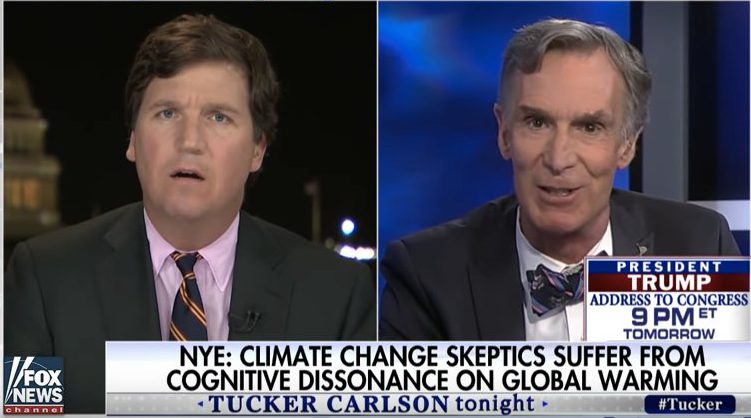
Try to make your face look like Tucker Carlson:

When dealing with a naturalist fundamentalist, make the Tucker Carlson face
The Tucker Carlson face conveys a mix of confusion, disappointment and horror

For God’s sake, even Richard Dawkins admitted in his debate with John Lennox that a good case can be made for a deistic God from the science we have now. If Dawkins can admit this, then you need to be extremely harsh to the village atheists.

If the word “naturalism” is all new to you, you should probably read the whole article and this longer article as well. The longer article really explains the different definitions of the words that are used in these debates. Johnson’s an excellent writer, and you will learn a lot.

CDC reports: STD rates hit all-time high for the fourth straight year

Preliminary CDC numbers for STDs in 2017

I’ve been blogging about skyrocketing rates of sexually-transmitted-diseases for the last few years, and particularly how it impacts high risk groups, e.g. – men who have sex with men. The attitude that the culture is taking towards this is to not make any moral judgments, but someone is going to have to pay for all the health care that is required to “fix” this problem.

Fox News reports on the latest numbers:

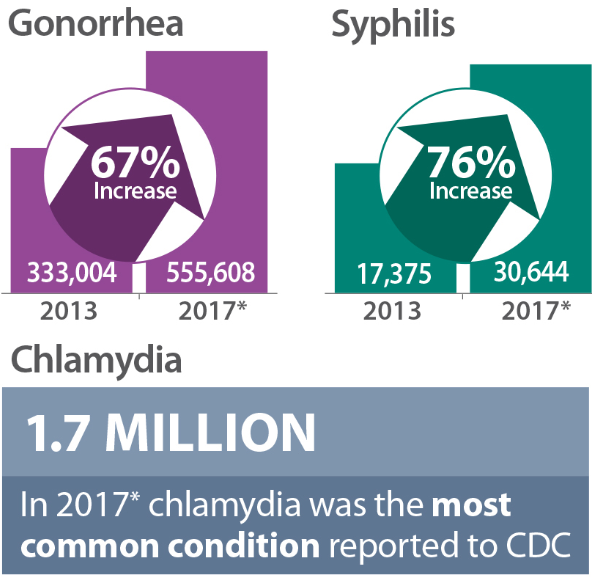
Sexually-transmitted diseases continue to hit all-time highs in the U.S. with the Centers for Disease Control and Prevention (CDC) reporting a 10 percent spike for chlamydia, gonorrhea and syphilis in 2017. The federal health agency said in a report released Tuesday that the numbers, which include nearly 2.3 million new cases of the aforementioned diseases, reflect a “steep, sustained increase” in STDs since 2013.

“We’re sliding backward,” Jonathan Mermin, director of CDC’s National Center for HIV/AIDS, Viral Hepatitis, STD and TB Prevention, said. “It is evident the systems that identify, treat and ultimately prevent STDs are strained to near-breaking point.”

The data, which was presented at the 2018 STD Prevention Conference, found a 67 percent increase in gonorrhea diagnoses, which officials sounded alarm over due to the growing threat of untreatable strains.

The CDC gives us the numbers well enough, but like all government agencies, their attitude is not to tell the selfish adults to behave morally. They blame “stigma and discrimination” for the rise in STDs, and recommend more government as the solution. I.e. – they think that people who disapprove of sex outside of marriage are to blame for the skyrocketing rates of STDs. If we all stopped making the irresponsible, reckless people feel bad with our ignorant moral judgments, then the STD problem would immediately be solved.

Anyway, here is an article that talks about untreatable strains of gonorrhea in particular:

Scientists have found a “superbug” strain of gonorrhea in Japan that is resistant to all recommended antibiotics and say it could transform a once easily treatable infection into a global public health threat.

The new strain of the sexually transmitted disease — called H041 — cannot be killed by any currently recommended treatments for gonorrhea, leaving doctors with no other option than to try medicines so far untested against the disease.

[…]Gonorrhea is a bacterial sexually transmitted infection and if left untreated can lead to pelvic inflammatory disease, ectopic pregnancy and infertility in women.

British scientists said last year that there was a real risk of gonorrhea becoming a superbug — a bacteria that has mutated and become resistant to multiple classes of antibiotics — after increasing reports of gonorrhea drug resistance emerged in Hong Kong, China, Australia and other parts of Asia.

Now, I know it’s tempting (for some people who like tolerance) to say that we should let people do whatever they want to do, and not judge them. After all, we can just take some money from the wealthy in order to solve these problems without making anyone feel bad. I hear this a lot from the the “don’t judge” crowd. But this time, it looks like no amount of money is going to solve this problem, and maybe the judgers were right to warn.

Syphilis is also a problem in certain high risk groups:

The sometimes-deadly disease syphilis is exploding in the United States, with most of the increase since 1995 among men who have sex with men (MSM), according to a new report from the Atlanta-based Center for Disease Control (CDC).

As recently as 2000, researchers believed the total elimination of syphilis was within reach. The recent dramatic increases in infections, coupled with the observation that syphilis closely tracks with other diseases like AIDS, have the medical and scientific community deeply concerned. The CDC report considers “the increase in syphilis among MSM is a major public health concern.”

According to the report, “During 2005-2013, the number of primary and secondary syphilis cases reported each year in the United States nearly doubled, from 8,724 to 16,663; the annual rate increased from 2.9 to 5.3 cases per 100,000 population.”

The report also says that “men contributed an increasing proportion of cases, accounting for 91.1% of all primary and secondary syphilis cases in 2013.” Most of the increases came from men who have sex with men, which were responsible for 77% of cases in 2009 but 83.9% in 2012, what the report calls “the vast majority of male… syphilis cases.”

HIV is also a problem for this same group:

A fact sheet released at the end of June by the US Centers for Disease Control (CDC) warns that HIV rates, already at epidemic proportions, are continuing to climb steadily among men who have sex with men (MSM).

“Gay and bisexual men remain at the epicenter of the HIV/AIDS epidemic,” says Jonathan Mermin, the director of the CDC’s division of HIV/AIDS prevention.

The CDC notes that while homosexual men make up only a very small percentage of the male population (4%), MSM account for over three-quarters of all new HIV infections, and nearly two-thirds (63 percent) of all new infections in 2010 (29,800).

“Men who have sex with men remain the group most heavily affected by HIV in the United States,” the fact sheet states.

We do have certain segments of the population who think that normal sexuality means having sex with dozens, hundreds and even thousands of partners. Just on the grounds of “they’re hot”. And naturally, these people are at higher risk for STDs.