Tag Archives: Atheism

U.S. birth rate hits record low, despite secular left’s obsession with “overpopulation”

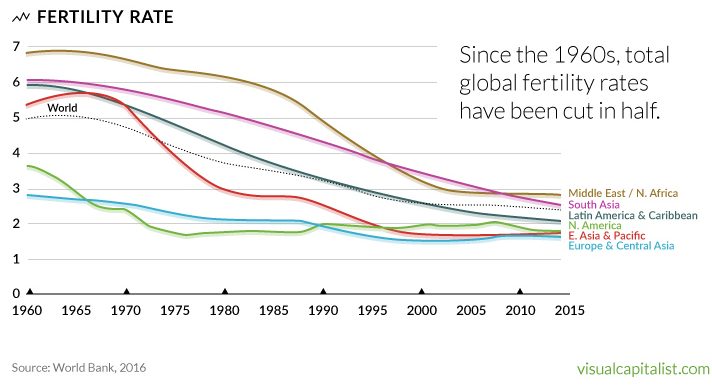
Total fertility rates have decreased globally by about half since 1960.

I had lunch with one of my co-workers on the secular left recently. I asked him what his biggest concern with the world. After telling me that he was a “libertarian”, he said that he was alarmed that people were having too many babies. I asked him what he wanted to do about it. He said keep abortion legal, and use the government to stop people from reproducing. Some libertarian!

Anyway, he was just factually wrong about the overpopulation, and I had to launch into a long, detailed explanation of replacement rates, birth rates across the world, and how the prosperity created by capitalism has caused birth rates to decline in even poorer countries. I also explained to him that once a country dips below the replacement fertility rate (2.1 births per woman), it never returns. I concluded my refutation of his assertion by stating that he should be more worried about underpopulation than overpopulation.

Anyway, I had to repeat the same explanation again with another secular leftist that same week. So when I saw this recent Daily Caller article about a new report from the US Centers for Disease Control, I figured I might as well equip you guys to respond to other people with the same wrong view.

It says:

The United States birth rate hit a record low in 2018 with numbers reflecting the lowest birthrates in the past 30 years, reports say.

A new report from the National Center for Health Statistics at the US Centers for Disease Control and Prevention reveals that almost every age group of women under 35 showed birth rate declines in 2018. The provisional number of births in the U.S. in 2018 was 3,788,235, down 2% since 2017. For every 1,000 women, the fertility rate declined 2% from 2017 to 1,728.0 births.

Birth rates had reached a record low in 2017 as well, marking a continuing trend of declining birth rates over the past four years, according to CNN.

[…]These 2018 birth rate numbers are below the necessary threshold needed for population replacement, which is 2,100 births per 1,000 women, CNN reports.

So we’re down to 1.73 births in the USA, which is below the 2.1 rate needed to maintain current population levels.

This new report isn’t an outlier. It confirms what we knew about from previous reports.

Here’s an earlier report from the far-left Pew Research Center, reported by the radically-leftist Slate, of all places.

Excerpt:

A report issued last month by the Pew Research Center found that immigrant births fell from 102 per 1,000 women in 2007 to 87.8 per 1,000 in 2012. That helped bring the overall U.S. birthrate to a mere 64 per 1,000 women—not enough to sustain our current population.

Moreover, the poor, highly fertile countries that once churned out immigrants by the boatload are now experiencing birthrate declines of their own. From 1960 to 2009, Mexico’s fertility rate tumbled from 7.3 live births per woman to 2.4, India’s dropped from six to 2.5, and Brazil’s fell from 6.15 to 1.9. Even in sub-Saharan Africa, where the average birthrate remains a relatively blistering 4.66, fertility is projected to fall below replacement level by the 2070s. This change in developing countries will affect not only the U.S. population, of course, but eventually the world’s.

Now I have a couple tools for you to share to those people who might have irrational views of this issue.

Useful videos

This video explains what’s wrong with overpopulation fears:

And this one explains what the replacement rate number is:

You can share those for people who don’t have time to read. It at least makes the point, even if it doesn’t link to a reputable report.

A useful podcast

This podcast featuring famous economist Dr. Jennifer Roback Morse will be useful for you to understand why the overpopulation myth is something you should be concerned about.

The MP3 file is here. (from 1/22/2010)

Topics:

  • how the transition from country to city discourages child-bearing
  • how religion impacts how many children parents have
  • what is the US birth rate, is it high enough?
  • can we just import immigrants to alleviate the low birth rate?
  • has increased prosperity encouraged people to have more children?
  • how has the purpose of sex changed after the sexual revolution?
  • how does the demographic crisis threaten entitlement programs?
  • what do we learn from the declining birth rate in Japan?
  • how does population growth impact stock market performance?

This podcast explains how some countries aren’t making enough young workers to pay for the social programs needed by a growing number of elderly people wanting to retire.

Please share the post if you found it useful.

The kalam cosmological argument defended in a peer-reviewed science journal

Christianity and the progress of science

Here’s the peer-reviewed article. It appears in a scientific journal focused on astrophysics.

Here’s the abstract:

Both cosmology and philosophy trace their roots to the wonder felt by the ancient Greeks as they contemplated the universe. The ultimate question remains why the universe exists rather than nothing. This question led Leibniz to postulate the existence of a metaphysically necessary being, which he identified as God. Leibniz’s critics, however, disputed this identification, claiming that the space-time universe itself may be the metaphysically necessary being. The discovery during this century that the universe began to exist, however, calls into question the universe’s status as metaphysically necessary, since any necessary being must be eternal in its existence. Although various cosmogonic models claiming to avert the beginning of the universe predicted by the standard model have been and continue to be offered, no model involving an eternal universe has proved as plausible as the standard model. Unless we are to assert that the universe simply sprang into being uncaused out of nothing, we are thus led to Leibniz’s conclusion. Several objections to inferring a supernatural cause of the origin of the universe are considered and found to be unsound.

The whole text of the article is posted online here.

Here’s an excerpt in which the author, Dr. William Lane Craig, explains the Big Bang cosmology:

The monumental significance of the Friedman-Lemaitre model lay in its historization of the universe. As one commentator has remarked, up to this time the idea of the expansion of the universe “was absolutely beyond comprehension. Throughout all of human history the universe was regarded as fixed and immutable and the idea that it might actually be changing was inconceivable.”{8} But if the Friedman-Lemaitre model were correct, the universe could no longer be adequately treated as a static entity existing, in effect, timelessly. Rather the universe has a history, and time will not be matter of indifference for our investigation of the cosmos. In 1929 Edwin Hubble’s measurements of the red-shift in the optical spectra of light from distant galaxies,{9} which was taken to indicate a universal recessional motion of the light sources in the line of sight, provided a dramatic verification of the Friedman-Lemaitre model. Incredibly, what Hubble had discovered was the isotropic expansion of the universe predicted by Friedman and Lemaitre. It marked a veritable turning point in the history of science. “Of all the great predictions that science has ever made over the centuries,” exclaims John Wheeler, “was there ever one greater than this, to predict, and predict correctly, and predict against all expectation a phenomenon so fantastic as the expansion of the universe?”{10}

As a GTR-based theory, the Friedman-Lemaitre model does not describe the expansion of the material content of the universe into a pre-existing, empty, Newtonian space, but rather the expansion of space itself. This has the astonishing implication that as one reverses the expansion and extrapolates back in time, space-time curvature becomes progressively greater until one finally arrives at a singular state at which space-time curvature becomes infinite. This state therefore constitutes an edge or boundary to space-time itself. P. C. W. Davies comments,

An initial cosmological singularity . . . forms a past temporal extremity to the universe. We cannot continue physical reasoning, or even the concept of spacetime, through such an extremity. . . . On this view the big bang represents the creation event; the creation not only of all the matter and energy in the universe, but also of spacetime itself.{11}

The popular expression “Big Bang,” originally a derisive term coined by Fred Hoyle to characterize the beginning of the universe predicted by the Friedman-Lemaitre model, is thus potentially misleading, since the expansion cannot be visualized from the outside (there being no “outside,” just as there is no “before” with respect to the Big Bang).{12}

The standard Big Bang model thus describes a universe which is not eternal in the past, but which came into being a finite time ago. Moreover,–and this deserves underscoring–the origin it posits is an absolute origin ex nihilo. For not only all matter and energy, but space and time themselves come into being at the initial cosmological singularity. As Barrow and Tipler emphasize, “At this singularity, space and time came into existence; literally nothing existed before the singularity, so, if the Universe originated at such a singularity, we would truly have a creation ex nihilo.“{13}

[…]On such a model the universe originates ex nihilo in the sense that at the initial singularity it is true that There is no earlier space-time point or it is false that Something existed prior to the singularity.

Every theist should be able to understand and defend this argument. It is a scientific refutation of materialism, and it is supported by six lines of scientific evidence – all of which emerged as science has progressed.

Scientific evidence:

  1. Einstein’s theory of general relativity (GTR)
  2. the red-shifting of light from distant galaxies implies an expanding universe
  3. the cosmic background radiation (which also disproves the oscillating model of the universe)
  4. the second law of thermodynamics applied to star formation theory
  5. hydrogen-helium abundance predictions
  6. radioactive element abundance predictions

Those are the scientific discoveries that have led us to the beginning of the universe, which support’s Dr. Craig’s argument.

This is the kind of evidence I expect all Christian theists to be using when discussing the question of whether God exists. Scientific evidence. When talking to non-Christians, we first need to show that we understand science, because science is a reliable and respected way of getting knowledge about the universe. Non-Christians do not accept the Bible, but they do accept science, so we begin evangelism with science. Science (experimental, testable, repeatable science) should set limits on what anyone can believe – including non-Christians, who might otherwise not be inclined to listen to Bible verses and theology. Important: it’s not a good idea to discuss the resurrection of Jesus with a person who does not accept the scientific evidence for a Creator of the universe.

A helpful short video:

The Big Bang is not compatible with atheism

According to the Secular Humanist Manifesto, atheism is committed to an eternally existing universe, (See the first item: “Religious humanists regard the universe as self-existing and not created.”). If something non-material brought all existing matter into being, that would be a supernatural cause, and atheists deny that anything supernatural exists. The standard Big Bang theory requires that all the matter in the universe come into being out of nothing. This falsifies eternal models of the universe, which are required by the atheistic worldview.

William Lane Craig lectures on the moral argument at Georgia Tech

Making sense of the meaning of atheism

This video has 3 parts, as well as questions and answers in individual clips.

For those who cannot watch the video, you can read this essay by Dr. Craig which covers exactly the same ground as the video. The essay is for Christians already familiar with basic apologetics.

Part 1 of 3:

Part 2 of 3:

Part 2 of 3:

Here’s a quick couple of quotes from the essay for those who cannot watch:

If there is no God, then any ground for regarding the herd morality evolved by homo sapiens as objectively true seems to have been removed. After all, what is so special about human beings? They are just accidental by-products of nature which have evolved relatively recently on an infinitesimal speck of dust lost somewhere in a hostile and mindless universe and which are doomed to perish individually and collectively in a relatively short time. Some action, say, incest, may not be biologically or socially advantageous and so in the course of human evolution has become taboo; but there is on the atheistic view nothing really wrong about committing incest. If, as Kurtz states, “The moral principles that govern our behavior are rooted in habit and custom, feeling and fashion,”5 then the non-conformist who chooses to flout the herd morality is doing nothing more serious than acting unfashionably.

The objective worthlessness of human beings on a naturalistic world view is underscored by two implications of that world view: materialism and determinism. Naturalists are typically materialists or physicalists, who regard man as a purely animal organism. But if man has no immaterial aspect to his being (call it soul or mind or what have you), then he is not qualitatively different from other animal species. For him to regard human morality as objective is to fall into the trap of specie-ism. On a materialistic anthropology there is no reason to think that human beings are objectively more valuable than rats. Secondly, if there is no mind distinct from the brain, then everything we think and do is determined by the input of our five senses and our genetic make-up. There is no personal agent who freely decides to do something. But without freedom, none of our choices is morally significant. They are like the jerks of a puppet’s limbs, controlled by the strings of sensory input and physical constitution. And what moral value does a puppet or its movements have?

[…]Moreover, if atheism is true, there is no moral accountability for one’s actions. Even if there were objective moral values and duties under naturalism, they are irrelevant because there is no moral accountability. If life ends at the grave, it makes no difference whether one lives as a Stalin or as a saint. As the Russian writer Fyodor Dostoyevsky rightly said: “If there is no immortality, then all things are permitted.”

If you want a much shorter, slicker version of this argument to share, Reasonable Faith has produced this nice 5-minute video that you can tweet or share on your Facebook page or whatever:

The moral argument is the easiest argument in the world to discuss with non-Christians, as everyone has to have an answer to questions like “what makes humans valuable?” and “why should I do the right thing when it goes against my self-interest?” and “will evildoers who escape justice in this life be punished when they die?” and “do humans have free will to make moral choices?” These are interesting questions, and people can just give their opinion and then think about it as they discuss it.

You can read a debate transcript where Dr. Craig puts his ideas to the test, against Dr. Richard Taylor. I found this debate very helpful for answering the question that everyone should be able to answer: “why should I be moral?”