Tag Archives: Atheism

Can atheist Louise Antony rationally ground objective morality?

A conflict of worldviews

The debate on video:

I read Dr. Craig’s report of his debate with Louise Antony on the topic of God and morality. My impression from his review was that she hadn’t prepared for the debate and didn’t understand the moral argument at all.

My impressions of her were confirmed by J.W. Wartick’s blog post.

Summary:

Recently, I listened [again] to the debate between William Lane Craig and Louise Anthony. Some have lauded this debate as a stirring victory for secular ethics. (See, for example, the comments here–one comment even goes so far as to say “I swoon when someone evokes the Euthyphro Dilemma and frown at the impotent, goal-post-moving, ‘Divine nature’ appeal.”) In reality, I think Louise Anthony did indeed present the case for secular metaethics. The problem is that this case is utterly vacuous. 

I’ll break down why this is the case by focusing upon three areas of development in secular and theistic ethics: objective moral truths, suffering, and moral facts.

Here’s the snarkiest part:

Louise Anthony seems to be just confused about the nature of objective morality. She says in response to a question from the audience, “The universe has no purpose, but I do… I have lots of purposes…. It makes a lot of difference to a lot of people and to me what I do. That gives my life significance… The only thing that would make it [sacrificing her own life] insignificant would be if my children’s lives were insignificant. And, boy you better not say that!”

Craig responded, “But Louise, on atheism, their lives are insignificant.” Anthony interjected, “Not to me!”

But then she goes on to make this confused statement, “It’s an objective fact that they [her children] are significant to me.”

Note how Anthony has confused the terms here. Yes, it is an objective fact that according to Louise Anthony, her children matter to her. We can’t question Anthony’s own beliefs–we must trust what she tells us unless we have reason to think otherwise. But that’s not enough. What Craig and other theists are trying to press is that that simple fact has nothing to do with whether her children are actually valuable. Sure, people may go around complaining that “Well, it matters to me, so it does matter!” But that doesn’t make it true. All kinds of things can matter to people, that doesn’t mean that they are ontologically objective facts.

It matters to me whether the Cubs [an American baseball team] win the World Series. That hasn’t happened in 104 years, so it looks like it doesn’t matter in the overall scheme of the universe after all. But suppose I were to, like Anthony, retort, “But the Cubs matter to me! It’s an objective fact that them winning the World Series is significant to me!” Fine! But all the Cardinals [a rival team] fans would just laugh at me and say “SO WHAT!?

Similarly, one can look at Anthony with incredulity and retort, “Who cares!?” Sure, if you can get enough people around Anthony who care about her children’s moral significance, you can develop a socially derived morality. But that’s not enough to ground objective morality. Why should we think that her values matter to the universe at large? On atheism, what reason is there for saying that her desires and purposes for her children are any better than my desires and purposes for the Cubs?

She doesn’t even understand the difference between objective and subjective morality! Sigh. For her, it’s enough that people have feelings about what they like and don’t like, and that they have the feeling that they ought to act in line with their feelings. And if you challenge her about obviously evil people, e.g. – radical Islamists blowing up innocent children for their ideology, well she has no reason to say that their feelings-based morality is any more rationally grounded than her own. The problem with atheists is that they approach morality with the goal of explaining it away. They want to avoid having to comply with objective, prescriptive morality, but they also want to justify themselves to theists  by saying “look at me, I have standards too, I’m not a sociopath!” So, they invent a subjective morality based on their need to feel good and get the praise of their peers and congratulate themselves about acting according to a subjective standard. Problem solved! The fact is that there is no way to get to an objective moral standard that applies in all times and places on atheism. Accidental universe = anything goes. Period. End of issue.
Is asking “Am I going to Hell?” a good rebuttal to scientific arguments for theism?

A conflict of worldviews

I want to use this woman’s story to show how sensible atheists reach a belief in God.

Excerpt:

I don’t know when I first became a skeptic. It must have been around age 4, when my mother found me arguing with another child at a birthday party: “But how do you know what the Bible says is true?” By age 11, my atheism was so widely known in my middle school that a Christian boy threatened to come to my house and “shoot all the atheists.” My Christian friends in high school avoided talking to me about religion because they anticipated that I would tear down their poorly constructed arguments. And I did.

As I set off in 2008 to begin my freshman year studying government at Harvard (whose motto is Veritas, “Truth”), I could never have expected the change that awaited me.

It was a brisk November when I met John Joseph Porter. Our conversations initially revolved around conservative politics, but soon gravitated toward religion. He wrote an essay for the Ichthus, Harvard’s Christian journal, defending God’s existence. I critiqued it. On campus, we’d argue into the wee hours; when apart, we’d take our arguments to e-mail. Never before had I met a Christian who could respond to my most basic philosophical questions: How does one understand the Bible’s contradictions? Could an omnipotent God make a stone he could not lift? What about the Euthyphro dilemma: Is something good because God declared it so, or does God merely identify the good? To someone like me, with no Christian background, resorting to an answer like “It takes faith” could only be intellectual cowardice. Joseph didn’t do that.

And he did something else: He prodded me on how inconsistent I was as an atheist who nonetheless believed in right and wrong as objective, universal categories. Defenseless, I decided to take a seminar on meta-ethics. After all, atheists had been developing ethical systems for 200-some years. In what I now see as providential, my atheist professor assigned a paper by C. S. Lewis that resolved the Euthyphro dilemma, declaring, “God is not merely good, but goodness; goodness is not merely divine, but God.”

Joseph also pushed me on the origins of the universe. I had always believed in the Big Bang. But I was blissfully unaware that the man who first proposed it, Georges Lemaître, was a Catholic priest. And I’d happily ignored the rabbit trail of a problem of what caused the Big Bang, and what caused that cause, and so on.

By Valentine’s Day, I began to believe in God. There was no intellectual shame in being a deist, after all, as I joined the respectable ranks of Thomas Jefferson and other Founding Fathers.

I wouldn’t stay a deist for long. A Catholic friend gave me J. Budziszewski’s book Ask Me Anything, which included the Christian teaching that “love is a commitment of the will to the true good of the other person.” This theme—of love as sacrifice for true good—struck me. The Cross no longer seemed a grotesque symbol of divine sadism, but a remarkable act of love. And Christianity began to look less strangely mythical and more cosmically beautiful.

So, I want to point out the progression of her beliefs from atheist to deist to Christian. First, she listened to the scientific arguments for God’s existence, which took her to deism, which is a variety of theism where God just creates the universe and then doesn’t interfere with it after. Those arguments, the Big Bang and the cosmic fine-tuning, were enough for her to falsify atheism and prove some sort of theism. After that, she remained open to the evidence for Christian theism, and finally got there after looking at other evidence.

But this makes me think of how some of the atheists that I talk to do the exact opposite of what she did. I start off by explaining to them scientific evidence for a Creator and Designer. I explain the mainstream discoveries that confirm an origin of the universe (e.g. – light element abundance predictions and observations), and I cite specific examples of fine-tuning, (e.g. – the gravitational constant). I explain protein sequencing and folding, and calculate the probabilities of getting a protein by chance. I explain the sudden origin of the phyla in the Cambrian explosion, and show why naturalistic explanations fail. I talk about the fine-tuning needed to get galaxies, solar systems and planets to support life. But many of these atheists don’t become deists like the honest atheist in the story. Why not?

Well, the reason why not is because they interrupt the stream of scientific evidence coming out of my mouth and they start to ask me questions that have nothing to do with what we can know through science. See, evangelism is like building a house. You have to start with the foundation, the walls, the plumbing, the electricity, etc., but you can’t know all the specific details about furniture and decorations at the beginning. But militant atheists don’t care that you are able to establish the foundations of Christian theism – they want to jump right to the very fine-grained details, and use that to justify not not building anything at all. Just as you are proving all the main planks of a theistic worldview with science, they start asking “am I going to Hell?” and telling you “God is immoral for killing Canaanite children”, etc. They want to stop the construction of the house by demanding that you build everything at once. But, it is much easier to accept miracles like the virgin birth if you have a God who created the universe first. The foundation comes first, it makes the later stuff easier to do.

So rather than adjust their worldview to the strong scientific evidence, and then leave the puzzling about Hell and Old Testament history for later, they want to refute the good scientific arguments with “Am I going to Hell?”. How does complaining about Hell and unanswered prayer a response to scientific evidence? It’s not! But I think that this does explain why atheists remain atheists in the face of all the scientific evidence against naturalism. They insulate their worldview from the progress of science by focusing on their emotional disappointment that they are not God and that God isn’t doing what they want him to do. That’s the real issue. Authority and autonomy. In my experience, they are usually not accountable to science, although there are, thank God, exceptions to that rule.

How the WMAP satellite confirmed nucleosynthesis predictions and falsified atheism

Apologetics and the progress of science

Prior to certain scientific discoveries, most people thought that the universe had always been here, and no need to ask who or what may have caused it. But today, that’s all changed. Today, the standard model of the origin of the universe is that all the matter and energy in the universe came into being in an event scientists call “The Big Bang”. At the creation event, space and time themselves began to exist, and there is no material reality that preceded them.

So a couple of quotes to show that.

An initial cosmological singularity… forms a past temporal extremity to the universe. We cannot continue physical reasoning, or even the concept of spacetime, through such an extremity… On this view the big bang represents the creation event; the creation not only of all the matter and energy in the universe, but also of spacetime itself.

Source: P. C. W. Davies, “Spacetime Singularities in Cosmology,” in The Study of Time III, ed. J. T. Fraser (Berlin: Springer Verlag ).

And another quote:

[A]lmost everyone now believes that the universe, and time itself, had a beginning at the big bang.

Source: Stephen Hawking and Roger Penrose, The Nature of Space and Time, The Isaac Newton Institute Series of Lectures (Princeton, N. J.: Princeton University Press, 1996), p. 20.

So, there are several scientific discoveries that led scientists to accept the creation event, and one of the most interesting and famous is the discovery of how elements heavier than hydrogen were formed.

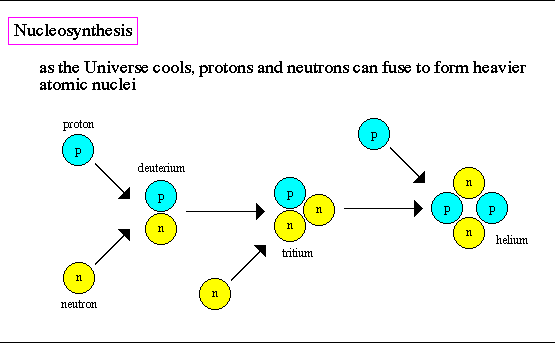
Nucleosynthesis: forming heavier elements by fusion

Here’s the history of how that discovery happened, from the National Aeronautics and Space Administration (NASA) web site:

The term nucleosynthesis refers to the formation of heavier elements, atomic nuclei with many protons and neutrons, from the fusion of lighter elements. The Big Bang theory predicts that the early universe was a very hot place. One second after the Big Bang, the temperature of the universe was roughly 10 billion degrees and was filled with a sea of neutrons, protons, electrons, anti-electrons (positrons), photons and neutrinos. As the universe cooled, the neutrons either decayed into protons and electrons or combined with protons to make deuterium (an isotope of hydrogen). During the first three minutes of the universe, most of the deuterium combined to make helium. Trace amounts of lithium were also produced at this time. This process of light element formation in the early universe is called “Big Bang nucleosynthesis” (BBN).

The creation hypothesis predicts that there will be specific amounts of these light elements formed as the universe cools down. Do the predictions match with observations?

Yes they do:

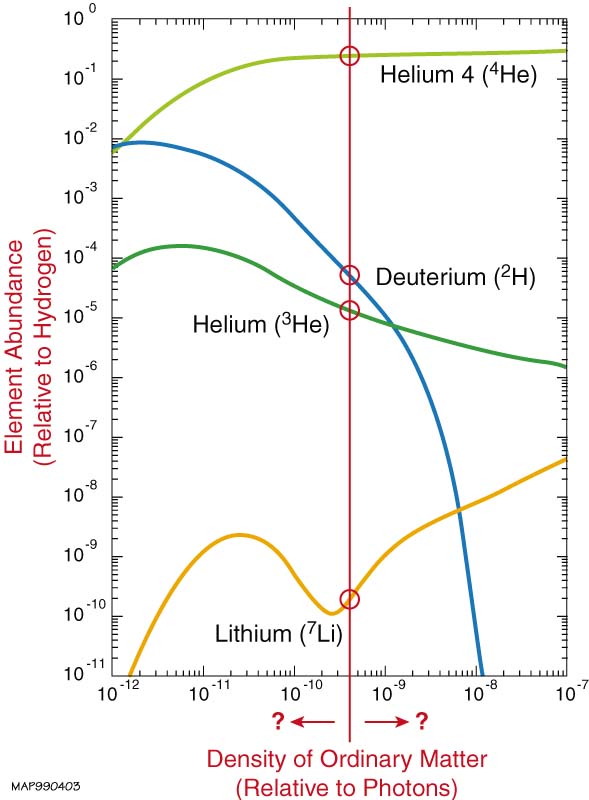
The predicted abundance of deuterium, helium and lithium depends on the density of ordinary matter in the early universe, as shown in the figure at left. These results indicate that the yield of helium is relatively insensitive to the abundance of ordinary matter, above a certain threshold. We generically expect about 24% of the ordinary matter in the universe to be helium produced in the Big Bang. This is in very good agreement with observations and is another major triumph for the Big Bang theory.

Moreover, WMAP satellite measurements of mass density agree with our observations of these light element abundances.

Here are the observations from the WMAP satellite:

Scientific observations match predictions

And here is how those WMAP measurements confirm the Big Bang creation event:

However, the Big Bang model can be tested further. Given a precise measurement of the abundance of ordinary matter, the predicted abundances of the other light elements becomes highly constrained. The WMAP satellite is able to directly measure the ordinary matter density and finds a value of 4.6% (±0.2%), indicated by the vertical red line in the graph. This leads to predicted abundances shown by the circles in the graph, which are in good agreement with observed abundances. This is an important and detailed test of nucleosynthesis and is further evidence in support of the Big Bang theory. 

“An important and detailed test”.

For completeness, we should learn how elements heavier than these light elements are formed:

Elements heavier than lithium are all synthesized in stars. During the late stages of stellar evolution, massive stars burn helium to carbon, oxygen, silicon, sulfur, and iron. Elements heavier than iron are produced in two ways: in the outer envelopes of super-giant stars and in the explosion of a supernovae. All carbon-based life on Earth is literally composed of stardust.

That’s a wonderful thing to tell a young lady when you are on a date: “your body is made of stardust”. In fact, as I have argued before, this star formation, which creates the elements necessary for intelligent life, can only be built if the fundamental constants and quantities in the universe are finely-tuned.

Now, you would think that atheists would be happy to find observations that confirm the origin of the universe out of nothing, but they are not. Actually, they are in denial.

Here’s a statement from the Secular Humanist Manifesto, which explains what atheists believe about the universe:

Religious humanists regard the universe as self-existing and not created.

For a couple of examples of how atheistic scientists respond to the evidence for a cosmic beginning, you can check out this post, where we get responses from cosmologist Lawrence Krauss, and physical chemist Peter Atkins.

You cannot have the creation of the universe be true AND a self-existing, eternal universe ALSO be true. Someone has to be wrong. Either the science is wrong, or the atheist manifesto is wrong. I know where I stand.

Positive arguments for Christian theism