Note: even if you have heard Dr. Craig’s arguments before, I recommend jumping to the 48 minutes of Q&A time, which starts 72 minutes in.
About Dr. William Lane Craig:
William Lane Craig (born August 23, 1949) is an American analytic philosopher, philosophical theologian, and Christian apologist. He is known for his work on the philosophy of time and the philosophy of religion, specifically the existence of God and the defense of Christian theism. He has authored or edited over 30 books including The Kalam Cosmological Argument (1979), Theism, Atheism and Big Bang Cosmology(co-authored with Quentin Smith, 1993), Time and Eternity: Exploring God’s Relationship to Time (2001), and Einstein, Relativity and Absolute Simultaneity (co-edited with Quentin Smith, 2007).
Craig received a Bachelor of Arts degree in communications from Wheaton College, Illinois, in 1971 and two summa cum laudemaster’s degrees from Trinity Evangelical Divinity School in Deerfield, Illinois, in 1975, in philosophy of religion and ecclesiastical history. He earned a Ph.D. in philosophy under John Hick at the University of Birmingham, England in 1977 and a Th.D. underWolfhart Pannenberg at the University of Munich, Germany in 1984.
Dr. Craig was in Scotland to lecture at a physics conference, but a local church organized this public lecture at the University of St. Andrews.
Here is the full lecture with Q&A: (2 hours)
Summary:
Naturalism defined: the physical world (matter, space and time) is all that exists
Dr. Craig will present 7 reasons why naturalism is false
1) the contingency argument
2) the kalam cosmological argument
3) the fine-tuning of the universe for intelligent life
4) the moral argument
5) the ontological argument
6) the resurrection of Jesus
7) religious experience
Dr. Craig does mention an 8th argument early in the Q&A – the argument from the non-physicality of mental states (substance dualism), which is an argument that I find convincing, because a materialist conception of mind is not compatible with rationality, consciousness and moral agency.
Questions and Answers
He gets a couple of questions on the moral argument early on – one of them tries to put forward an evolutionary explanation for “moral” behaviors. There’s another question the definition of naturalism. There is a bonehead question about the non-existence of Jesus based on a Youtube movie he saw – which Craig responds to with agnostic historian Bart Ehrman’s book on that topic. There’s a question about God as the ground for morality – does morality come from his will or nature.
Then there is a question about the multiverse, which came up at the physics conference Dr. Craig attended the day before. There is a good question about the Big Bang theory and the initial singularity at time t=0. Another good question about transfinite arithmetic, cardinality and set theory. One questioner asks about the resurrection argument. The questioner asks if we can use the origin of the disciples belief as an argument when other religions have people who are willing to die for their claims. One of the questioners asks about whether the laws of nature break down at 10^-43 after the beginning of the universe. There is a question about the religious experience argument, and Craig has the opportunity to give his testimony.
I thought that the questions from the Scottish students and faculty were a lot more thoughtful and respectful than at American colleges and universities. Highly recommended.
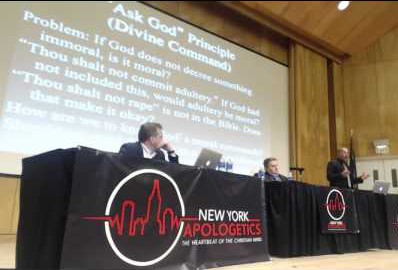
Turek’s cross-examination period starts at 74m22s and ends at 89m20s.
Shermer’s cross-examination period starts at 89m50s and ends at 105m0s.
Topics of Turek’s cross-examination:
evolution produces Shermer’s moral sense and Hitler’s moral sense
why does Shermer think his is better than Hitler’s, since both were produced by the same evolution?
what makes right or wrong if evolution is the source of morality?
why is Stalin’s opinion of right and wrong less valuable than the herd’s opinion of right and wrong?
do the Founding Fathers ground inalienable rights in a Creator, or in evolution?
can atheism ground the existence of inalienable rights?
can you ground objective moral values and objective moral duties by asking people how they feel?
can you ground objective human rights on atheism by shouting like a madman and interrupting?
how can you trust your thinking if they are the result of an unguided, random process of evolution?
how can you have rational thoughts if materialism is true, and you are a machine made out of meat?
can you ground objective moral values and objective moral duties on personal preferences?
how do the personal preferences of some individuals create an objective moral duty for other individuals?
does naturalistic evolution orient human beings toward survival or truth?
on materialism, what is the chemical composition of justice?
Topics of Shermer’s cross-examination:
Radical muslims are exactly the same as evangelical Christians, and have the same God (Allah is the same as the Triune Christian God)
Radical muslims would assert that their God is the same as the Triune Christian God, with Jesus and the Holy Spirit also being God
Therefore, we can lay the blame for what radical muslims do on the backs of evangelical Christians
Radical muslims and evangelical Christians are the same, because “you’re enthusiastic, they’re enthusiastic”
The Bible’s notion of indentured servitude to pay off debt is the identical to the idea of slavery based on race
The Bible’s notion that masters and slaves are equal in the sight of God forms a basis for thinking they are unequal
The Bible teaches things that I disagree with, like the idea that marriage should provide children with a mother and a father
Gay marriage is solidly grounded in evolution, even though the morality that evolution produces varies by time and place
Atheists can ground objective moral values and objective moral duties by asking people how they feel
Can atheists who want to legalize gay marriage because “they’re in love” prohibit polygamy or incest as marriage?
Is shouting “you’re on the wrong side of history” a way to rationally ground morality in an accidental atheistic universe?
Is it loving for atheists to celebrate a lifestyle that exposes gay men to sickness and premature death?
Is it “bigotry” for the Center for Disease Control to warn men who have sex with men about higher health risks?
How do Christians decide what is right and wrong when they are confronted with a moral dilemma?
How do humans sense the objective moral standard that is required for them to make moral judgments
Can enlightenment philosophers who merely imagine human rights actually create those human rights?
If revelations change over time for Mormons, does that undermine the need for God to ground objective morality?
I apologize for the poor quality of the video and audio. The moderator was extremely ineffective, letting Shermer go on and on making speeches instead of asking questions during his questioning time. Also, Shermer apparently thought that shouting at Turek and waving his finger at Turek was a good strategy to defend against Turek’s use of logic and evidence.
My thoughts on Michael Shermer
I do want to make some general comments about what Shermer said. Shermer’s view of morality is “what is best for the greatest number of people”. There are no inalienable rights that act as a break on the will of the majority. Shermer has no objection to anything that the majority has decided in any time or in any place. If he were there, he would agree that whatever they decided was morally right.
Two hundred years ago, Shermer would have endorsed slavery. And if he were in Germany 50 years ago, he would have endorsed the Holocaust. If he lived in a Pakistan today, he would endorse stoning women for wearing the wrong clothes. Atheists always think that whatever the majority is doing in a particular time and place is right for them. There are no inalienable human rights that exist apart from human opinions, on atheism.
Another problem is that Shermer is constantly making moral judgments when his own view is that morality is constantly changing in different times and places. He condemns the moral values of other times and places without having any standard in his worldview that can decide between different moral values and duties. It is like saying that lunch is better than breakfast because lunch is here and now, and breakfast was then and there. That is literally what atheists do when they make moral judgments. They have no standard that applies to different times and places, just the ever evolving opinions of the majority of people in different times and places.
Is Michael Shermer concerned about morality?
Finally, I want people to understand what kind of person Michael Shermer is. You can read a post by PZ Myers on his blog Pharyngula to get the picture. I think it’s useful to know about Shermer’s own morality since he seems to like to make moral judgments so much during debates. In my own experience in dealing with atheists, although they will talk about slavery and the Crusades, there is nothing in an atheist’s moral system that makes things wrong for all times and all places. They bring it up to stop you from judging them about the things that they care about. When an atheist says “the Crusades! Slavery!” what they really mean is “I need to shame you for having a basis for moral judgments against me, so that you won’t say anything about me getting married women drunk then raping them”. That’s what atheistic use of moral language is really about.
What atheists really think about morality
Atheist Richard Dawkins says atheists have no objective moral standards:
In a universe of blind physical forces and genetic replication, some people are going to get hurt, other people are going to get lucky, and you won’t find any rhyme or reason in it, or any justice. The universe that we observe has precisely the properties we should expect if there is, at bottom, no design, no purpose, no evil and no good, nothing but blind, pitiless indifference… DNA neither knows nor cares. DNA just is. And we dance to its music. (Richard Dawkins, River Out of Eden: A Darwinian View of Life (1995))
So, when Shermer tries to shame Christians for behaviors in other times and places which our society here and now disagrees with, what he really means is “morality, objectively speaking, is nonsense, but I will use your moral sense that comes from your non-atheistic worldview to shame you, so that you won’t have the confidence to judge me for my immoral behavior”. And we need to get used to understanding this about atheists. Morality is nonsense to them, and their real goal is to get you off their back for their hedonism. For atheists, morality is just complying with arbitrary social customs which vary by time and place. There is nothing more to it than aping their neighbors (at least when their neighbors are watching). And they would have aped slave-owners, widow-burners and Nazi prison guards too, if they lived in that time and place. And shouted at Christians for disagreeing with them, just like Shermer did about gay marriage.
If you like the way that Frank Turek debates, then be sure and check out his new book “Stealing From God“. I highly recommend it.
Some atheists who don’t understand the fine-tuning argument like to assert that the constants and quantities that are fine-tuned to allow for the existence of complex, embodied life can be changed arbitrarily, and life would still exist as it does now. They say that maybe we would have a ridges in our foreheads like Klingons, or maybe we would have longer ears like Vulcans or maybe green skin like Orions. The evidential support for this view seems to be grounded in Star Trek TV shows, not peer-reviewed evidence. Are atheists right to ground their rejection of a cosmic Designer in science fiction television shows? What does the peer-reviewed research say?
The fine-tuning argument
First, let’s review the structure of the fine-tuning argument.
The argument goes like this:
The fine-tuning of the universe to support life is either due to law, chance or design
It is not due to law or chance
Therefore, the fine-tuning is due to design
Although each permutation of values for the constants and quantities is equally improbable, the vast majority of the permutations will not permit life.
Let’s review:
Life has certain minimal requirements; long-term stable source of energy, a large number of different chemical elements, an element that can serve as a hub for joining together other elements into compounds, a universal solvent, etc.
In order to meet these minimal requirements, the physical constants, (such as the gravitational constant), and the ratios between physical constants, need to be withing a narrow range of values in order to support the minimal requirements for life of any kind.
Slight changes to any of the physical constants, or to the ratios between the constants, will result in a universe inhospitable to life.
The range of possible values spans 70 orders of magnitude.
The constants are selected by whoever creates the universe. They are not determined by physical laws. And the extreme probabilities involved required put the fine-tuning beyond the reach of chance.
Although each individual selection of constants and ratios is as unlikely as any other selection, the vast majority of these possibilities do not support the minimal requirements of life of any kind. (In the same way as any hand of 5 cards that is dealt is as likely as any other, but you are overwhelmingly likely NOT to get a royal flush. In our case, a royal flush is a life-permitting universe).
Now let’s see a specific example: carbon and oxygen formation.
Carbon is that element that can serve as a hub for larger molecules, and oxygen is also a vital element, since it is a component of water, which is required for life (universal solvent). Both are required for complex life of any imaginable kind.
Now for the study.
Here is an article on Science Daily about the fine-tuning argument.
It says:
Life as we know it is based upon the elements of carbon and oxygen. Now a team of physicists, including one from North Carolina State University, is looking at the conditions necessary to the formation of those two elements in the universe. They’ve found that when it comes to supporting life, the universe leaves very little margin for error.
Both carbon and oxygen are produced when helium burns inside of giant red stars. Carbon-12, an essential element we’re all made of, can only form when three alpha particles, or helium-4 nuclei, combine in a very specific way. The key to formation is an excited state of carbon-12 known as the Hoyle state, and it has a very specific energy — measured at 379 keV (or 379,000 electron volts) above the energy of three alpha particles. Oxygen is produced by the combination of another alpha particle and carbon.
NC State physicist Dean Lee and German colleagues Evgeny Epelbaum, Hermann Krebs, Timo Laehde and Ulf-G. Meissner had previously confirmed the existence and structure of the Hoyle state with a numerical lattice that allowed the researchers to simulate how protons and neutrons interact. These protons and neutrons are made up of elementary particles called quarks. The light quark mass is one of the fundamental parameters of nature, and this mass affects particles’ energies.
In new lattice calculations done at the Juelich Supercomputer Centre the physicists found that just a slight variation in the light quark mass will change the energy of the Hoyle state, and this in turn would affect the production of carbon and oxygen in such a way that life as we know it wouldn’t exist.
[…]The researchers’ findings appear in Physical Review Letters.
There are many, many other examples of fine-tuning of the constants and quantities to permit complex, embodied life. And, as we’ll see below, this evidence is admitted by atheists.
Atheists agree: the fine-tuning is a fact
Let me give you a citation from the best one of all, Martin Rees. Martin Rees is an atheist and a qualified astronomer. He wrote a book called “Just Six Numbers: The Deep Forces That Shape The Universe”, (Basic Books: 2001). In it, he discusses 6 numbers that need to be fine-tuned in order to have a life-permitting universe.
In chapter 1, Rees writes:
Mathematical laws underpin the fabric of our universe — not just atoms, but galaxies, stars and people. The properties of atoms — their sizes and masses, how many different kinds there are, and the forces linking them together — determine the chemistry of our everyday world. The very existence of atoms depends on forces and particles deep inside them. The objects that astronomers study — planets, stars and galaxies — are controlled by the force of gravity. And everything takes place in the arena of an expanding universe, whose properties were imprinted into it at the time of the initial Big Bang.
[…]This book describes six numbers that now seem especially significant.
[…]Perhaps there are some connections between these numbers. At the moment, however, we cannot predict any one of them from the values of the others.
[…]These six numbers constitute a ‘recipe’ for a universe. Moreover, the outcome is sensitive to their values: if any one of them were to be ‘untuned’, there would be no stars and no life. Is this tuning just a brute fact, a coincidence? Or is it the providence of a benign Creator?
There are some atheists who deny the fine-tuning, but these atheists are in firm opposition to the progress of science. The more science has progressed, the more constants, ratios and quantities we have discovered that need to be fine-tuned. Science is going in a theistic direction. Next, let’s see how atheists try to account for the fine-tuning.
Atheistic responses to the fine-tuning evidence
There are two common responses among atheists to this argument.
The first is to speculate that there are actually an infinite number of other universes that are not fine-tuned, (i.e. – the gambler’s fallacy). All these other universes don’t support life. We just happen to be in the one universe is fine-tuned for life. The problem is that there is no way of directly observing these other universes and no independent evidence that they exist.
Here is an excerpt from an article in Discover magazine, (which is hostile to theism and Christianity).
Short of invoking a benevolent creator, many physicists see only one possible explanation: Our universe may be but one of perhaps infinitely many universes in an inconceivably vast multiverse. Most of those universes are barren, but some, like ours, have conditions suitable for life.
The idea is controversial. Critics say it doesn’t even qualify as a scientific theory because the existence of other universes cannot be proved or disproved. Advocates argue that, like it or not, the multiverse may well be the only viable nonreligious explanation for what is often called the “fine-tuning problem”—the baffling observation that the laws of the universe seem custom-tailored to favor the emergence of life.
The second response by atheists is that the human observers that exist today, 14 billion years after the universe was created out of nothing, actually caused the fine-tuning by going back in time and causing the universe to be fine-tuned. This solution would mean that although humans did not exist at the time the of the big bang, they are going to be able to reach back in time at some point in the future and manually fine-tune the universe.
Here is an excerpt from and article in the New Scientist, (which is hostile to theism and Christianity).
…maybe we should approach cosmic fine-tuning not as a problem but as a clue. Perhaps it is evidence that we somehow endow the universe with certain features by the mere act of observation… observers are creating the universe and its entire history right now. If we in some sense create the universe, it is not surprising that the universe is well suited to us.
So, there are two choices for atheists. Either an infinite number of unobservable universes that are not fine-tuned, or humans go back in time at some future point and fine-tune the beginning of the universe, billions of years in the past. I think I will prefer the design explanation to those alternatives.



 WINTERY KNIGHT