
Tag Archives: Argument

New York Times profiles philosopher Alvin Plantinga and discusses his new book

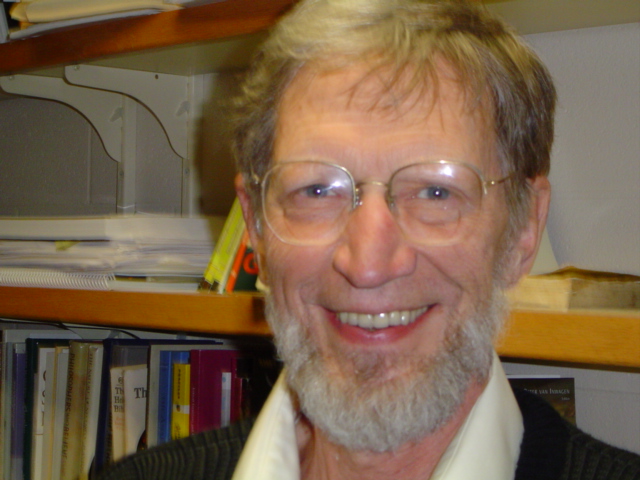
Christian philosopher Alvin Plantinga

Alvin Plantinga is widely regarded as the top Christian philosopher in the world, and a former head of the largest professional association of philosophers – the American Philosophical Association (APA).

 Mary sent me this article from the New York Times about Alvin Plantinga and his new book, published by Oxford University Press – the top academic press in the world.

Excerpt:

From Calvin [College], and later from the University of Notre Dame, Mr. Plantinga has led a movement of unapologetically Christian philosophers who, if they haven’t succeeded in persuading their still overwhelmingly unbelieving colleagues, have at least made theism philosophically respectable.

“There are vastly more Christian philosophers and vastly more visible or assertive Christian philosophy now than when I left graduate school,” Mr. Plantinga said in a recent telephone interview from his home in Grand Rapids, adding, with characteristic modesty, “I have no idea how it happened.”

Mr. Plantinga retired from full-time teaching last year, with more than a dozen books and a past presidency of the American Philosophical Association to his name. But he’s hardly resting on those laurels. Having made philosophy safe for theism, he’s now turning to a harder task: making theism safe for science.

For too long, Mr. Plantinga contends in a new book, theists have been on the defensive, merely rebutting the charge that their beliefs are irrational. It’s time for believers in the old-fashioned creator God of the Bible to go on the offensive, he argues, and he has some sports metaphors at the ready. (Not for nothing did he spend two decades at Notre Dame.)

In “Where the Conflict Really Lies: Science, Religion and Naturalism,” published last week by Oxford University Press, he unleashes a blitz of densely reasoned argument against “the touchdown twins of current academic atheism,” the zoologist Richard Dawkins and the philosopher Daniel C. Dennett, spiced up with some trash talk of his own.

[…] Longtime readers of Mr. Plantinga, who was raised as a Presbyterian and who embraced the Calvinism of the Christian Reformed Church as a young man, are used to such invocations of theological concepts. And even philosophers who reject his theism say his arguments for the basic rationality of belief, laid out in books like “Warranted Christian Belief” and “God and Other Minds,” constitute an important contribution that every student of epistemology would be expected to know.

But Mr. Plantinga’s steadfast defense of the biochemist and intelligent-design advocate Michael Behe, the subject of a long chapter in the new book, is apparently another matter.

“I think deep down inside he really isn’t a friend of science,” Michael Ruse, a philosopher of science at Florida State University, said of Mr. Plantinga. “I’m not objecting to him wanting to defend theism. But I think he gets his victory at the level of gelding or significantly altering modern science in unacceptable ways.”

Mr. Dennett was even harsher, calling Mr. Plantinga “Exhibit A of how religious beliefs can damage or hinder or disable a philosopher,” not to mention a poor student of biology. Evolution is a random, unguided process, he said, and Mr. Plantinga’s effort to leave room for divine intervention is simply wishful thinking.

“It’s just become more and more transparent that he’s an apologist more than a serious, straight-ahead philosopher,” Mr. Dennett said.

When Mr. Plantinga and Mr. Dennett (who said he has not read Mr. Plantinga’s new book) faced off over these questions before a standing-room-only crowd at a 2009 meeting of the American Philosophical Association, the event prompted ardent online debate over who had landed better punches, or simply been more condescending. (A transcript of the proceedings was published last year as “Science and Religion: Are They Compatible?”)

Mr. Plantinga, who recalled the event as “polite but not cordial,” allowed that he didn’t think much of Mr. Dennett’s line of reasoning. “He didn’t want to argue,” Mr. Plantinga said. “It was more like he wanted to make assertions and tell stories.”

Would you like to know how well Daniel Dennett can debate the naturalism/theism dispute? First of all, Plantinga has debated Dennett, and you can find the audio for it at Apologetics 315.

William Lane Craig also presented several arguments against naturalism to Daniel Dennett in 2007, and Dennett responded by calling it a “first-rate piece of philosophical reasoning”. I link to the exchange and complain about Dennett’s weak response to Craig’s arguments in a previous post.

You may also find this recent interview with Alvin Plantinga, conducted by Brian Auten, informative.

The resurgence of Christian theism in analytical philosophy

Now let’s move from the specific to the aggregate. What is going on with these Christian philosophers?

Well, you can read an excellent article about the resurgence of Christian theism in philosophy departments in the peer-reviewed philosophy journal Philo, which, in my opinion, is the best journal for atheists and agnostic philosophers. The article is authored by the well-known atheist Quentin Smith.

He writes:

THE DESECULARIZATION OF ACADEMIA THAT EVOLVED IN PHILOSOPHY DEPARTMENTS SINCE THE LATE 1960s

By the second half of the twentieth century, universities and colleges had been become in the main secularized. The standard (if not exceptionless) position in each field, from physics to psychology, assumed or involved arguments for a naturalist world-view; departments of theology or religion aimed to understand the meaning and origins of religious writings, not to develop arguments against naturalism. Analytic philosophers (in the mainstream of analytic philosophy) treated theism as an antirealist or non-cognitivist world-view, requiring the reality, not of a deity, but merely of emotive expressions or certain “forms of life” (of course there were a few exceptions, e.g., Ewing, Ross, Hartshorne, etc., but I am discussing the mainstream view).

[…]The secularization of mainstream academia began to quickly unravel upon the publication of Plantinga’s influential book on realist theism, God and Other Minds, in 1967. It became apparent to the philosophical profession that this book displayed that realist theists were not outmatched by naturalists in terms of the most valued standards of analytic philosophy: conceptual precision, rigor of argumentation, technical erudition, and an in-depth defense of an original world-view. This book, followed seven years later by Plantinga’s even more impressive book, The Nature of Necessity, made it manifest that a realist theist was writing at the highest qualitative level of analytic philosophy, on the same playing field as Carnap, Russell, Moore, Grünbaum, and other naturalists. Realist theists, whom hitherto had segregated their academic lives from their private lives, increasingly came to believe (and came to be increasingly accepted or respected for believing) that arguing for realist theism in scholarly publications could no longer be justifiably regarded as engaging in an “academically unrespectable” scholarly pursuit.

Naturalists passively watched as realist versions of theism, most influenced by Plantinga’s writings, began to sweep through the philosophical community, until today perhaps one-quarter or one-third of philosophy professors are theists, with most being orthodox Christians. Although many theists do not work in the area of the philosophy of religion, so many of them do work in this area that there are now over five philosophy journals devoted to theism or the philosophy of religion, such as Faith and Philosophy, Religious Studies, International Journal of the Philosophy of Religion, Sophia, Philosophia Christi, etc. Philosophia Christi began in the late 1990s and already is overflowing with submissions from leading philosophers. Can you imagine a sizeable portion of the articles in contemporary physics journals suddenly presenting arguments that space and time are God’s sensorium (Newton’s view) or biology journals becoming filled with theories defending élan vital or a guiding intelligence? Of course, some professors in these other, non-philosophical, fields are theists; for example, a recent study indicated that seven percent of the top scientists are theists.1 However, theists in other fields tend to compartmentalize their theistic beliefs from their scholarly work; they rarely assume and never argue for theism in their scholarly work. If they did, they would be committing academic suicide or, more exactly, their articles would quickly be rejected, requiring them to write secular articles if they wanted to be published. If a scientist did argue for theism in professional academic journals, such as Michael Behe in biology, the arguments are not published in scholarly journals in his field (e.g., biology), but in philosophy journals (e.g., Philosophy of Science and Philo, in Behe’s case). But in philosophy, it became, almost overnight, “academically respectable” to argue for theism, making philosophy a favored field of entry for the most intelligent and talented theists entering academia today. A count would show that in Oxford University Press’ 2000–2001 catalogue, there are 96 recently published books on the philosophy of religion (94 advancing theism and 2 presenting “both sides”). By contrast, there are 28 books in this catalogue on the philosophy of language, 23 on epistemology (including religious epistemology, such as Plantinga’s Warranted Christian Belief), 14 on metaphysics, 61 books on the philosophy of mind, and 51 books on the philosophy of science.

And how have naturalist philosophers reacted to what some committed naturalists might consider as “the embarrassment” of belonging to the only academic field that has allowed itself to lose the secularization it once had? Some naturalists wish to leave the field, considering themselves as no longer doing “philosophy of mind,” for example, but instead “cognitive science.” But the great majority of naturalist philosophers react by publicly ignoring the increasing desecularizing of philosophy (while privately disparaging theism, without really knowing anything about contemporary analytic philosophy of religion) and proceeding to work in their own area of specialization as if theism, the view of approximately one-quarter or one-third of their field, did not exist. (The numbers “one-quarter” and “one-third” are not the result of any poll, but rather are the exceptionless, educated guesses of every atheist and theist philosophy professor I have asked [the answers varied between “one-quarter” and “one-third”]). Quickly, naturalists found themselves a mere bare majority, with many of the leading thinkers in the various disciplines of philosophy, ranging from philosophy of science (e.g., Van Fraassen) to epistemology (e.g., Moser), being theists. The predicament of naturalist philosophers is not just due to the influx of talented theists, but is due to the lack of counter-activity of naturalist philosophers themselves. God is not “dead” in academia; he returned to life in the late 1960s and is now alive and well in his last academic stronghold, philosophy departments.

Quentin Smith is a good friend of William Lane Craig, who is a philosopher/theologian and the top Christian defender in the world, and probably of all time. Smith is the co-author, with William Lane Craig, of the book “Theism, Atheism, and Big Bang Cosmology“, also published by Oxford University Press. Craig and Smith debated at Harvard University in 2003, and I transcribed the debate for posterity. If some of you are looking for a way to help promote Christian apologetics, you should pick a debate that hasn’t been transcribed and transcribe it. A lot of people read these debate transcripts. I had them printed out in my binder when I was an undergraduate student, in case my professors got boring! I like a good fight.

On a lighter note, my office plant is named Alvin Plantinga. It was grown in water and then given to me by an atheist with whom I work. We discuss these interesting topics over lunch every few months. And so should you. Why not send the New York Times article and the Philo article to an atheist in your office and get the conversation started? There’s enough in this post alone to help you sound like Alvin Plantinga!

Do British humanists want to debate their opponents or silence them?

Now, you might remember that British humanists Polly Toynbee, A.C. Grayling and Richard Dawkins soiled their knickers at the thought of debating Christian philosopher William Lane Craig.

Here’s the press release from BeThinking, in case you didn’t hear about it:

The President of the British Humanist Association has pulled out of debating renowned Christian philosopher William Lane Craig.Polly Toynbee, Guardian columnist and prominent critic of religion, readily agreed in April to debate Craig on the Existence of God but withdrew her involvement last week saying “I hadn’t realised the nature of Mr Lane Craig’s debating style, and having now looked at his previous performances, this is not my kind of forum”.

The event, hosted by Premier Christian Radio and due to take place at London’s Westminster Central Hall in October, has already been advertised and hundreds of pounds of ticket sales banked. Toynbee apologised for the “inconvenience”. Organisers will be contacting ticket holders, but are hoping to find an alternative leading atheist voice for the debate [see note below], who is willing to dispute the strong rational grounds for Christian theism that Professor Craig is renowned for defending.

[…]Richard Dawkins recently described Craig as a“deeply unimpressive … ponderous buffoon”, who uses logic for “bamboozling his faith-head audience.” Yet he still has not responded to the actual content of the arguments presented by Craig. Dawkins’ refusal to debate one-to-one with Craig was recently described as “apt to be interpreted as cowardice” by Dr Daniel Came, a lecturer in Philosophy at Oxford University. Dr Came, who is himself an atheist, called it “a glaring omission” on Dawkins’ CV.

While Toynbee is President of the British Humanist Association, Dawkins and Grayling are both Vice-Presidents. The BHA describes one of its core values as “engaging in debate rationally, intelligently and with attention to evidence”.

So British humanists say they are interested in debate, but they run away from debates. But it’s worse than that – they don’t want anyone else to be debating whether humanism is true or false, either!

From Access Research Network. (H/T Mary)

Excerpt:

This week has seen the launch of a new website, with the title: “Teach evolution, not creationism!” registered by the British Humanist Association. The issue relates to education and the way the subject of origins is handled. The organisations in the campaign are the British Humanist Association, the Association for Science Education, the British Science Association, the Campaign for Science & Engineering and Ekklesia. There are 30 individual signatories and most publicity has been given to Sir David Attenborough. The Daily Telegraph‘s report said that “The naturalist joined three Nobel laureates, the atheist Richard Dawkins and other leading scientists in calling on the government to tackle the “threat” of creationism.” What they want is “enforceable statutory guidance” that will allow legal sanctions to be taken if any publicly-funded school allows creationism or intelligent design to be presented as science.

[…]At this point, most normal people will wonder what all this fuss is about. Why this campaign – when the two prime examples are compatible with government guidelines? Why the apoplectic comments about “threats” and why are they insisting that teaching “that God created the world is dangerous and must be prevented by law”? To explain this, it is necessary to see the relevance of their demarcation arguments. They deem it vital to show that creationism and ID are delusions that belong outside science. They are not prepared to contemplate a situation where scientific arguments are used to falsify the evolution of molecules to man. Yet this is what they are faced with: arguments about information that allow design inferences to be made (as here and here); arguments about the fossil record that falsify gradualism (as here and here); arguments based on exquisite design rather than ‘tinkering’ design (as here and here), and so on.

The only way such discussions can be excluded from science is to redefine science. This is exactly what the humanists/atheists are seeking to do. This means that they are re-framing science so it fits their philosophical preconceptions. This results in them wanting to trample all over the academic freedom of people (teachers, parents, students, scientists) who do not share their philosophical stance. The ID community has drawn attention to these issues repeatedly, as in this past ARN blog. Here is a recent example from Dr Alastair Noble, Director of the Centre for Intelligent Design, UK.

“You might rule out an explanation which invokes intelligent mind because it does not fit within the ideological naturalism which is invading science. In that case you’re no longer doing science, but have adopted an overarching philosophy of nature into which you then try to fit the data – a faith position in effect. [. . .] If the science of origins cannot be debated freely, in schools or anywhere else, then it’s not creeping creationism we should be concerned about, but galloping intolerance.”

There’s much more that needs to be said. What is needed though is a wider debate. Until parents, educators and scientists generally see the practical importance of these issues, we face the prospect of a small elite group imposing its will on the majority by influencing policy-makers, journal editors and science organisations. We need academic freedom in schools, colleges and universities, but unless we stand against the thought-police, we have only ourselves to blame when we lose it.

So what’s really going on here?

Here’s what’s going on. When Christians stand up to defend God’s existence, we use reliable science, like the Big Bang theory and the fine-tuning argument and the origin of life and the Cambrian explosion and the habitability arguments (galactic, stellar and planetary). Atheists don’t use science to debate, they instead use the power of the police to stifle criticism of their view. Their worldview is built on a religious presupposition which cannot be proved: naturalism. Naturalism is the view that the natural world is not, in all areas, ever the product of a creative intelligence.

Is the religion of naturalism compatible with science?

According to the Secular Humanist Manifesto, atheism is committed to an eternally existing universe, (See the first item: “Religious humanists regard the universe as self-existing and not created.”). If something non-material brought all existing matter into being, that would be a supernatural cause, and atheists deny that anything supernatural exists. The standard Big Bang theory requires that all the matter in the universe come into being out of nothing. The Big Bang has been confirmed by experimental evidence such as redshift measurements, light element abundances and the cosmic microwave background radiation. This falsifies eternal models of the universe, which are required by atheist Scriptures.

So it’s really no surprise that the High Priests of atheism like Toynbee, Dawkins and Grayling want to run away from debates where science will be used by their opponents – they hate science. It falsifies their religion of naturalism.

Ground Zero: Why truth matters for preventing another 9/11-style attack

Philosopher Michael J. Murray wrote an interesting research paper that I think is relevant to the 10th anniversary of the attack on the World Trade Center by Islamic terrorists. The title of the paper is “Who’s Afraid of Religion?”, and he begins by discussing why it is that people are so hesitant to talk about religion.

He writes:

…we would be perfectly happy to have a discussion of claims like…”Mahayana Buddhism emerged in the first century BCE with the appearance of the Mahayana sutras.” … It is OK to speak of religion… as a historical phenomenon or a socio-cultural influence. It is something altogether different to discuss religious commitments that one owns. That is the sort of religion that troubles us.

And:

…think about the last time you heard a devoutly religious person argue, on explicitly religious grounds, that gay marriage should be banned, or that intelligent design should be taught in the public school biology curriculum, or that abortion is murder and thus should be outlawed.

Why are religious commitments difficult to discuss? Well, I think most people think that religious convictions, no matter what the religion, are not rooted in logic or evidence. That’s the perception of religion that many people have. Even religious people have this idea that religion, no matter which religion it is, is not really something that people have arrived at by a careful process of investigation and study. Many people believe that religions are just stories that religious people grow up with and they “believe” those stories in order to get along with the families or their cultures.

The problem is that people often act in public on the basis of these religious convictions. Sometimes, they just vote in laws and policies that we all have to live by. But other times, they take over airplanes loaded with innocent people and fly them into buildings. What are we supposed to do when people act on convictions that are not rooted in logic or evidence? How should we respond to that?

So what’s the answer?

In his paper, Murray  argues that the evil actions of people acting on religion can be opposed by falsifying the underlying religion using reason and evidence. He points out that refuting of a religion is possible because religions all make testable claims. So, if we are afraid of the excesses of a dangerous religion, they we should argue that its testable claims are false.There is no reason to be afraid of expressions of religious belief when you are free to argue against the testable truth claims of that religion

Here are just a couple different claims made by different religions that can be opposed using widely-accepted facts:

  • Hinduism is committed to an eternally oscillating model of the universe, but this model has been falsified by the measurements from 1998 that showed that the mass-density of the universe was not sufficient to halt the expansion of the universe. That means the universe will expand forever, and there are no cycles of creation and destruction, as required by Hinduism.
  • According to the Secular Humanist Manifesto, atheism is committed to an eternally existing universe, (See the first item: “Religious humanists regard the universe as self-existing and not created.”). If something non-material brought all existing matter into being, that would be a supernatural cause, and atheists deny that anything supernatural exists. However,  eternal models of the universe have been falsified by the Big Bang cosmology, which requires that all the matter in the universe come into being out of nothing. The Big Bang has been confirmed by experimental evidence such as redshift measurements, light element abundances and the cosmic microwave background radiation.

So it’s quite easy to argue against an entire world religions like Hinduism and Atheism simply by using universally accepted facts.

How is it relevant to the 9/11 tragedy?

On the anniversary of the 9/11 tragedy, it might be a good idea for us to consider whether there is any similar evidence, accepted by virtually everyone, that falsifies Islam – the religion that motivated the 9/11 terrorists.

And it turns out that there is. The Islamic Scriptures contain the following verse that Muslims must accept in order to be Muslims.

Surah 4:157 from Quran.com:

And [for] their saying, “Indeed, we have killed the Messiah, Jesus, the son of Mary, the messenger of Allah .” And they did not kill him, nor did they crucify him; but [another] was made to resemble him to them. And indeed, those who differ over it are in doubt about it. They have no knowledge of it except the following of assumption. And they did not kill him, for certain.

They think that Jesus didn’t actually die – that he was never crucified by the Romans.

Now the interesting thing about this is that there is no non-Muslim historian who believes that Surah 4:157 is true. The crucifixion of Jesus is a fact that is acknowledged by atheist historians, Jewish historians, Christian historians, Buddhist historians, Hindu historians, and every other non-Muslim historian who has ever existed. There is not one shred of evidence that the Quran’s view, which is recorded hundreds of years after the death of Jesus, should supercede the attestation of Jesus’ death found in earlier Christian and non-Christian sources.

Eminent secular scholar E.P. Sanders of Duke University lists the facts about Jesus that the broad consensus of historians consider to be almost indisputable.

In his book, “Jesus and Judaism” (Philadelphia: Fortress Press, 1985)., he lists the following almost indisputable facts about Jesus on p. 11:

1. Jesus was baptized by John the Baptist.

2. Jesus was a Galilean who preached and healed.

3. Jesus called disciples and spoke of there being twelve.

4. Jesus confined his activity to Israel.

5. Jesus engaged in a controversy about the temple.

6. Jesus was crucified outside of Jerusalem by the Roman authorities.

7. After his death Jesus’ followers continued as an identifiable movement.

8. At least some Jews persecuted at least parts of the new movement . . . .

That book won the annual Grawemeyer Award in 1990 – a prize given to the best book in religion published that year.

The death of Jesus is corroborated in every source inside the Bible and outside the Bible, up until the Quran is written about 600 years after the death/non-death is supposed to have taken place.

Watch it disputed in debates

The best way to assess this testable claim made by Islam is by seeing how well Muslim scholars can defend this claim in formal, academic debates with non-Muslim scholars.

Here is a debate on the question “Was Jesus crucified?”:

And here’s a debate on the resurrection of Jesus featuring a Muslim scholar, which has a substantial discussion of the crucifixion:

So it turns out that there is a way for us to make sure that another terrorist attack like 9/11 never happens, quite apart from national security or foreign policy concerns. And the way that we do that is by arguing against religions and ideologies like Islam that can cause harm, using logic and evidence. There is no reason to treat religious ideologies- and non-religious ideologies – as being somehow above inquiry and investigation.