
Tag Archives: Apostasy

Why do atheists like Dan Barker abandon their faith?

Unbelievable’s latest radio show featured a discussion with former Christian Dan Barker, the founder and co-President of the Freedom From Religion Foundation.

The MP3 file is here. (60 minutes)

I thought that I would make some general comments about why I think that many people leave the Christian faith, and what you should be careful of in order to avoid following in Dan Barker’s footsteps, specifically.

Basically, there are four major reasons why people leave Christianity.

  1. They want to do something immoral with impunity. This type of person wants to do something immoral that is forbidden by Christianity, like pre-marital sex. They dump Christianity in order to feel better about seeking happiness in this life, apart from God and his moral duties.
  2. They want to pursue happiness in irresponsible ways. This type of person thinks that God’s job is to save them when they act irresponsibly while pursuing happiness. When God disappoints them by not giving them what they want in order to be happy, they leave the faith.
  3. They want to be loved by people, not by God. This type of person thinks that Christianity is a tool that they can use to become popular. When they first try to articulate the gospel in public, they find that people don’t like them as much, and they feel bad about offending people with exclusive truth claims that they cannot back up using logic and evidence. So, they water down Christianity to get along with atheists, liberal Christians and other religions. Finally, they jettison Christianity completely and focus on making everyone feel good about whatever they believe.
  4. They don’t want to learn to defend their faith. This type of person is asked questions by skeptics that they cannot answer. Usually this happens when people go to university after growing up in the shelter of the Church. The questions and peer pressure make them feel stupid. Rather than investigate Christianity to see if it’s true and to prepare to defend it in public, they dump it so they can be thought of as part of the “smart” crowd.

Now listen to the discussion and see if you can identify some of these factors from Barker’s own carefully-prepared words. He is trying very hard to make himself look honest and moderate, because he wants Christians to be sympathetic with his story and his motives for leaving Christianity. But I think that there is enough in his statements to construct a different hypothesis of why he left Christianity.

I’ve grouped the data by risk factor. (These are not his exact views)

Non-rational, emotional approach to Christianity

  • he was raised in a devout Christian family where he probably wouldn’t have faced skeptical questions
  • he converted to Christianity at age 15 as a result of a religious experience, not a serious investigation
  • his idea of God was probably idealized and uninformed, e.g. – a loving God who wants us to be happy
  • he wandered around from church to church preaching, with no fixed address or source of income
  • he earned money by collecting “love offerings” from churches where he performed his music
  • he wrote Christian songs and Christian musicals, but nothing substantive on apologetics and theology
  • he worked in three churches known for being anti-intellectual and fundamentalist
  • there’s no evidence that of any deep study of philosophy, science and history during this time

Desire to gain acceptance from non-Christians

  • he began to notice that some people were uncomfortable with sin and Hell
  • he began to avoid preaching about sin and Hell in order to make these people comfortable
  • he watered-down the gospel to focus on helping people to be happy in this life
  • his manic approach to Christian ministry was challenged by the “real life” needs of his growing family
  • he met liberal pastors while performing his music in their churches
  • he found it difficult to disagree with them because they seemed to be “good” people
  • he watered down his message further in order to appeal to people across the theological spectrum

Ignorance of Christian apologetics

  • he began to think that if there are many different views of religion, then no view can be correct
  • he was not intellectually capable of using logic and evidence to test these competing claims to see which was true
  • he decided to instead re-interpret Christian truth claims as non-rational opinions, so they could all be “valid”
  • he became a theological liberal, abandoning theism for an impersonal “ground of being”
  • he embraced religious pluralism, the view that all religions are non-rational and make no testable truth claims
  • he began to see God as a “metaphor” whose purpose is to make people have a sense of meaning and purpose
  • he jettisoned God completely and focused more on helping people find meaning and morality apart from God
  • seems to think that religion is about having a “great life”, and felt that you can have a “great life” without religion
  • seems to think that religion is about being “good”, and felt that you can be “good” without religion
  • religion makes people feel bad by telling them what to do instead of letting them do anything they want
  • religion makes people feel bad by telling them what is true, instead of letting them believe whatever they want
  • religion makes people feel bad by telling them that God will hold them accountable for their beliefs and actions

So what do I think happened?

I think he abandoned his faith because he wanted people to like him and because he needed to be invited to liberal churches in order to make money to pay for the “real life” needs of his family.

He seems to have thought that Christianity is about having his needs met and being liked by others. I think he wanted to feel good and to make people feel good with his preaching and singing. He seems to have become aware that the exclusive claims of Christianity made other people feel offended, so he cut them out. He hadn’t studied philosophy, science or history so that he would have been able to demonstrate to other people whether what he was saying was true. It’s hard to offend people when you don’t really know whether your claims are true or not, and when you don’t know how to demonstrate whether they are true or not.

I also think money was a factor. It seems to me that it would have hurt his career and reduced his invitations from liberal churches if he had kept up teaching biblical Christianity. In order to appeal to a wider audience, (like many Christian singers do – e.g. – Amy Grant, Jars of Clay, etc.), he would have felt pressured to water down the unpleasant parts of his preaching and singing. Lacking apologetics skill, he instead abandoned his message. He needed to account for his family’s needs and “real life”, and exclusive truth claims and Hell-talk would probably have reduced his ability to do that. It seems to me that he should have scaled back his extreme schedule of preaching and singing, and instead gotten a steady job so that he could afford “real life” and a family without being pressured into altering his message.

Life isn’t a fairy tale. God isn’t there to reward risky behavior. We need to be more shrewd about financial matters so that we have the ability to not care about what people think of us. Look at this blog. I work all day as a senior software engineer with two degrees in computer science so that I can refuse donations. I save most of what I make in case a tragedy strikes. Since I am financially secure, I can say what I think, and disregard anyone who wants me to change my message because they are offended. Becoming a Christian isn’t a license to behave irrationally and immaturely with money. For some people, (like William Lane Craig), stepping out in faith works. But if it doesn’t work, it’s better to retreat and re-trench, rather than to compromise your message for money.

Barker didn’t seem to make any effort to deal intellectually with typical challenges like the existence of Hell and religious pluralism. He just wanted to be liked by people instead of being liked by God. He seemed to have thought that being a Christian would make him happy and that other people would all respond to him and like him without having to do any work to explain why Christianity is true. But that’s not Biblical. When the singing and preaching is over, you still have to know how to give an answer to non-Christians. But Barker couldn’t give an answer – not one that allowed him to retain his beliefs. He had not prepared a defense.

What does Dan Barker think about Christianity today?

Many atheists today are interested in eradicating public expressions of Christian beliefs in the public square, because they hate Christianity and believe that Christians should not be allowed to make them feel bad by exercising their rights of free speech. Is Dan Barker one of these militant atheists?

Well, take a look at this video, in which he objects to a nativity scene and demands that an atheistic denunciation of theism be posted alongside it. In the video, Barker explains that the nativity scene is hate speech, and that the baby Jesus is a dictator. He seems to be totally oblivious to the the idea that if Christianity is true, then it doesn’t matter whether it’s mean and exclusive. And this seems to me to have been his problem all along, from the day of his “conversion”.

So the real question is this: is it true? Barker seems to be much more interested in asking “is it nice?” and “will it make me happy?”.
Younger evangelicals put happiness and popularity over morality

Here’s an interesting post by Mark Tooley in the American Spectator.

Excerpt:

A new generation of evangelical elites is imploring evangelicals to step back from the culture wars. Mostly they want to escape polarizing strong stances on same-sex marriage and abortion, and perhaps also contentious church-state issues, like the Obamacare contraceptive mandate.

Purportedly the evangelical church is failing to reach young, upwardly mobile professionals because evangelicals, who now broadly comprise perhaps one third of all Americans, are seen as reactionary and hateful. On their college campuses, at their coffee shops, and in their yoga classes, among other venues, some outspoken hip young evangelicals want a new public image for their faith.

[…]A popular young evangelical blogger echoing Merritt’s theme is Rachel Evans, who conveniently grew up in the Tennessee small town famous for the Scopes Monkey Trial. Her 2010 book was Evolving in Monkey Town: How a Girl Who Knew All the Answers Learned to Ask the Questions. “We are tired of the culture wars,” she explained in a recent interview. “We are tired of politics.” Lamenting the church’s preoccupation with “shame and guilt,” she urged evangelicals to reconsider their opposition to same-sex unions.

The post has a nice history of how evangelicals have always been involved in moral and political issues, and it’s worth reading. But I want to make a different point below.

What’s at the root of this movement to back away from moral issues? Here’s what I think is the problem. When you advocate for moral causes like protecting the unborn, or school choice, or freeing the slaves, a bunch of people are not going to like you. Christians in the time of Jesus knew that being bold about their Christian convictions would make a lot of people think bad things about them – they expected it. But young evangelicals have gotten the idea that being a Christian should not involve any sort of unhappiness and unpopularity. They wouldn’t have learned this from the Bible, because the Bible emphasizes suffering and unpopularity as part of the normal Christian life. It is their experience of church (and the hedonistic culture around them) that is likely to reinforce that view.

What young evangelicals learn in many churches is that religion is something that is centered on the Bible and the church building – it is not something that flows into real life. They learn that you can’t find out anything about God from the Big Bang, the DNA, the fossil record, or even from the peer-reviewed research on abortion, divorce, or gay marriage. They learn from the Bible that helping the poor is good, but then they never pick up an economic textbook to see which economic system really helps the poor. What you learn about in church is that religion is private and has no connection to reality whatsoever. This fits in with their view that Christianity should make them happy, because they’ve learned that it doesn’t involve any studying to connect the Bible to the real world.

What follows from having a view that Christianity only lives in the Bible and church, and not out there in the real world of telescopes and microscopes? Well, most young evangelicals interpret what their pastor is telling them as “our flavor of ice cream” or “our cultural preference”. They don’t link Christianity to the real world, they don’t think that it’s true for everyone. They think that you just accept what the Bible says on faith, and that’s all. No reasons can be given to non-Christians outside of just asking them to accept the Bible. Younger evangelicals believe that there are no facts that confirm or disprove Christianity – it’s just a blind belief. Young evangelicals think that their faith doesn’t have to be complemented with careful study of how things work in the real world.

What is the result of this anti-intellectual compartmentalization of faith? The result is that young evangelicals will balk at the idea of telling someone that they are going to Hell if they don’t believe in Jesus. They will balk at the idea that feminism is to blame for the destruction of the family. They will balk at the idea that the best way to help the poor is to push for free market capitalism. They will balk at the idea that it is wrong to kill unborn children. They will balk at the idea that disarmament and pacifism embolden terrorists and tyrants to attack peace-loving people. They will balk at the idea that traditional marriage is better for society and children. They will balk at the idea that man-made catastrophic global warming is not supported by science. They lack courage because they first lack knowledge. They don’t know how to make the case using hard evidence. They don’t learn that hard evidence is important in church.

If the purpose of religion is to have happy feelings and be liked, then studying the real world to find out whether the Bible is true is bad religion. If religion is divorced from reality, then it’s just a personal preference influenced by how a person was raised. No young evangelical is going to lift a finger to take bold moral stands if they think their worldview is just one option among many – like the flavors of ice cream in the frozen section of the grocery store. They have to know that what they are saying is true – then they will be bold. An example: there was a time when people believed that God did not create the first living cell, because it was just a simple lump of protoplasm that could easily come about by accident. Now we know better, and we can boldly make the case for intelligent design based on hard evidence – if we put in the time to study the evidence. And it is the same for everything – from theological claims, to moral claims, to social claims, to economic claims, to foreign policy claims. It doesn’t matter if people call you names when you have the facts to support unpopular claims, and that’s why public, authentic Christianity is built on facts. Non-Christians being offended by your claims doesn’t change the way the world is.

We have to turn away from our own ignorance, laziness and cowardice if we hope to have the ability to stand up for our beliefs in public. Christianity is not about being happy and feeling good and being liked by others. In a society that is increasingly secular and relativistic, studying outside the Bible necessarily precedes an authentic Christian life. There is no shortcut. We might have been able to get away with fideism 50 years ago, but not anymore. Not now.

Coalition of African American Pastors launches national pro-marriage campaign

Here’s some good news from CNS News.

Excerpt:

The Coalition of African American Pastors (CAAP) announced at the National Press Club on Tuesday that  the grassroots group – comprised of the more than 3,000 members – is a launching a national campaign to support marriage between one man and one woman and to oppose the Obama administration’s efforts to advance same-sex marriage.

“The time has come for a broad-based assault against the power that be that wants to change our culture to one of men marrying men and women marrying women,” CAAP President William Owens said at the press conference, held to announce the Marriage Mandate campaign, which includes a petition seeking 100,000 signatures pledging support for traditional marriage.

“Mr. President, I’m not going to stand with you, and there are thousands of others across this country that are not going to stand with you with this foolishness,” Owens said.

In a press release announcing the campaign, Owens encouraged black pastors and the black community to “withdraw their support for [Obama].”

“Today we will be launching a nationwide campaign rallying black pastors and African Americans to voice their opposition to the president’s position on same-sex marriage, and withdraw their support from him,” said Owens, who told reporters he voted for Obama in the 2008 presidential election.

“We will see that the black community is informed that the president is taking them for granted while pandering to the gay community,” Owens said.

Bishop Janice Hollis, presiding Prelate of the Covenant of International Fellowship of Churches, called Obama’s support of gay marriage a “travesty” and said it reflects the “disorder in the highest office in the land.”

Owens said CAAP sent a letter to Obama and Attorney General Eric Holder in May asking for a meeting to discuss the gay marriage issue.

“We wrote the president and Mr. Holder May the second, requesting an audience with him to discuss this very issue,” Owens said. “He has not given us the courtesy of any reply.

“The Coalition of African American Pastors (CAAP) consists of 3,742 African American pastors, and he has totally ignored us,” Owens said.

He said Obama is ignoring the black community “because he feels that he has us in his pocket.”

“Well, we are not in his pocket,” Owens said.

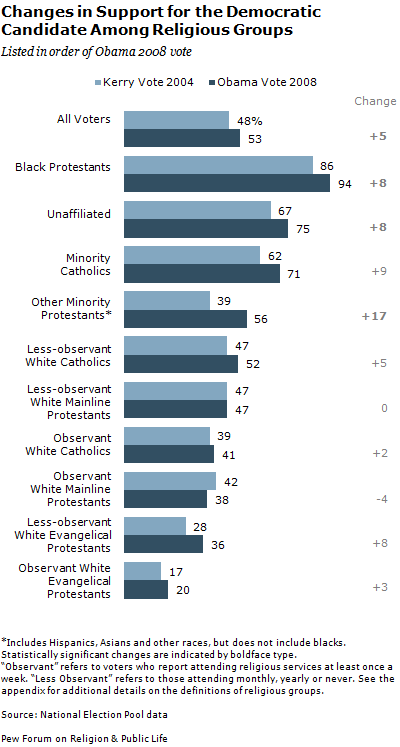
In the 2008 election, black Protestants voted overwhelmingly for the pro-abortion and pro-gay-marriage Obama. (He had a radical pro-abortion record and had come out for gay marriage earlier, so this was all known then).

Which religions supported Obama most in 2008?

So 94% of African-American Christians voted for an abortion and gay marriage radical. NINETY-FOUR PERCENT.

I actually believed, based on this voting data, that American black Protestant churches were officially pro-abortion and pro-gay-marriage. I just considered them to be apostate denominations the same way that denominations like the Episcopal Church and the Presbyterian Church United States of America are apostate. (Note: this does not apply to non-American black churches, which are conservative).

These voting numbers confirm my experiences. For example, I remember one African American woman at work who was interested in me who could not understand why I would not join her in working on The United Way workplace partnership initiative. I took her aside in the hallway and told her that the United Way supported abortion and opposed the Boy Scouts, and she was like “So what?“. She attended church weekly and she supported Barack Obama. So I just figured based on these voting numbers and my personal experiences that most African-American churches were pro-abortion, pro-gay-marriage, pro-socialism, etc.

This action by the 3,742 black African-American pastors shocks me as much as if those gay bishops in the Episcopal church had suddenly came out in favor of defending traditional marriage. Maybe these 3,742 pastors will be able to begin to educate their flocks about what the Bible actually says on these issues so that these voting numbers change. I did know about the good African-American pastors like Harry Jackson and Ken Hutcherson who are pro-life and pro-marriage, but I just thought that there were only a handful of faithful black pastors. I guess I was wrong, at least on the marriage issue, and that’s a good thing. Color me surprised.