Tag Archives: Apologetics

A possible reason why God permits suffering and evil: the soul-making theodicy

I have a key that will unlock a puzzling mystery

Steve Hays has a post up at Triablogue about one my favorite defenses to the inductive problem of evil – the soul-making theodicy.

He writes:

The soul-making theodicy was popularized by John Hick. In Augustinian anthropology, Adam and Eve were finished products. They fell from a state of moral perfection. Hick contrasted that with his own position, according to which Adam and Eve were created with the potential for moral growth. They were still in the process of creation. They had the potential for moral maturation. (Mind you, Hick denied the historicity of Adam and Eve.)

There’s some truth to this analysis, although it suffers from equivocation. To say unfallen Adam and Eve were morally “perfect” simply means they were sinless. It doesn’t mean there was no room for moral improvement.

Paradoxically, fallen humans can be both better and worse than unfallen humans. Inasmuch as they are sinners, they are worse. Yet Christians can have a moral grace that surpasses the mere sinlessness of Adam and Eve. Saints have virtues that angels lack.

3. Let’s take an example: Suppose you have a family of five. Both parents are social climbers and overachievers. The husband is consumed with career advancement. The wife is a tiger mom. She makes sure the kids are enrolled in all the right student clubs and extracurricular activities that will look good on a college application. The two teenage sons and a daughter are into the usual things kids in their age-bracket are into. At dinner, each member of the family is glued to the display on their smart phone.

The members of the family aren’t Christian. Aren’t into meaning-of-life questions. They lead superficial lives.

One son starts to forget routine things. At first this is amusing. They think he’s absent-minded. Distracted by too much multitasking. But he begins to complain about headaches.

His parents take him to the doctor, and he’s diagnosed with brain cancer. Suddenly their priorities come to a screeching halt.

They now have a sick family member who will just get sicker. Their social world contracts. Their center of gravity shifts.

Instead of being frivolous and self-absorbed, they make the most of the remaining time with their dying family member. The wrenching experience changes them. Deepens them. Makes them better people. Develops their unrealized moral potential.

Perhaps, in their distress and despair, they turn to God. They regret the missed opportunities. Regret taking life for granted. Regret taking one another for granted. Regret all the things they should have said and done differently, in retrospect.

That kind of regret can refine character. Moving forward, that prompts them to treat others with greater patience and understanding.

This is hypothetical, but there are real life examples of Christians like Eric Liddell and Ernest Gordon who exhibit moral heroism in the face of extreme adversity.

The rest of the article considers some objections to this defense.

Have you ever had that happen to you? Where something terrible happened and you found yourself having to pray, and care for others, and drop all your plans, and be unselfish? It’s happened to me. In fact, I think this is one of the main things that Christians should be doing. We ought to respond to setbacks as if they were opportunities for us to show our real character. Don’t treat the needs and sufferings of others as something to avoid, treat it as your opportunity to be more like Jesus. I know that we all have dreams of things that we would like to do and achieve. But sometimes, an opportunity arises for us to imitate Jesus by being obedient with suffering, or by caring for the suffering of others by putting our own needs and desires second. It’s tempting to think that our super-duper plan to change the world is the most important thing, but it really isn’t. Don’t miss the chance to form your character when you suffer, or when someone close to you is suffering.

I have to mention Dina, who has been busy visiting the elderly in a hospital for the last two weeks. She is a busy lady, and has things she would rather be doing. She hasn’t done any cross-stitching in months, because she is so stressed with work. Nevertheless, she didn’t take that as an excuse to put herself first. She found some people close to her who were suffering and thought “here is an opportunity for me to imitate Jesus by putting myself second, and serving others first”. Evil and suffering gives you the opportunity to be who God wants you to be.

Mark D. Linville: does Darwinian evolution make morality rational?

A conflict of worldviews

Have you ever heard an atheist tell you that naturalistic evolution is an answer to the moral argument? I have. And I found a good reply to this challenge in the book “Contending With Christianity’s Critics“. The chapter that responds to the challenge is authored by Dr. Mark D. Linville. It is only 13 pages long. I have a link to the PDF at the bottom of this post.

First, a bit about the author:

Blog: The Tavern at the End of the World
Current positions:

  • PhD Research Fellow
  • Tutoring Fellow in Philosophy

Education:

  • PhD in Philosophy with a minor in South Asian Studies and a specialization in Philosophy of Religion, University of Wisconsin-Madison
  • MA in Philosophy, University of Wisconsin-Madison
  • MA in Philosophy of Religion, Trinity Evangelical Divinity School
  • MA in Theology, Cincinnati Christian Seminary
  • BA in Biblical Studies, Florida Christian College

Here is his thesis of the essay:

Darwin’s account of the origins of human morality is at once elegant, ingenious, and, I shall argue, woefully inadequate. In particular, that account, on its standard interpretation, does not explain morality, but, rather, explains it away . We learn from Darwin not how there could be objective moral facts, but how we could have come to believe—perhaps erroneously—that there are.

Further, the naturalist, who does not believe that there is such a personal being as God, is in principle committed to Darwinism, including a Darwinian account of the basic contours of human moral psychology. I’ll use the term evolutionary naturalism to refer to this combination of naturalism and Darwinism. And so the naturalist is saddled with a view that explains morality away. Whatever reason we have for believing in moral facts is also a reason for thinking naturalism is false. I conclude the essay with a brief account of a theistic conception of morality, and argue that the theist is in a better position to affirm the objectivity of morality.

And here’s a sample to get your attention:

But even if we are assured that a “normal” person will be prompted by the social instincts and that those instincts are typically flanked and reinforced by a set of moral emotions, we still do not have a truly normative account of moral obligation. There is nothing in Darwin’s own account to indicate that the ensuing sense of guilt—a guilty feeling—is indicative of actual moral guilt resulting from the violation of an objective moral law. The revenge taken by one’s own conscience amounts to a sort of second-order propensity to feel a certain way given one’s past relation to conflicting first-order propensities (e.g., the father’s impulse to save his child versus his impulse to save himself). Unless we import normative considerations from some other source, it seems that, whether it is a first or second-order inclination,one’s being prompted by it is more readily understood as a descriptive feature of one’s own psychology than material for a normative assessment of one’s behavior or character. And, assuming that there is anything to this observation, an ascent into even higher levels of propensities (“I feel guilty for not having felt guilty for not being remorseful over not obeying my social instincts…”) introduces nothing of normative import. Suppose you encounter a man who neither feels the pull of social, paternal or familial instincts nor is in the least bit concerned over his apparent lack of conscience. What, from a strictly Darwinian perspective, can one say to him that is of any serious moral import? “You are not moved to action by the impulses that move most of us.” Right. So?

The problem afflicts contemporary construals of an evolutionary account of human morality. Consider Michael Shermer’s explanation for the evolution of a moral sense—the “science of good and evil.” He explains,

By a moral sense, I mean a moral feeling or emotion generated by actions. For example, positive emotions such as righteousness and pride are experienced as the psychological feeling of doing “good.” These moral emotions likely evolved out of behaviors that were reinforced as being good either for the individual or for the group.2

Shermer goes on to compare such moral emotions to other emotions and sensations that are universally experienced, such as hunger and the sexual urge. He then addresses the question of moral motivation.

In this evolutionary theory of morality, asking “Why should we be moral?” is like asking “Why should we be hungry?” or “Why should we be horny?” For that matter, we could ask, “Why should we be jealous?” or “Why should we fall in love?” The answer is that it is as much a part of human nature to be moral as it is to be hungry, horny, jealous, and in love.3

Thus, according to Shermer, given an evolutionary account, such a question is simply a non-starter. Moral motivation is a given as it is wired in as one of our basic drives. Of course, one might point out that Shermer’s “moral emotions” often do need encouragement in a way that, say, “horniness,” does not. More importantly, Shermer apparently fails to notice that if asking “Why should I be moral?” is like asking, “Why should I be horny?” then asserting, “You ought to be moral” is like asserting, “You ought to be horny.” As goes the interrogative, so goes the imperative. But if the latter seems out of place, then, on Shermer’s view, so is the former.

One might thus observe that if morality is anything at all, it is irreducibly normative in nature. But the Darwinian account winds up reducing morality to descriptive features of human psychology. Like the libido, either the moral sense is present and active or it is not. If it is, then we might expect one to behave accordingly. If not, why, then, as a famous blues man once put it, “the boogie woogie just ain’t in me.” And so the resulting “morality” is that in name only.

In light of such considerations, it is tempting to conclude with C. S. Lewis that, if the naturalist remembered his philosophy out of school, he would recognize that any claim to the effect that “I ought” is on a par with “I itch,” in that it is nothing more than a descriptive piece of autobiography with no essential reference to any actual obligations.

When it comes to morality, we are not interested in mere descriptions of behavior. We want to know about prescriptions of behavior, and whether why we should care about following those prescriptions. We are interested in what grounds our sense of moral obligation in reality. What underwrites our sense of moral obligation? If it is just rooted in feelings, then why should we obey our moral sense when obeying it goes against out self-interest? Feelings are subjective things, and doing the right thing in a real objective state of affairs requires more than just feelings. There has to be a real objective state of affairs that makes it rational for us to do the right thing, even when the right thing is against our own self-interest. That’s what morality is – objective moral obligations overriding subjective feelings. I wouldn’t trust someone to be moral if it were just based on their feelings.

The PDF is right here for downloading, with the permission of the author.

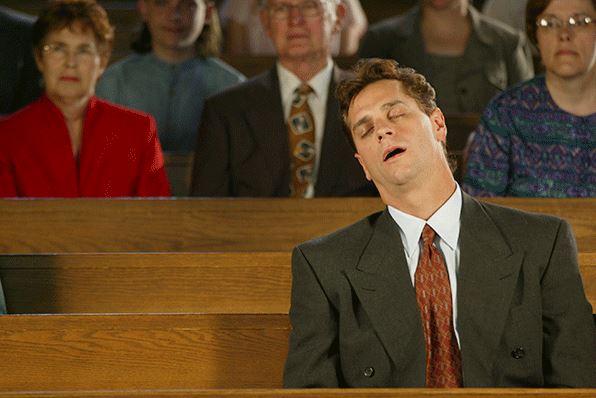
How can we get single men and husbands to be interested in church and ministry?

Church sucks, that's why men are bored there
Church is ineffective and impractical, and that’s why men are bored there

Consider this passage from William Lane Craig’s April 2013 newsletter, which made me very excited and happy. (H/T Triablogue)

Here it is:

One overwhelming impression of these engagements is the way in which the intellectual defense of Christian faith attracts men. Both at Texas A&M and again at Miami every single student who got up to ask a question was a guy! I wondered if the girls are just shy. But then I remembered a lengthy clip Jan and I watched of cast members of Downton Abbey doing a Q&A with an audience in New York. Almost every person who came to the microphone at that event was a woman! It wasn’t until late into the evening that a man finally asked a question, which was remarked by all the cast members. Why the difference between that session and the ones I experienced?—simply because the Downton Abbey program is highly relational, which is more appealing to women, whereas my talks were principally intellectually oriented, which is more appealing to men.

Churches have difficulty attracting men, and the church is becoming increasingly feminized. I believe that apologetics is a key to attracting large numbers of men (as well as women) to church and to Christ. By presenting rational arguments and historical evidences for the truth of the Gospel, by appealing to the mind as well as the heart, we can bring a great influx of men into the Kingdom. I’m so pleased that the church in Canada seems to be awakening to this challenge! I’m convinced that we have the opportunity to revolutionize Western Christianity by reclaiming our intellectual heritage.

Now, I hear a lot of complaints from women in the church and pastors in the church about men not being interested in going to church. I think that the problem is that church is hostile to men’s natures. Men thrive on conflict and competition. Men prefer strict rules and moral judgments. Men prefer to shame people who underperform, rather than coddle them. Men are practical and results focused. So how should the church accommodate the different nature that men have? Apologetics is one way to appeal to the male nature.

Let’s take a look at it.

Pastors: church as it is now is abrasive to men’s male nature

In William Lane Craig’s most recent podcast, at time 8:47, the WLC tells Kevin Harris about how he and his wife Jan asked about six of the young men who attend his “Defenders” apologetics class which morning service they attended: traditional or contemporary. ALL of the young men said that they attended neither service, because they go to church to learn something and the service has no educational value to them. The only attend the Defenders class. The apologetics class taught them things they could actually use – things they could actually use to think better, and fight better. This is my experience as well, although I am looking for a better church that does have some appeal to men. I might even have to move to find a decent church that has apologetics.

There is absolutely nothing going on in most churches that is valuable to a man. Men, by and large, only pray as a last resort, after we have done everything we can to solve the problem ourselves. We pay the most attention to the parts of the Bible that help us debate with non-Christians, or that give us things to do. We like to find evidence in the real world that connects with what the Bible is saying. We are interested in planning, execution and results. We are not very interested in feelings, singing, devotions, or bending the rules to make people doing bad things feel good. Now that’s not necessarily true for all men, but it is true for the majority of men.

And lest some people worry that fighting makes enemies, it doesn’t. Fighting with non-Christians has two effects: 1) they respect Christianity more, and 2) they want to be your friends and talk to you about spiritual things. I just got an e-mail from Captain Capitalism this week (he is a non-Christian) expressing some interest in what it is that I am doing as a Christian. He reads the posts where I take on atheism, they don’t make him respect me less as a Christian at all. He thinks that standing up for what you believe in and living consistently with it makes you authentic. That is not the exception, Christian women and pastors – that is the rule. Atheists don’t think that standing up for what you believe in makes Christianity look fake, they think it makes Christianity look authentic. Well, at least the ones who you want to talk to think that.

Wives: don’t choose men who had no interest in advocating for Christianity before you married them

A related problem I see is the problem of wives marrying the wrong men then complaining that the men they freely chose to marry are not interested in church. This is actually the woman’s fault. Most women don’t think about what is best for God when they think about who to marry and have children with, they think about what makes them feel good. They don’t have any kind of plan where they match the man’s ability to the roles he will play as husband and father – they just pick who makes them feel good. This works about as well as buying and selling stocks based on which make you feel good, or choosing electronics and computers based on the color, or choosing a job or a church based on what the building looks like. The Bible lays out a few minimal requirements for a man: chastity, self-sacrificial love, providing for family, leading on moral and spiritual issues. Most young, unmarried women don’t value those things. If a woman picks a man who doesn’t make any demands on them, and who doesn’t judge them, then she cannot depend on him to show spiritual and moral leadership later on in the marriage. So don’t pick a man like that.

Wives: men respond to attention, recognition and approval from women

The reason that most husbands don’t engage in Christianity is because most wives (not my married friends of course) haven’t approached Christianity as something that is objectively true. Men don’t create illusions for themselves in order to feel better – they are more practical than that. Men only invest in things that they think are true, and where they can see that their practical efforts will make a difference. Men are turned off by the view that Christianity is just something that helps families and communities bond, and makes people feel comfort. We think that’s weakness, and we abhor weakness. Once men get the idea that a woman thinks of Christianity as feelings-fulfillment, we stop trying to achieve anything for the Kingdom of God. Men don’t want to be roped into Christianity if all it means is helping people get along and feel good. But they very much want to be roped into a demanding relationship with God where their efforts to achieve results count with God and gets them recognition and approval from their wives.

So how do wives learn to recognize and approve of what men do as Christians? Well, women need to learn apologetics and they need to practice debating with non-Christians. That will teach them to value conflict and competition, and to see how engagement and authenticity drives relationships with non-Christians forward. If women show an interest in objective truth, moral goodness and theological correctness, then men will become interested in these things, too. They will do it because men are addicted to pleasing women, and they want to help women more than anything in the world, second only to pleasing God. Men will enthusiastically engage in whatever will get them praise and recognition from women, and that means that women have to care about Christianity beyond their personal emotional experience of it and beyond their social cohesion experience of it. Initially, wives must be ready to praise and encourage their husbands, and then once the husbands get it, then they will be self-motivated and move out on their own. It will be self-sustaining.