
Tag Archives: Apologetics

What got me started on apologetics? William Lane Craig debate transcripts

William Lane Craig lecturing to university students

Yes, William Lane Craig debate transcripts. In fact, I still read them from time to time to keep up my skills.

Here’s one of my favorites, the Craig-Nielsen debate on grounding morality without God

Summary:

THE CRAIG-NIELSEN DEBATE: GOD, MORALITY, AND EVIL
William Lane Craig and Kai Nielsen
with annotations by William Lane Craig
February 1991, University of Western Ontario

Best part:

Finally, he raises the issue of immortality and says, “Death doesn’t undermine moral values. In fact, things that we value become all the more precious.” Well, in one sense he’s right. It’s the absence of God that undermines the objectivity of moral values, not death. But let’s suppose that there are objective moral values. What would be undermined by the lack of immortality? I think two things.

First, I think there would be no reason to adopt the moral point of view. Since you’re going to die, everyone ends up the same. It doesn’t make any difference whether you live as a Hitler or a Mother Teresa. There is no relationship between your moral living and your ultimate fate. And so in that sense, death undermines the reason for adopting the moral point of view rather that just being an egoist and living for self.

Second, there’s no basis for self-sacrifice on this point of view. Why should an atheist, who knows everything is going to end in death, do things that are morally right that go against self-interest? For example, a few years ago there was a terrible mid-winter air disaster in Washington, DC, as a plane crashed into a bridge spanning the Potomac River, spilling its passengers into the icy waters. And as the helicopters came to rescue these people, attention focused on one man who again and again passed by the rope ladder rather than be pulled to safety himself. Seven times he did this, and when they came again, he was gone. The whole nation turned its eyes to this man in respect and admiration for the noble act of self-sacrifice that he did. And yet on the atheistic view, that man wasn’t noble. He did the stupidest thing possible. He should have gone for the rope ladder first, pushed others away, if necessary, in order to survive! But to give up all the brief existence he will ever have for others he didn’t even know? Why? It seems to me, then, that it’s not simply the absence of God that undermines objective moral values, but ethical living is also undermined by the atheistic point of view because you then have no reason to adopt the moral point of view and you have no basis for acts of self-sacrifice.

By contrast, on the Christian view, where you have both God and immortality, you have the necessary presuppositions for the affirmation of objective moral values and for consistent living of the ethical life.

And another of my favorites, the Craig-Taylor debate on the ontological grounding of morality.

Summary:

Is The Basis Of Morality Natural Or Supernatural?
Richard Taylor and William Lane Craig
October 1993, Union College, Schenectady, New York

Sample Craig:

(2) I argued that moral accountability also exists under the supernaturalist view, and Professor Taylor didn’t deny the point.

(II) What about my critique, then, of naturalism? I said that naturalism doesn’t provide a sound foundation for morality, and here I made two points:

(1) On the naturalist view, objective right and wrong do not exist. Again, Professor Taylor doesn’t deny this point; he just says, “Well, to say that they’re conventional doesn’t mean they’re contemptible.” Well, granted; but it does mean they’re arbitrary, they’re non–objective. There’s no more difference between moral right and wrong than driving on the right–hand side of the road versus the left–hand side of the road. It’s simply a societal convention. And the modern evolutionist thinks these conventions are just based in socio–biological evolution. According to Michael Ruse, a professor of the philosophy of science,

The position of the modern evolutionist…is that humans have an awareness of morality…because such an awareness is of biological worth. Morality is a biological adaptation, no less than are hands and feet and teeth…. Considered as a rationally justifiable set of claims about an objective something, [ethics] is illusory. I appreciate that when somebody says, ‘Love thy neighbor as thyself,’ they think they are referring above and beyond themselves…. Nevertheless…such reference is truly without foundation. Morality is just an aid to survival and reproduction and…any deeper meaning is illusory….{26}

This is essentially the same view as Professor Taylor’s. Moral values are simply rooted in socio–biological evolution, that have passed down as certain taboos and certain commands, but they have no objective validity in terms of their moral rightness or wrongness. Professor Taylor says, “But I have a high regard for people who are truly moral and decent.” I don’t deny that. Of course he does! But the point is that in his ethics, in his philosophy, he has no basis for that affirmation. What I bring is not a new set of values—I think we pretty much hold those in common—but I’m offering a secure foundation for those values that we all want to hold dear.

You see, on Professor Taylor’s view, there really isn’t any objective morality. I think every one of us here tonight would agree that it’s wrong to kill babies and that the holocaust was morally wrong. But in his book Professor Taylor says, “The infanticide practiced by the Greeks of antiquity did not violate their customs. If we say it was nevertheless wrong, we are only saying that it is forbidden by our ethical and legal rules. And the abominations practiced by the Nazis…are forbidden by our rules, and not, obviously, by theirs.”{27} I submit that that is simply a patently false view of moral values and that naturalism, therefore, can’t provide any objective basis for right and wrong.

And another of my favorites, the Craig-Tooley debate on the problem of evil.

Summary:

A Classic Debate on the Existence of God
Dr. William Lane Craig & Dr. Michael Tooley
November 1994, University of Colorado at Boulder

Sample Craig:

(2) Christian doctrines increase the probability of the coexistence of God and the evils in the world. Let me just mention a couple of these.

(i) On the Christian view, the purpose of life is not happiness as such in this life. Rather it is the knowledge of God—which will ultimately produce true and everlasting happiness. What that means is that many evils occur in this life which might be utterly pointless with respect to producing human happiness. But they might not be pointless with respect to producing the knowledge of God. Dr. Tooley assumes when he talks about changes that would make this world a better place, that the purpose of life is basically to be happy in this life. And I certainly admit that you could make changes that might appear to make this life a better place, make it happier. But that’s not God’s purpose. So if you understand that the purpose of life is not happiness as such, I think that you can see that the existence of evil doesn’t necessarily cast any improbability upon God’s existence.

(ii) It’s also the Christian view that God’s purpose spills over into eternal life. In the afterlife God will bestow a glory and happiness upon us that is incomparable to what we’ve suffered here on earth. And the longer we spend in eternity with Him, the more the sufferings in this life shrink by comparison to an infinitesimal instant. Dr. Tooley admits in his article that it is possible that immortality could justify such evils. But, he says, it’s “very unlikely” that there is life after death. Well, I have two comments. First, I’d like him to prove that it’s unlikely that there is life after death.{26} Second, I suggest that the resurrection of Jesus gives us grounds for hoping in life after death, and I’ve attempted to justify that historically. So given these Christian doctrines, I think you can see that the existence of God and evil is not so improbable after all.

[…]

(4) Finally, I think that there is actually an argument for God from evil. It would go like this:

(i) If God does not exist, objective moral values do not exist. If there is no God, moral values are either socio-biological by-products or just expressions of personal preference.

(ii) Evil exists. That’s the premise of the atheist. There is real evil in the world.

(iii) Therefore, objective values do exist. Some things are really wrong.

(iv) Therefore, God exists.

Thus the presence of evil in the world actually demonstrates God’s existence because in the absence of God, there wouldn’t be any distinction objectively between good and evil, between right and wrong. So although evil in one sense calls into question God’s existence, in a much deeper sense, I think, it actually requires God’s existence.

So in the light of these four responses, I think that the argument from evil, as difficult and emotionally pressing as it might be, in the end doesn’t constitute a good argument against the existence of God. So I think the four arguments given against the existence of God by Dr. Tooley are inconclusive. You’ve still got my six arguments for God’s existence, and therefore I still think that on balance the evidence favors theism as the more rational worldview.

There are more debate transcripts on Craig’s Reasonable Faith web site.
Bible study: Was the resurrection body of Jesus spiritual or physical?

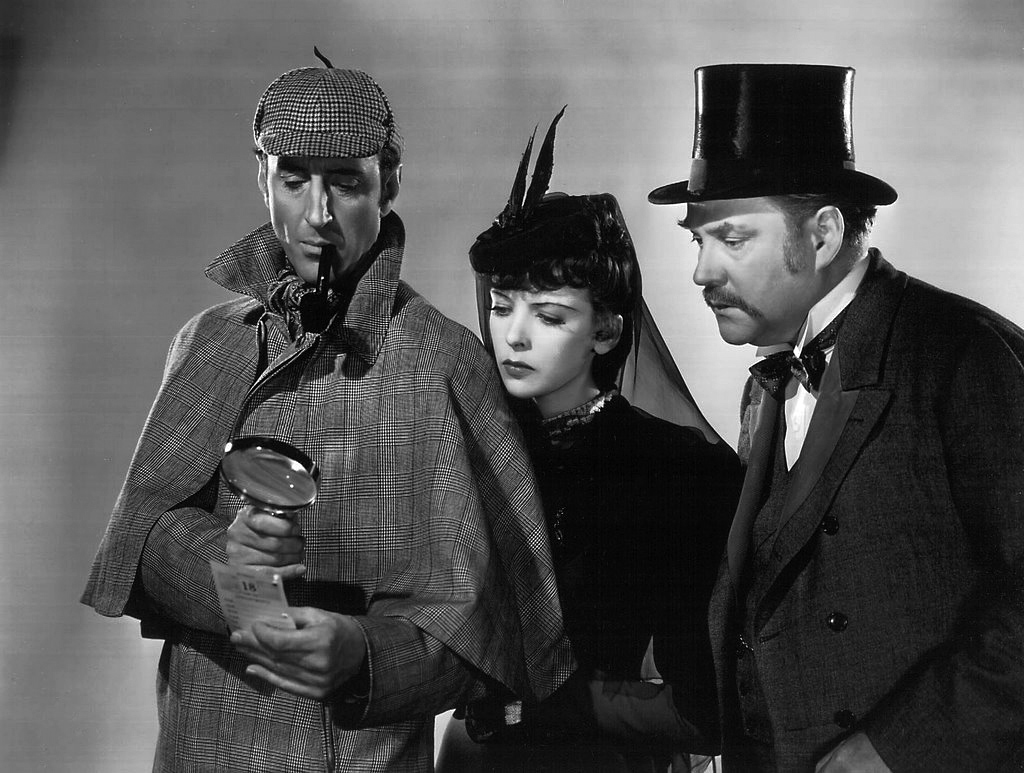
Sherlock Holmes and John Watson are going to take a look at the data

So, everyone from left to right accepts the early creed in 1 Corinthians 15:3-7 being dated to 1-3 years after the death of Jesus, even atheists like Crossley, Ludemann and Crossan. The thing is, some people are not sure that the appearances of Jesus to individuals, groups, and skeptics really were physical appearances. They say “well, Paul’s appearance was non-physical, so the other ones must have been, too”.

Let’s take a look.

Here’s a paragraph from my friend Eric Chabot, from his blog Think Apologetics. He explains why Paul’s use of the word “resurrection” to describe what the other witnesses saw means bodily resurrection.

He writes:

If Paul did have a vision then the term “vision” is vague and must be defined. As Licona points out, visions are either objective (i.e., something that is seen without the use of our natural senses) or subjective (i.e., a  product of our minds). The real  problem is with the vision hypothesis is that it doesn’t explain Paul’s use of resurrection to explain what had happened to Jesus.  The two words are used for resurrection in the New Testament “anastasis” (rising up) and “egersis” (waking up), both imply a physical body. Furthermore, the use of the word “opethe” (the Greek word for appeared) shows the Gospel writers did believe that Jesus appeared physically. “There you will see (opethe) him” (Matt. 28:7); “The Lord has risen and has appeared (opethe) to Simon” (Luke 24:24). When they used “opethe” here, it means that He appeared physically to them.

So when Paul gives his list of appearances in 1 Cor. 15, the issues becomes whether the appearance to him is the same as it was to the disciples. There is no doubt the post resurrection body of Jesus (after the ascension) had to be somewhat different than the body the disciples saw. Also, whenever the New Testament mentions the word body, in the context of referring to an individual human being, the Greek word “soma” always refers to a literal, physical body.Greek specialist Robert Gundry says “the consistent and exclusive use of soma for the physical body in anthropological contexts resists dematerialization of the resurrection, whether by idealism or by existentialism.” [9] Furthermore, in N.T. Wright’s  The Resurrection of the Son of God shows that the Greek word for resurrection which is “anastasis” was used by ancient Jews, pagans, and Christians as bodily in nature.

Now, I think my view on this, and I’m not sure if Eric would correct me, is that Paul got an objective but non-physical vision of Jesus. There was something there that everyone else could see and hear, in my view. But in my view Paul’s “veridical” vision was post-ascension, and so non-physical. Paul uses the word resurrection to describe what the other eyewitnesses saw (and he met them at least twice, according to Gal 1 and Gal 2), and that means physical resurrected body.

Eric Chabot writes this in another place:

Acts 9- Paul’s Damascus Road Experience

Here we see whatever happened,  this was after the ascension. Hence, to say Paul saw the exact same Jesus before he ascended is hard to infer from the text. There simply isn’t enough information here.  The Bible says, “they heard” the same voice Paul did ” (Acts 9: 7). But they “did not see anyone ” (Acts 9: 7). Notice  Paul was physically blinded by the brightness of the light.  One way or the other, the experience involved something that was external to Paul. It wasn’t something that was the same thing as a vision that Paul talks about in 2 Cor. 12:1.  Furthermore, the phrase “he let himself be seen’” (ōphthē , aorist passive, ), is the word Paul uses  in 1 Cor. 15:7 to describe of his own resurrection appearance as the other ones in the creed. As Paul Barnett says:

“It is sometimes claimed that the word appeared (ōphthē) means a mystical seeing, as of a vision, and that since this was what Paul “saw” it was what the other apostles “saw.” In other words, after death, Jesus was taken directly to heaven whence he “appeared” to various people, mystically, as it were. This however, is not all the meaning of Paul’s words. First, the word ōphthē, “appeared” is not limited to visionary seeing it is also used for physical seeing. Moreover, the verb raise used in the phrase ‘raised on the third day” is used elsewhere in combination with the words “from the dead” which literally means “from among the corpses.” Thus raised preceding  appeared gives the latter a physical not a mystical meaning. Christ, as “raised from the dead” ….appeared.”  Furthermore, when Paul asks “ Am I not free? Am I not an apostle? Have I not seen Jesus our Lord?”(1 Cor. 9: 1), he is using the ordinary word horan, “to see” for physical sight. If “seeing” the Lord “raised from the dead” qualified others to be apostles, then Paul is, indeed, an apostle. It was no mere subjective vision that arrested Paul en route to Damascus. (8) .

In the end, word studies can’t entirely resolve this issue. We need to remember the etymological fallacy as well. We  would have to look at all the texts that speak of resurrection (including the entire 1 Cor. 15 chapter in their entire context as well as the anthropology of the New Testament. We also need to study the resurrection in light of the Second Temple Jewish period. See our reading list here for some resources that may help.

But conservative ancient historian Gary Habermas seems to think that Paul got the physical body as well.

He says:

Now, I said before in 1 Corinthians 15, Paul could have chosen to only use the word pneuma. He doesn’t. He does say “spiritual,” but he’s got an adjective there. He also says, soma, “body.” What did Paul mean?

Philippians Chapter 3. It’s a short chapter. There are 21 verses, but Paul says three things in one chapter that indicate he’s talking about a physical resurrection. In the opening verses he says, “I was a Hebrew of the Hebrews” and “as touching the law,” he says, “I was a Pharisee.” Now, it’s very well known that the Pharisee believed in a bodily resurrection. In fact, according to Acts 23, as Paul was being taken captive by the Romans to prevent his being killed, he shouted out to the group of people and said, “Why are you taking me? Because I believe in the resurrec­tion of the dead?” He meant a literal resurrection.
When the Pharisees heard that, they said there’s nothing wrong with this guy. But the Sadducees [who didn’t believe in the Resurrection] didn’t like it. So as a Pharisee, he’s agreeing with the Pharisees.
So, the first evidence is from Philippians 3. As a Pharisee, Paul believes in a physical resur­rection.
Secondly, in verse 11 he says, “That I may attain the resurrection of the dead.” Now, the normal Greek word for resurrection is anastasis, but in this passage, Philippians 3:11, he puts a prefix on there, ek anastasis. Ekanastasis, according to all Greek scholars that I know of, is translated in this passage: “The out resurrection from among the dead.” Paul said, “I want to attain the out resurrection.”
Now, to a Jew, “out resurrection” means “what goes down is what comes up.” You come out from death. And then just a few verses later, Philippians 3:20,21, he said, “From Heaven, we look for Jesus who will change our vile soma (body) to be like unto His glorious soma (or body),” when he should have said pneuma, according to this other view.
So he’s a Pharisee who believes in a physical resurrection. Ek anastasis—“resurrection from out among the dead ones.”
Thirdly, Paul says, “He Jesus will change my body to be like His body.”

So right there in Philippians 3 alone, I think the picture of Jesus being some wispy spirit that appeared to him on the road to Damascus doesn’t fit Paul’s own data.

Yes, that’s why Philippians is my favorite book. You can get so much useful theology out of it. Something about the resurrection in Phil 3, something about Jesus’ divinity in Phil 2, and loads of practical advice on stewardship, charity, fellowship, endurance and practical love for others throughout. Some of it takes a little digging, but that’s what commentaries are for, am I right? But I digress.

If you want to read something a little more challenging, I found a paper from the Evangelical Theological Society (ETS) from their journal, where it talks more about soma and anastasis. If you want a bit of a challenge, download the PDF and read it. It’s by Kirk R. MacGregor and the title is “1 Corinthians 15:3B–6A, 7 And The Bodily Resurrection Of Jesus”.

If unborn babies don’t have consciousness or don’t feel pain, may we kill them?

Unborn baby scheming about pro-life apologetics

Was having a conversation by e-mail yesterday with a pro-abortion atheist, and he gave two reasons why he supported abortion in the first and second trimester. First, he said that unborn babies can’t feel pain, so it’s OK to kill them. Second, he said that unborn babies don’t have consciousness, so it’s OK to kill them. I thought it might be useful to link to something that answers both of these objections.

Frank Beckwith is the author of “Defending Life: A Moral and Legal Case Against Abortion Choice“. He wrote that book for Cambridge University Press, a top academic press. But before Cambridge University Press, Beckwith wrote four easy-to-understand essays for the Christian Research Journal. Part IV is the one that has the response to the two questions raised by my atheist friend.

Part I. The Appeal to Pity

Part II. Arguments from Pity, Tolerance, and Ad Hominem

Part III. Is The Unborn Human Less Than Human?

Part IV. When Does a Human Become a Person?

Excerpt:

Some ethicists argue that the unborn becomes fully human sometime after brain development has begun, when it becomes sentient: capable of experiencing sensations such as pain. The reason for choosing sentience as the criterion is that a being that cannot experience anything (i.e., a presentient unborn entity) cannot be harmed. Of course, if this position is correct, then the unborn becomes fully human probably during the second trimester and at least by the third trimester. Therefore, one does not violate anyone’s rights when one aborts a nonsentient unborn entity. [13]

There are several problems with this argument. First, it confuses harm with hurt and the experience of harm with the reality of harm. [14] One can be harmed without experiencing the hurt that sometimes follows from that harm, and which we often mistake for the harm itself. For example, a temporarily comatose person who is suffocated to death “experiences no harm,” but he is nevertheless harmed. Hence, one does not have to experience harm, which is sometimes manifested in hurt, in order to be truly harmed.

Second, if sentience is the criterion of full humanness, then the reversibly comatose, the momentarily unconscious, and the sleeping would all have to be declared nonpersons. Like the presentient unborn, these individuals are all at the moment nonsentient though they have the natural inherent capacity to be sentient. Yet to countenance their executions would be morally reprehensible. Therefore, one cannot countenance the execution of some unborn entities simply because they are not currently sentient.

Someone may reply that while these objections make important points, there is a problem of false analogy in the second objection: the reversibly comatose, the momentarily unconscious, and the sleeping once functioned as sentient beings, though they are now in a temporary state of nonsentience. The presentient unborn, on the other hand, were never sentient. Hence, one is fully human if one was sentient “in the past” and will probably become sentient again in the future, but this cannot be said of the presentient unborn.

There are at least three problems with this response. First, to claim that a person can be sentient, become nonsentient, and then return to sentience is to assume there is some underlying personal unity to this individual that enables us to say that the person who has returned to sentience is the same person who was sentient prior to becoming nonsentient. But this would mean that sentience is not a necessary condition for personhood. (Neither is it a sufficient condition, for that matter, since nonhuman animals are sentient.) Consequently, it does not make sense to say that a person comes into existence when sentience arises, but it does make sense to say that a fully human entity is a person who has the natural inherent capacity to give rise to sentience. A presentient unborn human entity does have this capacity. Therefore, an ordinary unborn human entity is a person, and hence, fully human.

Second, Ray points out that this attempt to exclude many of the unborn from the class of the fully human is “ad hoc and counterintuitive.” He asks us to “consider the treatment of comatose patients. We would not discriminate against one merely for rarely or never having been sentient in the past while another otherwise comparable patient had been sentient….In such cases, potential counts for everything.” [15]

Third, why should sentience “in the past” be the decisive factor in deciding whether an entity is fully human when the presentient human being “is one with a natural, inherent capacity for performing personal acts?” [16] Since we have already seen that one does not have to experience harm in order to be harmed, it seems more consistent with our moral sensibilities to assert that what makes it wrong to kill the reversibly comatose, the sleeping, the momentarily unconscious, and the presentient unborn is that they all possess the natural inherent capacity to perform personal acts. And what makes it morally right to kill plants and to pull the plug on the respirator-dependent brain dead, who were sentient “in the past,” is that their deaths cannot deprive them of their natural inherent capacity to function as persons, since they do not possess such a capacity.

These four essays are a very good introduction to common responses to pro-abortion arguments. I recommend that people get familiar with this, as once you look into it, you will see that the abortion issue can be debated with as much confidence as William Lane Craig defends Christian theism. You will have the same access to scientific evidence and rational arguments on this topic, and so you will have the upper hand. And that’s fun.

The best introductory book on the abortion / right to life issue is “The Case for Life” by pro-life debater Scott Klusendorf. The best comprehensive book is a tie between “The Ethics of Abortion” by Christopher Kaczor, and Frank Beckwith’s “Defending Life: A Moral and Legal Case Against Abortion Choice“.