Tag Archives: Apologetics

Why doesn’t God make his existence more obvious to people?

Sherlock Holmes and John Watson are going to take a look at the data

Have you ever heard someone say that if God existed, he would give us more evidence? This is called the “hiddenness of God” argument. It’s also known as the argument from “rational non-belief”.

Basically the argument is something like this:

  1. God is all powerful
  2. God is all loving
  3. God wants all people to know about him
  4. Some people don’t know about him
  5. Therefore, there is no God.

In this argument, the atheist is saying that he’s looked for God real hard and that if God were there, he should have found him by now. After all, God can do anything he wants that’s logically possible, and he wants us to know that he exists. To defeat the argument we need to find a possible explanation of why God would want to remain hidden when our eternal destination depends on our knowledge of his existence.

What reason could God have for remaining hidden?

Dr. Michael Murray, a brilliant professor of philosophy at Franklin & Marshall College, has found a reason for God to remain hidden.

His paper on divine hiddenness is here:
Coercion and the Hiddenness of God“, American Philosophical Quarterly, Vol 30, 1993.

He argues that if God reveals himself too much to people, he takes away our freedom to make morally-significant decisions, including responding to his self-revelation to us. Murray argues that God stays somewhat hidden, so that he gives people space to either 1) respond to God, or 2) avoid God so we can keep our autonomy from him. God places a higher value on people having the free will to respond to him, and if he shows too much of himself he takes away their free choice to respond to him, because once he is too overt about his existence, people will just feel obligated to belief in him in order to avoid being punished.

But believing in God just to avoid punishment is NOT what God wants for us. If it is too obvious to us that God exists and that he really will judge us, then people will respond to him and behave morally out of self-preservation. But God wants us to respond to him out of interest in him, just like we might try to get to know someone we admire. God has to dial down the immediacy of the threat of judgment, and the probability that the threat is actual. That leaves it up to us to respond to God’s veiled revelation of himself to us, in nature and in Scripture.

(Note: I think that we don’t seek God on our own, and that he must take the initiative to reach out to us and draw us to him. But I do think that we are free to resist his revelation, at which point God stops himself short of coercing our will. We are therefore responsible for our own fate).

The atheist’s argument is a logical/deductive argument. It aims to show that there is a contradiction between God’s will for us and his hiding from us. In order to derive a contradiction, God MUST NOT have any possible reason to remain hidden. If he has a reason for remaining hidden that is consistent with his goodness, then the argument will not go through.

When Murray offers a possible reason for God to remain hidden in order to allow people to freely respond to him, then the argument is defeated. God wants people to respond to him freely so that there is a genuine love relationship – not coercion by overt threat of damnation. To rescue the argument, the atheist has to be able to prove that God could provide more evidence of his existence without interfering with the free choice of his creatures to reject him.

Murray has defended the argument in works published by prestigious academic presses such as Cambridge University Press, (ISBN: 0521006104, 2001) and Routledge (ISBN: 0415380383, 2007).

Positive arguments for Christian theism

Did “thousands of women” die in “back alley abortions” before Roe v. Wade?

I get into debates about abortion, and sometimes my opponent will complain that if Roe v. Wade were overturned, then thousands of women would die in illegal abortions. Well, if that ever happens to you, this post will help you to know how to respond to it.

First of all, if Roe v. Wade were overturned, then each of the 50 states would pass legislation deciding when abortions would be legal.

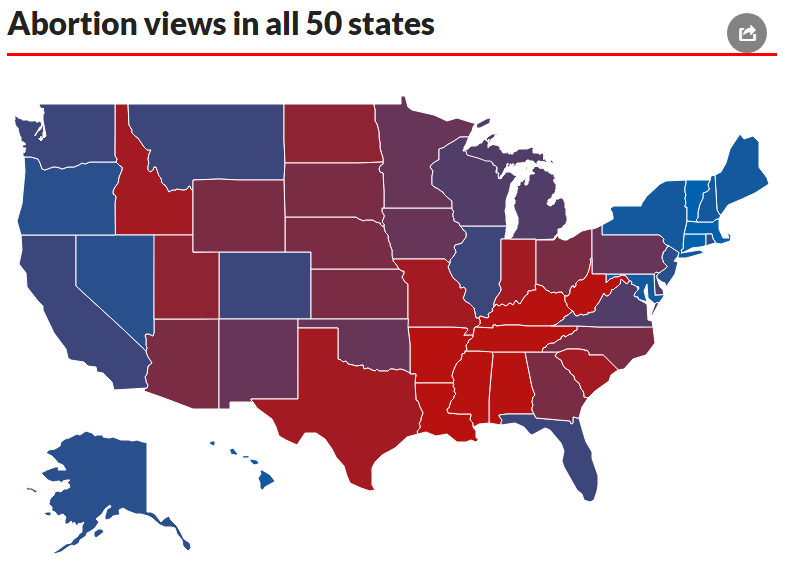
Here’s a map taken from the Washington Examiner:

Abortion rights after Roe v. Wade is overturned

Red states are more pro-life than blue states in this map. For example, New York is ranked #6, and Tennessee is ranked #45.

So, if a woman did have irresponsible sex with a hot bad boy, then she easily could terminate her child in one of the blue states.

Second, the number thrown around by abortion advocates is not accurate. It’s simply not true that “thousands of women” were dying from poorly-performed abortions when abortion was still illegal. Actually, abortions were performed by trained medical personnel, but it just wasn’t reported to the police.

Here’s a recent article from the radically leftist Washington Post:

Erica Sackin, a Planned Parenthood spokeswoman, directed us to a 2014 policy statement issued by the American College of Obstetricians and Gynecologists (ACOG): “It is estimated that before 1973, 1.2 million U.S. women resorted to illegal abortion each year and that unsafe abortions caused as many as 5,000 annual deaths.”

There is no citation in the statement for the estimate of “as many as 5,000 annual deaths,” even though many of the other sentences are carefully documented. None of the citations around this sentence supports the figure, and there is no explanation about how it was calculated.

[…]Meanwhile, Sackin also sent a variety of reports, many of which were referenced in a footnote in a document published by NARAL Pro-Choice America. One of the citations especially caught our eye: Frederick Taussig, “Abortion Spontaneous and Induced: Medical and Social Aspects,” (1936).

Why was a study from 1936 being cited? Because in 1936, we didn’t have antibiotics! People were dying all the time from any kind of surgery – not just abortion.

More:

The advent of antibiotics such as penicillin and improved medical procedures suddenly made abortion less risky. Another prominent researcher, Christopher Tietze, argued in a 1948 paper that the number of deaths from abortion was rapidly declining because of three reasons: contraceptive methods had improved so fewer women were getting pregnant, abortion providers were getting better at avoiding infections, and many lives had been saved because of the introduction of sulfa drugs and penicillin.

[…]The data collected by Tietze showed 2,677 deaths from abortion in 1933, compared with 888 in 1945, with much of the decline in septic cases associated with illegal abortions. (The numbers also include deaths from “therapeutic abortions,” permitted by law, and “spontaneous abortions.”)

By 1959, a leading researcher wrote: “Abortion is no longer a dangerous procedure. This applies not just to therapeutic abortions as performed in hospitals but also to so-called illegal abortions as done by physicians. In 1957, there were only 260 deaths in the whole country attributed to abortions of any kind. In New York City in 1921, there were 144 abortion deaths, in 1951 there were only 15.”

The writer was Mary Steichen Calderone, at the time medical director of Planned Parenthood. She attributed the decline in the mortality rate to antibiotics and the fact that 90 percent of illegal abortions were done by trained physicians.

OK, so abortion advocates cite the study from 1936, which already relies on questionable estimates, because they know that the later numbers are far, far lower – thanks to the widespread use of antibiotics. They’re lying, essentially, because lying helps them to persuade people who think with their feelings, and don’t look too closely at facts.

My third point is simple. Even if women hurt themselves during abortions, that wouldn’t be a reason to legalize abortion. Bank robbers hurt themselves during bank robberies, and drug dealers hurt themselves during drug deals. We do not legalize criminal activities just because criminals get hurt during the commission of those activities. So the real question is, what is the unborn? If the unborn is a living human being, then abortion on demand takes the life of an innocent human being without justification, and should therefore be illegal.

UPDATE: My pro-life friend Nathan sent me a fourth response:

There is a difference today that did not exist in 1973. We have a pro-life movement. We have over 2,000 pregnancy care ministries and clinics operating throughout the continental United States. I highly doubt these clinics will just disappear overnight if abortion became illegal nationwide. Women and children will still be in need, and the free market principles that enable charity to flourish will be there to help.

Given this reality, will proponents of abortion now finally step forward to help provide the support to women necessary so they never have to choose a back alley abortion? Given how they have worked themselves into a panic about rusty coat hangers, it seems they would be the most motivated to do so. The fact many don’t seem to want to do so is telling: They just want to justify their own support for abortion, regardless of whether it helps women or not.

The most important thing Christian parents need to focus on with their children

A family praying and reading the Bible

I know what you’re thinking – I’m going to say apologetics. But I was actually having a talk with a young women who found the arguments for God convincing, but wasn’t sure whether she was ready for a personal relationship with the God of the Bible. It got me thinking about my past and what it was about the God of the Bible that caused me to make a commitment.

If I had to say what it is that cause me to take Christianity seriously, including accepting Jesus as my Leader (more than just as my Savior), it would be the conviction that God was lining things up in my life to show himself to me. This was particularly welcome because I could see that I had not been blessed with the best situation in life to start out with.

Sean McDowell has a recent post about it, and since he is an expert in apologetics, I’m inclined to agree with him.

He writes:

In his book The Four Loves, C.S. Lewis makes a distinction between “Gift-love” and “Need-love.” As for Gift-love, he gives the example of a father who works and plans for the future well being of his family, even though he will die without seeing them benefit. As for Need-love, Lewis gives the example of a lonely and frightened child who comes to its mother’s arms for comfort and protection. Such love is neither selfish nor improper, because children are intended to have nurturing mothers, and mothers are intended to care for their kids.

According to Lewis, God’s love for mankind is entirely Gift-love: “The Father gives all He is and has to the Son. The Son gives Himself back to the Father, and gives Himself to the world, and for the world to the Father, and thus gives the world (in Himself) back to the Father too.” God does not need our love or worship. Rather, He freely loves us as an extension of His grace.

But our love for God is different. While we may be able to offer God Gift-love, our love is primarily need based. Lewis explains: “But man’s love for God, from the very nature of the case, must always be very largely, and must often be entirely, a Need-love.” We desperately need God in both this world and the next.

And then Lewis makes an additional (and helpful) distinction—while our objective need for God will never change, our awareness of that need can. And if our awareness of the need for God fades, then so may our faith. Thus, Lewis says:

There seems no reason for describing as hypocritical the short-lived piety of those whose religion fades away once they have emerged from “danger, necessity or tribulation.” Why should they not have been sincere? They were desperate and howled for help. Who wouldn’t?

In other words, if someone believes in God because of an immediate need for safety or comfort, then as soon as the danger or pain ends, so may the faith. How does this relate to students? Think about it. If a young person believes in God for social or relational needs in the family, church, or school, then when those needs fade, so will his or her faith. If belief in God fulfills some external need, then as soon as that need fades, or another venue provides satisfaction of that need, the student will likely abandon his or her faith (or minimally, have a marginalized faith).

The whole post is worth reading, because no less than Sean McDowell himself had a moment like this where he realized his own sinfulness and had to rely on Jesus for his forgiveness.

Judging from his tweets, I know that Sean is obsessed with super-heroes like Spider-Man, and so he would not be comparing himself to his peers in terms of righteousness. That sort of distance between you and Spider-Man can be really grating for boys. Inside, we feel like we are meant to be super-heroes. Many young men go into apologetics because they see it as a super-power. The problem of not measuring up is very strong for us, because we see the demands of Christianity as much greater than mere church attendance. I imagine that as Sean engaged with people using his apologetics super-power, he probably realized how difficult it was to know everything and give an answer to everyone. That’s above and beyond the standard shortcomings or pride, anger, hatred, and so on that are inside of every person.

We are not super-heroes but we need to have super-human righteousness (that is, perfect righteousness) in order to stand before our Creator and Designer. The only solution is to rely on the imputed righteousness of Jesus for our super-hero status. It is a good and healthy thing to take on Jesus as King, and to imitate him. But when we fail, we must also rely on him as Savior. And thank God the Father for that provision of salvation. And indeed, I myself think of Jesus as Savior in the moments where I am conscious of my own sin. But I need to think about him more than that, and I’ll explain how next.

In my case, I wanted to be a super hero growing up, but I knew I wasn’t coming from a family or a background that made super-heroes. I was saved in a non-Christian home where, thanks to my hands-off “parents”, I was on a very dark path to failure. In fact, I can see where I would have ended up by just looking at where my older brother is now. That disaster is what my parents, my schools, my culture, etc. produced in him, and it would have been me except for God stepping in to make himself known. I get excited about God as initiator and architect of salvation (not without my free will to trust). When God architects a divine appointment for me to use my prepared abilities in his defense or in mentoring little ones, I praise God as author of salvation. But I forget that Christ is the one who allows me to be clean enough to participate in this plan.

My ambition from small was to be a super-hero, and this later turned into great respect for people in the military, especially those who are awarded the Medal of Honor, like Michael Murphy. I want God to give me the Medal of Honor, too. But sin ruins my ambition every day. When I am called out to serve and am found faithful and competent, I need to remember that what makes me fit for service is Christ’s sacrifice on the cross. His shed blood is the cape that I put on when it is my turn to come off the bench and be who I was designed to be. It is very important to me that the God I serve is the kind of God who won’t turn away from me when I fall short.