
William Lane Craig discusses faith and reason with university students

William Lane Craig lecturing to university students

This is an interview of Dr. William Lane Craig before college students at the University of Central Florida. (95 minutes)

Questions from the interviewer: (40 minutes)

  • What started you on his journey of studying faith and reason?
  • How would you define the word “faith”?
  • Are faith and reason compatible? How are they related?
  • How can reasonable faith help us to avoid the two extremes of superstition and nihilism?
  • Who makes the best arguments against the Christian faith?
  • Why are angry atheists like Dawkins and Hitchens more well known than better-informed academic atheists?
  • Does the Bible require Christians to give the unbeliever reasons for their faith?
  • How does faith spur Christians to think carefully about the big questions in life?
  • Should the American church prod churchgoers to develop their minds so they can engage the secular culture?
  • When talking about Christianity intellectually, is there a risk of neglecting the experience of being a Christian?
  • Which Christian apologist has shaped your thinking the most?
  • Which Christian philosopher has shaped your thinking the most?
  • Does the confidence that comes from apologetics undermine humility and reverence?
  • If you had to sketch out a 5 minute case for Christianity, what would you present?
  • Can non-Christians use their reason to arrive at truth?
  • Are there cases where atheists must affirm irrational things in order to remain atheists?
  • Can the universe have existed eternal, so that there is no need to explain who created it?
  • Even if you persuade someone that Christianity is true, does that mean they will live it out?

There is also a long period of questions, many of them hostile, from the audience of students (55 minutes).

  • Haven’t you said nasty things about some atheists? Aren’t you a meany?
  • What do you make of the presuppositional approach to apologetics?
  • Can a person stop being a Christian because of the chances that happen to them as they age?
  • Why did God wait so long after humans appeared to reveal himself to people through Jesus?
  • Can a person be saved by faith without have any intellectual assent to truth?
  • How do you find time for regular things like marriage when you have to study and speak so much?
  • How would you respond to Zeitgeist and parallels to Christianity in Greek/Roman mythology?
  • Do Christians have to assume that the Bible is inerrant and inspired in order to evangelize?
  • If the universe has a beginning, then why doesn’t God have a beginning?
  • Can you name some philosophical resources on abstract objects, Platonism and nominalism?
  • How can you know that Christianity more right than other religions?
  • Should we respond to the problem of evil by saying that our moral notions are different from God’s?
  • Define the A and B theories of time. Explain how they relate to the kalam cosmological argument.
  • How can Christians claim that their view is true in the face of so many world religions?
  • What is the role of emotions in Christian belief and thought?
  • Can evolution be reconciled with Christian beliefs and the Bible?
  • When witnessing person-to-person, should you balance apologetics with personal testimony?
  • Is there a good analogy for the trinity that can help people to understand it? [Note: HE HAS ONE!]
  • How can Christians reconcile God’s omniscience, God’s sovereignty and human free will?

This is a nice introductory lecture that is sure to get Christians to become interested in apologetics. As you watch or listen to it, imagine what the world would be like if every Christian could answer the questions of skeptical college students and professors like Dr. Craig. What would non-Christians think about Christianity if every Christian had studied these issues like Dr. Craig? Why aren’t we making an effort to study these things so that we can answer these questions?

It is really fun to see him fielding the questions from the skeptical university students. My favorite question was from the physics student who sounds really foreign, (at 1:19:00), then you realize that he is a Christian. I do think that Dr. Craig went a little far in accommodating evolution, but I put that down to the venue, and not wanting to get into a peripheral issue. I’m also surprised that no one asked him why God allows humans to suffer and commit acts of evil.

If you are looking for a good basic book on apologetics, then I would choose “Is God Just a Human Invention?” by Sean McDowell and Jonathan Morrow.

Who is William Lane Craig?

About William Lane Craig:

William Lane Craig is Research Professor of Philosophy at Talbot School of Theology in La Mirada, California.

Dr. Craig pursued his undergraduate studies at Wheaton College (B.A. 1971) and graduate studies at Trinity Evangelical Divinity School (M.A. 1974; M.A. 1975), the University of Birmingham (England) (Ph.D. 1977), and the University of Munich (Germany) (D.Theol. 1984). From 1980-86 he taught Philosophy of Religion at Trinity… In 1987 they moved to Brussels, Belgium, where Dr. Craig pursued research at the University of Louvain until assuming his position at Talbot in 1994.

He has authored or edited over thirty books, including The Kalam Cosmological Argument; Assessing the New Testament Evidence for the Historicity of the Resurrection of Jesus; Divine Foreknowledge and Human Freedom; Theism, Atheism and Big Bang Cosmology; and God, Time and Eternity, as well as over a hundred articles in professional journals of philosophy and theology, including The Journal of Philosophy, New Testament Studies, Journal for the Study of the New Testament, American Philosophical Quarterly, Philosophical Studies, Philosophy, and British Journal for Philosophy of Science.

Craig’s CV is here.

Craig’s list of publications is here.

William Lane Craig is, without a doubt, the top living defender of Christianity. He has debated all of the most famous atheists, including Christopher Hitchens, Sam Harris, etc. as well as academic atheists like Quentin Smith, Peter Millican, etc. if you search this blog, you’ll find many debates posted here, sometimes even with snarky summaries.
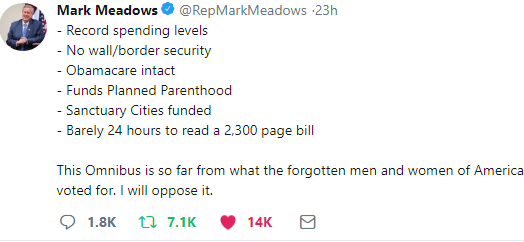
Conservatives vote against wasteful $1.3 trillion spending bill

The new Republican spending bill has nothing for conservatives

Even though many conservative Republican congressmen voted against the massive spending bill, it still passed the House. All the Democrats voted for it. It’s a Democrat spending bill – there’s nothing in it that Trump promised. No money for the wall. No de-funding of sanctuary cities. No de-funding of Planned Parenthood. No de-funding of Obamacare.

CNBC reports:

The U.S. Congress was racing on Thursday to approve a massive spending bill and send it to President Donald Trump for enactment before a midnight Friday government shutdown deadline, in a move that would significantly boost defense and non-military funding through Sept. 30.

The House of Representatives planned to debate and vote on the measure on Thursday. If it clears the chamber, despite opposition from some conservatives protesting the measure’s crushing deficit spending, it is likely to have an easier time passing the Senate.

When coupled with recently enacted tax cuts, the bill is projected to result in budget deficits hitting more than $800 billion for this year. That could create political difficulties for Republicans running for re-election in November if the conservative wing of the party lashes out at this legislation.

[…]It also would deliver a further setback to Trump, whose proposals for severe cuts to the Environmental Protection Agency, State Department and other federal agencies would be scaled back.

The bill, which also excludes some of Trump’s immigration-related funding requests, was unveiled late on Wednesday. Senate No. 2 Republican John Cornyn said his chamber could take it up on Thursday night if no senator acts to slow it.

On Wednesday, the White House signaled that Trump would sign the legislation if Congress sends it to him.

House Republicans’ conservative Freedom Caucus on Thursday said its roughly three dozen members would not back the bill because it massively increases spending while not defunding Obamacare, Planned Parenthood and so-called sanctuary cities.

“You’re going to see lots of conservatives vote against it,” U.S. Representative Jim Jordan, a caucus member, told Fox News in an interview.

Trump at one point wanted $25 billion included in the bill to fully fund construction of his proposed U.S.-Mexico border wall, but negotiations with Democrats to make that happen fell apart early this week, according to congressional aides.

Instead, Trump would get nearly $1.6 billion more for border security this year.

Trump is busy lying about border wall funding in the bill, promising that “more will be forthcoming”. But this bill is a loss for conservatives. Ted Cruz has vowed to vote against the bill in the Senate, which tells you something about whether the bill is conservative or not. It’s garbage. We’re going back to trillion-dollar deficits to fund worthless government bureaucracies again.


What criteria do historians use to get to the minimal facts about the historical Jesus?

Sherlock Holmes and John Watson: let's take a look at the facts
Sherlock Holmes and John Watson: let’s take a look at the facts

Have you ever heard Gary Habermas, Michael Licona or William Lane Craig defend the resurrection of Jesus in a debate by saying that the resurrection is the best explanation for the “minimal facts” about Jesus? The lists of minimal facts that they use are typically agreed to by their opponents during the debates. Minimal facts are the parts of the New Testament that meet a set of strict historical criteria. These are the facts that skeptical historians agree with, totally apart from any religious beliefs.

So what are the criteria that skeptical historians use to derive a list of minimal facts about Jesus?

Dr. Craig explains them in this article.

Excerpt:

The other way, more influential in contemporary New Testament scholarship, is to establish specific facts about Jesus without assuming the general reliability of the Gospels. The key here are the so-called “Criteria of Authenticity” which enable us to establish specific sayings or events in Jesus’ life as historical. Scholars involved in the quest of the historical Jesus have enunciated a number of these critieria for detecting historically authentic features of Jesus, such as dissimilarity to Christian teaching, multiple attestation, linguistic semitisms, traces of Palestinian milieu, retention of embarrassing material, coherence with other authentic material, and so forth.

It is somewhat misleading to call these “criteria,” for they aim at stating sufficient, not necessary, conditions of historicity. This is easy to see: suppose a saying is multiply attested and dissimilar but not embarrassing. If embarrassment were a necessary condition of authenticity, then the saying would have to be deemed inauthentic, which is wrong-headed, since its multiple attestation and dissimilarity are sufficient for authenticity. Of course, the criteria are defeasible, meaning that they are not infallible guides to authenticity. They might be better called “Indications of Authenticity” or “Signs of Credibility.”

In point of fact, what the criteria really amount to are statements about the effect of certain types of evidence upon the probability of various sayings or events in Jesus’ life. For some saying or event S and evidence of a certain type E, the criteria would state that, all things being equal, the probability of S given E is greater than the probability of S on our background knowledge alone. So, for example, all else being equal, the probability of some event or saying is greater given its multiple attestation than it would have been without it.

What are some of the factors that might serve the role of E in increasing the probability of some saying or event S? The following are some of the most important:

(1) Historical congruence: S fits in with known historical facts concerning the context in which S is said to have occurred.

(2) Independent, early attestation: S appears in multiple sources which are near to the time at which S is alleged to have occurred and which depend neither upon each other nor a common source.

(3) Embarrassment: S is awkward or counter-productive for the persons who serve as the source of information for S.

(4) Dissimilarity: S is unlike antecedent Jewish thought-forms and/or unlike subsequent Christian thought-forms.

(5) Semitisms: traces in the narrative of Aramaic or Hebrew linguistic forms.

(6) Coherence: S is consistent with already established facts about Jesus.

For a good discussion of these factors see Robert Stein, “The ‘Criteria’ for Authenticity,” in Gospel Perspectives I, ed. R. T. France and David Wenham (Sheffield, England: JSOT Press, 1980), pp. 225-63.

Notice that these “criteria” do not presuppose the general reliability of the Gospels. Rather they focus on a particular saying or event and give evidence for thinking that specific element of Jesus’ life to be historical, regardless of the general reliability of the document in which the particular saying or event is reported. These same “criteria” are thus applicable to reports of Jesus found in the apocryphal Gospels, or rabbinical writings, or even the Qur’an. Of course, if the Gospels can be shown to be generally reliable documents, so much the better! But the “criteria” do not depend on any such presupposition. They serve to help spot historical kernels even in the midst of historical chaff. Thus we need not concern ourselves with defending the Gospels’ every claim attributed to Jesus in the gospels; the question will be whether we can establish enough about Jesus to make faith in him reasonable.

And you can see Dr. Craig using these criteria to defend minimal facts in his debates. For example, in his debate with Ehrman, he alludes to the criteria when making his case for the empty tomb.

Here, he uses multiple attestation and the criteria of embarrassment:

Among the reasons which have led most scholars to this conclusion are the following:

1. The empty tomb is also multiply attested by independent, early sources.

Mark’s source didn’t end with the burial, but with the story of the empty tomb, which is tied to the burial story verbally and grammatically. Moreover, Matthew and John have independent sources about the empty tomb; it’s also mentioned in the sermons in the Acts of the Apostles (2.29; 13.36); and it’s implied by Paul in his first letter to the Corinthian church (I Cor. 15.4). Thus, we have again multiple, early, independent attestation of the fact of the empty tomb.

2. The tomb was discovered empty by women.

In patriarchal Jewish society the testimony of women was not highly regarded. In fact, the Jewish historian Josephus says that women weren’t even permitted to serve as witnesses in a Jewish court of law. Now in light of this fact, how remarkable it is that it is women who are the discoverers of Jesus’ empty tomb. Any later legendary account would certainly have made male disciples like Peter and John discover the empty tomb. The fact that it is women, rather than men, who are the discoverers of the empty tomb is best explained by the fact that they were the chief witnesses to the fact of the empty tomb, and the Gospel writers faithfully record what, for them, was an awkward and embarrassing fact.

There are actually a few more reasons for believing in the empty tomb that he doesn’t go into in the debate, but you can find them in his written work. For example, in his essay on Gerd Ludemann’s “vision” hypothesis. That essay covers the reasons for all four of his minimal facts.

So, if you are going to talk about the resurrection with a skeptic, you don’t want to invoke the Bible as some sort of inerrant/inspired Holy Book.

Try this approach instead:

  1. Explain the criteria that historians use to get their lists of minimal facts
  2. Explain your list of minimal facts
  3. Defend your list of minimal facts using the criteria
  4. Cite skeptics who admit to each of your minimal facts, to show that they are widely accepted
  5. List some parts of the Bible that don’t pass the criteria (e.g. – guard at the tomb, Matthew earthquake)
  6. Explain why those parts don’t pass the criteria, and explain that they are not part of your case
  7. Challenge your opponent to either deny some or all the facts, or propose a naturalistic alternative that explains the facts better than the resurrection
  8. Don’t let your opponent attack any of your minimal facts by attacking other parts of the Bible (e.g. – the number of angels being one or two, etc.)

And remember that there is no good case for the resurrection that does not make heavy use of the early creed in 1 Corinthians 15:3-8.

The best essay on the minimal facts criteria that I’ve read is the one by Robert H. Stein in “Contending with Christianity’s Critics“. It’s a good short essay that goes over all the historical criteria that are used to derive the short list of facts from which we infer the conclusion “God raised Jesus from the dead”. That whole book is really very, very good.