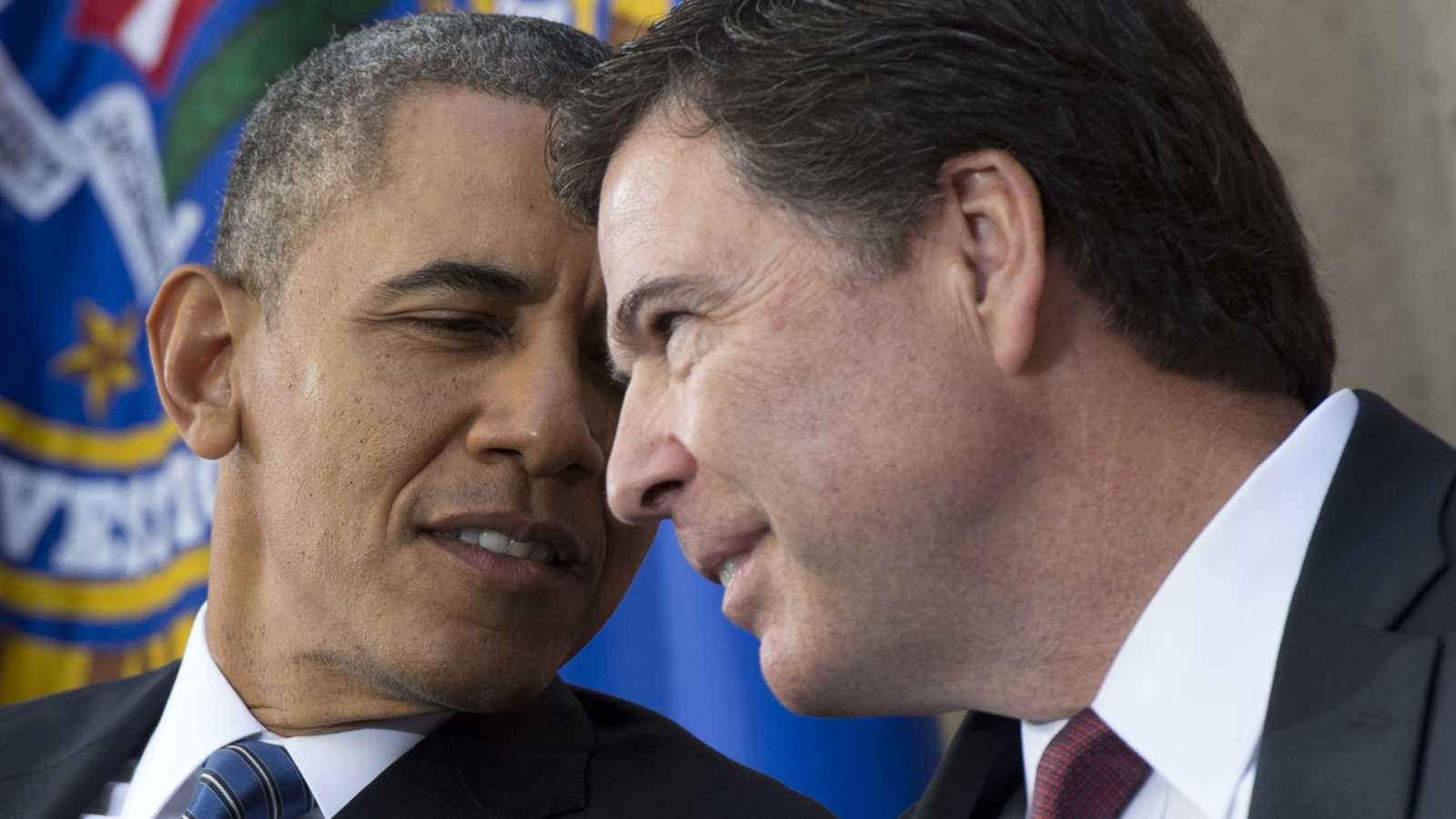
So, the Department of Justice Inspector General’s report on the FBI’s political bias came out yesterday, and I’ve rounded up some of the most interesting findings from a variety of sources. It’s important that everyone finds out just what kind of administration we had under the Democrat Barack Obama.
Here’s an article from Fox News, which listed out 7 of the most important findings.
Let’s start with #1:
New texts between FBI lovers Strzok and Page were ‘disappointing’ and cast a shadow over the integrity of the entire Clinton email probe
A slew of anti-Trump text messages between special counsel Lisa Page and FBI Deputy Assistant Director Peter Strzok damaged the integrity of the entire Clinton email probe, Horowitz writes.
The report unearths striking new messages between the pair that were sent and received on government devices, including one in which Strzok vows to “stop” Trump from being elected just months before the presidential election.
On August 8, 2016, the IG found, Page asked Strzok “[Trump’s] not ever going to become president, right? Right?!” and Strzok replied “No. No he won’t. We’ll stop it.”
Trump won’t win, because the FBI will stop it (in their spare time, between adulterous affairs).
More:
Five unnamed FBI employees — including one lawyer who later worked on the Mueller probe — are under scrutiny for anti-Trump bias
Strzok and Page are not the only FBI officials who evidenced anti-Trump bias during the Clinton email probe, Horowitz noted in the report.
The watchdog identified five other unnamed individuals, including two agents and one FBI attorney who worked on the Muller Russia probe until earlier this year, who made “statements of hostility toward then-candidate Trump and statements of support for candidate Clinton,” and improperly mixed “political opinions” with case-related discussions.
The FBI fumbled the investigation of Hillary Clinton’s storage and transmission of classified data on an unsecured home-brew server, which allowed her to escape government record-keeping requirements.
The Daily Caller noted that the FBI slow-walked the investigation of Hillary Clinton:
When further Clinton emails were discovered on a laptop belonging to former congressman Anthony Weiner, who is married to longtime Clinton aide Huma Abedin, the FBI agents overseeing her case took just under a month to take meaningful action, Horowitz’s report found.
No later than Sept. 29, 2016, FBI executives and the agents who oversaw the Clinton email investigation were informed that “that Weiner investigation agents had discovered 141,000 emails on Weiner’s laptop that were potentially relevant to the [Clinton email] investigation.” Comey didn’t authorize a search warrant until Oct. 27, after he was briefed on them that day, the IG report found.
But do you know what was a priority? The investigation of the Trump campaign because of the Democrat-funded Russia dossier.
The Daily Caller continues:
The FBI prioritized investigating the Trump campaign’s ties to Russia over the discovered emails on Weiner’s laptop, possibly due to political bias, according to the report. Anti-Trump agent Peter Strzok was intimately involved with that decision.
So, who decided that the FBI should exonerate Clinton?
The report also, whether intentionally or not, makes it clear why the FBI had concluded early on that there wasn’t a case against Clinton: President Obama had already cleared Hillary of any wrongdoing.
The IG report recalls how, during a 60 Minutes interview on October 11, 2015, Obama “characterized former Secretary Clinton’s use of a private email server as a ‘mistake,’ but stated that it did not ‘pose a national security problem’ and was ‘not a situation in which America’s national security was endangered.’ Obama also stated that the issue had been ‘ginned up’ because of the presidential race.”
It goes on to say that “Obama’s comments caused concern among FBI officials about the potential impact on the investigation.”
Former EAD John Giacalone told the IG, “We open up criminal investigations. And you have the President of the United States saying this is just a mistake … That’s a problem, right?”
Obama repeated his absolution in April 2016 — right around the time Comey was starting to draft his statement dropping the case against Clinton.
“Obama stated that while former Secretary Clinton had been ‘careless’ in managing her emails while she was Secretary of State, she would never intentionally do anything to endanger the security of the United States with her emails.”
[…]From Obama on down, no one ever wanted or intended to do what should have been done: Prosecute Clinton for gross negligence in her handling of highly classified material. The entire investigation was just for show.
Should we be surprised at any of this? Not at all. We already knew that the Obama administration used the IRS to persecute conservatives. These are not people who make a it a priority to do the right thing. Being secularists, they lack an objective foundation for morality. For them, morality is just customs and conventions, not an objective design for how we ought to live. Whenever morality interferes with their desire to serve their own interests, the question they ask is “will I get caught?”. Instead of listening to their consciences, they think of their own feelings and how they will be perceived.
It turns out that you can’t expect a man who votes in favor of infanticide multiple times (as a state senator) to take morality seriously. It doesn’t matter if a man’s skin color is the color you like. If he has no capacity for put moral duties above self-interest, then you should expect corruption and abuse of power. He ruined everything he touched, from religious liberty to Iran to Syria to Libya to the cost of health care to the $20 trillion national debt, and beyond. An absolute disaster of incompetence and immorality.
Air Force TACPs confirm target locations with their map
I really liked this article from Intellectual Takeout, which had a list of recommendations to reduce gun violence. Although most people today are looking at gun regulations to reduce gun violence, we actually had a lot of guns in previous generations, but a lot less gun violence. Maybe it’s because more people made wiser choices.
The article says:
Don’t commit suicide. This is the most common gun-related death, being about 63% of all firearm deaths in the US.
Adopt a policy of not escalating any road rage situations. If someone does something offensive on the highways have it pre-settled in your mind to react by de-escalating the situation (refrain from responding in kind) and back off to allow the heat of the moment to cool.
Do not join a gang. Violence is the accepted norm among gang members, resulting in many becoming victims of gun violence.
Do not buy or sell illegal drugs. Yes, I do know that it’s the drug laws more than the drugs themselves that leads to gun violence among drug buyers and sellers. But, people already on the wrong side of the law are more likely to commit gun violence than the law-abiding population.
Do not get involved with abusive people. Someone who previously has physically abused a partner is more likely to do so than are those who have never engaged in such abuse.
Implement a personal curfew. The safest place anyone can be at 2am is at home in bed. Roaming the streets in the middle of the night exposes one to gangs, drug sellers, and other dangerous people.
Stay away from Gun Free Zones. One study showed that 98% of all mass shootings happen in these places. Gun Free Zone signs tell violent people this is a spot where the picking will be easy. As for everywhere else, these predators may be deterred since they have to wonder if there’s already a good guy with a gun on the property.
Do not associate with convicted criminals. Like the abuser, violent criminals out of prison are likely to continue their habits.
Be aware of your surroundings. Make it a habit to look around and assess any situation you are in. Most victims of gun violence have no warning of the impending danger, the old saying “to be forewarned is to be forearmed” is pertinent here. So, no staring at your cell phone!
Avoid people who handle guns in an irresponsible manner. Anyone who casually or even unknowingly points a gun at someone or who does not exercise good gun safety such as carefully checking to see that a gun is unloaded is someone to be avoided.
Bonus Suggestion: Do not be a predator. A significant number (about 700 each year) of gun deaths are justifiable homicide wherein a victim successfully defends themselves from criminal assault.
This list of self-control laws is so different than what you see politicians proposing. This list is targeted to individuals, and it is telling them to understand how danger works, and then make adjustments in their choices and priorities in order to minimize the risk. The politicians instead want to blame inanimate objects and take away the rights of law-abiding people to defend themselves from criminals.
Is expecting self-control reasonable?
I have talked to anti-gun people about changing their behavior to minimize their risk of being a victim. Their response was that they shouldn’t have to act any particular way in order to avoid bad consequences. They should just be able to make the government big enough to somehow magically stop bad things from happening to them, no matter what choices they made. Their right to pursue happiness in the moment could not be challenged in any way.
It made me think of women who want to go out wearing skimpy clothes, get drunk in bars surrounded by strange men, and then cry victim when they wake-up somewhere strange the next morning. There is a wisdom to life, and wise people don’t mind that they have to show a little self-control in order to avoid bad outcomes. A woman cannot shack up with a hunky guy who has tattoos, piercings and a criminal record, and then complain when he gets violent. If you choose poorly, then you will face consequences. There is a cost to making choices based on feelings alone.
The same thing happens with people who want to study English, Journalism, and other easy subjects, then can’t find jobs when they graduate with tens of thousands of dollars in loans. “It’s not fair” they say “I need a bailout”. “The government should raise the minimum wage, so I can be paid the same as people who studied hard STEM subjects and got more productive jobs”. Again, the solution is not to blame others and punt to government, the solution is to respect the way the world works and make decisions that are likely to succeed. Don’t let your feelings decide. Don’t do what is free, easy and fun. Don’t chase thrills and travel.
Black economist Walter Williams has a famous list of four choices that he tells young people to make in order to avoid being poor.
Here are his four choices:
Graduate from high school
Get married before you have children
Take any job (to start out)
Don’t commit any crimes
I have one more to add: when you marry, marry someone who takes commitment seriously, so there is no divorce. Divorce is a wealth-killer. Pick a spouse who is able to make and keep commitments that survive their changing feelings and desires. And maybe one more: study for a STEM degree if you go to college.
Again, if you try to tell young people to make good decisions like those, they don’t want to listen. But making those decisions correctly actually gets them the result they want.
Previous generations tended to emphasize the importance of understanding how the world works, and then making good decisions in order to reach a goal. Those people don’t look to government to solve their problems. This generation seems to be more focused on doing what feels good, then acting surprised when it doesn’t “work out”. They aren’t curious to find out how the world really works so they can do the right thing. They just want to do and say what makes them feel good and look good to others.
The topic: What are the arguments that make belief in God reasonable or unreasonable?
First speech: arguments for reasonableness of belief in God
Second speech: respond to arguments against reasonableness of belief in God
Eight arguments:
Contingency argument: God – a transcendent, personal being – is the explanation of why a contingent universe exists.
Cosmological argument: God is the cause of the beginning of the universe, which is attested by physics and cosmology.
Applicability of mathematics to nature: God is the best explanation for the applicability of mathematics to nature.
Fine-tuning argument: God is the best explanation of the fine-tuning of the universe to permit life.
Intentionality of conscious states: God is the best explanation of the intentionality of our mental states.
The moral argument: God is the best explanation for the existence of objective moral values and duties.
The resurrection of Jesus: God is the best explanation for the core of historical facts accepted by most ancient historians across the ideological spectrum.
Religious experience: God is the best explanation of our immediate experience and knowledge of his existence.
Dr. Rosenberg’s opening speech
First argument: The fallacy of ad hominem
I don’t know whether to laugh or to cry
Dr. Craig has said all of that before in other debates
You didn’t need to come out on this cold night
Craig’s arguments have all been refuted
Dr. Craig just doesn’t listen
Dr. Craig is not interested in getting at the truth
Dr. Craig is just interested in scoring debate points
The adversarial system is the wrong approach to decide truth
Dr. Craig is very confident about his take of physics
Second argument: The fallacy of arguing from authority
95% of members of the NAS are atheists
Therefore Dr. Craig cannot use science
Third argument: Effects don’t require causes
I am going to pretend that Craig said that “every effect requires a cause”
Quantum mechanics shows that some effects occur without causes
A particle of uranium (which is not nothing, it is something) decays without a cause
This uncaused effect is the same as the universe coming into being out of nothing uncaused
Therefore the principle of sufficient reason is false
Fourth argument: Silicon-based life and the multiverse
If these constants had been different, maybe we would have other kinds of intelligent life, like silicon-based life
Carbon-based life is not the only kind of life, maybe you can have other kinds of life, none of which have been observed
There could be different kinds of life in other areas of the universe that we can’t see
There are things we can’t see that disprove the current physics that we can see
Quantum foam is evidence that a multiverse exists
The multiverse would solve the problem of fine-tuning
Fifth argument: The Euthyphro dilemma
The moral argument is refuted by Euthyphro dilemma
Dr. Craig is such a moron that he has never heard of the Euthyphro dilemma ever before
This is found in the first and simplest of Plato’s dialogs
Why is Dr. Craig so stupid that he has not read this simple dialog ever before?
Evolution explains why humans evolve arbitrary customs and conventions that vary by time and place
Alternative moral theories: utilitarianism, social contract, etc. that don’t require God
Sixth argument: Mormonism undermines Dr. Craig’s three minimal facts about Jesus
Why is Dr. Craig so stupid and ignorant to persist in pushing such an ignorant, stupid argument?
Mormonism is a silly religion that is not historically well founded
Therefore, Jesus was not buried
Islam is a silly religion that is not historically grounded
Therefore, the tomb was not found empty
Scientology is a silly religion that is not historically grounded
Therefore, the eyewitnesses didn’t have post-mortem appearances
Eyewitness testimony is unreliable in some cases
Therefore, eyewitness testimony was unreliable in this case
Apparitions of Mary are bizarre
Therefore, the majority of historians are wrong to think that the disciples saw post-mortem appearances
Seventh argument: Deductive problem of evil
Evil and suffering are logically incompatible with an all good, all powerful God
Eight argument: God is not just to allow evil and suffering
God cannot make the evils of this life right in the afterlife
Dr. Craig’s first rebuttal
Dr. Rosenberg sketched the deductive argument from evil.
Dr. Rosenberg presupposes naturalism. Naturalism is a false theory of knowledge:
1. It’s too restrictive: There are truths that cannot be proved by natural science.
2. It’s self-refuting: no scientific proof for naturalism exists.
That’s why epistemological naturalism is considered false by most philosophers of science.
But more importantly than that: Epistemological naturalism does not imply metaphysical naturalism. (E.g. – W. Quine)
Dr. Rosenberg has to present arguments in favor of (metaphysical) naturalism, not just assume that (metaphysical) naturalism is true.
Dr. Craig presented eight arguments against metaphysical naturalism taken from Rosenberg’s own book:
1. The argument from the intentionality (aboutness) of mental states implies non-physical minds (dualism), which is incompatible with naturalism
2. The existence of meaning in language is incompatible with naturalism, Rosenberg even says that all the sentences in his own book are meaningless
3. The existence of truth is incompatible with naturalism
4. The argument from moral praise and blame is incompatible with naturalism
5. Libertarian freedom (free will) is incompatible with naturalism
6. Purpose is incompatible with naturalism
7. The enduring concept of self is incompatible with naturalism
8. The experience of first-person subjectivity (“I”) is incompatible with naturalism
Metaphysical naturalism is false: it is irrational and it contradicts our experience of ourselves.
And epistemological naturalism is compatible with theism.
Rebutting Dr. Rosenberg’s responses:
1. Contingency: no response
2. Cosmological: he mis-states the first premise to say every effect… when it is whatever begins to exist…, the origin of the universe was not from a vacuum, virtual particles come from a vacuum not nothing, there are interpretations of QM that are compatible with determinism. Rosenberg has to believe that the entire universe popped into being from non-being.
3. Mathematics: no response
4. Fine-tuning: the multiverse is refuted by empirical observations of the universe. Without fine-tuning, it’s not that we still have silicon to make life out of. It’s that we lose basic minimal things like chemical diversity, matter, stars, planets, etc. No life of any kind, not just no carbon-based life.
5. Intentionality: no response.
6. Moral argument: the answer to the dilemma is that you split the dilemma: God is the standard of good, and the commands flow from his unchanging moral nature. The commands are not arbitrary, and the standard is not external to God. Dr. Rosenberg is a nihilist and he cannot ground good and evil on his nihilistic view.
7. Resurrection: The Gospels are early eyewitness testimony. Mormonism and Islam have nothing to do with the minimal set of historical facts about Jesus agreed to by the majority of ancient historians across the ideological spectrum, general statements against eyewitnesses do not refute the specific eyewitness testimony in this case.
8. Religious experience: No response.
Dr. Rosenberg’s first rebuttal
I wrote a book and you should buy it, because it got me invited to this debate. Let me repeat the title a few times for you. Please buy it.
Dr. Craig is right, there are multiple interpretations of QM, not just the one I presented, including deterministic ones.
All the disturbing implications of naturalism that Dr. Craig stated follow from metaphysical naturalism, and metaphysical naturalism is true. (Note: he equates science with metaphysical naturalism)
Science proves that metaphysical naturalism is true, but I won’t say what specific scientific tests prove my philosophical assumption of metaphysical naturalism.
I’ll pretend that the Big Bang (science) doesn’t disprove naturalism, like Dr. Craig said. Again. (covers ears) La la la, there is no Big Bang.
We didn’t come here to debate epistemological naturalism and metaphysical naturalism.
Let me explain the problem of intentionality since I’m so smart and no one knows what it means.
There are many answers to this problem of intentionality.
My answer is that most scientists are naturalists, therefore naturalism is true, regardless of the argument from intentionality of mental states.
That’s how I would respond to one of the eight problems with naturalism that Dr. Craig raised. I won’t answer the other seven problems.
It is an argument from ignorance to argue that the applicability of mathematics to the universe requires a designer, because there are non-Euclidean geometries. Craig’s argument, which he gets from people like respected physicists like Eugene Wigner, is bizarre. It is bizarre, therefore I refute Eugene Wigner and all the other scholars who make that argument. It is bizarre! Bizarre!
Deductive problem of evil: there is no response to this argument, certainly not Alvin Plantinga’s free will defense. The deductive argument from evil has not been entirely abandoned at all! It’s not like arch-atheist J.L. Mackie himself admits that the deductive problem of evil doesn’t lead to a logical inconsistency between evil and God.
Dr. Craig has to tell me why God allows evil or God doesn’t exist.
It is offensive that Dr. Craig cannot tell me why God allows every evil and suffering that occurs.
He literally said this: “I will become a Christian if Dr. Craig can tell me why God allowed EVERY EVIL THAT OCCURRED IN THE LAST 3.5 BILLION YEARS”
Dr. Craig’s second rebuttal
We are not in a position to know why God allows specific instances of evil and suffering.
God cannot force people to freely do anything – freedom is not compatible with determinism. Freedom is a good, but freedom opens up the possibility of moral evil. You cannot have the good of free will without allowing people to choose to do morally evil things.
God can permit evil and suffering in order to bring more people into a relationship with him.
The atheist has to show that God could allow less evil and achieve more knowledge of God in order to say there is too much evil.
The purpose of life is not happiness, but knowledge of God.
Dr. Craig quotes agnostic Paul Draper (Purdue) and Peter Van Inwagen (Notre Dame) to state that the deductive problem of evil is dead because of free will and morally sufficient reasons for permitting evil.
1. Contingency: no response.
2. Cosmological: QM does not apply, because the universe came from nothing, not a vacuum, and QM only works in a vacuum.
3. Mathematics: He mentions alternatives like non-Euclidean geometry, but we have to explain the structure of THIS universe.
4. Fine-tuning: ???
5. Intentional states: intentional mental states proves that minds exist, which fits with theism better than it fits with atheism.
6. Moral argument: You need God to ground morality, and Dr. Rosenberg believes in morality. He needs God to ground objective moral values and duties.
7. Historical argument: He has to respond to the minimal facts supported by the consensus of ancient historians across the ideological spectrum.
8. The problems of naturalism: He says that you can’t have science without naturalism, but you can have science with EPISTEMOLOGICAL NATURALISM, and theists accept science and methodological naturalism. We don’t accept METAPHYSCIAL NATURALISM because of the eight problems Craig presented, like intentionality, first-person, persistence of self, etc. You can believe in both science and theism, by embracing epistemological naturalism, while rejecting methaphysical naturalism.
Dr. Rosenberg’s second rebuttal
Dr. Craig hasn’t answered many of my points, I won’t say which ones though.
Debates don’t work as a way of deciding what’s true, so we should overturn the entire criminal justice system.
The principle of sufficient reason is false because it is disconfirmed by quantum mechanics. And quantum mechanics (vacuum and virtual particles that exist for a short time) is similar to the origin of the universe (nothing and entire universe and 14 billion years).
We know that alpha particles come into being without cause all the time from a quantum vacuum for a tiny sub-second duration before going out of existence, so we can say that the entire physical universe came into being for 14 billion years from absolute nothing which is not a quantum vacuum.
Peter Van Inwagen is the best metaphysician working today, and he says that my deductive argument from evil is not decisive, it’s not a successful argument. (Why is he undermining his own problem of evil argument????!)
Dr. Craig invoked Plantinga’s free will defense to the deductive POE. Freedom allows us to do evil. God could have given us free will without evil and suffering. I won’t show how, but I’ll just assert it, because debates are such a bad forum for supplying evidence for my speculative assertions.
If you answer the question 3 + 5 as being 8, then you don’t have free will – you are biologically determined if you answer 8, because everyone answers 8, and that means everyone is biologically determined with no free will.
Why can’t God give us free will and then prevent us from making a free choice?
No scholars date the gospels earlier than 60-70 AD, especially not atheists like James Crossley who dates Mark to 40 AD. Therefore Jesus’ burial isn’t historical, like the majority of scholars across the broad spectrum of scholarship agree it is.
The original New Testament documents were written in Aramaic.
All New Testament scholars are orthodox Christians, like atheist Robert Funk for example.
Dr. Craig’s concluding speech
In order to sustain the deductive argument from evil, Dr. Rosenberg must show that God could create a world of free creatures with less evil.
Principle of Sufficient Reason: not using the general principle of sufficient reason, but a more modest version of this states that contingent things should have an explanation for their existence. And we know that the universe is a contingent.
The New Testament was not written in Aramaic, they were written in Greek. Dr. Rosenberg is wrong there too.
(Dr. Craig spends the rest of his concluding speech giving his testimony and urging people to investigate the New testament).
Dr. Rosenberg’s concluding speech
Some long-dead French guy named Laplace said that he has no need of that (God) hypothesis. He did not know about any of Dr. Craig’s arguments made in this debate tonight when he said that, though.
There is no need to explain how the universe began or how the universe is finely-tuned if you just assume metaphysical naturalism on faith.
The Easter Bunny, therefore atheism.
Most scientists are atheists, therefore atheism.
You can do a lot of science without God, just don’t look at the origin of the universe, the fine-tuning of the universe, or the other parts of science that Craig mentioned, as well as the origin of life, the Cambrian explosion, the habitability argument, and so on.
You can be a Christian, but good Christians should not use arguments and evidence.
Good Christians should be irrational and ignorant. Bad Christians look for arguments and evidence from science and history.
Good Christians should embrace the absurd. Bad Christians want to search for truth and use logic and evidence.