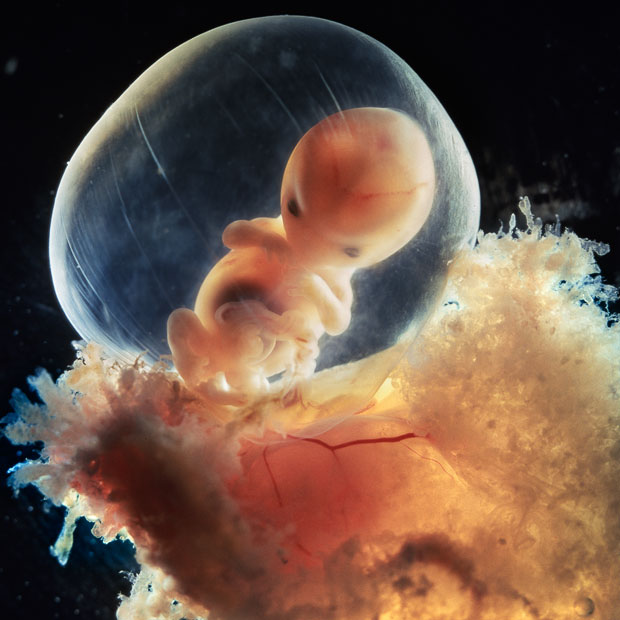
If unborn babies don’t have consciousness or don’t feel pain, may we kill them?

Unborn baby scheming about pro-life apologetics

Was having a conversation by e-mail yesterday with a pro-abortion atheist, and he gave two reasons why he supported abortion in the first and second trimester. First, he said that unborn babies can’t feel pain, so it’s OK to kill them. Second, he said that unborn babies don’t have consciousness, so it’s OK to kill them. I thought it might be useful to link to something that answers both of these objections.

Frank Beckwith is the author of “Defending Life: A Moral and Legal Case Against Abortion Choice“. He wrote that book for Cambridge University Press, a top academic press. But before Cambridge University Press, Beckwith wrote four easy-to-understand essays for the Christian Research Journal. Part IV is the one that has the response to the two questions raised by my atheist friend.

Part I. The Appeal to Pity

Part II. Arguments from Pity, Tolerance, and Ad Hominem

Part III. Is The Unborn Human Less Than Human?

Part IV. When Does a Human Become a Person?

Excerpt:

Some ethicists argue that the unborn becomes fully human sometime after brain development has begun, when it becomes sentient: capable of experiencing sensations such as pain. The reason for choosing sentience as the criterion is that a being that cannot experience anything (i.e., a presentient unborn entity) cannot be harmed. Of course, if this position is correct, then the unborn becomes fully human probably during the second trimester and at least by the third trimester. Therefore, one does not violate anyone’s rights when one aborts a nonsentient unborn entity. [13]

There are several problems with this argument. First, it confuses harm with hurt and the experience of harm with the reality of harm. [14] One can be harmed without experiencing the hurt that sometimes follows from that harm, and which we often mistake for the harm itself. For example, a temporarily comatose person who is suffocated to death “experiences no harm,” but he is nevertheless harmed. Hence, one does not have to experience harm, which is sometimes manifested in hurt, in order to be truly harmed.

Second, if sentience is the criterion of full humanness, then the reversibly comatose, the momentarily unconscious, and the sleeping would all have to be declared nonpersons. Like the presentient unborn, these individuals are all at the moment nonsentient though they have the natural inherent capacity to be sentient. Yet to countenance their executions would be morally reprehensible. Therefore, one cannot countenance the execution of some unborn entities simply because they are not currently sentient.

Someone may reply that while these objections make important points, there is a problem of false analogy in the second objection: the reversibly comatose, the momentarily unconscious, and the sleeping once functioned as sentient beings, though they are now in a temporary state of nonsentience. The presentient unborn, on the other hand, were never sentient. Hence, one is fully human if one was sentient “in the past” and will probably become sentient again in the future, but this cannot be said of the presentient unborn.

There are at least three problems with this response. First, to claim that a person can be sentient, become nonsentient, and then return to sentience is to assume there is some underlying personal unity to this individual that enables us to say that the person who has returned to sentience is the same person who was sentient prior to becoming nonsentient. But this would mean that sentience is not a necessary condition for personhood. (Neither is it a sufficient condition, for that matter, since nonhuman animals are sentient.) Consequently, it does not make sense to say that a person comes into existence when sentience arises, but it does make sense to say that a fully human entity is a person who has the natural inherent capacity to give rise to sentience. A presentient unborn human entity does have this capacity. Therefore, an ordinary unborn human entity is a person, and hence, fully human.

Second, Ray points out that this attempt to exclude many of the unborn from the class of the fully human is “ad hoc and counterintuitive.” He asks us to “consider the treatment of comatose patients. We would not discriminate against one merely for rarely or never having been sentient in the past while another otherwise comparable patient had been sentient….In such cases, potential counts for everything.” [15]

Third, why should sentience “in the past” be the decisive factor in deciding whether an entity is fully human when the presentient human being “is one with a natural, inherent capacity for performing personal acts?” [16] Since we have already seen that one does not have to experience harm in order to be harmed, it seems more consistent with our moral sensibilities to assert that what makes it wrong to kill the reversibly comatose, the sleeping, the momentarily unconscious, and the presentient unborn is that they all possess the natural inherent capacity to perform personal acts. And what makes it morally right to kill plants and to pull the plug on the respirator-dependent brain dead, who were sentient “in the past,” is that their deaths cannot deprive them of their natural inherent capacity to function as persons, since they do not possess such a capacity.

These four essays are a very good introduction to common responses to pro-abortion arguments. I recommend that people get familiar with this, as once you look into it, you will see that the abortion issue can be debated with as much confidence as William Lane Craig defends Christian theism. You will have the same access to scientific evidence and rational arguments on this topic, and so you will have the upper hand. And that’s fun.

The best introductory book on the abortion / right to life issue is “The Case for Life” by pro-life debater Scott Klusendorf. The best comprehensive book is a tie between “The Ethics of Abortion” by Christopher Kaczor, and Frank Beckwith’s “Defending Life: A Moral and Legal Case Against Abortion Choice“.

Luke Barnes discusses the fine-tuning of the fine structure constant

Fine-tuning of the strong nuclear force and the fine structure constant

Here is an article from The New Atlantis written by cosmologist Luke Barnes about one specific example of cosmic fine-tuning. (H/T Uncommon Descent via J. Warner Wallace tweet)

Excerpt:

Today, our deepest understanding of the laws of nature is summarized in a set of equations. Using these equations, we can make very precise calculations of the most elementary physical phenomena, calculations that are confirmed by experimental evidence. But to make these predictions, we have to plug in some numbers that cannot themselves be calculated but are derived from measurements of some of the most basic features of the physical universe. These numbers specify such crucial quantities as the masses of fundamental particles and the strengths of their mutual interactions. After extensive experiments under all manner of conditions, physicists have found that these numbers appear not to change in different times and places, so they are called the fundamental constants of nature.

These constants represent the edge of our knowledge. Richard Feynman called one of them — the fine-structure constant, which characterizes the amount of electromagnetic force between charged elementary particles like electrons — “one of the greatest damn mysteries of physics: a magic number that comes to us with no understanding by man.”

[…]A universe that has just small tweaks in the fundamental constants might not have any of the chemical bonds that give us molecules, so say farewell to DNA, and also to rocks, water, and planets. Other tweaks could make the formation of stars or even atoms impossible. And with some values for the physical constants, the universe would have flickered out of existence in a fraction of a second. That the constants are all arranged in what is, mathematically speaking, the very improbable combination that makes our grand, complex, life-bearing universe possible is what physicists mean when they talk about the “fine-tuning” of the universe for life.

Atheists, both rank-and-file and expert, almost universally misunderstand the fine-tuning argument. They imagine that if the constants and quantities specified at the origin of the universe were different, then humans would just have green skin, or maybe forehead ridges, or pointy ears. Atheists tend to get their view of science from science fiction in novels or television or movies. Just this week I was talking to an agnostic woman (who since reverted to atheism) and brought up the fine-tuning argument. And she said “well, maybe if the initial constants and quantities were different, then we would have evolved differently”. No, the whole point is that life of any conceivable kind becomes impossible if the constants and quantities are altered higher or lower. Even slightly. It’s not that you have green skin, pointy ears, and forehead ridges. It’s that you have a universe that recollapses into a hot fireball, or contains only hydrogen, or does not form stars and planets at all.

I got the impression that she hadn’t read anything about the fine-tuning from peer-reviewed scientific publications, but had just read popular responses to it from atheists with degrees in English and drama and philosophy. If you want to understand a scientific argument, then you have to go to the scientific publications, and read the science. Here is an excellent start, from two astrophysicists, and published by Cambridge University Press.

So what does the scientific evidence actually show?

Barnes explains:

The strong nuclear force, for example, is the glue that holds protons and neutrons together in the nuclei of atoms. If, in a hypothetical universe, it is too weak, then nuclei are not stable and the periodic table disappears again. If it is too strong, then the intense heat of the early universe could convert all hydrogen into helium — meaning that there could be no water, and that 99.97 percent of the 24 million carbon compounds we have discovered would be impossible, too. And, as the chart to the right shows, the forces, like the masses, must be in the right balance. If the electromagnetic force, which is responsible for the attraction and repulsion of charged particles, is too strong or too weak compared to the strong nuclear force, anything from stars to chemical compounds would be impossible.

Stars are particularly finicky when it comes to fundamental constants. If the masses of the fundamental particles are not extremely small, then stars burn out very quickly. Stars in our universe also have the remarkable ability to produce both carbon and oxygen, two of the most important elements to biology. But, a change of just a few percent in the up and down quarks’ masses, or in the forces that hold atoms together, is enough to upset this ability — stars would make either carbon or oxygen, but not both.

It’s very important that theists are well-equipped to explain how individual cases of fine-tuning work. We need to know what you lose if you alter these constants and quantities even slightly. You can read about some more examples in this previous post.

Whose job is it to teach young, unmarried women not to delay marriage for fun and thrills?

Do young women understand how to get to a stable marriage?

I found a very interesting post on a blog called Oz Conservative, which is run by an Australian traditional conservative. In the post, he looks at two women who wasted their 20s on fun and thrills. Both of them are childless and unmarried. And they are complaining that they should be married with children. How did it happen?

Excerpt:

Rachael spent her youth going out with the bad boy type:

relationships have never been my strong point. Historically, I’ve picked good-looking villains and addictive personalities.

I’ve had a ball and many passionate experiences, but nothing functional enough to constitute a long-term future and never anyone ‘normal’ enough to bring home to meet the parents.

Although she puts a positive spin on being single, she admits:

I’m realistic. I’ve probably missed the boat as far as children are concerned, and that is a shame…

[…]Yes, the life I have today is not quite the one I envisaged 20 years ago as a young woman. I foresaw a satisfying career along with 2.4 children and a handsome husband.

Then there is Bibi, now 44. She tells her story this way:

I am staring down the barrel of a lonely future without a man, let alone children.

And how do I find myself in this perilous position? One reason is undoubtedly that men like young women. Yes, I was young once and all that. In my 20s and 30s I wasn’t exactly a supermodel, but I was constantly surrounded by men. The trouble is I wasn’t necessarily looking to settle down back then…

Now that I am, there are very few available men out there and the ones there are would be more interested in my teenage nieces than in me…

[…]Bibi has a lot of friends in exactly the same boat:

In my close circle of friends, there are eight of us who are single and childless. This is a generational phenomenon  –  we are all aged between 37 and 45.

When our mothers were that age, such numbers would be unimaginable.

Like many women writing this kind of literature, when she looks back she recognises the negative influence of feminism on her generation of women:

I think the feminist teachings of the Sixties and Seventies seeped into our brains. My mum couldn’t be called a feminist, but I, too, grew up thinking we could be anything we wanted to be and have a fulfilling career, life and relationship…

[…]What she is trying to say here is that feminism pushed marriage and motherhood down the list of priorities (“there was more to contend with beforehand”). She admits that she was led into the magical kind of thinking I described earlier in which there is nothing in reality to limit having things as you want them to be (“we didn’t realise that men wouldn’t be interested … my generation was spoilt – unrealistic, even”).

The comments to the post are very interesting.

I was thinking about whose job it was to warn young Christian women about these bad choices, and I remembered a passage from the Bible.

Titus 2:3-5 explains:

3 Likewise, teach the older women to be reverent in the way they live, not to be slanderers or addicted to much wine, but to teach what is good.

4 Then they can urge the younger women to love their husbands and children,

5 to be self-controlled and pure, to be busy at home, to be kind, and to be subject to their husbands, so that no one will malign the word of God.

The problem is that many older Christian women made a lot of mistakes in their youth, especially with alcohol and premarital sex. And for most of them, it’s more important that they not feel guilty about it, than that they warn younger women not to make the same mistakes. So, instead of admitting guilt and setting boundaries, they often tell young women that it doesn’t matter what you do in your 20s because God, the cosmic butler, will make everything work out in the end.

We just had a situation where one woman who had a successful marriage tried to give younger women some very basic advice about how to be attractive to marriage-minded men. And what happened was that she was attacked by pretty much everyone. The reaction seemed to be strongest from Christian women, however, who insisted that God’s grace meant that Christian women didn’t have to care what the Bible taught about morality and wisdom. The important thing was that they follow their desires in the moment, because to exercise self-control would be “horrible” and would “send the wrong message”. Telling a woman not to do what she feels like is worse than murder, because women must always do what feels good. Who cares about the words of the Bible, when a woman has feelings that are a direct line to God’s mysterious will for her happiness?

One of the commenters on this blog put it this way:

I’ve been observing this phenomenon among so-called “Christians” for well over a decade. Concepts like “tolerance” and not being “judgmental” took hold in our culture and many Christians absorbed the mindset completely. If you point out that what someone is doing is sinful or might potentially lead to sinful behavior, they act defensive or turn the tables on you and say “well, you’re not perfect either!” Some even say that they do certain things for the express purpose of not being “legalistic,” because clearly, legalism is far worse than compromising one’s witness. Jesus has become a postmodern hippie whose primary message is “let’s all be cool to each other.” The only sins left are transgressions against the belief that everyone is equal and worthy of acceptance.

In reading the responses to Lori Alexander’s article, my greatest takeaway is that people are rationalization machines. If they’ve made mistakes, they won’t humbly acknowledge them and use the wisdom of their experience to guide others in the right direction. Instead, they’ll try to find a way to argue that their mistakes weren’t mistakes at all, and that the real sinner is the person who’s judging them for what they did. It’s a deceitful, selfish game, and anyone who plays it is an enemy of the Gospel. Their argument essentially boils down to “every woman, regardless of whatever bad decisions she’s made in life, is entitled to a loving husband who’ll provide for her.” Same way everyone’s entitled to free health care, regardless of whether sufficient medical resources exist, I suppose. It doesn’t work that way, ladies.

And they use this feminist scare word “shaming.” How dare you “shame” me? I would go so far as to say that shaming is a good thing, because it incentivizes proper behavior. Men have good reasons for wanting their wives to be virgins, and if you remove the stigma against premarital sex, a lot of women are going to take Biblical teaching on the subject less seriously. If Christian men as a whole agreed that they would only marry virgins, I guarantee you that a lot of women would think twice about what kind of men they associated with. If you feel “shamed,” it’s probably a sign that you haven’t truly repented of your sins. Sin separates us from God, and if you see your sins for what they are, you should have no problem condemning the sins that you yourself have committed and discouraging them in others.

I’m sorry for this long-winded ramble, but it disgusts me how much politically correct rot has infested the churches, and this entire incident just confirms that Paul was correct to forbid women teaching. When everyone is afraid of upsetting women, we get false teachers popping up everywhere spreading a destructive message with nothing but rhetoric behind it. The end result? Fewer marriages, fewer children, fewer people taking Christian teachings seriously, and more people being miserable and lonely. Once you start ceding ground to liberalism, the whole thing eventually unravels. Lots of good Christian men and women can’t find a spouse anymore, because their society has lied to them and they don’t realize it until it’s too late. Did their churches stand against the world? Did their churches provide them the guidance they needed? Or were their churches too afraid to be seen as “out of touch,” and did they prioritize numbers over holiness and correct teaching? If we are sincere believers, it should be obvious which is more important.

Many of the women who chose to delay marriage for fun and thrills with the bad boys grew up in married Christian homes. Parents and pastors have, for one reason or another, decided that it is too unpleasant to warn young Christian women that their behavior may involve some costs in the long term. They don’t want to make them feel bad, and women’s feelings are so very much more important than what the Bible says, or even what peer-reviewed research on marriage best practices says. Even theologically conservative pastors just don’t have the courage to address the influence that feminism has had on the goal-setting and decision-making of young, unmarried women. It’s much easier to blame men when the woman’s fun and thrills plan doesn’t work out.