Marine Captain earned Medal of Honor fighting communists in North Korea

First, let’s go from the top down to set the context for the profile of William E. Barber.
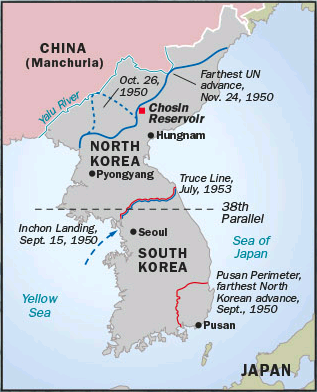
Map of the Korean War

In the summer of 1950, North Korean communists launch a completely unprovoked attack across the 38th parallel against their peaceful, democratic neighbors, the South Koreans. The Americans immediately sent an invasion force by sea to drive them out. The North Koreans easily manage to take over the capital Seoul, and the allies are left with only one port in the southeast – Pusan. In September of 1950, American forces land an invasion force at Inchon, cutting off the North Korean invasion force surrounding Pusan. The North Koreans retreat, and there is hope that American forces will be home by Christmas. But then, unbeknownst to the Americans, the Chines communists  invade North Korea from the north and surround the American forces near the Chosin reservoir, threatening to annihilate an entire Marine division.

The Marines at Yudam-Ni are surrounded and must retreat to Hagaru-Ri

As you can see from the map, there are a whole bunch of American troops fighting to the north/east and south/west of the Chosin Reservoir. The marines near Yudam-Ni need to retreat along a road called the MSR (main supply road) back to Hagaru-Ri. But in order to conduct that retreat, they have to hold onto the vital Toktong pass, which is overwatched by Fox company from their position on Fox Hill. Can Charlie company and Fox company hold off the entire Chinese 59th division (10,000 men) with only two companies (about 250 men each)?
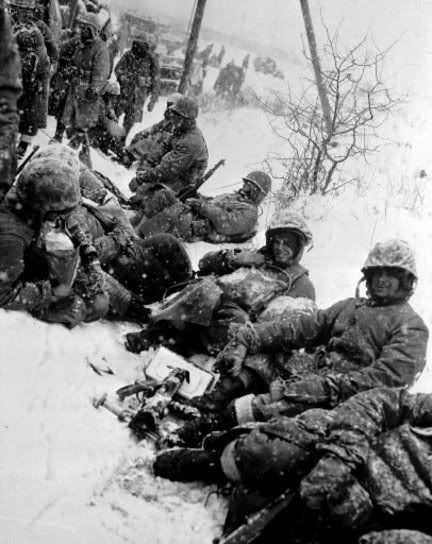
U.S. Marines "The Chosin Few", December 1950
U.S. Marines “The Chosin Few”, December 1950

Well, the book I read (which Dina gave me for Christmas), was about Fox company and their defense of the Toktong pass. This is what the leftist New York Times had to say about the man in charge of Fox company (“F company”) in a 2002 article:

Col. William E. Barber, who won the Medal of Honor for his leadership of a vastly outnumbered company under siege on a snowy hilltop in one of the worst defeats in Marine history, the Battle of the Chosin Reservoir in 1950, died on April 19 at his home in Irvine, Calif. He was 82.

The cause was bone-marrow cancer, said Jerry Courtier, a friend who hopes to write Colonel Barber’s biography.

The reservoir is south of the Yalu River, which separates North Korea from China. After the Americans had pushed the North Koreans almost to the Yalu, 150,000 Chinese troops unexpectedly crossed the river into North Korea. Colonel Barber’s unit, Company F of the Second Battalion of the Seventh Marines, First Marine Division, was on a hill that commanded the Toktong Pass, a vital gap between Yudam Ni and Hagaru Ri, two towns separated by 78 miles.

The stakes were huge. If F Company yielded its position, 8,000 marines at Yudam Ni would be cut off from the 3,000 at Haguru Ri by tens of thousands of Chinese troops.

Through five days and six nights in subzero weather and often swirling snow, Colonel Barber, then a captain, inspired his men, outnumbered more than five to one, to cling to their tenuous positions. He was shot in a bone near his groin on the second day but continued to make the rounds of the hill. He likened the wound to a bee sting.

When the unit was ordered to withdraw and fight its way to safety, Captain Barber refused. Three times, the enemy broke through the line, only to be repulsed.

”I knew that we could probably hold, and I knew that if we didn’t hold we could exact a very heavy toll,” he said in an interview in 1976 with The Los Angeles Times.

His citation for the nation’s top medal said that he commanded his men from a stretcher. But Hector A. Cafferata Jr., who as a rifleman won the Medal of Honor in the same battle, insisted that Captain Barber refused the stretcher.

”He walked the line, he kept us together,” said Mr. Cafferata, who was beside Captain Barber when he was shot.

In the mayhem, the Chinese blew whistles, beat cymbals and tooted bugles as they repeatedly attacked. Coffee froze before men could drink it, and some of the wounded died because plasma froze with no way to thaw it.

When the battle was over, more than 1,000 enemy soldiers were dead. Of Captain Barber’s original 240 men, 82 were able to walk away.

Gen. Raymond G. Davis, who was a lieutenant colonel in the Marines, received a Medal of Honor for leading the unit that rescued F Company.

William Earl Barber was born on Nov. 30, 1919, in Dehart, Ky. He attended what is now Morehead State University in Morehead, Ky., for two years and enlisted in the Marines, at the age of 21, in 1940.

He was so good at shooting a rifle that he was made a weapons instructor. After volunteering for parachute training, he demonstrated such proficiency that he became a parachute instructor.

In World War II, he was promoted to sergeant in 1942 and commissioned a second lieutenant in 1943. He was a rifle platoon commander at Camp Pendleton, Calif., when his unit was shipped to the Pacific.

Colonel Barber was in the first wave to hit Iwo Jima, where he was wounded twice. He received the Silver Star for bravery in addition to two Purple Hearts. At a ceremony on the 50th anniversary of the battle in 1995, he said:

”I am older now, as you are, but I can still see the colors of that February morning. The sky. The island. And sometimes I think I can hear the noise of battle.”

He was treated in Japan for his wounds and returned to the United States, where he worked as a recruiter, among other positions. He was promoted to captain in 1949 and was in the force that occupied Japan.

When he joined F Company in Korea, he saw a raggedy unshaven bunch and immediately ordered the the troops to shave, shine their shoes and look like marines. He suggested that his new charges resembled Pancho Villa’s bandits.

”He was one tough guy,” Mr. Cafferata said. ”He was by the book.”

He was by the book. He enlisted in the Marines because he was grateful to his country for allowing him to escape poverty and go into college, and he wanted to give something back.

You can read a review of the book I read about Fox company, and read about some of the details of what it was like for those men. You’ll never look at your own troubles the same way again. You can also read about Barber’s Medal of Honor citation here.
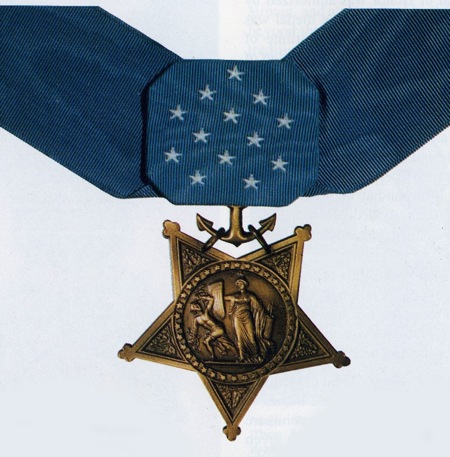
The Medal of Honor, Navy and Marines variant

So, now that I am done with that book, I have moved on to another Korean War book that Dina gave me, this one about George company. The Korean War might have been our most just war – defending a peaceful democratic ally from a totalitarian communist regime. You just have to compare North Korea and South Korea today to understand the stakes. North Korea is basically a godless concentration camp that tortures and murders its people if they so much as think the wrong thoughts about the atheist state. South Korea is free and prosperous, where the people have human rights, like the right to free speech and freedom of religion.

It’s important for me to read about the hardships that real heroes face, so that I don’t complain too much about my own tiny struggles. When you read about the struggles of great American soldiers, so many good things happen to you. Your own problems get smaller, your humility and gratitude get bigger. And you are reminded about why America is a great country, and what American character is really like. These things are not taught by leftists in the public schools. They are not talked about by leftists in the mainstream media. They are not presented by leftists in the Hollywood film industry. If you want to know the real America, you have to find it yourself.
Jim Wallis debates Jay Richards on Christianity and economics

In this post, I have the video of a debate on the topic of what Christians should think about economics and economic policies. In addition to the video, I summarized the two opening speeches and the two rebuttals, for those who prefer to read rather than watch. We’ll start with a short biography about each of the debaters.

The video recording:

The debaters

Jay Richards:

Jay Richards, Ph.D., is a Senior Fellow of the Discovery Institute where he directs the Center on Wealth, Poverty and Morality, and is a Visiting Scholar at the Institute for Faith, Work & Economics. Most recently he is the co-author with James Robison of the best-selling Indivisible: Restoring Faith, Family, and Freedom Before It’s Too Late”.

In addition to writing many academic articles, books, and popular essays on a wide variety of subjects, he recently edited the new award winning anthology, God & Evolution: Protestants, Catholics and Jews Explore Darwin’s Challenge to Faith . His previous book was Money, Greed, and God: Why Capitalism Is the Solution and Not the Problem (HarperOne, May 2009), for which he received a Templeton Enterprise Award in 2010.

[…]In recent years, he has been a Contributing Editor of The American at the American Enterprise Institute, a Visiting Fellow at the Heritage Foundation, and a Research Fellow and Director of Acton Media at the Acton Institute. Richards has a B.A. with majors in Political Science and Religion, an M.Div. (Master of Divinity) and a Th.M. (Master of Theology), and a Ph.D. (with honors) in philosophy and theology from Princeton Theological Seminary.

Jim Wallis:

Jim Wallis (born June 4, 1948) is a Christian writer and political activist. He is best known as the founder and editor of Sojourners magazine and as the founder of the Washington, D.C.-based Christian community of the same name. Wallis is well known for his advocacy on issues of peace and social justice. […]He works as a spiritual advisor to President Barack Obama.

[…]In 2010, Wallis admitted to accepting money for Sojourners from philanthropist George Soros after initially denying having done so. […]In 2011, Wallis acknowledged that Sojourners had received another $150,000.00 from Soros’ Open Society Foundation.

Wallis just came out this month in favor of gay marriage. He is also a strong supporter of Barack Obama, who is radically pro-abortion. Some pro-lifers have argued that Barack Obama has the same views on abortion as Kermit Gosnell, because Obama voted twice to allow abortions on babies who were already born alive.

The format of the debate

  • 20 minute opening speeches
  • 10 minute rebuttals
  • 10 minutes of discussion
  • Q&A for the remainder

SUMMARY

I use italics below to denote my own observations.

Jim Wallis’ opening speech:

My goal is to spark a national conversation on the “common good”.

A story about my son who plays baseball.

The central goal of Christianity is to promote the “common good”.

Quotes “Catholic social teaching” which values “human flourishing”.

The “common good” is “human flourishing”.

Is the purpose of Christianity is to make sure that everyone has enough material stuff or to preach the gospel?

When Christians go on mission trips, it’s good that they focus on things like human trafficking.

Democrat John Lewis is the “conscience of the U.S. Congress”.

John Lewis gets a 0% rating from the American Conservative Union in 2012.

John Lewis gets a 8% rating from the American Conservative Union in 2011.

John Lewis gets a 2.29% lifetime rating from the American Conservative Union.

Nothing is going well in Washington right now except comprehensive immigration reform.

Does he think that Christianity means giving 20-30 million illegal immigrants a path to citizenship, while skilled engineers cannot even get green cards, even though there is a shortage of them? Does he think that the other people in society who earn more than they receive from the government ought to be taxed more in order to provide more services and benefits to those who earn less than they take from the government?

Jay Richards’ opening speech:

Two topics: 1) what is the common good? 2) what should Christians do to promote the common good?

Catholicism defines the “common good” as “Indeed, the common good embraces the sum of those conditions of the social life whereby men, families and associations more adequately and readily may attain their own perfection.”

We have natural ends that we are supposed to be achieving and some places, like South Korea, are better for allowing that to happen.

The common good is broader and prior to any sort of political specification.

It’s not the political good or what the state is supposed to do.

It’s not about the communal good, as in Soviet Russia, where the communal good was above individual and familial good.

The common good is the social conditions that promote the things that we humans have in common as individuals and members of family.

The common good takes account of who we are as individuals and in associations with other individuals, e.g. – families.

Christians don’t have to be doing the same things to promote the common good, e.g. – pastors, entrepreneurs, etc.

The church, as the church, has as its primary goal making disciples of all nations.

But even in that capacity, the church should be interested in more than just conversions and saving souls.

We also have to care about God’s created reality including things like physics, education, etc.

How should Christians promote the common good in politics?

Question: when is coercion warranted?

In Romans 13, Paul says that the state does have power to coerce to achieve certain ends, like justice.

Most Christians think that there are some things where the state can use coercion, for example, to prevent/punish murder.

It is OK for the police to use coercive force to maintain public order and the rule of law.

But we need to ask whether other things are legitimate areas for the state to use coercive force.

We should only give the state power to coerce when there is no other way to achieve a goal.

We need to leverage the science of economics in order to know how to achieve the common good.

Jay Richards' main point in the debate
Jay Richards’ main point in the debate

Henry Hazlitt: “The art of economics consists in looking not merely at the immediate but at the longer effects of any act or policy; it consists in tracing the consequences of that policy not merely for one group but for all groups.”

For example, what happens if we raise the federal minimum wage to $50. What happens next for all groups? That’s what we need to ask in order to know which policies achieve the common good.

When it comes to economics a lot of things have been tried in other places and times.

We can know what works and doesn’t work by studying what was tried before and in other places.

Many things are counter-intuitive – things that sound good don’t work, things that sound bad do work.

Principle: “We are our brother’s keeper”. Christians have an obligation to care for their neighbors.

We all agree on the goal. But how do we do things that will achieve that goal?

We have to distinguish aspirations from principles and prudential judgment.

Principle: We should provide for the material needs of the poor.

Prudence: Seeing the world as it is, and acting accordingly.

Example policies: which minimum wage is best? None? $10? $20?

We decide based on seeing how different economic policies achieve the goal of helping the poor.

Jim Wallis’ first rebuttal:

Jesus commanded us to “care for the poor and help to end poverty”.

Actually, Jesus thought that acknowledging him and giving him sacrificial worship was more important than giving money to the poor, see Matthew 26:6-13:

6 While Jesus was in Bethany in the home of Simon the Leper, 

7 a woman came to him with an alabaster jar of very expensive perfume, which she poured on his head as he was reclining at the table.

8 When the disciples saw this, they were indignant. “Why this waste?” they asked. 

9 “This perfume could have been sold at a high price and the money given to the poor.”

10 Aware of this, Jesus said to them, “Why are you bothering this woman? She has done a beautiful thing to me. 

11 The poor you will always have with you, but you will not always have me. 

12 When she poured this perfume on my body, she did it to prepare me for burial. 

13 Truly I tell you, wherever this gospel is preached throughout the world, what she has done will also be told, in memory of her.”

It’s not clear to me whether Jim Wallis thinks that preaching is more important than redistributing wealth to address material inequality.

I like what Jesus said in a TV series, even though it’s not in the Bible when an actor playing Jesus said to “change the world”.

Jesus never said to “change the world” in the Bible. Should we be concerned that he is quoting a TV actor playing Jesus instead of Jesus.

Here is a terrific story about Bill Bright.

I love Catholic social teaching.

Quote: “All are responsible for all”.

I go to the World Economic Forum at Davos, Switzerland every year. I spoke once at 7 AM on the 4th floor.

It’s a funny place for a Christian to be if they care about the poor – rubbing shoulders with leftist elites. He must have named a dozen high-profile people that he spoke with during the debate, as if he could win the debate by some sort of argument from name-dropping. He mentioned the Davos thing several times!

The greatest beneficiary of government actions to deal with the economic crisis was Wall Street banks.

I’m going to tell you a story about what a Washington lawyer says to Jesus.

I’ve had conversations with business leaders where I tell them to integrate moral truths.

I talk about the Good Samaritan parable.

Quote: “Do you love your undocumented neighbor?”

Quote: “Do you love your Muslim neighbor?”

Jay Richards’ first rebuttal:

Who is responsible for your own children? Who knows the most about them?

Parents should have more discretion over their children because they have more knowledge about their child and what’s best for them.

The Good Samaritan doesn’t show that government should confiscate wealth through taxation and redistribute it.

The Good Samaritan emphasizes voluntarily charity to help people who are not necessarily your immediate neighbor.

Some of the things we do should be for the good of other people in other countries.

But then we are back to leveraging economics to know what policies are good for those other people in other countries.

The principle of subsidiarity: if a problem can be addressed by a lower level of society (family) then we shouldn’t make higher levels (government) address it.

The best place to take care of children is within the family.

Only if the family fails should wider and wider spheres get involved.

Although we want to think of the common good in a global sense, we don’t want to lose sight of the fact

The financial crisis: we need to integrate moral truths, but also economic truths.

We don’t want to assume policies based on intuitions, we want to check our intuitions using economic principles.

Why did we have a financial crisis in mortgages, but not in commodities futures or technology, etc.?

Greed is a contributing factor in all areas of business.

Something more was going on in the mortgage markets than just greed.

There were specific policies that caused the mortgage lending crisis.

The root cause of the problem were “affordable housing policies” that lowered lending restrictions on low income people.

The policy ended up degrading the underwriting standards on loans.

Government intruded into the market and undermined the normal ways of

People were getting massive loans with no income, no jobs, no assets and no down payment.

The federal government created a market for risk loans by guaranteeing

There was a government imposed quota on mortgage lenders such that 50% of their loans had to be given to high-risk borrowers.

That is what led to the financial crisis. Not the free market, but intrusions into the free market.

These policies were well-meaning and implemented by people from both parties. But they had bad effects.

A Harvard University student explains how evidence changed her mind about God

Harvard University student discovers apologetics

Here’s a must-read article  about the effectiveness of apologetics on college campuses in Christianity Today.

Excerpt:

I don’t know when I first became a skeptic. It must have been around age 4, when my mother found me arguing with another child at a birthday party: “But how do you know what the Bible says is true?” By age 11, my atheism was so widely known in my middle school that a Christian boy threatened to come to my house and “shoot all the atheists.” My Christian friends in high school avoided talking to me about religion because they anticipated that I would tear down their poorly constructed arguments. And I did.

As I set off in 2008 to begin my freshman year studying government at Harvard (whose motto is Veritas, “Truth”), I could never have expected the change that awaited me.

It was a brisk November when I met John Joseph Porter. Our conversations initially revolved around conservative politics, but soon gravitated toward religion. He wrote an essay for the Ichthus, Harvard’s Christian journal, defending God’s existence. I critiqued it. On campus, we’d argue into the wee hours; when apart, we’d take our arguments to e-mail. Never before had I met a Christian who could respond to my most basic philosophical questions: How does one understand the Bible’s contradictions? Could an omnipotent God make a stone he could not lift? What about the Euthyphro dilemma: Is something good because God declared it so, or does God merely identify the good? To someone like me, with no Christian background, resorting to an answer like “It takes faith” could only be intellectual cowardice. Joseph didn’t do that.

And he did something else: He prodded me on how inconsistent I was as an atheist who nonetheless believed in right and wrong as objective, universal categories. Defenseless, I decided to take a seminar on meta-ethics. After all, atheists had been developing ethical systems for 200-some years. In what I now see as providential, my atheist professor assigned a paper by C. S. Lewis that resolved the Euthyphro dilemma, declaring, “God is not merely good, but goodness; goodness is not merely divine, but God.”

Joseph also pushed me on the origins of the universe. I had always believed in the Big Bang. But I was blissfully unaware that the man who first proposed it, Georges Lemaître, was a Catholic priest. And I’d happily ignored the rabbit trail of a problem of what caused the Big Bang, and what caused that cause, and so on.

By Valentine’s Day, I began to believe in God. There was no intellectual shame in being a deist, after all, as I joined the respectable ranks of Thomas Jefferson and other Founding Fathers.

I wouldn’t stay a deist for long. A Catholic friend gave me J. Budziszewski’s book Ask Me Anything, which included the Christian teaching that “love is a commitment of the will to the true good of the other person.” This theme—of love as sacrifice for true good—struck me. The Cross no longer seemed a grotesque symbol of divine sadism, but a remarkable act of love. And Christianity began to look less strangely mythical and more cosmically beautiful.

Now, I’m going to get into a lot of trouble for saying this, but I think that if you are a Christian and you are in a secular university, then you really need to have put in the effort to study the areas of science, history and philosophy that are relevant to the Christian faith. This is regardless of your personal abilities or field of study. We must all make an effort regardless of how comfortable we are with things that are hard for us to learn.

Granted, most people today are not interested in truth, because we just have this cultural preoccupation with having fun and feeling good and doing whatever we want to do whenever we want to do it. Most atheists I’ve met are like that, but some are more honest, open-minded, and they just have never encountered any good reasons or evidence to think that God exists and that Jesus is anything other than a man. There are a lot of atheists like that who are just waiting to hear some decent evidence. Our job is to prepare for them and then engage them, if they are willing to be engaged.

I think that definition of love she cited – self-sacrifice for the true good of another person – is important. I don’t think that ordinary Christians like you or me spends time on apologetics because we “like” it. I know lots of Christians who are in tough, expensive academic programs trying to get the skills they need to defend truth in areas that matter. They do this because they know that there are people out there who are interested in truth, and who are willing to re-prioritize their lives if the truth is made clear to them. We need to be willing to serve God by doing hard things that work.

Positive arguments for Christian theism