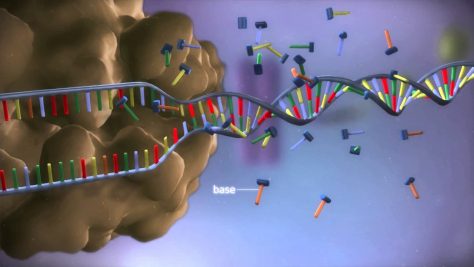
Yale computer science professor David Gelernter expresses doubts about Darwinism

How did life begin?
How did life begin?

I had to learn about David Gelernter when I was doing my Masters in computer science. We studied his book “Mirror Worlds”. A few weeks ago, I blogged about his impressions of the difficulty in forming a simple protein by chance – something that naturalistic mechanisms would have to do in order to avoid intelligent agency as a cause in nature. He found it very unlikely. But there’s more!

Recently, my friend Terrell sent me a video featuring Peter Robinson (who hosts the splendid Uncommon Knowledge show out of Stanford University), and three interesting people. First, there was Dr. Stephen C. Meyer, who is one of my two favorite thinkers. I’ve blogged on his work about the origin of life and the Cambrian explosion here many times. Then, there was Dr. David Berlinski, a secular Jewish professor of mathematics, who has studied origins issues. And then Dr. David Gelernter, who teaches computer science at Yale University, and is a legend in computer science research.

Here’s the video: (H/T Terrell)

Here is an article by Jennifer Kabbany in The College Fix about the video.

She writes about his recent Claremont Review of Books article, as well as the interview above:

In May, the Claremont Review of Books published a column by Gelernter headlined “Giving Up Darwin.” In it, he explained how his readings and discussions of Darwinian evolution and its competing theories, namely intelligent design, have convinced him Darwin had it wrong.

In particular, he cited Stephen Meyer’s 2013 book Darwin’s Doubt as well as The Deniable Darwin by David Berlinski. The professor expanded on his views in an interview with Stanford University’s Hoover Institution that was published last week.

Gelernter stops short of fully embracing intelligent design, both in his essay and during his interview. He said in his interview he sees intelligence in Earth’s design, and has no quarrel with ID proponents, but notes the world a mess, its suffering far outweighs its goodness.

“My argument is with people who dismiss intelligent design without considering, it seems to me — it’s widely dismissed in my world of academia as some sort of theological put up job — it’s an absolutely serious scientific argument,” Gelernter said during his interview. “In fact it’s the first and most obvious and intuitive one that comes to mind. It’s got to be dealt with intellectually.”

I found this part the most interesting, since we are seeing so much intolerance from the secular left, whenever anyone disagrees with their dogma:

Gelernter said he likes many of his colleagues at Yale, that they are his friends, but when he looks at “their intellectual behavior, what they have published — and much more importantly what they tell their students — Darwinism has indeed passed beyond a scientific argument as far as they are concerned. You take your life in your hands to challenge it intellectually. They will destroy you if you challenge it.”

“Now, I haven’t been destroyed, I am not a biologist, and I don’t claim to be an authority on this topic,” Gelernter added, “but what I have seen in their behavior intellectually and at colleges across the West is nothing approaching free speech on this topic. It’s a bitter, fundamental, angry, outraged rejection [of intelligent design], which comes nowhere near scientific or intellectual discussion. I’ve seen that happen again and again.”

Gelernter acknowledges “I am attacking their religion and I don’t blame them for being all head up, it is a big issue for them.”

Dr. Gelernter cited three arguments in his article: the origin of life, and the Cambrian explosion, and genetic entropy. In the first two problems, there is a problem of huge amounts of biological information coming into being . We know that software engineers can write code like that, but there is no Darwinian mechanism for writing that much code and that short of a time period. The third problem shows that Darwinian mechanisms not only don’t produce functional code – they actually break it down.

I’ve covered both of the arguments before on this blog, but if you really want the details, you should pick up the books that convinced Dr. Gelernter: Dr. Stephen C. Meyer’s “Signature in the Cell” and “Darwin’s Doubt”. Each book tackles one of the arguments. For the third problem, a good book is Dr. Michael Behe’s “Darwin Devolves”. Even if you just read something about each book, then you’ll know about the arguments for intelligent causes being the best explanation for the history of life on this planet.

University of Louisville attacks professor of psychiatry for disagreeing with transgenderism

Thinking about transgenderism

A while back, I watched a panel of scholars discussing the science behind transgender doctrine. The panel was hosted by the Heritage Foundation, my favorite think tank. One of the participants was Dr. Allan M. Josephson, a distinguished professor of psychiatry at the University of Louisville. He disagreed with the official position of the secular left on transgenderism. And now he’s in big trouble.

Here’s the video, entitled “Gender Dysphoria in Children: Understanding the Science and Medicine“:

National Review posted an interview with Dr. Josephson.

Here is the intro:

Dr. Allan Josephson discusses academic freedom, child welfare, gender ideology, and the price he has paid for his principles.
Allan M. Josephson is a distinguished psychiatrist who, since 2003, has transformed the division of child and adolescent psychiatry and psychology at the University of Louisville from a struggling department to a nationally acclaimed program. In the fall of 2017 he appeared on a panel at the Heritage Foundation and shared his professional opinion on the medicalization of gender-confused youth. The university responded by demoting him and then effectively firing him.

As soon as the video of the panel came out, his employer came after him:

MK: How stressful has this ordeal been?

AJ: It has had various phases. The first phase was “this just can’t be happening to me.” I was very successful and very well liked. I built my division up from a few people to probably 15 and we had a clinic of almost 30 people. I was banned from faculty meetings. I was banned from certain kinds of interactions with staff and told what I could and couldn’t say to people. And this was a place that I built, you know. And then the stress of one’s personal relationships. My family worried about me, friends worried about me. It was probably was six months before I felt comfortable and was sleeping again. You know, the personal stress is pretty enormous, but then I decided to do something.

The professor expresses concerns about how cursory the evaluations of the children are, and about how transgender health clinics seem to work more like stores, where people just walk in and demand the prescriptions and treatments they want.

Dr. Josephson has decided to put forward a legal challenge to his employer, which is important for others who may also want to disagree without being fired by their employers.

This story made me think of a story that I saw last year from the UK, where a doctor was fired for refusing to participate in transgenderism.

The New York Post reports:

A UK doctor who was fired for refusing to refer to transgender people by their preferred gender pronoun says there is a “climate of fear” in his profession with staff “trained to inform” on one another for breaching discrimination laws.

Dr. David Mackereth’s contract as a medical assessor for the Department of Work and Pensions (DWP) was terminated three weeks ago on the grounds that his refusal to use transgender pronouns could be considered harassment under the 2010 Equality Act.

The 55-year-old said his refusal to comply with the edict from the DWP has effectively ended his career, as he would never be hired for another government or National Health Service job again.

So, it’s not safe now to disagree with transgenderism. If you do, then your job is at risk. What a change this is from just a few years ago, when free speech was not limited by the feelings of other people. I don’t want to hurt anyone’s feelings, but I don’t think that hurt feelings should be allowed to impose restrictions on free speech.


Feminist explains how she chose to drink alcohol before recreational sex

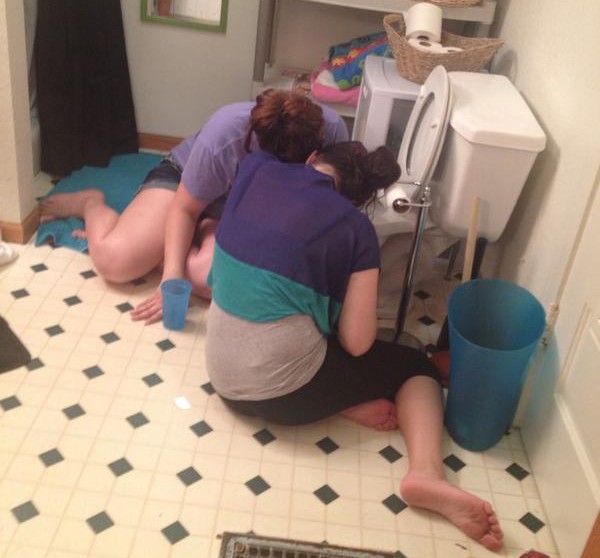
College students puking in toilet

Guess where I’m linking today? To a radical feminist web site named Jezebel, to an article written by a radical feminist who writes for the radically leftist Slate.

No, I’m not crazy. Just read it:

Much of the conversation around alcohol and sex has focused on assault—the line at which intoxication becomes incapacitation, for instance—but what we fail to mention is how haunted people can be by the sex they actually, technically consented to.

[…]I wonder what my sex life would even look like if alcohol hadn’t been there. Alcohol gave me comfort in my own body, and it allowed me to turn my erotic curiosity and hunger for experience into an action plan. I was tired of being the stuttering girl sucking in her stomach after the lights went out. I wanted to be the woman who roamed wild and free.

Alcohol also helped me cut the girlish strings on my heart, an action my college years demanded. Three months into my freshman year, I split a six pack with a dashing sophomore, and we wound up partially clothed on his bed, my bare legs wrapped around his waist, my hands around his neck. I pulled back slightly and asked him the question, the naive question of a girl who does not yet understand her fate: “What does this mean?”

He looked past me, into his studio apartment, and then back into my eyes. “It means that I’m a 19-year-old boy, and we’re having fun.”

What is interesting is that she didn’t see this man’s using her for fun after getting her drunk as any disqualification for a serious relationship. On the contrary, she believes that a serious relationship built on self-sacrificial love and commitment that lasts through difficulties can be found in a man who uses her for fun sex:

I’m not saying I didn’t enjoy that night with the dashing sophomore. I’m saying the fun part for me might have been turning our physical intimacy into a sustained attachment.

Amazing. She wasn’t looking for men with good educations, good jobs, lots of savings, who were sober and chaste – they would have made her unhappy with their bossy leading, and strict plans about courting and marriage. She thought that she could get to live-long married love by choosing what was free, easy and fun in the moment.

She is 35 now, and still single. I’m sure if you ask her, she would like to be married “some day”, but who would say that her past decisions were good preparation for the challenges of marriage? Marriage is about self-sacrificial love, and endurance. To prepare for marriage, you practice self-denial and self-control. You learn how to accept expectations, obligations and responsibilities. You grow up.

Anyway, back to the article. She choose the alcohol herself, and she did it for a very specific reason:

I wanted to have fun, too. And alcohol evened the score. I cared less about everything when I was drinking: What you thought of me, what I looked like in this dress, whether that taco was warm or cold when I stuffed it in my mouth. I don’t want to make it sound like I drank in order to have sex. I drank for a million reasons.

[…]Booze downshifted my intense body consciousness, and it revved up my bravado. Sex was scary—but alcohol made me feel safe.

She drank in order to have sex. Got it? She chose to get drunk in order to feel safe about having sex. Many young women think that recreational sex with hot guys is a pathway to marriage. They drink in order to make progress towards the marriage they want – the marriage to the man who is fun. Not the man who is serious. They don’t want the serious man who makes plans for marriage, and expects the woman to sober up, behave responsibly and honor obligations.

Why are millenials acting like children into adulthood?

This reminds me of the Institute for American Values study. Despite their name, it is not a conservative organization

Look at this citation from p. 15:

A number of students noted that being drunk could later serve as your excuse for the hook up.

A Yale University student said, “Some people like hook up because they’re drunk or use being drunk as an excuse to hook up.”

A New York University student observed, “[Alcohol is] just part of an excuse, so that you can say, oh, well, I was drinking.”

A Rutgers University student commented, “If you’re drinking a lot it’s easier to hook up with someone… [and] drugs, it’s kind of like a bonding thing… and then if you hook up with them and you don’t want to speak to them again, you can always blame it on the drinking or the drugs.”

[…]A University of Chicago junior observed, “One of my best friends… sometimes that’s her goal when we go out. Like she wants to get drunk so I guess she doesn’t have to feel guilty about [hooking up].”

I hope that many of the men out there who refuse to hold women accountable for their own desires start to understand that not everything a woman wants is good, and not every plan a woman makes will work. Sometimes, you need to calmly and constructively challenge them about their priorities, plans and actions. It’s for their own good.