Reformed Baptist theologian Wayne Grudem speaks on the Bible and the right of self-defense.
About Wayne Grudem:
Grudem holds a BA from Harvard University, a Master of Divinity from Westminster Theological Seminary, and a PhD from the University of Cambridge. In 2001, Grudem became Research Professor of Bible and Theology at Phoenix Seminary. Prior to that, he had taught for 20 years at Trinity Evangelical Divinity School, where he was chairman of the department of Biblical and Systematic Theology.
Grudem served on the committee overseeing the English Standard Version translation of the Bible, and in 1999 he was the president of the Evangelical Theological Society. He is a co-founder and past president of the Council on Biblical Manhood and Womanhood. He is the author of, among other books, Systematic Theology: An Introduction to Biblical Doctrine, which advocates a Calvinistic soteriology, the verbal plenary inspiration and inerrancy of the Bible, the body-soul dichotomy in the nature of man, and the complementarian (rather than egalitarian) view of gender equality.
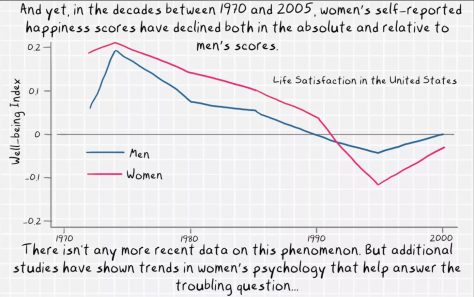
Male and female happiness throughout America’s adoption of radical feminism
I was reading this article by a feminist fiction writer on Vox, where she explains that although feminists have gotten what they wanted (careers, contraceptives, promiscuity, abortion, no-fault-divorce, daycare, etc. it hasn’t made them happier. So, what does this feminist fiction writer think would make feminists happier?
She gives two reasons why women women are still unhappy after feminism has been adopted by our society:
men don’t do enough housework
women are not as successful as men because they are discriminated against, the so-called “glass ceiling”
I think those complaints are pretty popular among feminists. Let’s take a look at some studies to see if her opinions are supported by peer-reviewed studies.
Researchers at the University of Illinois examined data on nearly 1,500 men and 1,800 women, aged between 52 and 60. Their well-being was evaluated through surveys.
The researchers first found that men’s well-being decreased once they had exited the workforce to become home-makers.
Meanwhile, the inverse was not so for women: Women’s psychological well-being was not affected by leaving their jobs to become stay-at-home mothers.
A study called “Egalitarianism, Housework and Sexual Frequency in Marriage,” which appeared in The American Sociological Review last year, surprised many, precisely because it went against the logical assumption that as marriages improve by becoming more equal, the sex in these marriages will improve, too. Instead, it found that when men did certain kinds of chores around the house, couples had less sex. Specifically, if men did all of what the researchers characterized as feminine chores like folding laundry, cooking or vacuuming — the kinds of things many women say they want their husbands to do — then couples had sex 1.5 fewer times per month than those with husbands who did what were considered masculine chores, like taking out the trash or fixing the car. It wasn’t just the frequency that was affected, either — at least for the wives. The more traditional the division of labor, meaning the greater the husband’s share of masculine chores compared with feminine ones, the greater his wife’s reported sexual satisfaction.
Regarding the pay gap, that is entirely caused by women’s own choices. E.g. – the choice to study creative writing instead of petroleum engineering, the choice to work 35 hour weeks instead of 70 hour weeks, etc.
When the [Bureau of Labor Statistics] reports that women working full-time in 2018 earned 81.4% of what men earned working full-time, that is very much different from saying that women earned 81.4% of what men earned for doing exactly the same work while working the exact same number of hours in the same occupation, with exactly the same educational background and exactly the same years of continuous, uninterrupted work experience, and with exactly the same marital and family (e.g., number of children) status. As shown above, once we start controlling individually for the many relevant factors that affect earnings, e.g., hours worked, age, marital status, and having children, most of the raw earnings differential disappears.
This study leads to the unambiguous conclusion that the differences in the compensation of men and women are the result of a multitude of factors and that the raw wage gap should not be used as the basis to justify corrective action. Indeed, there may be nothing to correct. The differences in raw wages may be almost entirely the result of the individual choices being made by both male and female workers.
I think that women are entitled to make their own decisions, but they aren’t allowed to force the rest of us to subsidize their failures and celebrate their destructive outcomes.
I could go on, but I think enough has been said to show that research is very much at odds with feminist rhetoric. They feel they know what will make them happy and we gave them everything they asked for. They eliminated shaming of promiscuity with sex education. They get preferential treatment in the schools in a female-dominated education system.They are hired because of affirmative action quotas. They get expensive daycare, government schools, welfare and other programs. Taxes are raised to equalize outcomes for divorced women who choose men for feelings, and then nuke their own marriage enterprise. We have been on a long experiment of giving feminists everything they felt they wanted, at the expense of men’s rights and children’s rights, and it hasn’t even produced the results that feminists felt it would.
The social costs of feelings-based decision-making
Let’s look at two examples of policies that feminists asked for in the past, which didn’t work out the way they wanted.
I can understand why feminists would introduce sex education. They felt that “if everyone is having sex, then I won’t be the only one chasing attention from hot no-commitment bad boys by giving them recreational sex before marriage”. They wanted to eliminate the standards of chastity and marriage-focused dating and normalize fun-focused drunken promiscuity. And they got that. But since they didn’t consult any research and evidence about how that would affect their future marriage stability and marriage happiness, they are even more unhappy than before.
How about no-fault divorce? No-fault divorce was brought in by a coalition of feminists, Marxists and trial lawyers. The Marxists want to destroy the family in order to increase dependence on the state. The trial lawyers wanted to make money. And the feminists thought that the standard approach to courting and marriage was just too much work. They didn’t want to be chaste. They didn’t want to be sober. They didn’t want to evaluate a man for traditional husband and father roles. The no-fault divorce laws gave them an escape from the messes caused by their own feelings-driven choices. But divorce just makes makes men and women much poorer, and passes the costs of supporting single mothers onto taxpayers.
And the costs of the failures of feminism are passed onto taxpayers.
This paper examines the growth of government during this century as a result of giving women the right to vote. Using cross-sectional time-series data for 1870–1940, we examine state government expenditures and revenue as well as voting by U.S. House and Senate state delegations and the passage of a wide range of different state laws. Suffrage coincided with immediate increases in state government expenditures and revenue and more liberal voting patterns for federal representatives, and these effects continued growing over time as more women took advantage of the franchise. Contrary to many recent suggestions, the gender gap is not something that has arisen since the 1970s, and it helps explain why American government started growing when it did.
We are already $22 trillion in debt, partly because of feminism’s replacement of husbands and families with higher taxes and big government. Every time we transfer money from tax-paying men to feminists to fix their mistakes, it leaves less money in the hands of the men who actually want to get married. The declining value of marriage after feminism for men explains why marriage is being delayed, and why marriage rates are plunging.
The Christian view of marriage
In other places, I have written about the evidence for a Christian worldview:
If Christianity is true, then we have inherited a design for marriage and family which includes male and female roles.
Here is what Jesus says about marriage and divorce in Matthew 19:4:
4 “Haven’t you read,” he replied, “that at the beginning the Creator ‘made them male and female,’5 and said, ‘For this reason a man will leave his father and mother and be united to his wife, and the two will become one flesh’?6 So they are no longer two, but one flesh. Therefore what God has joined together, let no one separate.”
Jesus does not approve of no-fault divorce.
And here’s what Jesus said about premarital sex (“fornication”) in Mark 7:20-23:
20 He went on: “What comes out of a person is what defiles them.21 For it is from within, out of a person’s heart, that evil thoughts come—sexual immorality, theft, murder,22 adultery, greed, malice, deceit, lewdness, envy, slander, arrogance and folly.23 All these evils come from inside and defile a person.
Jesus does not approve of premarital sex.
Christians should not show even a hint of sexual immorality, (premarital sex and no-fault divorce), nor should they partner with those who approve of sexual immorality and no-fault divorce, according to Ephesians 5:
3 But among you there must not be even a hint of sexual immorality, or of any kind of impurity, or of greed, because these are improper for God’s holy people.4 Nor should there be obscenity, foolish talk or coarse joking, which are out of place, but rather thanksgiving.5 For of this you can be sure: No immoral, impure or greedy person—such a person is an idolater—has any inheritance in the kingdom of Christ and of God.[a]6 Let no one deceive you with empty words, for because of such things God’s wrath comes on those who are disobedient.7 Therefore do not be partners with them.
Christians should not partner with feminists.
And this is one of the most famous passages on male and female roles in the Bible, also from Ephesians 5:
22 Wives, submit yourselves to your own husbands as you do to the Lord.23 For the husband is the head of the wife as Christ is the head of the church, his body, of which he is the Savior.24 Now as the church submits to Christ, so also wives should submit to their husbands in everything.
25 Husbands, love your wives, just as Christ loved the church and gave himself up for her26 to make her holy, cleansing[b] her by the washing with water through the word,27 and to present her to himself as a radiant church, without stain or wrinkle or any other blemish, but holy and blameless.28 In this same way, husbands ought to love their wives as their own bodies. He who loves his wife loves himself.29 After all, no one ever hated their own body, but they feed and care for their body, just as Christ does the church—30 for we are members of his body.31 “For this reason a man will leave his father and mother and be united to his wife, and the two will become one flesh.”32 This is a profound mystery—but I am talking about Christ and the church.33 However, each one of you also must love his wife as he loves himself, and the wife must respect her husband.
Christians do not approve of egalitarian marriage which erases sex differences in husband and wife roles.
Most women in the church, and most of their “conservative” pastors, don’t believe that Jesus is an authority about chastity, marriage and male headship. They agree with feminists about premarital sex and no-fault divorce and egalitarian marriage. But the feminist design for women isn’t working out for women – that’s undeniable. Should we really be surprised that feminist’s feelings were not better for women than the Creator’s own design?
I guess everyone already knows about Gary Chapman and his 5 Love Languages. But have you heard of his 5 Love Languages of apologies?
I want to focus on two of them that I think are important, because I don’t want people to think that just saying “I’m sorry” is good enough.
Here they are (straight out of his book):
Apology Language #3: Making Restitution
In the public arena, our emphasis upon restitution is based upon our sense of justice. The one who commits the crime should pay for the wrongdoing. In contrast, in the private sphere of family and other close relationships, our desire for restitution is almost always based upon our need for love. After being hurt deeply, we need the reassurance that the person who hurt us still loves us.
“How could they love me and do that?” is the question that lingers in our minds. The words “I’m sorry; I was wrong” may not be enough.
For some people, restitution is their primary apology language. For them the statement, “It is not right for me to have treated you that way,” must be followed with “What can I do to show you that I still care about you?” Without this effort at restitution, this person will question the sincerity of the apology. They will continue to feel unloved even though you may have said, “I am sorry; I was wrong.” They wait for the reassurance that you genuinely love them.
The question, then, is how do we make restitution in the most effective way? Since the heart of restitution is reassuring the spouse or family member that you genuinely love him or her, it is essential to express restitution in the love language of the other person.
[…]If restitution is the primary apology language of an individual, then this becomes the most important part of the apology. “I’m sorry; I was wrong” will never be taken as sincere if these words are not accompanied by a sincere effort at restitution. They wait for the assurance that you still genuinely love them. Without your effort to make amends, the apology will not have the desired results of forgiveness.
Apology Language #4: Genuinely Repenting
The word repentance means “to turn around” or “to change one’s mind.” In the context of an apology, it means that an individual realizes that his or her present behavior is destructive. The person regrets the pain he or she is causing the other person, and he chooses to change his behavior.
Without genuine repentance, the other languages of apology may fall on deaf ears. What people who’ve been hurt want to know is, “Do you intend to change, or will this happen again next week?”
How then do we speak the language of repentance?
It begins with an expression of intent to change. When we share our intention to change with the person we have offended, we are communicating to them what is going on inside of us. They get a glimpse of our heart—and this often is the language that convinces them we mean what we say.
The second step down the road of repentance is developing a plan for implementing change.Often apologies fail to be successful in restoring the relationship because there is no plan for making positive change.
The third step down the road of repentance is implementing the plan. Following through with the plan gives evidence to the offended party that your apology was sincere.
Most people do not expect perfection after an apology, but they do expect to see effort.
Thus, expressing your desire to change and coming up with a plan is an extremely important part of an apology to this person. Inviting the offended person to help you come up with a plan for change is perhaps the best way to effectively show repentance.
Here are some practical tips that I recommend to someone who has done something morally wrong and who wants to apologize.
To fix the problem you need more than talk
To me, the only thing that needs an apology is breaking a moral rule – you can’t beat someone up for just making a mistake. Whenever someone breaks a moral rule with me, like disrespecting me or being selfish, then I pick out a book for them to read and ask them to read it and then write something about how what they learned in the book applies to what they did to me. I don’t pick very long books! But I do this for a very important reason.
The very important reason is that I don’t trust people who just agree with me. I don’t trust people’s words. If someone is really sorry about something, then I want them to read something that describes the moral rule that they broke, and to be willing to listen to the feelings of the person they harmed by breaking that rule. That goes a long way in my mind.