
Can a man marry a woman who thinks that all male leadership is “sexist”?

These days, many people of both sexes graduate college with a lot of student loan debt and no marketable skills at all. What do they learn? Well, they don’t learn anything, but they are brainwashed to believe in secular leftist dogma. And they’re also brainwashed to dismiss all opposition to secular leftist dogma by labeling it as “sexist”, “racist”, “homophobic”, “xenophobic”, etc.

I wrote previously about how men don’t like to marry non-virgins. I argued that women with a lot of sexual experience have proven that they prefer men who have “no-commitment” abilities. And those women also avoid men who have commitment abilities. I argued that if a man marries a woman with a lot of experience of giving no-commitment men sex, then she probably wouldn’t respect and admire his marriage-oriented skills enough to let him lead the home.

I believe that the brainwashing that women get when they do non-STEM degrees in liberal arts programs in college is the cause of their resistance to the leadership of marriage-minded men.

How does a marriage happen? Basically, a marriage-minded man prepares himself for marriage by denying himself “fun” in order to position himself to be a husband and father. He studies hard STEM subjects in order to get good jobs. His resume is gap-free. He started working early, and didn’t take summers off. He saves his money. He understands beliefs that are incompatible with marriage, such as pro-abortion, pro-divorce, etc. and he is able to argue against them. When he meets a woman, he presents his preparations to her, and tries to get her to focus on behaviors that will put her on a path to becoming a wife and mother. If she follows his lead, then she becomes safe for him to marry. He is able to see how she listens to his marriage plan, and adjusts her behavior in order to help him to execute the plan.

So what does this leadership look like? Well, in my case, I’ve tried to get women to switch from non-STEM to STEM degrees. To quit easy jobs like waitress and teacher and get hard jobs like IT Project Manager or Software Engineer. To stop wasting money on thrill-seeking and instead pay off loans, then invest. To stop watching TV and movies, and start reading good non-fiction books about marriage, parenting, apologetics, economics, etc. And to inform themselves about marriage related topics, e.g. – divorce, infertility, child development, homeschooling, daycare, school choice. Basically, getting them to drop childish anti-marriage and anti-family behaviors, and take up mature pro-marriage and pro-family behaviors, so that they become useful partners for a marriage enterprise.

But what about non-STEM college programs? What does college teach young women about this marriage-focused leadership from marriage-minded men? It depends on what she studies. If she does a STEM degree, she’ll have been forced to be accountable to reality in her assignments and exams. She’ll get a decent job and pay off student loans, allowing her husband to quickly buy her a house and give her children to raise while she’s still young. But, if she does a non-STEM degree, then not only will she probably have student loan debt and a useless degree and low-pay jobs, but she’ll also have been brainwashed with all sorts of anti-marriage and anti-family beliefs and behaviors. That’s because non-STEM programs are nothing more than brainwashing in secular leftist dogma. And I have an example of how this works in real life.

Everything too hard for her to learn or do is “sexist”

In the example below, a male expert on climate science corrects a female journalist about climate science. She dismisses his correction (not shown) as sexism.
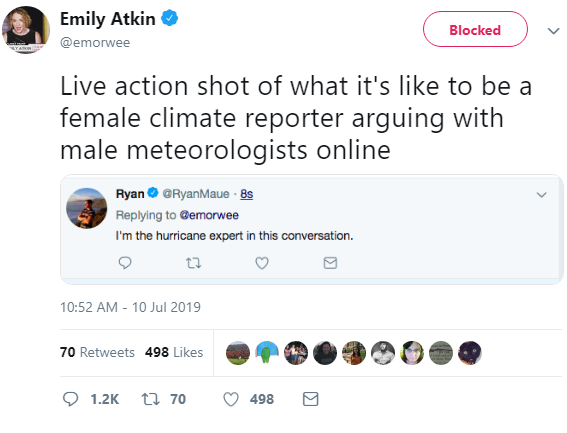
Feminist journalist shames science expert as "sexist"
Feminist journalist shames science expert as “sexist”

Here is the biography of the male PhD in meteorology:

Ryan Maue is a research meteorologist. He has developed and maintained a popular weather maps and climate data service based on the world’s best numerical weather prediction systems. During his graduate studies at Florida State University, he researched extratropical and tropical cyclones, utilizing mesoscale models and large reanalysis datasets, and published multiple peer-reviewed articles. After his PhD in 2010, Maue was awarded a National Research Council postdoctoral associateship at the Naval Research Lab in Monterey, California where he focused on global weather prediction and verification.

And here is the biography of the female journalist with the BA in journalism:

She has a BA in journalism, and knows literally nothing about climate science, and has achieved literally nothing of value in the field of climate science that anyone would be willing to pay her for.

Crying “sexist” is literally everything that her degree in journalism taught her to do. She has one skill: how to dismiss expertise in reality-based practical disciplines as “sexist”, and therefore inferior to her feelings and intuitions.

Should marriage-minded men marry feminists?

So let’s ask and answer one simple question: should a marriage-minded man marry a woman who dismisses leadership from qualified men as “sexist”?

Let’s review the red flags of secular leftist feminist women:

  • she’s pro-abortion, so she thinks murdering an innocent child is how selfish adults escape the consequences of their own reckless actions
  • she’s pro-divorce, and will not hesitate for a second to break a commitment that makes her unhappy
  • she’s an atheist, so she can’t rationally ground the basic requirements of morality: free will, objective moral laws, etc. and therefore cannot be relied on to behave morally against her own self-interest
  • she’s a socialist, so she views money earned by the husband as the property of the secular left government
  • she’s a feminist, so she believes sex is recreational, and need not be reserved for a husband and wife in a covenant marriage, and she thinks that newborns should be tossed into daycare then public schools
  • she believes in same-sex marriage, so she thinks that children can be deprived of a relationship with their biological mother and/or father, for the benefit of selfish adults
  • etc.

Does this sound like she’s ready for a husband and children?

But more than the worldview issues are the practical issues. A woman with a non-STEM degree didn’t want to study subjects that are accountable to reality. She didn’t want to be a pharmacist, a nurse or a software engineer – those jobs would require her to produce work that corresponds to reality, and has value in the real world. People like her who graduate with non-STEM degrees don’t understand anything about how the world really works. People like her aren’t equipped to earn money in a free market by satisfying customers. They don’t understand basic economics, so they’re socialists. They can’t be reasoned with, because their views are determined by what makes them feel good, look good to peers, and what gives them maximum autonomy to pursue pleasure with minimum accountability. When secular leftists feminists crash and burn at self-sufficiency, they blame everyone else instead of themselves. All of these character traits make them really difficult to get along with in a marriage.

Can women like this be fixed up for marriage and motherhood? Well, that would require them to be open to marriage-minded men who would be able to lead them towards marriage and motherhood behaviors. But how did Emily respond to leadership from a male with real-world demonstrated ability in a practical area? She called his attempt to lead her “sexist”. And that is the standard response of secular leftist feminist women to male leadership. If you tell them to study computer science, you’re “sexist”. If you tell them to stop wasting money, you’re “sexist”. If you tell them to stop getting drunk, you’re “sexist”. If you tell them to read a book on economics, you’re “sexist”. If you tell them to watch a William Lane Craig debate, you’re “sexist”. If you tell them to eat healthy and lift weights, you’re “sexist”. If you tell them to get a challenging job, you’re “sexist”. If you tell them to stop having recreational sex with bad boys, you’re “sexist”. Every attempt to focus a secular leftist feminist woman on preparing for marriage and motherhood is called “sexist”.

If women would only listen to what men ask of them as future wives and future mothers, and build themselves up for wife and mother roles, then women would never struggle to find husbands. No man in his right mind can risk marriage to a secular leftist feminist. There is no “secular leftist feminist” path to marriage. No amount of immodesty and premarital sex from a secular leftist feminist is enough to trick a man into marrying her. That might work on some men to get sex, but it’s not going to work to get her to marriage and children.

Atheist Jerry Coyne explains why morality is impossible for atheists

Sherlock Holmes and John Watson about to do philosophy

Let’s review what you need in your worldview in order to have a rationally grounded system of morality.

You need 5 things:

1) Objective moral values

There needs to be a way to distinguish what is good from what is bad. For example, the moral standard might specify that being kind to children is good, but torturing them for fun is bad. If the standard is purely subjective, then people could believe anything and each person would be justified in doing right in their own eyes. Even a “social contract” is just based on people’s opinions. So we need a standard that applies regardless of what people’s individual and collective opinions are.

2) Objective moral duties

Moral duties (moral obligations) refer to the actions that are obligatory based on the moral values defined in 1). Suppose we spot you 1) as an atheist. Why are you obligated to do the good thing, rather than the bad thing? To whom is this obligation owed? Why is rational for you to limit your actions based upon this obligation when it is against your self-interest? Why let other people’s expectations decide what is good for you, especially if you can avoid the consequences of their disapproval?

3) Moral accountability

Suppose we spot you 1) and 2) as an atheist. What difference does it make to you if you just go ahead and disregard your moral obligations to whomever? Is there any reward or punishment for your choice to do right or do wrong? What’s in it for you?

4) Free will

In order for agents to make free moral choices, they must be able to act or abstain from acting by exercising their free will. If there is no free will, then moral choices are impossible. If there are no moral choices, then no one can be held responsible for anything they do. If there is no moral responsibility, then there can be no praise and blame. But then it becomes impossible to praise any action as good or evil.

5) Ultimate significance

Finally, beyond the concept of reward and punishment in 3), we can also ask the question “what does it matter?”. Suppose you do live a good life and you get a reward: 1000 chocolate sundaes. And when you’ve finished eating them, you die for real and that’s the end. In other words, the reward is satisfying, but not really meaningful, ultimately. It’s hard to see how moral actions can be meaningful, ultimately, unless their consequences last on into the future.

Theism rationally grounds all 5 of these. Atheism cannot ground any of them.

Let’s take a look at #4: free will and see how atheism deals with that.

Atheism and free will?

Here’s prominent atheist Jerry Coyne’s editorial in USA Today to explain why atheists can’t ground free will. (Note: link is dead)

Excerpt:

And that’s what neurobiology is telling us: Our brains are simply meat computers that, like real computers, are programmed by our genes and experiences to convert an array of inputs into a predetermined output. Recent experiments involving brain scans show that when a subject “decides” to push a button on the left or right side of a computer, the choice can be predicted by brain activity at least seven seconds before the subject is consciously aware of having made it. (These studies use crude imaging techniques based on blood flow, and I suspect that future understanding of the brain will allow us to predict many of our decisions far earlier than seven seconds in advance.) “Decisions” made like that aren’t conscious ones. And if our choices are unconscious, with some determined well before the moment we think we’ve made them, then we don’t have free will in any meaningful sense.

If you don’t have free will, then you can’t make moral choices, and you can’t be held morally responsible. No free will means no morality.

Here are some more atheists to explain how atheists view morality.

William Provine says atheists have no free will, no moral accountability and no moral significance:

Let me summarize my views on what modern evolutionary biology tells us loud and clear — and these are basically Darwin’s views. There are no gods, no purposes, and no goal-directed forces of any kind. There is no life after death. When I die, I am absolutely certain that I am going to be dead. That’s the end of me. There is no ultimate foundation for ethics, no ultimate meaning in life, and no free will for humans, either.

Richard Dawkins says atheists have no objective moral standards:

In a universe of blind physical forces and genetic replication, some people are going to get hurt, other people are going to get lucky, and you won’t find any rhyme or reason in it, or any justice. The universe that we observe has precisely the properties we should expect if there is, at bottom, no design, no purpose, no evil and no good, nothing but blind, pitiless indifference… DNA neither knows nor cares. DNA just is. And we dance to its music. (Richard Dawkins, River Out of Eden: A Darwinian View of Life (1995))

When village atheists talk about how they can be moral without God, it’s important to ask them to justify the minimum requirements for rational morality. Atheists may act inconsistently with their worldview, believing in free will, expecting praise and blame for complying with the arbitrary standards of their peer group, etc. But there is nothing more to morality on atheism that imitating the herd – at least when the herd is around to watch them. And when the herd loses its Judeo-Christian foundation – watch out. That’s when the real atheism comes out – the atheism that we’ve seen before in countries that turned their backs on God, and the moral law. When God disappears from a society, anything is permissible.

What is the fine-tuning argument for God’s existence, and does the multiverse counter it?

Christianity and the progress of science

One of the best arguments for the existence of a Creator and Designer of the universe is the cosmic fine-tuning argument. The argument argues that individual constants and quantities in nature cannot be much smaller or larger than they are, because it would remove the ability of the universe to support life of any kind. Dr. Michael Strauss, an experimental physicist, explains some examples of the fine-tuning in a recent post on his blog.

He writes:

I liken the finely-tuned universe to a panel that controls the parameters of the universe with about 100 knobs that can be set to certain values. If you turn any knob just a little to the right or to the left the result is either a universe that is inhospitable to life or no universe at all.

Consider the knob that controls the strength of the strong nuclear force that holds quarks inside the neutrons and protons and binds the nucleus of the atom together. If the strength were increased by 2%, the element hydrogen would be either non-existent or very rare. Without hydrogen there would be no water (H2O) or stars that burn hydrogen as their nuclear fuel like our sun.  Without hydrogen there would be no life. If the strength of the strong nuclear force were decreased by about 5%, then hydrogen would be the only element in the universe. That would simplify the periodic table and make Chemistry class very easy, but it would render life impossible.

All known life in this universe is based on the element carbon, which is formed in the final stages of a star’s life. The carbon you and I are made of is the result of the nuclear processes that occurred as previous stars ended their lives. One nice recent study showed that if the mass of the quarks that make up neutrons and protons were changed by just a few percent, then the process that makes carbon as stars die would be altered in such a way that there would not be sufficient carbon in the universe for life. The masses of the lightest sub-atomic quarks are the precise value that is required for carbon to form and for life to exist.

Regarding the multiverse, let me just quote from MIT physicist Alan Lightman, writing in Harper’s magazine about the multiverse:

The… conjecture that there are many other worlds… [T]here is no way they can prove this conjecture. That same uncertainty disturbs many physicists who are adjusting to the idea of the multiverse. Not only must we accept that basic properties of our universe are accidental and uncalculable. In addition, we must believe in the existence of many other universes. But we have no conceivable way of observing these other universes and cannot prove their existence. Thus, to explain what we see in the world and in our mental deductions, we must believe in what we cannot prove.

Sound familiar? Theologians are accustomed to taking some beliefs on faith. Scientists are not. All we can do is hope that the same theories that predict the multiverse also produce many other predictions that we can test here in our own universe. But the other universes themselves will almost certainly remain a conjecture.

The multiverse is not pure nonsense, it is theoretically possible.But even if there were a multiverse, the generator that makes the universes itself would require fine-tuning, so the multiverse doesn’t get rid of the problem. And, as Lightman indicates, we have no independent experimental evidence for the existence of the multiverse in any case. Atheists just have to take it on faith, and hope that their speculations will be proved right. Meanwhile, the fine-tuning is just as easily explained by postulating God, and we have independent evidence for God’s existence, like the the origin of biological information, the sudden appearance of animal body plans, the argument from consciousness, and so on. Even if the naturalists could explain the fine-tuning, they would still have a lot of explaining to do. Theism (intelligent causation) is the simplest explanation for all of the things we learn from the progress of science.

It’s very important to understand that if these values were any different, then it’s not like we would bridges on our foreheads, or have green skin, or have pointy ears, etc. That’s what science fiction teaches you. And many atheists form their view of science by watching science fiction entertainment. But the truth is that the consequences of changing these values are much more consequential: no stars, no planets, no hydrogen, no heavy elements, the universe re-collapses into a hot fireball. You’re not going to have complex, embodied intelligent agents running around making moral decisions and relating to God in a world like that.

Questions like the existence of God should be NOT decided by feelings and faith and superstitious nonsense. They ought to be decided by evidence. Specifically, scientific evidence. Everyone has to account for this scientific evidence for fine-tuning within their worldview, and they have to account for it in a way that is responsible and rational. Punting to the multiverse, without any evidence for it, is neither rational nor responsible. Holding out hope that the evidence we have now will all go away is neither rational nor responsible.

By the way, if you are looking for a good book on the cosmic fine-tuning, especially for evangelism and debating with atheists, you really need to get a copy of “A Fortunate Universe“. Although it is from one of the most prestigious academic presses, it is pretty funny to read, and the main points are made clearly, even if you don’t understand the science. Two astrophysicists wrote it – one who believes that God is the best explanation of the fine-tuning, and one who doesn’t. I really think that Christians need to get used to the idea that evangelism can be pretty easy, so long as you are arguing from peer-reviewed facts. When you get a good book on evidence for God that is not in dispute, then you are invincible. Everybody ought to believe in God in a universe with this much overt scientific evidence spilling out everywhere. Whether this Creator and Designer is the God of the Bible, who visited us as Jesus of Nazareth, takes more work to establish. Working through the emotional objections people have to God, and coaching them to take on the difficulties of living out a authentic Christian life (very unpopular!), is even harder.