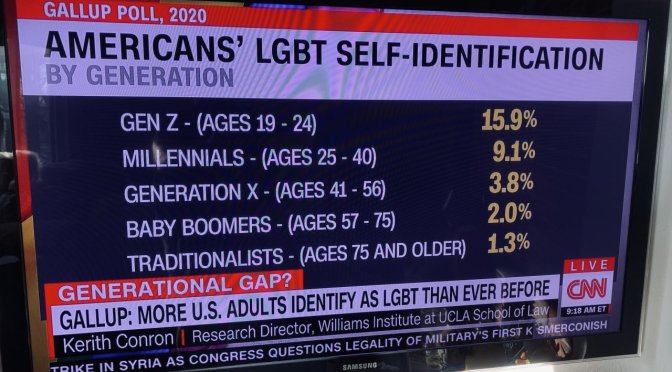
A new Gallup poll published on Feb. 24 shows 1 in 6 Gen Z adults identify as LGBT. These results represent a remarkable jump from 2017, when 4.5 percent of Americans identified as LGBT, a number that has now risen to 5.6 percent just three years later.
The increase is indeed dramatic, yet it doesn’t fully tell the whole story. Why? While the population of Americans identifying as LGBT has risen steadily since 2012, last year the question was expanded from a simple “yes” or “no” to LGBT identity to include specific categories to choose from. Only one identity group showed a dramatic increase: bisexual women.
[…]One in ten high school students identify as LGBT. Of these, 75 percent are female, and 77 percent identify as bisexual. As detailed by the Washington Post, the Williams Institute at the University of California at Los Angeles has found that 35 percent of LGBT adults are bisexual women.
Further, Hammack argues that his research shows young women are more likely to identify as “non-binary” or “gender-fluid.”
I’m going to have something to say about this in a minute, but for now just note that it’s young women who are the ones who are most likely to abandon natural marriage, traditional families and complementary sex roles.
More:
As Abigail Shrier discussed in great detail with in-depth research in her book, “Irreversible Damage: The Transgender Craze Seducing Our Daughters,” the power of social contagion and peer group identity is important to consider:
Between 2016 and 2017, the number of gender surgeries for natal females in the US quadrupled; in the UK, the rates of gender dysphoria for teenage girls are up 4,400 percent over the previous decade.
Indeed, as 16-year-old Jasper Swartz — who identifies as non-binary — expressed to the Washington Post, all of her friends are “queer in some way.”
Rather than reflecting the natural progression of openness to human variation in sexuality and gender identity, it seems to better reflect a pop culture fad to be included in the LGBT spectrum in any way possible. This seems especially true for younger people, who are inundated with LGBT education, culture, and positivity and, as Abigail discusses in her book, find meaning in being different, unique, and rebellious, along with their friends. As indicated by the Gallup survey, as people age, their identities become more stable and bisexuality drops significantly.
[…]For young women seeking identity and being part of a special or important group, all they have to do is cut their hair short, dress like a boy, and declare themselves non-binary or bisexual to gain instant victimhood status and self-validation. If it becomes too much and they still get the exciting thrill of being LGBT, they can always slip back into safer roles.
So, my suspicion is that young women are more vulnerable to this for two reasons. One, young women are more likely to determine their beliefs by deciding what makes them feel good. And two, young women are more likely to determine their beliefs by what makes them look good to their peer group. They’re not reading non-fiction, and forming a worldview that’s bound by logic and evidence. They like fiction. They like entertainment. They’re not even embracing their values based on their future goals. Their long-term goals might be to marry and have security and family. But they’re not taking steps towards that right now. Right now, they’re just doing what feels good in the moment. They’re adapting to their peers, and the culture at large, rather than thinking for themselves.
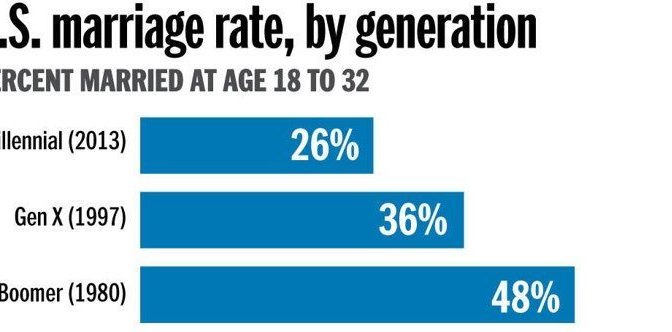
Young women like LGBT lifestyles more than they like natural marriage and family
In fact, there have been studies on how these ideas spread, and that’s exactly what they found – young women are the ones who swallow this, and for reasons of feelings and peer approval. It’s a social benefit to claim to be a minority sexual identity. Our culture has set it up so that you get prestige and sympathy for this. You get to play the victim, and everyone has to be nice to you. And you’re so interesting! So sophisticated. To young women, it’s an offer they can’t refuse – so they don’t.
I’ve always been suspicious of women who make a living through their physical beauty. I see a few problems with modeling as a career. First, you don’t have to produce anything useful that requires understanding the real world, like a programmer or a nurse. Second, you focus a lot on your appearance, and that’s not healthy, since it all fades out by age 35 anyway. Women who get a lot of attention for free typically don’t know how to treat men, either. They don’t learn because they don’t have to learn.
With that in mind, here’s an article by an aging 38-year-old model that illustrates the problem: (H/T Better Bachelor)
Earlier this month I opened the door to a bouquet of flowers.
They were from yet another man who wants to date me. He’s 35, tall, dark and handsome.
[…]And this week, as the gifts roll in from admirers for Valentine’s Day — I have already received two…
[…]I am 38 and have been single for four years.
So, the first thing to point out about this is that it confirms what I was saying about pretty women. Look at the way she talks about how all these men are paying attention to her. Like it or not, her worldview is going to be conditioned by this attention she’s getting from men. She isn’t having to write code to get attention. Or set a fracture. Or do anything. She just gets it because she was born with good looks. And she doesn’t see that it is her job to 1) prepare her character for attracting a man who wants to commit, or 2) choose men who are interested in commitment. Her job is just to be pretty, and then tell everyone how much attention she’s getting from men. Men who will not commit to her. She is mistaking the attention for intent to marry. But men who pay attention to dumb, pretty women don’t intend to marry them. They just want to pump and dump them.
But she doesn’t see her failure to prepare herself for commitment and to prefer commitment-minded men as her problem. On the contrary – her singleness at 38 is the fault of men being worthless:
And I hate to break it to any other single women in their late thirties, but all the decent men in our age bracket have been taken.
[…]While I work out every day, these men look a decade older.
Beer bellies, bad manners, little respect for single women and minimal hygiene — I’ve seen it all on the apps.
Over the past four years I’ve been on almost 500 dates trying to find Mr Right.
And while I have become something of an expert on dating apps — last year I got a congratulations from Tinder for getting 25,000 likes for my profile — unfortunately, I am still looking for The One.
My theory is all the good men were snapped up when they were young. All that’s left is the dregs.
Now, she doesn’t think that she is the dregs for being 38 and being completely unsuited to marriage. She thinks that men are the dregs – because they don’t have an attractive height and appearance. That’s what she’s looking for – and that’s the only thing she’s looking for. She’s had relationships with men, but they just LIVED WITH HER. They never committed, because she wasn’t looking for a man who would commit, she was looking for a man with appearance, height, fitness and hygiene. Someone who looked as good as her. That commitment thing? That’s easy. Nothing to be concerned about. No need to assess religion and morality in a man, which is the ground of commitment, when you get so much attention by looking hawt.
Doubt me? Read her own words – this is what she values in a man:
During my 500 dates, the only guy I have seriously dated was my age and had the best hair and teeth in the world.
He even had a “proper” job and took me out for fancy dinners. Alas, he wasn’t ready to settle down — or something like that.
Apart from that, there was the guy who looked like Superman on his dating profile but turned up with a long white Santa beard. His body had gone to pot and he was wearing unwashed clothes.
Then there was the wealthy consultant who took me to his club where cocktails were thirty quid a pop. He was generous but knew the value of nothing. Plus, he continually scoffed salt and vinegar nuts on our date — the odour was revolting.
[…]Then there are the beer bellies. If a man has one, I know we’ll have nothing in common as I’m active…
And so on. Everything is about appearance. She’s looking for exactly what she is: a pretty face. And she has no idea that the willingness to commit is not related to external appearances. The important thing for her is the man’s appearance. And that’s why she has 5 billion dates and no commitment. Only a certain kind of man commits. It’s going to be related to his personal character – religion, morality, etc. – more than it’s related to what she can see with her eyes.
Today, I want to say something this article about lambs in Scotland, written by Sheila Walsh in the The Stream.
She writes:
I am very fond of sheep. I grew up on the west coast of Scotland with sheep all around me, field after field of white wool and incessant crying when things seemed a little off.
[…]Of all the lessons I have learned from these defenseless, gentle animals, the most profound is the most painful. Every now and then, a ewe will give birth to a lamb and immediately reject it. Sometimes the lamb is rejected because they are one of twins and the mother doesn’t have enough milk or she is old and frankly quite tired of the whole business. They call those lambs, bummer lambs.
Unless the shepherd intervenes, that lamb will die. So the shepherd will take that little lost one into his home and hand feed it from a bottle and keep it warm by the fire. He will wrap it up warm and hold it close enough to hear a heartbeat. When the lamb is strong the shepherd will place it back in the field with the rest of the flock.
“Off you go now, you can do this, I’m right here.”
The most beautiful sight to see is when the shepherd approaches his flock in the morning and calls them out, “Sheep, sheep, sheep!”
The first to run to him are the bummer lambs because they know his voice. It’s not that they are more loved — it’s just that they believe it.
I am so grateful that Christ calls himself the Good Shepherd.
“He calls his own sheep by name and leads them out. After he has gathered his own flock, he walks ahead of them, and they follow him because they know his voice.” (John 10:3-4 NLT)
My older brother and I grew up with a mother who was very much focused on her career and earning and saving money for her retirement. We were both stuck in daycare very early after being born, so that she could go back to work right away. (Me after 6 weeks) My older brother has shown the ill effects of our parents (especially our mother) not having any plan for us, especially morally and spiritually. He dropped out of college after failing his first year, never had a career. Although he has normal intelligence and mental health, he never could stick in any real job.
Although there were early warning signs when his grades started to drop in Grade 5, my parents never took responsibility to make a plan to solve it. Oh, they would yell and scream at him at report card time, but just for a day or two, and after that, nothing constructive. My brother decided that he could just ride out the flak my parents gave him on report card night, and keep going with his plan of having fun and being popular. My parents just forgot about it until the next report card day, because they did not want to be distracted from their careers, hobbies and retirement planning. When dispensing rewards, my brother was always given the same as me, despite our different levels of achievement. And my parents considered this equal dispensation of rewards regardless of performance to be a great virtue, and excellent parenting.
I had the exact same upbringing as my older brother. He actually did pretty well until Grade 5 just like me, but then our paths diverged. From Grade 5 on, his grades deterioriated. He got tired of having to study and he was more interested in the opinions of his peers and conforming to popular culture. In my case, from Grade 5 on, my grades were always high-90s. I remember taking the same classes as he did, in the same high school, with the same teachers. He got a 44 in data processing, I got a 96 with the same teacher and won the award for the entire grade. Every class I went to, the teachers would speak fondly of my older brother – he was a nice guy, very popular with his peers, good at sports. But not a very good student. How was it that I was winning awards when he had scored so poorly. Was I really his brother? How could we be so different?
The difference is that in Grade 5, he got a Gideon’s New Testament and he read it and he didn’t put it into practice, and in Grade 5, I got a Gideon’s New Testament and I read it twice and I did put it into practice. That was the difference. I had the awareness of the moral law (i.e.- wisdom) that allowed me to judge my parents and judge my peers and judge my teachers and stand alone. When you cannot rely on anyone to lead you, be able to judge when others mistreat you is very important. That is what allows you to maintain appropriate boundaries and minimize the influence of friends and family who are teaching you self-destructive behaviors. Awareness of the moral law is what allows you to stop trying to please people who do not want what is best for you. On the other hand, God is always willing to give you wisdom if you ask Him for it, and you can find out all about him because he has left plenty of evidence concerning his existence and character for you to find. It is in knowing God as he really is that you can find your sense of value, purpose and meaning. The God of the New Testament is the God of people who are lost and need a Savior.
For me, Christianity was a simple matter of being willing to go along with what was true, and not insisting on having fun or conforming to peer expectations. The essential characteristic of my faith, in contrast to my older brother’s lack of faith, was this – I did not mind being different, so long as I never lost a debate about what was true. My obedience to Christ has never been conditional on things going my way, on being liked, or anything like that. The only thing that mattered was being factually correct. It never bothered me what other people were doing, or what other people expected me to do, so long as I was acting on what I knew to be true. And God helped me to find out what was true by motivating me to study, and leading me to him with good evidence, and good mentors. Thanks to Jesus’ death on the cross, the mistakes I made early did not count against me, and they never will. Jesus’ death on the cross gives me the imputed righteousness that I need to stand before God holy and blameless. This is what allows me to keep learning and keep trying no matter how much I fail on any given day.
How has this affected me? Well, this is the second thing I wanted to say about the bummer lamb analogy. Since I was a victim of this hands-off, me-first style of parenting, it’s caused me to be extra sensitive about being a good spiritual leader to others in the same predicament. The people I mentor can see it in the way that I treat them . I treat them the opposite of the way that my older brother and I were treated. I care what people read. I care what courses they choose. I care what they eat. I care how they feel. I care about their finances. I care about their plans to serve God. I care about their romantic relationships. I care whether they get recognition for doing good. I care whether their life is going in the right direction. One person I mentored who once considered taking her own life wrote to me when she graduated from a STEM program, and she said this: “I wish you could have been here at my graduation. My parents only paid for this degree. You were the one who got me through it”. We have never met in person, but she is going to continue to make a huge difference for Christ and His Kingdom going forward.
I think when you have been a bummer lamb, you are extra careful to make decisions that will enable you to be a good shepherd to other lambs. Being a good shepherd does not mean being pious, spiritual, mystical, etc. Being a good shepherd does not mean making the lambs feel good about making bad decisions. Being a good shepherd means understanding what God has done to lead you, and then reflecting that love back to others in practical, self-sacrificial actions that solve actual real-world problems for other people who want to know and serve God. If you are about to jump off a cliff, the last thing you need is someone with no wisdom or experience telling you that God is OK with you doing whatever feels good to you. What you need is someone practical and competent to give you good advice, however much that advice may make you feel bad, or block your pursuit of fun.
One of my friends proof-read the draft of this post and told me that it made her think of 2 Cor 1:3-5:
3 Praise be to the God and Father of our Lord Jesus Christ, the Father of compassion and the God of all comfort,
4 who comforts us in all our troubles, so that we can comfort those in any trouble with the comfort we ourselves receive from God.
5 For just as we share abundantly in the sufferings of Christ, so also our comfort abounds through Christ.“
Nothing else I do in life matters to me as much as taking care of the people I mentor, especially the ones who are lost and lacking guidance and care. I have good health, good education, good career, and great finances. But by far the most important thing I do is following the example of the Shepherd by caring for other lambs.



 WINTERY KNIGHT