Knight and Rose Show – Episode 21: Quick Answers to Common Atheist Objections, Part 1

Welcome to episode 21 of the Knight and Rose podcast! In this episode, Wintery Knight and Desert Rose discuss how to respond quickly to common atheist objections to Christianity. If you like this episode, please subscribe to the podcast, and subscribe to our YouTube channel. We would appreciate it if you left us a 5-star review on Apple Podcasts or Spotify.

Podcast description:

Christian apologists Wintery Knight and Desert Rose discuss apologetics, policy, culture, relationships, and more. Each episode equips you with evidence you can use to boldly engage anyone, anywhere. We train our listeners to become Christian secret agents. Action and adventure guaranteed. 30-45 minutes per episode. New episode every week.

Episode 21:

Episode  Summary:

Wintery Knight and Desert Rose discuss how to respond to common atheist objections to Christianity, in a minute or two. We cover these topics: insufficient evidence, evolution, women’s rights, days of Genesis, copying from ancient myths, and slavery. This is the first of a three-part series.

Speaker biographies

Wintery Knight is a black legal immigrant. He is a senior software engineer by day, and an amateur Christian apologist by night. He has been blogging at winteryknight.com since January of 2009, covering news, policy and Christian worldview issues.

Desert Rose did her undergraduate degree in public policy, and then worked for a conservative Washington lobbyist organization. She also has a graduate degree from a prestigious evangelical seminary. She is active in Christian apologetics as a speaker, author, and teacher.

Podcast RSS feed:

https://feed.podbean.com/knightandrose/feed.xml

You can use this to subscribe to the podcast from your phone or tablet. I use the open-source AntennaPod app on my Android phone.

Podcast channel pages:

Video channel pages:

Music attribution:

Strength Of The Titans by Kevin MacLeod
Link: https://incompetech.filmmusic.io/song/5744-strength-of-the-titans
License: https://filmmusic.io/standard-license

Physicist Victor Stenger debates William Lane Craig: Does God Exist?

This debate took place on March 1, 2010 at Oregon State University.

In this debate, Victor Stenger does affirm his belief that the universe could be eternal in his second rebuttal (1:02:30), thus denying the standard Big Bang cosmology. He also denies the law of conservation of energy and asserts that something can come from nothing in his concluding speech (1:33:50). He also caused the audience to start laughing when he said that Jesus was not moral and supported slavery. There is almost no snark in this summary. Instead, I quoted Dr. Stenger verbatim in many places. I still think that it is very entertaining even without the snarky paraphrasing.

The debate includes 30 minutes of Q&A with the students.

Here’s the video of the debate:

Dr. Craig’s opening speech:

  • The ontological argument
  • The contingency argument
  • The cosmological argument
  • The moral argument
  • The resurrection of Jesus (3-fact version)
  • Religious experience

Dr. Stenger’s opening speech:

  • There is no scientific evidence for God’s existence in the textbooks
  • There is no scientific evidence for God acting in the universe
  • God doesn’t talk to people and tell them things they couldn’t possibly know
  • The Bible says that the Earth is flat, etc.
  • There is no scientific evidence that God answers prayers
  • God doesn’t exist because people who believe in him are ignorant
  • Human life is not optimally designed and appears to be the result of a blind, ad hoc evolutionary process
  • The beginning of the universe is not ordered (low entropy) but random and chaotic
  • It’s theoretically possible that quantum tunneling explains the origin of the universe
  • The laws of physics are not objectively real, they are “our inventions”
  • Regarding the beginning of the universe, the explanation is that something came from nothing*
  • Nothing* isn’t really nothing, it is “the total chaos that we project existed just before the big bang”
  • If something has no structure, then “it is as much nothing as nothing can be”
  • Consciousness is explainable solely on the basis of material processes
  • There are well-informed, rational non-believers in the world and God would not allow that

Dr. Craig’s first rebuttal:

Stenger’s argument that there is no objective evidence for God’s existence:

  • First, it is not required that God rely only on objective evidence in order to draw people to himself (Alvin Plantinga)
  • Second, God is not required to provide evidence to everyone, only to the people who he knows would respond to him
  • Third, Craig gave lots of objective evidence, from science, history and philosophy
  • Stenger asks for certain evidence (answered prayers, prophecy, etc.), but Craig presented the evidence we have

Stenger’s argument that the balance of energy is zero so “nothing” exists:

  • if you have the same amount of assets and liabilities, it doesn’t mean that nothing exists – your assets and liabilities exist
  • Christopher Isham says that there needs to be a cause to create the positive and negative energy even if they balance
  • the quantum gravity model contradicts observations
  • the vacuum is not the same as nothing, it contains energy and matter
  • the BVG theorem proves that any universe that is expanding must have a beginning

Stenger’s argument that mental operations can be reduced to physical operations:

  • mental properties are not reducible to physical properties
  • epiphenomenalism: is incompatible with self-identity over time
  • epiphenomenalism: is incompatible with thoughts about other things
  • epiphenomenalism: is incompatible with free will
  • substance dualism (mind/body dualism) is a better explanation for our mental experience
  • God is a soul without a body
Dr. Stenger’s first rebuttal:

Craig’s cosmological argument:

  • Craig’s premise is “everything has a cause”, but quantum mechanics has causeless events
  • There are speculative theories about how something could have come into being uncaused out of nothing
  • “I don’t know of a single working cosmologist today who believes there was a singularity prior to the Big Bang”
  • “If there wasn’t a singularity then there’s no basis for arguing that time began at that point”
  • “There’s no reason from cosmology that we know of that the universe can’t be eternal”
  • “When I talk about an eternal universe, I mean a universe that has no beginning or end”
  • The Hartle-Hawking model doesn’t have a beginning
  • “There was no violation of energy conservation by having a universe coming from nothing”
  • “The universe could have come from a previous universe for example or even just from a region of chaos”
  • The paper by Vilenkin is counteracted by other papers (he doesn’t specify which ones)

Craig’s moral argument:

  • Dr. Craig is arguing from ignorance
  • But morality can be decided by humanity just like governments pass laws, and that’s objective
  • Dr. Craig has too little respect for the human intellect
  • I don’t need to tell me that slavery is wrong
  • The Bible supports slavery
  • Atheists can behave as good as theists
  • Morality just evolved naturally as an aid to survival

Craig’s resurrection argument:

  • No Roman historians wrote about the execution of Jesus
  • The empty tomb is doubtful because it is only mentioned in the gospels, not by Paul
  • John Dominic Crossan says there was no empty tomb
  • Christianity only survived because the Roman empire thought that they were useful

Dr. Craig’s second rebuttal:

Craig’s cosmological argument:

  • There is no reason to prefer an indeterministic interpretation of quantum mechanics
  • Dr. Stenger himself wrote that deterministic interpretations of quantum mechanics are possible
  • The vacuum in quantum mechanics is not nothing
  • The quantum vacuum he proposes cannot be eternal
  • The cosmological argument does not require a singularity
  • The Hartle-Hawking model is from 1983
  • Hawking says that there is a beginning of space and time after that model
  • The Hartle-Hawking model does still have a beginning of time – the model is not eternal
  • The BVG theorem that requires a beginning for expanding universes is widely accepted among cosmologists

Craig’s moral argument:

  • Stenger redefined objective to mean that most people agree with it – but that’s not what objective means
  • Objective means right and wrong whether anyone accepts it or not
  • Richard Dawkins himself says that on atheism there is “no evil and no good” – why is he wrong?
  • Even Dr. Stenger says that morality is the same as passing laws – it’s arbitrary and varies by time and place
  • But on his view, right and wrong are the same as deciding which side of the road to drive on
  • But somethings really are right and some things are really wrong

Craig’s resurrection argument:

  • Josephus is a Roman historian and he wrote about Jesus, for example
  • There were four biographies of Jesus are the best sources for his life
  • The scholars that Stenger mentioned are on the radical fringe

Dr. Stenger’s second rebuttal:

Knowledge and the burden of proof:

  • Dr. Craig has to bear the burden of proof, not me – because his claim is more “extravagant”
  • “I don’t have to prove that a God was not necessary to create the universe”
  • “I don’t have to prove that a God did not design the universe and life”
  • “I don’t have to prove that the universe did not have a beginning”
  • “I don’t have to prove that God did not provide us with our moral sense”
  • There are a lot of books written about how morality evolved naturally
  • “I don’t have to prove that the events surrounding the supposed resurrection of Jesus did not take place”
  • Bart Ehrman says that the gospels are generally unreliable (Note: Ehrman accepts all 3 of Craig’s minimal facts)
  • Just because people are willing to die for a cause, does not make their leader God, e.g. – the Emperor of Japan

Aesthetic concerns about the universe:

  • I don’t like dark matter and I wouldn’t have made the universe with dark matter
  • I don’t like the doctrine of penal substitution
  • I don’t like the doctrine of original sin
  • I don’t like the heat death of the universe

Dr. Craig’s conclusion:

The case for atheism:

  • Dr. Stenger had two arguments and he has to support his premises
  • Dr. Craig addressed his two arguments and each premise and Dr. Stenger never came back on it

The contingency argument:

  • Dr. Stenger has dropped the refutation of this argument

The cosmological argument:

  • The theoretical vacuum he proposes cannot be eternal

The moral argument:

  • He asserts that things are wrong, but there is no grounding for that to be objective on atheism

The resurrection of Jesus:

  • There are surveys of scholars on the empty tomb and 75% of them agree with it
  • Bart Ehrman agrees with all 3 of the minimal facts that Dr. Craig presented
  • Ehrman’s objection to the resurrection is not historical: he’s an atheist – he thinks miracles are impossible

Religious experience:

  • No response from Dr. Stenger

Dr. Stenger’s conclusion

The cosmological argument:

  • “I argued that we have very good physical reasons to understand how something can come from nothing”
  • “There is a natural tendency in the universe… to go from.. simpler thing to the more complicated thing”
  • The transition from a vapor to a liquid to ice shows how something could come from nothing
  • “It cannot be proven that the universe had a beginning”

The moral argument:

  • Objective morality, which is independent of what people think, could be developed based on what people think
  • “Jesus himself was not a tremendously moral person… he had no particular regard for the poor… he certainly supported slavery… he was for the subjugation of women” (audience laughter)

The resurrection argument:

  • Bart Ehrman says that the majority of the gospels are unreliable

Religious experience:

  • I don’t see any evidence that there is anything more to religious experience than just stuff in their heads

God’s purpose of the world should be to make people feel happy:

  • God could have made people feel happier
  • God could have made people not die
  • God could could have made the universe smaller: it’s too big
  • God could have made it possible for humans to live anywhere “even in space”

California demands blocking of natural gas pipeline, as blackouts loom

I collected together 3 news stories and I think they show a very interesting portrait of how Democrats think. Although they would like to present themselves as practical problem-solvers, the truth is that they always do what makes them look virtuous to others. And then, when they get terrible results, they throw blame onto others. Let’s take a look at the stories.

First one is from the Daily Caller:

Attorney generals (AGs) from California, Oregon and Washington are calling for the Federal Energy Regulatory Commission (FERC) to stop the expansion of a crucial gas transmission project, arguing that it will violate climate laws; despite the states facing some of the highest gas prices in the country as well as the prospect of blackouts.

California Attorney General Rob Bonta, Washington Attorney General Bob Ferguson and Oregon Attorney General Ellen Rosenblum filed a motion on Monday asking the FERC to deny the proposed capacity expansion of TC PipeLines’ Gas Transmission Northwest (GTN) XPress pipeline project (GTN), according to a press release. The three western states currently hold some of the highest gas prices in the nation and may be at risk of suffering blackouts.

California possesses the highest national average of $5.3 per gallon, meanwhile, Oregon’s and Washington’s gas price averages sit at $4.80 and $4.70 per gallon, according to AAA data. California may also be at risk of experiencing blackouts as its grid which is undergoing a green transition struggles to cope with statewide energy demand as it phases out fossil fuels.

Those three states are very secular and very leftist. And they certainly have embraced “green energy” policies. But green energy has a lot of problems. First, it’s intermittent, not stable. Second, it’s expensive, requiring subsidies from taxpayers. And third, it’s incredibly harmful to the environment – not just in killing birds and bats, but also in damaging the environment with huge solar panel farms and wind turbine farms.

What’s interesting though is that the green energy states are the ones who are most threatened by green energy.

Here is something from far-left Newsweek:

Much of Southern California remains under an excessive heat warning, with the state’s grid operator warning that the high temperatures could lead to blackouts.

The state is facing a prolonged late-summer heat wave, with temperatures expected to reach as high as 115 degrees Fahrenheit in some parts, the National Weather Service (NWS) said.

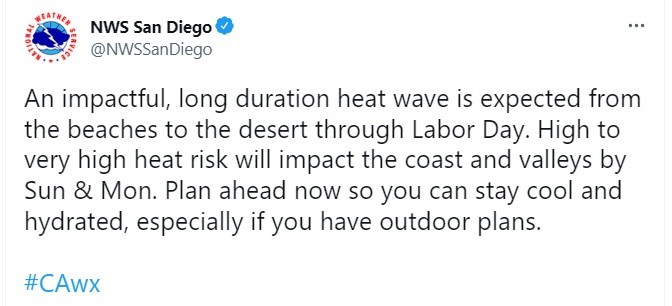
“An impactful, long duration heat wave is expected from the beaches to the desert through Labor Day,” the San Diego office of the NWS wrote on Twitter on Tuesday. “High to very high heat risk will impact the coast and valleys by Sun & Mon. Plan ahead now so you can stay cool and hydrated, especially if you have outdoor plans.”

An excessive heat warning is in effect from 11 a.m. on Wednesday until 8 p.m. Monday across a vast swath of Southern California, including Los Angeles County.

“Dangerously hot” conditions are expected, according to the NWS, with peak temperatures of 95 to 112 degrees expected through Saturday, and 100 to 115 degrees on Sunday and Monday.

I thought this was interesting – they are telling people how much use electricity – even to charge their electric cars:

During a Flex alert, consumers will be urged to reduce energy usage between 4 p.m. and 9 p.m. when the system is most stressed.

“The top three conservation actions are to set thermostats to 78 degrees or higher, avoid using large appliances and charging electric vehicles, and turn off unnecessary lights,” the grid operator said. “Lowering electricity use during that time will ease strain on the system, and prevent more drastic measures, including rotating power outages.”

You might have heard that California wants to ban gas vehicles by 2035. That’s interesting, but what’s more interesting is that they don’t want people charging their electrical vehicles either. And the people in California voted for this.

They’re addicted to virtue signaling. It’s almost as though when they themselves off from the moral law and from forgiveness, it suddenly became a huge problem for them to tell everyone how good they are. Being good used to be between a man and God. Now, people have to signal their virtue in order to keep guilt, shame and meaninglessness at bay.