I have the most amazing video for you to see. It’s a crazy left-wing activist doxing a libertarian lesbian woman wearing a breathe-through mask. First, let’s take a look at the video. Then, we’ll look at a recent survey reported by Pew Research in 2020, which assesses how mentally stable far-left feminist women are (self-reported). Then, I’ll make some comments for unmarried men.
OK, so here is the video, which was shared by the woman who was doxed. So it’s OK for me to share it, since the doxed woman didn’t care about it.
So, is this crazy woman rare? Or is she common?
Progressive white women and mental illness
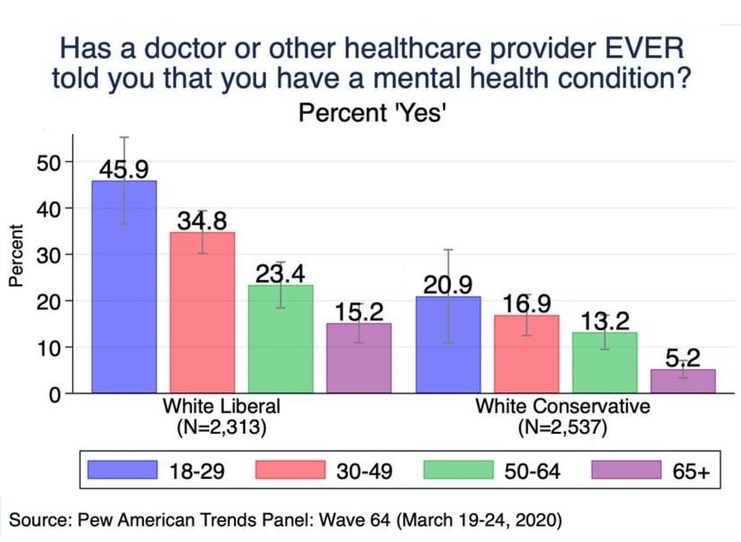
Feminist web site Evie Magazine reported on the some 2020 findings by Pew Research (left-wing pollster):
A 2020 Pew Research study reveals that over half of white, liberal women have been diagnosed with a mental health condition at some point.
[T]he study, which is titled Pew American Trends Panel: Wave 64, was dated March 2020 — over a year ago.
The study, which examined white liberals, moderates, and conservatives, both male and female, found that conservatives were far less likely to be diagnosed with mental health issues than those who identified as either liberal or even “very liberal.”
[…]White women, ages 18-29, who identified as liberal were given a mental health diagnosis from medical professionals at a rate of 56.3%, as compared to 28.4% in moderates and 27.3% in conservatives.
Here’s the part of the data I thought was most interesting:
Who would marry a crazy person?
So, the point about this that I want to make is… who is going to marry these mentally ill progressive white women? Being a good wife and mother takes a certain amount of connection to reality. It takes a certain amount of empathy, compassion, and rationality. These progressive white women don’t have any of that. So, who is going to marry them? I know that there are thirsty progressive men (and thirsty conservative men who fake being progressive), who will go ahead and hit it and quit it. Pump it and dump it. But how many men would commit to someone who’s mentally ill?
And in fact, that’s exactly what we’re seeing with the marriage rates:
That’s for America, but things are even worse in countries that have slid further toward the secular left edge of the political spectrum.
When you look at marriage rates in Canada and Europe, you understand that men are even LESS likely to choose marriage when they have to pay over 50% of what they earn in taxes. And so the marriage rate is declining. I think young, unmarried women in Canada and Europe are want to raise taxes in order to get free stuff from government. Single mother welfare, food stamps, abortions, contraceptives, IVF, breast enlargements, etc. Some feminists are even asking for free cosmetic surgery. With a big enough government, they don’t have to marry at all. Big government leaves them free to play the field, without having to care about finding a good man. But what if taxes get so high that the few good men those women passed over for 40 years simply can’t afford to take on a wife and support multiple children he didn’t father? Paying for things like a stay-at-home wife and homeschooling, etc. is expensive. Men can’t afford a wife, and also pay for goodies for all the single progressive women with mental illnesses.
Conservative men want nothing to do with daycare and public schools – we know that those facilities are dominated by progressive women. And we don’t want trouble from feminist lawyers and feminist judges in the divorce courts. Divorce is very expensive for men. And we may never see our children again. Then there are the progressive white women in the workplace, who get very bitter with men as a result of getting wrecked by bad boys. Even if we find a good wife, we still have to deal with all these progressive white women with mental illnesses in positions of power. Is it worth it to take risks like this? It depends on the reward, I guess. There comes a point where the juice isn’t worth the squeeze.
I found an interesting article where a Christian woman explains how she used to share her testimony with non-Christians. But that wasn’t working. So she decided to try something different.
She writes:
I’ll never forget the first time I shared my personal testimony with a non-Christian.
When the opportunity arose and I shared my story with an unbelieving friend, she replied, “That’s so cool. I’m so happy you found something that works for you.”
For me?
“It’s not about what works forme,” I said, trying to hide my discouragement. “It’s about what’s true for everyone.”
“That doesn’t make sense,” she responded. “That’s your experience, not mine. I had a similar revelation when I realized I could leave the church, and I’ve become a better person for my decision. Just as you were freed from your heaviest burdens by finding God, I was freed from mine by leaving God behind.”
I was devastated but I chalked it up to my friend’s hardheartedness. I decided to shake the dust off my feet and look forward to the next opportunity.
But time after time of sharing my testimony resulted in similar responses. People expressed enthusiasm that I was happy, that Christianity worked for me, and that I had “found my niche.” Yet no one considered my experience as anything more than just that—my own personal experience.
[…]I had been taught that sharing what God had done in my life was the ideal way to witness to non-Christians. A personal testimony was interesting yet non-confrontational, compelling but inoffensive. And yet, despite having shared my testimony with dozens of unbelievers, not a single person felt challenged to consider the truth claims of Christianity.
She noticed that her approach wasn’t actually in the Bible. There was a different approach being demonstrated by Jesus, and later by his disciples.
She writes:
When Jesus called his first disciples, he taught truth and provided evidence (miracles) to support his claims, then he asked people to follow him (Luke 5:1–11). In fact, this was his method whenever he went into new regions (see Luke 4:14–44; John 4:7–26). People decided to follow Jesus not on blind faith or a subjective feeling, but based on the evidence they had seen and heard.[i]
Jesus also used evidence to assuage the doubts of even those who had been with him a long time. John the Baptist was Jesus’ cousin, who leapt in the womb during Mary’s visit (Luke 1:39–45), baptized Jesus in the Jordan River, heard God’s voice from heaven, and saw the Holy Spirit descend on Jesus in bodily form like a dove (Luke 3:21–22). Yet when John experienced unexpected suffering, he began to doubt.
Jesus didn’t respond as many do today, by insisting that John “just believe” or “have faith” or “prayer harder.” Rather, he responded with more evidence, saying, “Go and tell John what you hear and see: the blind receive their sight and the lame walk, lepers are cleansed and the deaf hear, and the dead are raised up, and the poor have good news preached to them. And blessed is the one who is not offended by me.” (Matt. 11:2–6).
[…]At Pentecost, the apostle Peter offered signs and wonders, fulfilled prophecy, and relayed eyewitness testimony to persuade people from all over the Roman Empire that the most reasonable explanation for what they were seeing was not morning drunkenness, but a risen Messiah (Acts 2:1–41).
On his missionary journeys, the apostle Paul reasoned with the Jews from the Scriptures, explaining and proving that Jesus was the Messiah who needed to suffer and rise from the dead (Acts 17:1–3, 17). And he reasoned with the Gentiles from outside the Scriptures, making a case with their own accepted beliefs to convince them (Acts 17:17–34).
In fact, in describing his mission, Paul told the Philippians, “I am put here for the defense of the gospel” (1:7, 16). This word translated defense is the same word from which we get our English word “apologetics,” meaning to make reasoned arguments or to provide evidence as justification. Using this same word, Peter commanded believers to “always [be] prepared to make a defense to anyone who asks you for a reason for the hope that is in you”(1 Pet. 3:15).
So, she decided to dump the testimony approach, and try the Biblical approach. But she had to change it a little bit, since she couldn’t perform miracles herself:
We are not eyewitnesses to Jesus’s life and resurrection, but we have the accounts of those who were. We don’t typically see miracles, but we have millennia of biblical scholarship and archaeology that provide reasons to believe the accounts are trustworthy. We don’t often hear God speaking audibly or see him parting seas, but we have significant scientific evidence that shows the universe had a beginning, and millennia of observation to confirm the scientific principle that everything that begins to exist has a cause.
I think a lot of Christians never move on from approach she described that wasn’t getting results. And there’s a reason for that – studying evidence is hard work. But I can tell you from my experience as a software engineer, there is no better way to convince other people to adopt your view than to show them working code that produces results. If they have a prototype, they will adopt your design. Similarly with Christianity. If you have evidence, then you will be persuasive.
When talking about spiritual things with non-Christians, always remember the joke about the two men walking in the woods who meet a bear. One man starts to put on his running shoes. The other man says “what are you doing? you can’t outrun a bear!” And the first man says “I don’t have to. I only have to outrun you”. It’s the same with apologetics. You don’t have to be William Lane Craig to talk about your faith to non-Christians. You just have to know more than your non-Christian opponent knows about evidence.
The way things are going these days with the public schools and the mainstream news media, this is actually pretty easy to do. One or two introductory books on the origin of the universe, the fine-tuning for intelligent life, the origin of biological information, the origin of body plans, the historical reliability of the New Testament, the minimal facts case for the resurrection, etc. will do the job. You might need another one on philosophical challenges like evil, suffering, divine hiddenness, etc. But we’re talking no more than 5 books, and you’ll be effective in the vast majority of your conversations. If you can only get one book, I like Sean McDowell and Jonathan Morrow’s “Is God Just a Human Invention?” best.
If you’ve been following David French’s writing closely, you’ll know that he no longer supports public policies that are consistent with the Christian worldview. In this post, we’ll take a look at Jesus’ definition of marriage, then we’ll see whether David French thinks that Jesus knows more about the definition of marriage than the Democrat party.
1 Now when Jesus had finished these sayings, he went away from Galilee and entered the region of Judea beyond the Jordan.
2 And large crowds followed him, and he healed them there.
3 And Pharisees came up to him and tested him by asking, “Is it lawful to divorce one’s wife for any cause?”
4 He answered, “Have you not read that he who created them from the beginning made them male and female,
5 and said, ‘Therefore a man shall leave his father and his mother and hold fast to his wife, and the two shall become one flesh’?
6 So they are no longer two but one flesh. What therefore God has joined together, let not man separate.”
7 They said to him, “Why then did Moses command one to give a certificate of divorce and to send her away?”
8 He said to them, “Because of your hardness of heart Moses allowed you to divorce your wives, but from the beginning it was not so.
9 And I say to you: whoever divorces his wife, except for sexual immorality, and marries another, commits adultery.”
10 The disciples said to him, “If such is the case of a man with his wife, it is better not to marry.”
11 But he said to them, “Not everyone can receive this saying, but only those to whom it is given.
To be a Christian, minimally, is to be a follower of Jesus Christ. That means that we accept what Jesus teaches, on whatever he teaches about. We don’t overturn the teachings of Jesus in order to make people who are rebelling against God feel better about their rebellion. It is central to the Christian worldview that Christians care more about what God thinks of them than what non-Christians think of them. In fact, Christians are supposed to be willing to endure suffering rather than side with non-Christians against God’s authority.
Here’s an article from The Federalist by conservative Christian lioness Megan Basham.
She writes:
[P]erhaps no one has done more to further the idea that Christians should not let the God they worship influence their policy views than one-time defender of traditional marriage, David French.
[…]As a political pundit, French has been singularly influential in evangelical establishment circles, referenced regularly not only in Christianity Today’s pages and podcasts but also giving speeches at Southern Baptist seminaries and winning praise from outlets such as The Gospel Coalition as “one of the few Christians who is able to bring gospel-centered arguments into the public square.”
In all three of his essays on RMA in the last week, French reveals that he, too, has evolved on marriage and… discourages Christians from resisting the enshrinement of gay marriage into U.S. law.
French… adds, “Religious belief is not the same thing as declaring civil law … I don’t want the law to discriminate against those Americans who sincerely hold different views of sexual morality, sexuality, and marriage and organize their lives and their institutions accordingly.”
What does David French think about same-sex marriage as public policy?
French reveals that… believes [the Obergefell ruling’s] argument for ushering in an entirely new form of marriage, unknown to previous ages, was well-founded. He writes that as far back as 2004, he believed, “In a diverse, pluralistic republic, granting the same rights to others that we’d like to exercise ourselves should be the default posture of public advocacy and public policy.”
Now that the fundamental transformation of marriage has taken place, French argues it should be permanent: “It would be profoundly disruptive and unjust to rip out the legal superstructure around which they’ve ordered their lives,” he writes.
When it comes to policy, David French thinks that the Democrat party’s definition of marriage is better than Jesus’ definition of marriage.
Previously, I noted how the Alliance Defending Freedom thinks that the “Respect for Marriage Act” will threaten the religious liberty of Christian organizations:
The so-called Respect for Marriage Act is a misnamed bill that expands not only what marriage means, but also who can be sued for disagreeing with the new meaning of marriage.
While proponents of the bill claim that it simply codifies the 2015 Obergefell decision, in reality it is an intentional attack on the religious freedom of millions of Americans with sincerely held beliefs about marriage.
The Respect for Marriage Act threatens religious freedom and the institution of marriage in multiple ways:
It further embeds a false definition of marriage in the American legal fabric.
It opens the door to federal recognition of polygamous relationships.
It jeopardizes the tax-exempt status of nonprofits that exercise their belief that marriage is the union of one man and one woman.
It endangers faith-based social-service organizations by threatening litigation and liability risk if they follow their views on marriage when working with the government.
The truth is the Respect for Marriage Act does nothing to change the status of same-sex marriage or the benefits afforded to same-sex couples following Obergefell. It does much, however, to endanger religious freedom.
David French wants Christians who agree with Jesus about the definition of marriage to be persecuted by the secular left state. That’s why he supports this Democrat party legislation.
Leaving aside how this same argument could have been applied to Dred Scott, it’s interesting that French repeatedly references “LGBT families” in his essays (a phrase that naturally brings up sympathetic associations) without specifically treating the question of how children come to be a part of these sterile couplings or how they fare once they are present. In fact, the only passing allusion he makes to children in these households is positive, as when he says, “Millions of Americans are living stable, joyful lives in LGBT families.”
It has been said many times (but it cannot be said enough apparently) that the law’s compelling interest in acknowledging marriage at all is not to sanction romantic attachment between various individuals. It is to recognize the sexually reproductive union of men and women in order to foster the arrangement that best cultivates individual flourishing, which, in turn, creates a flourishing society.
Right, and that’s why Rose and I talked about that evidence in our podcast. But if you are expecting David French to understand what marriage is, and how to interact with scientific evidence on the effects of non-traditional unions on children, you’re expecting too much. In Christian apologetics, we know how to make a case for what the Bible teaches about God’s existence from scientific evidence, such as the Big Bang cosmology and the cosmic fine-tuning. Mainstream scientific data. We do the same thing when it comes to the abortion question. Serious Christians know how to be persuasive to non-Christians. That’s why we are able to defend the Bible’s teachings without capitulating to peer pressure from the secular left.
Basham concludes:
There is no need to rehearse the litany of evidence that children raised apart from their married, biological mothers and fathers fare worse on all manner of social, educational, and developmental outcomes. But it might be necessary to start speaking forthrightly about the more specific emerging evidence that children conceived via donorship suffer from “profound struggles with their origins and identities” and that those raised in same-sex households are more likely to experience depression, anxiety, and sexual abuse.
French never mentions these children. Nor does Dalrymple. Nor does the Christianity Today essay. Nor has Sen. Blunt. Yet this is the dystopian, domino effect of redefining marriage so that Christians may assure themselves they are pluralists in good standing, on the right side of rapidly devolving modern history.
If you only have 15 minutes, this short video from Katy Faust makes the case:
And she has an excellent article about it in the Daily Signal. It’s too bad that Christians look to David French for leadership. I would rather rely on Megan Basham and Katy Faust. And it’s not David French who will be defending religious liberty at the Supreme Court. It’s Kristen Waggoner of the ADF.




 WINTERY KNIGHT