Previously, I blogged about the historical criteria that historians use to evaluate documents. One of the criteria is “multiple independent sources”. If a story is reported in multiple independent sources, then historians are more likely to evaluate it as historically accurate. But how about the four gospels? Are they independent sources? The answer might not be what you expect.
Here’s how the question was put to Dr. Craig:
The latest video, “Did Jesus Rise From the Dead,” is especially compelling, but I had a question about it. In the part one video, you cite as evidence, the Gospels plus Acts and First Corinthians and you refer to them as “independent” and “unconnected” sources. But this isn’t exactly true, is it? After all, two of these books were written by the same author, Luke, and so Luke and Acts are connected by authorship. Furthermore, isn’t it true that much information relayed in Matthew and Luke were taken from Mark? This two facts would make it untrue to call the Gospels “independent” and “unconnected” would they not?
Here’s the video he’s talking about:
Dr. Craig answers the question in his latest question of the week. I think this answer is important for those who aren’t aware of how the gospels are organized.
He writes:
The objection is based on a simple misunderstanding. It assumes that the sources I’m referring to are the books of the New Testament. But that’s not what I’m talking about.
New Testament critics have identified a number of sources behind the New Testament, sources on which the New Testament authors drew. For example, Matthew and Luke drew not only upon Mark as a source but also upon a source which scholars designate “Q,” which appears to have been a source containing Jesus’ sayings or teachings. Thus, if you could show that a saying in Matthew or Luke appears in both Mark and Q, that would count as multiple, independent attestation.
What does this mean? It means that although there is overlap between Matthew and Luke, called “Q”, there are actually three independent sources there: Matthew’s source, called M. Luke’s source, called L. And the material common to Matthew and Luke, which therefore PRE-DATES Matthew and Luke, called Q.
Dr. Craig lists out several independent sources in his full reply:
the pre-Markan Passion story used by Mark
the rest of the gospel of Mark has a source
Matthew’s source (M)
Luke’s source (L)
John’s gospel which is very different from Mark, Luke and Matthew
the sermons in Acts have a source
the early creed found in Paul’s 1 Corinthians 15
So if you are trying to lay out something from the New Testament, and you can find it in two of these sources, and at least one of them is very early, you’re in pretty good shape.
You can watch more of Dr. Craig’s videos in his playlist, here. These are especially useful for people who want to get the overall scope of the battlefield before deciding where to focus in study. Everybody should know about all of these arguments regardless of where you choose to specialize.
So, on Wednesday, I found a story on Daily Wire that made me really concerned. In the story, famous feminist Meghan Markle said that people should not reject women for marriage just because those women have had many past sexual partners. And she said that women can “make up” for their sexual pasts by excelling in their careers. I thought I should say something about this.
Markle, a far-left previously divorced radical feminist who only has work experience as an actress, says this:
Meghan Markle said she doesn’t understand why women are “vilified” for exploring their sexuality while she said it appeared that men are instead “celebrated” for doing the same.
The former actress talked about what she called the double standard when it comes to men and women “exploring” their “sensuality”… “One of the things that I think as all women, we face, as you’re getting older, you’re exploring and starting to understand your sensuality, your feminine divine,” the Duchess of Sussex shared. “Your sexuality, oftentimes, it can be very much used against you.”
“A man, if he is a player, out having fun or whatever he’s doing, it’s often celebrated, even heralded,” she added. “But for a woman, I don’t care if she is perhaps the most successful woman in finance in her mid-50s, I promise you, someone will still go, ‘But she was such a slut in college.’ It will stick with her.”
“And I don’t understand what it is about the stigma surrounding women and their sexuality, the exploration of their sexuality that is so much more vilified than for a man…,”Markle continued.
So, the reason I have to say something about this is because Markle is a radical feminist, and her views are being accepted by many young, unmarried women. And the church is not opposing this, believing that not judging feminism is a form of “chivalry”. Christian men are terrified of telling women no, even when it’s best for women to be told no. So let’s take a look at the mistakes Markle makes.
A fixation on promiscuous men
First, notice how she is concerned with emulating men who are promiscuous. Thanks to feminism, young women reject traditional male roles such as moral and spiritual leader. Men who talk about truth and morality are seen as inferior to the men who are attractive and promiscuous. Unfortunately, 80% of the women are all chasing after the 5% of men who have a pleasing physical appearance and displayed wealth. And since these men have options, they feel no pressure to commit to any woman. In fact, these men treat women terribly. Which is why women should ignore them, and focus on men who are displaying marriage-ability and marriage-intentions. But Meghan Markle is telling women that these promiscuous men are great, and that women need to emulate them. She just doesn’t want women to be judged for acting like these scummy promiscuous men.
What does the data say?
So why do men quietly avoid women who are promiscuous? The short answer is because promiscuous women are risky to marry.
Many feminists think that men choose women based on emotions, but this is a mistaken way of understanding men. Men do not make decisions based on feelings. Men calculate risks and costs. Men’s top concern with marriage is avoiding financial ruin from the divorce courts. Men read social science studies to understand what kinds of behaviors make a woman initiate divorce. And what those men find in the studies is that a woman’s promiscuity is a major risk factor for her initiating divorce. The more sexual partners a woman has, the higher the risk of marital instability, and the greater the likelihood of financial ruin for the man.
We found that the longer a dating couple waits to have sex, the better their relationship is after marriage. In fact, couples who wait until marriage to have sex report higher relationship satisfaction (20% higher), better communication patterns (12% better), less consideration of divorce (22% lower), and better sexual quality (15% better) than those who started having sex early in their dating. For couples in between—those that became sexually involved later in their dating, but prior to marriage—the benefits were about half as strong.
Consistent with prior research, those with fewer sex partners were less likely to divorce. [W]omen who married as virgins had the lowest divorce rates by far… 6 percent. […]Premarital sex with one partner substantially increases the odds of divorce (21%).
[…]The highest five-year divorce rates of all are associated with… having ten or more premarital sex partners: 33 percent.
Feminists don’t like to think that men are guiding their decisions from these studies. But men are. Feminists look at these studies, and they think “who cares about scientific studies?” and “who cares about the risks to men?” Markle is focused on women being shamed for her promiscuity, but she has no concerns about the financial ruin that men experience in divorce courts. And that’s why she finds men avoiding promiscuous women so objectionable.
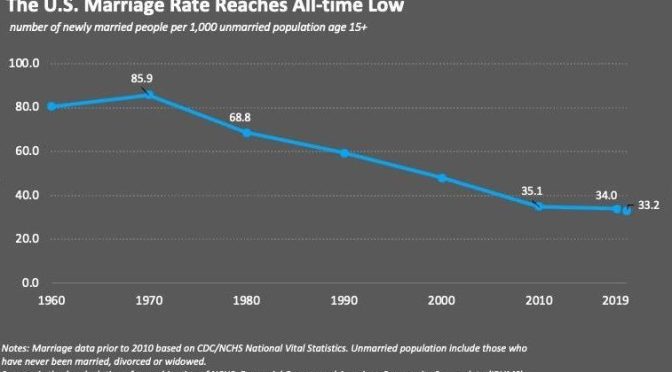
A man would have to be a fool to undertake an enterprise where he has all of the risks, all of the responsibilities, all of the exposure to legal tyranny, but none of the authority to lead the relationship. And that’s why the marriage rate is in a free-fall, because men are declining the offer of unstable marriage, which is being produced by promiscuous feminists. Markle is mad because women are feeling bad about being shamed. But men feel much worse, when they lose their house, car, money, children, and are put in debtor’s prison.
Remember, feminist thought leaders approve of the hook-up culture, believing that it is critical to making sure that women can have fun with the no-commitment bad boys that they are attracted to, but without letting their flings derail their educations and careers. The goal is to prevent pregnancies with abortion, and delay marriage for as long as possible while climbing the corporate ladder. But hook-up culture is terrible for men who desire early marriage and children. These are the exact men who are passed over by women like Markle, who despise male headship. The problem is not that promiscuous women are being shamed. The problem is that promiscuous men are NOT being shamed. Markle needs to start shaming the hot bad boys who are spending all of their future wife’s money on casual sex with no-commitment feminists. We need more shaming of promiscuity, not less. For both sexes.
And of course, these studies work the other way, too. Women should also avoid promiscuous men, in order to avoid marriage instability. So, it is actually even more awful that Meghan Markle doesn’t tell women to avoid these promiscuous men. Her support for promiscuity is exposing women to poor treatment by unstable, manipulative, narcissistic predators. A cynical man might think that Markle was working for socialists, who want women to make themselves unstable for marriage. That way, they would never marry, and just keep working and paying taxes for the bureaucrats to spend on buying votes from the reckless people who need government handouts in order to survive.
No fix is in the pipeline
It’s important to understand that there is no fix for Markle’s embrace of promiscuity in the pipeline. No one is thinking about the risks men face from divorce courts. (See Dr. Stephen J. Baskerville’s “Taken Into Custody: The War Against Fathers, Marriage, and the Family”)
Feminists and their Christian allies agree that women should be encouraged to embrace feminism, and men must simply “man up” and marry them anyway, regardless of the financial risks of divorce. 68% of unmarried women voted for abortion, transgenderism, same-sex marriage, and cracking down on Christians who oppose these things in the 2022 mid-terms. But that is no problem for these feminists and their Christian allies. Just bully the men into marrying these promiscuous Democrat women anyway. Who cares? Men are expendable, like slaves. Whip them harder, and force them to serve.
Marriage is voluntary. If all the focus is on women’s needs not to be “shamed” for promiscuity, and no one cares about what marriage-minded men need, then marriages will not happen. That is how the world works in reality. Right now, a good man would have to be literally insane to marry a promiscuous feminist. Men have to assume that any woman who does not have a record of demonstrated opposition to feminism and promiscuity has taken part in the hook-up culture, and is therefore a high risk of divorce.
The video of the debate was posted by ReasonableFaith.org – Dr. Craig’s organization. This debate occurred in March 2017 at the University of Dublin, in Ireland.
The video: (91 minutes)
My non-snarky summary is below.
Dr. Craig’s opening speech
Two claims:
1. There are good reasons to think that theism is true.
2. There are not comparably good reasons to think that atheism is true.
Five reasons for God’s existence:
1. The beginning of the universe
– actual infinite past is mathematically impossible
– BGV theorem: any universe that is on balance expanding in its history (like ours) cannot be past eternal
2. Fine-tuning of cosmic quantities and constants
– slight changes to quantities and constants prevent a universe from supporting complex embodied life
– the multiverse response of atheists conflicts with observations, e.g. the Boltzmann Brains problem
3. Objective moral values
– God’s existence is required to ground objective moral values and duties
4. Minimal facts case for the resurrection of Jesus
– there are good reasons to accept the most widely accepted facts about the historical Jesus (empty tomb, appearances, early widespread belief in the resurrection)
– the best explanation of these minimal facts is that God raised Jesus from the dead
5. Experience God directly
– in the absence of any defeaters to belief in God, a person can experience God directly
Dr. Daniel Came’s opening speech
1. The hiddenness of God
– if God wants a personal relationship with us, and a relationship with God would be the greatest good for us
– God ought to reveal himself to us, but he does not reveal himself to many people, the “non-resistant non-believers”
2. The inductive problem of evil
– many evil events occur that are pointless – there is no morally sufficient reason why God would allow them to occur
– examples: animal suffering, children born with disease, tsunamis
– the theistic response to this is that humans are not in a position to know whether there are morally sufficient reasons, due to our limitations of knowing the consequences
– but this ripple effect defense has 4 possible outcomes, 3 of which don’t do the job of justifying
Dr. Craig’s first rebuttal
1. The hiddenness of God
– God’s goal is not to make his existence known, but to draw them into a love relationship
– it’s speculative that overt displays of God’s existence would draw people to him in a love relationship, they might resent his bullying
– atheist would have to prove that God could draw more people into a love relationship with him by revealing himself more overtly
2. The inductive problem of evil
– as humans, we are not in a position to know for certain that any apparently pointless evil really is pointless
– William Alston article: 6 limitations of human knowing make it impossible to judge that an evil is actually “pointless”
– Dr. Came says that there are 4 possibilities for the ripple effects, and since 3 are bad, it’s likely that there are not morally sufficient reasons for a apparently pointless evil
– it is logically fallacious to assert probability conclusions without knowing the probabilities of those 4 options
– there is actually an argument from evil: since the problem of evil requires an objective standard of good and evil by which to measure, and God is the only possible ground of objective morality, then pressing the problem of evil actually requires the atheist to assume God, in order to ground this objective moral standard
Dr. Came’s first rebuttal
3. Objective moral values
– there are naturalistic theories of moral realism where objective moral duties and objective moral values exist in a naturalistic universe
– I’m not saying that any of them are correct, but there are many theories about object morality in a naturalistic universe
There are naturalistic theories for all of the 5 arguments that Dr. Craig presented. It is Dr. Craig’s responsibility to present those naturalistic theories and prove that they are not as good as his explanations. I’m not going to defend (or even name!) a single naturalistic theory for any of these 5 arguments by Dr. Craig.
Dr. Craig’s explanations for the 5 evidences he gave can’t be admitted, because we have to know how God did something in naturalistic terms before we can know that God did it supernaturally. Explanations are only valid if they are naturalistic.
1. The beginning of the universe
– naturalism explains how the universe expands after it came into being, so that explains how it came into being
– the God explanation, that God created the universe out of nothing, is not admissible, because it is not naturalistic
– how does God, as an unembodied mind interact with the physical world?
– the only agency that we know about is human agents, and we have bodies, so how could God perform actions without having a body?
The theistic hypothesis does not make any predictions, but naturalism makes lots of testable predictions. God could do anything, so he is not constrained and is therefore untestable. We can’t infer God as an explanation in principle because we can’t predict what is more probable if God exists than if he does not.
2. Fine-tuning of cosmic quantities and constants
– the university was not set up to make embodied intelligence plausible, because the vast majority of the universe is hostile to life
– there are models of the multiverse that escape the Boltzmann Brains problem that Dr. Craig raised
Dr. Craig’s second rebuttal
Some of Dr. Craig’s arguments are deductive (e.g. – the beginning of the universe, objective moral values), so that the conclusion follows from the premises if the premises are true. The resurrection passes the standard tests for historical explanations.
1. The beginning of the universe
– the whole point of the argument is that there is no naturalistic explanation for an ultimate beginning of the universe
2. Fine-tuning of cosmic quantities and constants
– the whole point of the argument is that there is no naturalistic explanation for a design of the universe to support life
– he has to prove that intelligences has to be attached to bodies
– human beings are non-physical minds united to physical bodies
– naturalistic attempts to explain mental operations fail
– the arguments prove that unembodied minds exist
– the vast expanse of the universe is required in order to form the galaxies, stars and heavy elements needed for complex life
– why expect that the entire universe should be small, or that life would be everywhere?
– a non-fine-tuned world is more likely in the multiverse, and in a multiverse, we are more likely to have a Boltzmann brain world than a world with complex, embodied life
– Dr. Came has not advanced any naturalistic explanation for the fine-tuning
3. Objective moral values
– non-theistic ethical theories cannot account for the ontological foundations of objective moral values and duties
– atheistic theories of moral realism simply assume objective moral values out of thin air
– it is especially hard to find any basis for objective moral duties in the absence of God
Dr. Came’s second rebuttal
5. Religious experience
– Dr. Craig should not bring up religious experience in a debate where arguments and evidence are central
– people who have dreams, hallucinations and psychotic delusions could appeal to religious experience
– religious experience is by no means universal, and it is possible to doubt it
3. Objective moral values
– there are lots of atheists who hold to objective moral values
– Dr. Craig has to explain how God grounds objective moral values and duties
– Dr. Craig has to explain why atheist moral realist theories don’t work to ground objective moral values and duties
1. The beginning of the universe
– Dr. Craig claims that something can’t come from nothing, that’s not an argument
– there are numerous models that don’t require an absolute beginning of the universe
– Dr. Craig cites the BGV theorem, but Guth (one of the authors) says that only the inflation has a beginning, not the whole universe
Dr. Craig’s conclusion
1. The beginning of the universe
– on theism, there is an efficient cause, but no material cause, for the origin of the universe
– on atheism, there is neither an efficient cause nor a material cause, for the origin of the universe: that’s worse!
– if he thinks that there are models of the universe that don’t require a beginning, then let him name a viable eternal model of the universe
– he never refuted the mathematical argues against an infinite past
2. Fine-tuning of cosmic quantities and constants
– nothing to refute
3. Objective moral values
– God is a better ground for morality than humans, because he is ultimate, and not contingent and arbitrary
– God is a being who is worthy of worship, and therefore command his creatures with moral duties
4. Minimal facts case for the resurrection of Jesus
– nothing to refute
5. Religious experience
– only justified because there are no defeaters to it
1. The hiddenness of God
– atheist has to show that if God’s existence were more obvious, that it would result in more people being drawn to him
2. The inductive problem of evil
– Dr. Came’s argument was logically fallacious, and makes errors in probability theory
Dr. Came’s conclusion
Sometimes, people can’t prove something, but lack of evidence is a justification for doubting it, e.g. – werewolves.
If none of Craig’s arguments work, then it follows that it is not rational to believe that God exists, and it is rational to believe that God does not exist.
Atheists shouldn’t have a burden of proof for what they know, only theists have a burden of proof for what they know.
My thoughts
One quick point. If life were common everywhere then atheists would infer that God wasn’t involved in it. Period. “Life is everywhere, so it’s common, why do we need a designer?” they’d say. I agree with Dr. Came about denouncing religious experience in a formal debate. I don’t like when Dr. Craig brings this up, but I see why he does it – he’s an evangelist, and that’s a good thing, too. I just worry about how it looks to atheists, although it’s good for sincere seekers. I’m not the one on the stage, though, Dr. Craig is.
I think the point about more overt revealing by God would annoy people and make them turn away. Think of how gay people respond to the suggestion that there is anything wrong with them, with rage, vandalism, threats, coercion, attempts to get you to lose your job and business, and using government as a weapon to fine and imprison you. It’s really obvious to me that more God does not mean more love of God. For those who don’t want God, the hiddenness is respect for their choice to put pleasure above the search for truth. (I mean the gay activists – I have great sympathy for people who struggle with same-sex unwanted attractions because they were impacted by a failed bond with their parent of the same sex as they are).
Whenever I meet people like Dr. Came, I always urge them to keep investigating and pursuing truth, because they will find it if they are sincerely seeking after God. Some atheists do sincerely seek God, but I don’t know any who haven’t found him. I’m not sure if that’s because those atheists who claim to be non-resistant and rational are in fact resistant and non-rational, or what the real reason is. If you believe the Bible, all unbelief is non-rational and resistant (see Romans 1). Regarding the werewolves, we don’t have any good arguments for werewolves, we do have good arguments for God. Dr. Came didn’t refute the arguments that Craig raised, nor did his own arguments for atheism work. And there are many, many more arguments (origin of life, Cambrian explosion, habitability-discoverability, molecular machines) that Craig did not raise, too.




 WINTERY KNIGHT