
MUST-READ: Mexico shuts down government-owned utility and lays off entire union

Mvd1055542

Here’s the story from Investors Business Daily.

Excerpt:

The Mexican president shut down a money-losing state-owned electrical utility, taking a labor union down with it. The union is howling, but the shutdown is one of the best things to happen to Mexico.

For months, the SME union had been trying to intimidate Felipe Calderon into continuing to subsidize the Luz y Fuerza del Centro electrical distributor, even as its $16 billion in revenue didn’t come close to its $32 billion in salaries and pension costs.

And why not? The union had done the same thing to all the other reform-minded Mexican presidents and saw all of them back off.

But it didn’t have a clue about Calderon, a former energy minister who on Sept. 24 warned the union to cut costs or else. The union ignored the warning and tried to intimidate Calderon with political tactics, whipping up fear that he intended to privatize the utility. Calderon had a better idea: shut down the utility.

The stunning decision to disband the company and lay off 44,000 workers effectively ends the SME union.

Yes, he’s a conservative.

Check out the effects:

It took just hours for Mexico’s peso to rise on news that a huge financial burden had been lifted from the government. Luz y Fuerza del Centro was a money pit that cost the government $42 billion a year in subsidies. Analysts said the shutdown would save $25 billion — enough to enable the government to scrap a planned 2% tax hike.

The improved fiscal picture will keep interest rates in place and avert a ratings downgrade. All of this increases Mexican purchasing power, helps the government finance itself and releases money for lending and investment in a new economy.

Read the whole article. He sent in troops.

It’s a proud day for Mexico. Like Canada, Mexico is on the way up. But the United States is on the way down. Canada elected a conservative, and Mexico elected a conservative. Only the United States was blind and ignorant enough to elect a radical socialist.

One other thing: I was having lunch with one of my agnostic co-workers today, who was following this story. He was concerned that Mexico would start up a new company to take the place of the old, inefficient one. But that is not the case. The Mexican government has decided to liquidate the inefficient company and pass its customers to another firm.

Prime Minister Stephen Harper polling in majority territory in Canada

It’s a Parliamentary system, and Prime Minister Stephen Harper’s currently has a minority government.

But check out the latest poll results from Dr. Roy:

w-fed-vote-graph-cbc

(Click to see enlarged image from CBC)

About the Ekos poll, courtesy of the National Post:

The polling firm this morning reported that the Tories have 40.7% support among Canadians, pushing the party past the symbolic 40% mark and into majority government territory if an election was held now (which it won’t be). The Liberals trail with 25.5% support, with the NDP a distant third at 14.3%. Ekos says the Conservatives are “comprehensively ahead.”

The results put the Conservatives up a full percentage point over the polling firm’s results last week, while the Liberals, NDP and Bloc are slightly down. (Interestingly, the Greens are slightly up, with 10.5% support; they were at 9.7% last week.)

“The Liberals are under siege everywhere they turn,” Frank Graves, president of EKOS, said in a statement. “Even new Canadians, under- 25 Canadians, and the university-educated appear to be turning against them. Most stunning of all, the Conservatives now have a lead among women of almost 11 percentage points.”

The telephone survey was conducted between Oct. 7 and Oct. 13, 2009, for CBC. It included 2,729 Canadians and is considered accurate within 1.9 percentage points, 19 times out of 20.

The PDF of the poll is here.

There are a total of 308 seats, and Harper needs 155 to have a majority. The projection from this poll that the Conservatives would get more than 155 seats, and get their majority, if the election were held today. Anything better than 40% usually means a majority.

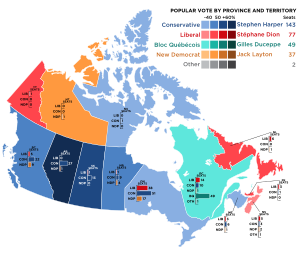
To compare, here are the results from the last federal election, held on October 14, 2008:

  • The Grown-Ups (Conservatives) got 37.7%
  • The Socialists (Liberals) got 26.3%
  • The English Communists (New Democrats) got 18.8%
  • The Green Communists (Greens) got 6.8%
  • The French Communists (Bloc Quebecois) got 10.0%

Here’s a map that show who voted for whom:

706px-Canada_2008_Federal_Election.svg

A “minority” government means that you need the support from another party to get over the 155 barrier so that you can pass a piece of legislation.

Peter Atkins explains how to easily reconcile the Big Bang and atheism

It’s easy! Just watch the video of his debate with William Lane Craig, who responds to Atkins’ explanation.

So, just who is this Peter Atkins, and why is he a good spokesman for atheism?

From his Wikipedia bio.

Peter William Atkins (born August 10, 1940) is an English chemist and a fellow and professor of chemistry at Lincoln College of the University of Oxford. He is a prolific writer of popular chemistry textbooks, including Physical Chemistry, 8th ed. (with Julio de Paula of Haverford College), Inorganic Chemistry, and Molecular Quantum Mechanics, 4th ed. Atkins is also the author of a number of science books for the general public, including Atkins’ Molecules and Galileo’s Finger: The Ten Great Ideas of Science.

[…]Atkins is a well-known atheist and supporter of many of Richard Dawkins’ ideas. He has written and spoken on issues of humanism, atheism, and what he sees as the incompatibility between science and religion. According to Atkins, whereas religion scorns the power of human comprehension, science respects it.

[…]He was the first Senior Member for the Oxford Secular Society and an Honorary Associate of the National Secular Society. He is also a member of the Advisory Board of The Reason Project, a US-based charitable foundation devoted to spreading scientific knowledge and secular values in society. The organisation is led by fellow atheist and author Sam Harris.

Peter Atkins thinks that nothing exists. He thinks he doesn’t exist. He thinks that you don’t exist.

If you watch the debate in full, he also argues that objective morality doesn’t exist, and that moral values and moral obligations are illusory. That’s right: atheists cannot even make rational statements about morality because there is no such thing as an objective moral standard. This is in addition to denying the science of the creation out of nothing.

You can watch the whole debate here, posted by ChristianJR4.

And now you know why atheists like Richard Dawkins run away from debates with Christians like Stephen C. Meyer and William Lane Craig. Because he’s an atheist, and it is very difficult to defend atheism, on the merits. Atheism’s appeal is entirely psychological, not rational.

Consider this quote from an honest, respectable atheist philosopher named Thomas Nagel:

“In speaking of the fear of religion, I don’t mean to refer to the entirely reasonable hostility toward certain established religions and religious institutions, in virtue of their objectionable moral doctrines, social policies, and political influence. Nor am I referring to the association of many religious beliefs with superstition and the acceptance of evident empirical falsehoods. I am talking about something much deeper–namely, the fear of religion itself. I speak from experience, being strongly subject to this fear myself: I want atheism to be true and am made uneasy by the fact that some of the most intelligent and well-informed people I know are religious believers.

I want atheism to be true and am made uneasy by the fact that some of the most intelligent and well-informed people I know are religious believers. It isn’t just that I don’t believe in God and, naturally, hope that I’m right in my belief. It’s that I hope there is no God! I don’t want there to be a God; I don’t want the universe to be like that.”
(”The Last Word” by Thomas Nagel, Oxford University Press: 1997)

People embrace atheism for entirely psychological reasons, not on the basis of arguments and evidence. If they had the arguments and evidence, then they wouldn’t run from debates like Richard Dawkins does.