Michael Murray explains how to talk about religion in the public square

In this post, I want to discuss a research paper by evangelical Christian philosopher Michael J. Murray. The title of the paper is “Who’s Afraid of Religion?”

Murray begins with a distinction, as philosophers love to do:

…we would be perfectly happy to have a discussion of claims like…”Mahayana Buddhism emerged in the first century BCE with the appearance of the Mahayana sutras.” … It is OK to speak of religion… as a historical phenomenon or a socio-cultural influence. It is something altogether different to discuss religious commitments that one owns. That is the sort of religion that troubles us.

People who aren’t religious feel discomfort about hearing about the religious beliefs of others, because those beliefs influence public policy, but (they think) those beliefs are based non-rational factors, such as place of birth, parental beliefs, peer groups, emotions, prejudices, superstitions, etc. They are uncomfortable living in a government that was voted in by people whose views are based on irrational religious beliefs.

Murray has some illustrations of this “theo-phobia” here:

…think about the last time you heard a devoutly religious person argue, on explicitly religious grounds, that gay marriage should be banned, or that intelligent design should be taught in the public school biology curriculum, or that abortion is murder and thus should be outlawed.

He thinks that arguing for views on pureliy religious grounds makes people uncomfortable.

And I agree with that. I feel uncomfortable when people argue for positions from faith-based premises, especially if I don’t believe in their religion. But do discussions of religious beliefs necessarily have to be about faith-based personal preferences? Or is there another way to discuss religion that doesn’t make non-religious people squirm with discomfort?

In the remainder of the paper, Murray explores five reasons why theo-phobia exists in academic settings:

  1. Religion supports oppression, violence, and tyranny and is thus best ignored, excluded or perhaps even actively opposed.
  2. Religion is a personal or subjective matter and as a result can’t be subjected to canonical standards of rational scrutiny. It thus has no place in the academy.
  3. Religion can’t have a role in scholarly inquiry since it at best plays a balkanizing role in the scholarly world.
  4. If religion is allowed to have a role in the academy it will quickly intrude into domains where it does not belong.
  5. Reason #5 is kept secret until the end of the paper.

Regarding point 1, Murray argues that religious excesses can be controlled by falsifying the religion using reason and evidence, because religions make testable claims. So, if academics are afraid of the excesses of a dangerous religion, they should falsify it by arguing that its claims are false. There is no reason to be afraid of expressions of religious belief when you are free to argue against the testable truth claims of that religion.

I repeat: different religions make different claims about the external world. Either the universe had a beginning (Christianity) or it didn’t (Mormonism). Either Jesus died on the cross (Christianity) or he didn’t (Islam). If academics are worried about the effects of some religion, they can argue against it! If a religious person is not willing to defend the testable truth claims, then they are discredited anyway by refusing to engage.

For the remaining 4 points, especially the last one, I recommend you read the whole article. Give it to your friends, religious and non-religious, who believe that faith is fundamentally different from other academic disciplines. Some truth claims of different religions can be tested. And Christians especially should help others to feel comfortable talking to them by sticking to testable truth claims and publicly accessible evidence.

I’ll give you a hint about reason #5, from atheist philosopher Thomas Nagel of New York University. Nagel is quoted as follows:

“In speaking of the fear of religion, I don’t mean to refer to the entirely reasonable hostility toward certain established religions and religious institutions, in virtue of their objectionable moral doctrines, social policies, and political influence. Nor am I referring to the association of many religious beliefs with superstition and the acceptance of evident empirical falsehoods. I am talking about something much deeper–namely, the fear of religion itself. I speak from experience, being strongly subject to this fear myself: I want atheism to be true and am made uneasy by the fact that some of the most intelligent and well-informed people I know are religious believers.
(“The Last Word” by Thomas Nagel, Oxford University Press: 1997)

So we learn from Murray that religions stand or fall based on logical consistency and empirical validation against the external world, just like any other academic discipline. So long as you stick to discussing the public, testable claims of religions, there is no reason to be uncomfortable about discussing religions. Don’t discuss the parts of a religion that can’t be tested, only discuss the parts that can be tested.

(Note: Nagel isn’t all bad, he defends intelligent design as science in a research paper summarized here).

If you would like to see how you can discuss religion in a public forum, check out this debate between a Christian philosopher, William Lane Craig, and an atheist Christopher Hitchens:

It can be done. Theists just have to learn to stick to discussing things that can be tested and proved using public knowledge.

Positive arguments for Christian theism

Could Obama have done better? He could learn from Canada’s success

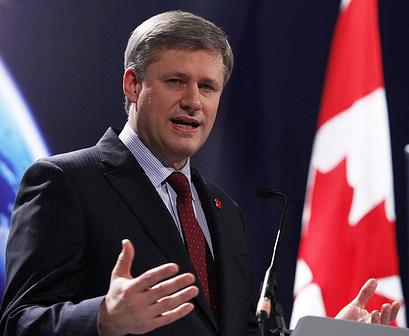
Prime Minister Stephen Harper

Here’s an editorial from Investors Business Daily.

Excerpt:

Away from the low growth and high regulation of an America under Washington’s thumb, our northern neighbor is economically strong. As 2011 ends, Canada has announced yet another tax cut — and will soar even more.

The Obama administration and its economic czars have flailed about for years, baffled about how to get the U.S. economy growing.

In reality, the president need look no further than our neighbor, Canada, whose solid growth is the product of tax cuts, fiscal discipline, free trade, and energy development. That’s made Canada a roaring puma nation, while its supposedly more powerful southern neighbor stands on the outside looking in.

On Thursday, Canadian Prime Minister Stephen Harper announced that he will slash corporate taxes again on Jan. 1 in the final stage of his Economic Action Plan, dropping the federal business tax burden to just 15%.

Along with fresh tax cuts in provinces such as Alberta, total taxes for businesses in Canada will drop to 25%, one of the lowest in the G7, and below the Organization of Economic Cooperation and Development average.

“Creating jobs and growth is our top priority,” said Minister Jim Flaherty. “Through our government low-tax plan … we are continuing to send the message that Canada is open for business and the best place to invest.”

It’s not just that Canada’s conservative government favors makers over takers. Harper’s also wildly popular for shrinking government. “The Harper government has pursued a strategic objective to disembed the federal state from the lives of citizens,” wrote University of Calgary Professor Barry Cooper, in the Calgary Herald.

Harper also has made signing free trade treaties his priority. Canada now has 11 free trade pacts in force, and 14 under active negotiation — including pacts with the European Union and India, among others.

“We believe in free trade in Canada, we’re a free-trading nation. That’s the source of our strength, our quality of life, our economic strength,” Flaherty said last month.

Lastly, Canada has pursued its competitive advantage — oil. And it did so not through top-down “industrial policy,” but by getting government out of the way.

Harper has enacted market-friendly regulations to accomplish big things like the Keystone Pipeline — and urged President Obama to move forward on it or else Canada would sell its oil to China.

These policies have been well-known since the Reagan era. But in a country that’s been institutionally socialist since the 1950s, Harper’s moves represent a dramatic affirmation for free market economics.

For Canada, they’ve had big benefits.

Canada’s incomes are rising, its unemployment is two percentage points below the U.S. rate, its currency is strengthening and it boasts Triple-A or equivalent sovereign ratings across the board from the five top international ratings agencies, lowering its cost of credit.

Is it too much to ask Washington to start paying attention to the Canadian success story?

These sound principles work every time they are tried, and they have led to a transformation in Canada.

Although this article doesn’t mention it, Stephen Harper is also the most solid statesman on foreign policy issues as well.

And here’s a view from up north from Canadian journalist Brian Lilley.

Excerpt:

Prime Minister Stephen Harper has put out his own list of accomplishments for the year that just ended but here are a few of the key conservative minded actions that spring to mind for me.

  • Ending political welfare. The per-vote subsidy that made political parties lazy and unresponsive to the voters of this country and insulated them from angering their core supporters will be gone by 2015-2016. Legislation ending the subsidy has already passed but the parties are slowly being weaned off the money and will get smaller amounts each year until the subsidy is gone.
  • They saw the light of common sense and released the names of those on their wanted list of suspected foreign war criminals. These were people that officials admitted should not be in the country, had been ordered out but that were still in Canada. At first officials would only admit there was a list of suspected war criminals but not say who they were. After much pressure, common sense won the day.
  • Ending the insane rules that would see farmers from certain provinces jailed for daring to sell their wheat to the customer of their choice. The Canadian Wheat Board still exists for those that want to use its centralized system. For those that want freedom, they now have that choice.
  • While much attention has been paid to Bill C-10, the omnibus crime bill, the government has passed C-2 (the mega-trials bill), this bill will make it easier to conduct the mega-trials now associated with organized crime without infringing on the right to a fair trial.
  • While the bill to end the gun registry has not been passed yet, it has been introduced and will pass early this year.
  • Immigration. On this file the Conservatives continue to push for ever higher numbers of newcomers while keeping those skeptical of high immigration onside by cracking down on fraud, cleaning up the system and putting Canada first.

Another thought for those, often myself included, that like to say this government is not conservative enough.

Lilley also notes that electing Harper presented a national day care program (which punishes families with stay-at-home), increasing unemployment benefits (which encourages people not to work), etc.


Rick Santorum surges past 20% support level in latest Iowa poll

From Real Clear Politics:

Mitt Romney leads the Republican field in the Des Moines Register’s final pre-Iowa caucuses poll released Saturday night.

The Register’s highly anticipated survey, which was accurate in predicting both the Democratic and Republican caucus winners in 2008, shows Romney holding the support of 24 percent of respondents. Ron Paul is in second place at 22 percent, while Rick Santorum has ascended into third with 15 percent.

However, Santorum appears to have all of the late momentum on his side, having surged significantly in the final two days of the four-day polling period. If considered separately, he is at 21 percent in that period, while Romney remained atop the pack at 24 percent during the second half of the poll’s sample.

A whopping 41 percent of likely Republican caucus-goers said they are open to changing their minds.

[…]Perhaps the last significant wild card before Tuesday is the potential endorsement of Iowa Rep. Steve King, who told RealClearPolitics in an interview just hours before the Register’s poll was released that there was about a 50/50 chance he would get behind a candidate at the last minute.

“With big decisions, at some point your intellect is overcome by your instincts — at least mine is,” King said. “If I make a bold decision in the next few days, it will be one of conviction, and I will be eager to advocate for that position and defend it against all critics, if I happen to have any, and I’m sure I will.”

The endorsement of King, perhaps Iowa’s most influential conservative voice, has for months been heavily sought by the Republican candidates.

Until recently, the five-term congressman has hinted that he was unlikely to back anyone publicly, but he suggested to RCP on Saturday that he may change his mind given the recent polling gains by Ron Paul, whose foreign policy King said is “so alarming to me.”

Just before the Register poll was released, King gave his sense of where the Iowa horse race stands.

“If I had to pick them, I’d say this: Romney, Santorum, Paul, in that order — then I think likely Gingrich,” he said. “I do think Romney’s strong enough to win here in Iowa, and I do think Paul’s support is drifting away from him — people are coming to grips with what that would really mean. And the third component of this is the ascendancy of Rick Santorum. Is his ascendancy a sharp enough incline to catch up with Ron Paul and Mitt Romney?”

King said that the final poll conducted by Iowa’s largest newspaper “would be a factor” in his decision, since he wanted to get behind someone who had discernible momentum.

In 2008, King endorsed Fred Thompson, whose campaign quickly fizzled after he finished third in the Hawkeye State.

I was for Fred Thompson in 2008. If I were Steve King, I would be endorsing Rick Santorum now. So, I am predicting an endorsement of Rick Santorum by Steve King today, and a second-place finish for Rick Santorum on Tuesday in the Iowa caucuses. Santorum is the most conservative of the top 3 candidates. Gingrich is also a conservative, but he is not in the top 3 in Iowa.