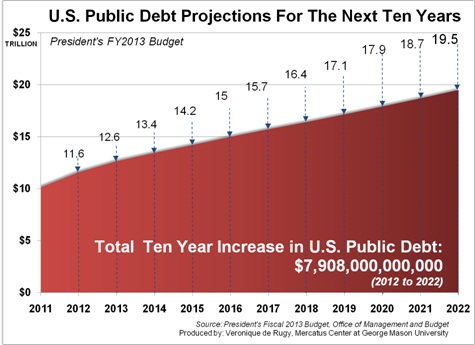
Obama’s new budget adds $8 trillion to the debt over the next 10 years

Obama 2013 Budget Debt Projection

What does the liberal Associated Press think?

Excerpt:

Taking a pass on reining in government growth, President Obama unveiled a record $3.8 trillion election-year budget plan Monday, calling for stimulus-style spending on roads and schools and tax hikes on the wealthy to help pay the costs. The ideas landed with a thud on Capitol Hill.

Though the Pentagon and a number of Cabinet agencies would get squeezed, Obama would leave the spiraling growth of health care programs for the elderly and the poor largely unchecked. The plan claims $4 trillion in deficit savings over the coming decade, but most of it would be through tax increases Republicans oppose, lower war costs already in motion and budget cuts enacted last year in a debt pact with GOP lawmakers.

[…]By the administration’s reckoning, the deficit would drop to $901 billion next year – still requiring the government to borrow 24 cents of every dollar it spends – and would settle in the $600 billion-plus range by 2015.The deficit for the current budget year, which ends Sept. 30, would hit $1.3 trillion, a near record and the fourth straight year of trillion-plus red ink.

Obama’s budget blueprint reprises a long roster of prior proposals: raising taxes on couples making more than $250,000 a year; eliminating numerous tax breaks for oil and gas companies and approving a series of smaller tax and fee proposals. Similar proposals failed even when the Democrats controlled Congress.

The Pentagon would cut purchases of Navy ships and F-35 Joint Strike Fighters – and trim 100,000 troops from its rolls over coming years – while NASA would scrap two missions to Mars.

But there are spending increases, too: The Obama plan seeks $476 billion for transportation projects including roads, bridges and a much-criticized high-speed rail initiative.

The Heritage Foundation has more.

Excerpt:

Spending in the President’s budget rises inexorably from today’s $3.8 trillion to $5.8 trillion in 2022. Throughout the decade, outlays hold stubbornly above 22 percent of gross domestic product (GDP), more than twice the New Deal’s share of the economy in its peak years. In constant dollars, outlays are more than three times the peak of World War II.

In 2012, his budget results deliver a fourth consecutive annual deficit exceeding $1 trillion and then make it worse with another round of not-so-shovel-ready construction projects and government “investments” totaling $178 billion. Among these are the typical road, bridge, and school construction, but then they go alarmingly beyond the usual “infrastructure” arguments to fund teachers’ pay.

Obama’s future deficit reduction comes mainly from Budget Control Act cuts already in place, $848 billion in discredited phantom “savings” from the wind-down of operations in Iraq and Afghanistan, taking credit for reductions in 2011 appropriations, and roughly $1.8 trillion in unnecessary tax increases on those earning above $250,000 and the oil and gas industry.

Yet even with the hefty tax increases and illusory savings, the President’s deficits over the next decade never fall below $575 billion (in 2018) and climb back to $704 billion (in 2022)—but again only assuming the tax increases and mystical savings cited above.

Debt held by the public in the President’s budget rises from 74.2 percent of GDP today to an economically hazardous 76.5 percent of GDP in 2022. These are historically high debt levels: the post–World War II average is just 43 percent. Moreover, the President’s debt estimates are low because of the unreal nature of much of his proposed deficit reduction.

Regarding the most critical fiscal challenge of the day—the need to restructure Medicare, Medicaid, and Social Security—the President has once again taken a pass. By the middle of this century, these three programs and Obamacare will consume about 18 percent of GDP, soaking up all the historical average of federal tax revenue. The notion of “protecting” them through benign neglect only ensures their collapse, and the longer Congress and the President wait to address the problem, the more wrenching will be the consequences. But the President merely reruns previous ideas, such as more cuts to medical providers, ignoring the need for fundamental reform.

For other entitlements, the President repeats a range of mere chipping-around-the-edges proposals from last year’s budget, many of which are really tax or fee increases, not spending reductions.

In short, the President’s budget is the same worn-out collection of higher spending and higher taxes he has offered three times before—with the same inevitable result of more spending, higher taxes, and still more government debt.

Here’s a Republican reaction from Senator Bob Corker:

The libertarian Reason magazine has more budget charts.

For Valentine’s Day, a story of lifelong love and marriage

I found this story from ABC News on Dr Laura.com.

Excerpt:

A devoted Iowa couple married for 72 years died holding hands in the hospital last week, exactly one hour apart.

The passing reflected the nature of their marriage, where, “As a rule, everything was done together,” said the couple’s daughter Donna Sheets, 71.

Gordon Yeager, 94, and his wife Norma, 90, left their small town of State Center, Iowa, on Wednesday to go into town, but never made it. A car accident sent the couple to the emergency room and intensive care unit with broken bones and other injuries. But, even in the hospital, their concerns were each other.

“She was saying her chest hurt and what’s wrong with Dad? Even laying there like that, she was worried about Dad,” said the couple’s son, Dennis Yeager, 52. “And his back was hurting and he was asking about Mom.”

When it became clear that their conditions were not improving, the couple was moved into a room together in beds side-by-side where they could hold hands.

“They joined hands; his right hand, her left hand,” Sheets said.

Gordon Yeager died at 3:38 p.m. He was no longer breathing, but the family was surprised by what his monitor showed.

“Someone in there said, ‘Why, then, when we look at the monitor is the heart still beating?'” Sheets recalled. “The nurse said Dad was picking up Mom’s heartbeat through Mom’s hand.”

“And we thought, ‘Oh my gosh, Mom’s heart is beating through him,'” Dennis Yeager said.

Norma Yeager died exactly an hour later.

“Dad used to say that a woman is always worth waiting for,” Dennis Yeager said. “Dad waited an hour for her and held the door for her.”

The inseparable couple was engaged and married within 12 hours in 1939 on the day Norma Yeager graduated from high school.

“She graduated from high school on May 26, 1939, at about 10 a.m., and at about 10 p.m. that night she was married to my dad at his sister’s house,” Sheets said.

The vibrant duo had a “very, very full life.”

They worked as a team. They traveled together, they were in a bridge club together and they worked in a Chevrolet dealership, creamery and other businesses together.

“They always did everything together,” Sheets said. “They weren’t apart. They just weren’t.”

I think that this kind of lasting love is a mystery to many people who come from broken homes. It’s good for us to reflect on a couple who got it right on Valentine’s Day.

Were you taught that black and white moths are evidence of evolution?

Here’s a post by Jonathan Wells at Evolution News, which re-caps the history of the peppered moths experiment.

Excerpt: (links removed)

The peppered moth story is familiar — even overly familiar — to most readers of ENV, so I will summarize it only briefly here. Before the industrial revolution, most peppered moths in England were light-colored; but after tree trunks around cities were darkened by pollution, a dark-colored (“melanic”) variety became much more common (a phenomenon known as “industrial melanism”). In the 1950s, British physician Bernard Kettlewell performed some experiments that seemed to show that the proportion of melanic moths had increased because they were better camouflaged on darkened tree trunks and thus less likely to be eaten by predatory birds.

Kettlewell’s evidence soon became the classic textbook demonstration of natural selection in action — commonly illustrated with photos of peppered moths resting on light- and dark-colored tree trunks.

By the 1990s, however, biologists had discovered several discrepancies in the classic story– not the least of which was that peppered moths in the wild do not usually rest on tree trunks. Most of the textbook photos had been staged.

In the 2000s the story began disappearing from the textbooks. British biologist Michael Majerus then did some studies that he felt supported the camouflage-predation explanation. But before he died of cancer in 2009, he only managed to publish a report of his study in the Darwin lobby’s in-house magazine Evolution: Education and Outreach. Now four other British biologists have presented his results posthumously in the Royal Society’s peer-reviewed Biology Letters. In an accompanying supplement, the authors presented their version of what they call “the peppered moth debacle.” And a debacle it certainly is, but not in the way they think.

According to Charles Darwin, natural selection has been “the most important” factor in the descent with modification of all living things from one or a few common ancestors, yet he had no actual evidence for it. All he could offer in The Origin of Species were “one or two imaginary illustrations.” It wasn’t until almost a century later that Kettlewell seemed to provide “Darwin’s missing evidence” by marking and releasing light- and dark-colored moths in polluted and unpolluted woodlands and recovering some of them the next day. Consistent with the camouflage-predation explanation, the proportion of better-camouflaged moths increased between their release and recapture.

Throughout the 1970s and 1980s, however, researchers reported various problems with the camouflage-predation explanation, and in 1998 University of Massachusetts biologist Theodore Sargent and two colleagues published an article in volume 30 of Evolutionary Biology concluding “there is little persuasive evidence, in the form of rigorous and replicated observations and experiments, to support this explanation at the present time.” (p. 318)

The same year, Michael Majerus published a book in which he concluded that evidence gathered in the forty years since Kettlewell’s work showed that “the basic peppered moth story is wrong, inaccurate, or incomplete, with respect to most of the story’s component parts.” (p. 116) In a review of Majerus’s book published in Nature, University of Chicago evolutionary biologist Jerry Coyne wrote: “From time to time, evolutionists re-examine a classic experimental study and find, to their horror, that it is flawed or downright wrong.” According to Coyne, the fact that peppered moths in the wild rarely rest on tree trunks “alone invalidates Kettlewell’s release-and-recapture experiments, as moths were released by placing them directly onto tree trunks.”

In 1999, I published an article in The Scientist summarizing these and other criticisms of the peppered moth story, and in 2000 I included a chapter on peppered moths in my book Icons of Evolution. Then, in 2002, journalist Judith Hooper published a book about the controversy titled Of Moths and Men. Hooper accused Kettlewell of fraud, though I never did; my criticism was directed primarily at textbook writers who ignored problems with the story and continued to use staged photos even after they were known to misrepresent natural conditions.

Jonathan has actually written about a number of  misleading things that you may mind in Biology textbooks.

Here are the sections in his book “Icons of Evolution“:

  • The Miller-Urey Experiment
  • Darwin’s Tree of Life
  • Homology in Vertebrate Limbs
  • Haeckel’s Embroys
  • Archaeopteryx–The Missing Link
  • Peppered Moths
  • Darwin’s Finches
  • Four-Winged Fruit Flies
  • Fossil Horses and Directed Evolution
  • From Ape to Human: The Ultimate Icon

There’s also a documentary based on the book on Youtube.

Dr. Wells holds a Ph.D in Molecular and Cell Biology from the University of California at Berkeley.