The kalam cosmological argument defended in a peer-reviewed science journal

Here’s the peer-reviewed article. It appears in a scientific journal focused on astrophysics.

Here’s the abstract:

Both cosmology and philosophy trace their roots to the wonder felt by the ancient Greeks as they contemplated the universe. The ultimate question remains why the universe exists rather than nothing. This question led Leibniz to postulate the existence of a metaphysically necessary being, which he identified as God. Leibniz’s critics, however, disputed this identification, claiming that the space-time universe itself may be the metaphysically necessary being. The discovery during this century that the universe began to exist, however, calls into question the universe’s status as metaphysically necessary, since any necessary being must be eternal in its existence. Although various cosmogonic models claiming to avert the beginning of the universe predicted by the standard model have been and continue to be offered, no model involving an eternal universe has proved as plausible as the standard model. Unless we are to assert that the universe simply sprang into being uncaused out of nothing, we are thus led to Leibniz’s conclusion. Several objections to inferring a supernatural cause of the origin of the universe are considered and found to be unsound.

The whole text of the article is posted online here.

Here’s an excerpt in which the author, Dr. William Lane Craig, explains the Big Bang cosmology:

The monumental significance of the Friedman-Lemaitre model lay in its historization of the universe. As one commentator has remarked, up to this time the idea of the expansion of the universe “was absolutely beyond comprehension. Throughout all of human history the universe was regarded as fixed and immutable and the idea that it might actually be changing was inconceivable.”{8} But if the Friedman-Lemaitre model were correct, the universe could no longer be adequately treated as a static entity existing, in effect, timelessly. Rather the universe has a history, and time will not be matter of indifference for our investigation of the cosmos. In 1929 Edwin Hubble’s measurements of the red-shift in the optical spectra of light from distant galaxies,{9} which was taken to indicate a universal recessional motion of the light sources in the line of sight, provided a dramatic verification of the Friedman-Lemaitre model. Incredibly, what Hubble had discovered was the isotropic expansion of the universe predicted by Friedman and Lemaitre. It marked a veritable turning point in the history of science. “Of all the great predictions that science has ever made over the centuries,” exclaims John Wheeler, “was there ever one greater than this, to predict, and predict correctly, and predict against all expectation a phenomenon so fantastic as the expansion of the universe?”{10}

As a GTR-based theory, the Friedman-Lemaitre model does not describe the expansion of the material content of the universe into a pre-existing, empty, Newtonian space, but rather the expansion of space itself. This has the astonishing implication that as one reverses the expansion and extrapolates back in time, space-time curvature becomes progressively greater until one finally arrives at a singular state at which space-time curvature becomes infinite. This state therefore constitutes an edge or boundary to space-time itself. P. C. W. Davies comments,

An initial cosmological singularity . . . forms a past temporal extremity to the universe. We cannot continue physical reasoning, or even the concept of spacetime, through such an extremity. . . . On this view the big bang represents the creation event; the creation not only of all the matter and energy in the universe, but also of spacetime itself.{11}

The popular expression “Big Bang,” originally a derisive term coined by Fred Hoyle to characterize the beginning of the universe predicted by the Friedman-Lemaitre model, is thus potentially misleading, since the expansion cannot be visualized from the outside (there being no “outside,” just as there is no “before” with respect to the Big Bang).{12}

The standard Big Bang model thus describes a universe which is not eternal in the past, but which came into being a finite time ago. Moreover,–and this deserves underscoring–the origin it posits is an absolute origin ex nihilo. For not only all matter and energy, but space and time themselves come into being at the initial cosmological singularity. As Barrow and Tipler emphasize, “At this singularity, space and time came into existence; literally nothing existed before the singularity, so, if the Universe originated at such a singularity, we would truly have a creation ex nihilo.“{13}

[…]On such a model the universe originates ex nihilo in the sense that at the initial singularity it is true that There is no earlier space-time point or it is false that Something existed prior to the singularity.

Every theist should be able to understand and defend this argument. It is a scientific refutation of materialism, and it is supported by six lines of scientific evidence – all of which emerged as science has progressed.

Scientific evidence:

  1. Einstein’s theory of general relativity (GTR)
  2. the red-shifting of light from distant galaxies implies an expanding universe
  3. the cosmic background radiation (which also disproves the oscillating model of the universe)
  4. the second law of thermodynamics applied to star formation theory
  5. hydrogen-helium abundance predictions
  6. radioactive element abundance predictions

Those are the scientific discoveries that have led us to the beginning of the universe, which support’s Dr. Craig’s argument.

Here’s a re-cap of the three main evidences for the Big Bang cosmology from Caltech. (Numbers 2, 3 and 5 from the list above)

Excerpt:

Until the early 1900s, most people had assumed that the universe was fixed in size. New possibilities opened up in 1915, when Einstein formulated his famous general relativity theory that describes the nature of space, time, and gravity. This theory allows for expansion or contraction of the fabric of space. In 1917, astronomer Willem de Sitter applied this theory to the entire universe and boldly went on to show that the universe could be expanding. Aleksandr Friedmann, a mathematician, reached the same conclusion in a more general way in 1922, as did Georges Lemaître, a cosmologist and a Jesuit, in 1927. This step was revolutionary since the accepted view at the time was that the universe was static in size. Tracing back this expanding universe, Lemaître imagined all matter initially contained in a tiny universe and then exploding. These thoughts introduced amazing new possibilities for the universe, but were independent of observation at that time.

Why Do We Think the Big Bang Happened?

Three main observational results over the past century led astronomers to become certain that the universe began with the big bang. First, they found out that the universe is expanding—meaning that the separations between galaxies are becoming larger and larger. This led them to deduce that everything used to be extremely close together before some kind of explosion. Second, the big bang perfectly explains the abundance of helium and other nuclei like deuterium (an isotope of hydrogen) in the universe. A hot, dense, and expanding environment at the beginning could produce these nuclei in the abundance we observe today. Third, astronomers could actually observe the cosmic background radiation—the afterglow of the explosion—from every direction in the universe. This last evidence so conclusively confirmed the theory of the universe’s beginning that Stephen Hawking said, “It is the discovery of the century, if not of all time.”

The article goes into detail about each of these three evidences.

This is the kind of evidence I expect all Christian theists to be using when discussing the question of whether God exists. Scientific evidence. When talking to non-Christians, we first need to show that we understand science, because science is a reliable and respected way of getting knowledge about the universe. Non-Christians do not accept the Bible, but they do accept science, so we begin evangelism with science. Science (experimental, testable, repeatable science) should set limits on what anyone can believe – including non-Christians, who might otherwise not be inclined to listen to Bible verses and theology.

The Big Bang is not compatible with atheism

According to the Secular Humanist Manifesto, atheism is committed to an eternally existing universe, (See the first item: “Religious humanists regard the universe as self-existing and not created.”). If something non-material brought all existing matter into being, that would be a supernatural cause, and atheists deny that anything supernatural exists. The standard Big Bang theory requires that all the matter in the universe come into being out of nothing. This falsifies eternal models of the universe, which are required by the atheistic worldview.

You should definitely print out both articles and get familiar with the arguments and the evidence. I have tried this argument out on atheists, and the response I usually get is that scientific discoveries will soon emerge that falsifies all of these six scientific discoveries. That sounds more like faith than reason to me. And we have to make it clear to others who are still deciding that there is a conflict between science and religion. Just not the one they’re expecting. Let’s make our decisions about what to believe based on what science is telling us today. Let’s hold accountable people who want to have a worldview that is based on speculations.
Scientists troubled by lack of simple explanation for our life-permitting moon

This entire article from Evolution News is a must-read. It talks about a recent paper by a naturalist named Robin Canup which appeared in Nature, the most prestigious peer-reviewed science journal.

So, there’s too much to quote here. I’ll grab a few snippets to give you the gist of it, then you click through and read the whole thing. 

The moon is important for the existence of a life permitting planet:

Canup knows our moon is important for life:

The Moon is more than just a familiar sight in our skies. It dictates conditions on Earth. The Moon is large enough to stabilize our planet’s rotation, holding Earth’s polar axis steady to within a few degrees. Without it, the current Earth’s tilt would vary chaotically by tens of degrees. Such large variationsmight not preclude life, but would lead to a vastly different climate.

The moon requires an improbable sequence of events:

Canup states that “No current impact model stands out as more compelling than the rest.” All are equally improbable, in other words. Indeed, they are:

It remains troubling that all of the current impact models invoke a process after the impact to effectively erase a primary outcome of the event — either by changing the disk’s composition through mixing for the canonical impact, or by changing Earth’s spin rate for the high-angular-momentum narratives.

Sequences of events do occur in nature, and yet we strive to avoid such complexity in our models. We seek the simplest possible solution, as a matter of scientific aesthetics and because simple solutions are often more probable. As the number of steps increases, the likelihood of a particular sequence decreases. Current impact models are more complex and seem less probable than the original giant-impact concept.

This is a good challenge to naturalism, but it lends support to one part of the habitability argument.

Previously, I blogged about a few of the minimum requirements that a planet must satisfy in order to support complex life.

Here they are:

  • a solar system with a single massive Sun than can serve as a long-lived, stable source of energy
  • a terrestrial planet (non-gaseous)
  • the planet must be the right distance from the sun in order to preserve liquid water at the surface – if it’s too close, the water is burnt off in a runaway greenhouse effect, if it’s too far, the water is permanently frozen in a runaway glaciation
  • the solar system must be placed at the right place in the galaxy – not too near dangerous radiation, but close enough to other stars to be able to absorb heavy elements after neighboring stars die
  • a moon of sufficient mass to stabilize the tilt of the planet’s rotation
  • plate tectonics
  • an oxygen-rich atmosphere
  • a sweeper planet to deflect comets, etc.
  • planetary neighbors must have non-eccentric orbits

This is a good argument, so if you want to learn more about it, get the “The Privileged Planet” DVD, or the book of the same name.

Israel boosts navy with two guided missile destroyers from Germany

Big story from the Jerusalem Post.

Excerpt:

Germany has agreed to sell Israel two destroyers in exchange for one billion euros, AFP reported on Saturday, citing a report in German daily Bild.

According to the report, the torpedo-laden destroyers are intended to provide protection for Israel’s natural gas installations.

I suspect that the primary role of these vessels will be to intercept surface-to-surface missiles and air-to-surface missiles. Israel’s submarine force does not have this capability – they are primarily built for missile strike capability. Now why do you think that Israel is choosing to equip naval vessels with these capabilities? It’s to convey a clear message to her enemies: “even if you are able to strike our mainland and destroy our land-based missile defense system (Iron Dome) we will still have a naval-based air defense capability”.

This is a great deterrent against Israel’s enemies. It’s a second layer of defense to Israel’s Iron Dome system, which is tested and ready to shoot down incoming missiles. In addition to this missile-defense capability, these DDGs also offer surface-to-surface strike capability, but I can’t say what that would be without knowing what model they got. My suspicion is that they are older FFG Bremen class, which are being decommissioned and replaced by newer models. But they could also be FFG Brandenburg class, which are newer, but also scheduled for upgrades already. I wouldn’t call either of those “destroyers” though – they displace only about 3,600 tonnes each.

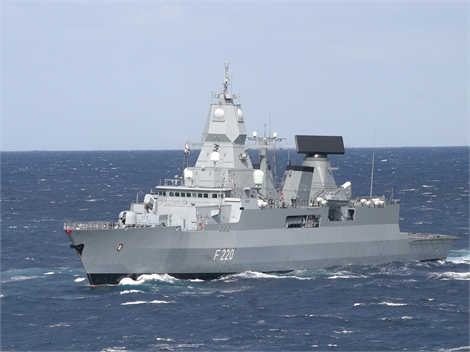
So could they be these 5,800 tonne vessels?

FFG Saschen class guided missile frigate
F124 Saschen class guided missile frigate (FFG)

Germany doesn’t have any real destroyers, although their new FFG Saschen class are as big as destroyers. If Israel somehow managed to get Saschen class FFGs, then I would really be thrilled and impressed. Those things are awesome and they excel at the air defense role. I noticed that the “file photos” being used in news releases were of FFG Saschen class vessels. But I just can’t believe that, it would be so awesome. That would explain why they are being called “destroyers” in the press stories. One can hope! If anyone knows, please tell me.

UPDATE: I did get some feedback through a friend of a friend who is an expert in missile defense, and here is his response:

Good for Israel. The article is mainly correct. I would say it is wrong on three points. One, Iron Dome will not assist in defending against TBMs or longer range missiles…Israel has other systems for that. Two, the DDGs are not meant to provide BMD if Iron Dome is destroyed. Sea based BMD can allow layered defense against ballistic missiles. Ballistic missiles require multiple interceptors to give a high probability of kill. Three, that being said, none of the Frigates mentioned possess a BMD cape. The Netherlands is working on a BMD cape for a ship they use that is similar to the Saschen class. The Dutch however, have a seafaring history and a navy that is more advanced than the Deutsch.

BMD means Ballistic Missile Defense, and TBM means Tactical Ballistic Missile.

And another SSK Dolphin submarine, too

And more good news from YNet News.

Excerpt:

Earlier this year, a significant deal between Germany and the Israeli security establishment was completed, as the Germans handed a fifth Dolphin-class submarine to Israel. The handover was marked in an official ceremony in Germany’s city of Kiel.

The vessel is considered one of the most advanced submarines in the world and is the most expensive war vessel the Defense Ministry has procured for the IDF. The diesel-powered submarines are widely regarded as an Israeli vanguard against foes like Iran. In total, Israel has purchased six Dolphin submarines from Germany.

There are two kinds of submarines that are used today: attack submarines, which are armed with torpedoes and anti-ship missiles, and ballistic missile submarines, which are armed with heavier missiles that can travel further. Although the SSK Dolphin class is an attack submarine on paper, my suspicion is that Israel will refit them to have long-range missile strike capability, including nuclear guided missiles. And in fact after doing a search, I found an article that confirmed my hopes.

Take a look at this article from NTI, a global security think tank based in Washington.

Excerpt:

As previous conflicts involving Israel began with naval blockades, Israel views its submarine force as critical to national security. Israel’s submarines are also intended to exercise sea control over the Eastern Mediterranean and secure sea lines of communication; Israel is dependent on imports of grain, crude oil, and raw materials. [4] There has been consistent speculation that Israel’s submarines could be refitted to carry missiles armed with nuclear weapons in order for the country to maintain a survivable second-strike option. Acknowledging Israel’s lack of strategic depth, officials have asserted that only submarines can provide a secure weapons platform in the future. [5]

The arming of Israel’s submarines has received a great deal of attention. While HDW has stated that Israel’s Dolphin-class submarines were equipped with weapon systems similar to those installed on other diesel-electric submarines, various sources have alleged that upon their arrival in Israel, the submarines were modified, and fitted with cruise missiles armed with nuclear warheads. [6] The three initial Dolphin-class submarines were designed in accordance with Israeli demands, and include a “wet and dry” compartment for special operations, as well as four 650mm torpedo tubes, which could be used for Swimmer Delivery Vehicles (SDVs). [7] The German Defense Ministry has stated that these larger tubes were intended to fire Harpoons; upon delivery to Israel, liners were to be fitted to decrease the diameter of the tubes to accommodate the 533mm Harpoon containers. However, the Dolphin-class is equipped with six 533mm torpedo tubes as well, which are capable of launching Harpoons. [8] It seems possible, therefore, that the 650mm tubes might have been designed to accommodate indigenously built, long-range SLCMs.The German government has stated that it does not have information on whether Israel installed different equipment on the submarines after delivery, although former German officials have acknowledged that they assumed that Israel intended to equip the submarines with nuclear weapons. [9]

Some reports suggest that Israel has adapted Harpoon cruise missiles, which have a range of 130 kilometers, to carry an indigenously developed nuclear warhead and guidance system, though other experts argue that such modifications to a Harpoon missile are not feasible. [10] Others believe that Israel has developed an indigenous cruise missile with a range of 320 kilometers that could be a version of Rafael Armament Development Authority’s Popeye turbo cruise missile. [11] Still others believe that the missile may be a version of the Gabriel 4LR produced by Israel Aircraft Industries, which could be launched in 533mm torpedo tubes similar to the Harpoon. [12] Such speculation was further fueled by an unconfirmed test of a nuclear-capable, submarine-launched cruise missile (SLCM) in the Indian Ocean in 2000. Some reports claimed targets 1,500 kilometers away were hit. [13] Such a range, however, implies an entirely new type of missile. [14] In June 2002, former State Department and Pentagon officials confirmed that the U.S. Navy observed Israeli missile tests in the Indian Ocean in 2000, and that the Dolphin-class vessels have been fitted with nuclear-capable cruise missiles of a new design. [15] However, the Israeli Defense Forces have consistently denied any such missile tests. [16]

[…]The new boats will be equipped with 650mm torpedo tubes—again leading to much speculation that the Israelis intend to outfit the submarines with nuclear-armed cruise missiles.

These submarines are designed to protect Israel’s supply lines in the Mediterranean Sea, and also to give them retaliation capabilities in the event of a large-scale missile strike. Iran and her allies will have a tough time detecting these submarines and destroying them – the subs have an extremely quiet propulsion system and can operate submerged for up to a week. These six submarines are a deterrent against any nation that would try to attack Israel, because they know that there is no hope for them to destroy all of their strike capability in the initial strike against Israel’s land-based assets. Israel could also depend on ground-based missile launchers,some of which might be mobile, and their airborne strike platform.

This is an application of the principal of peace through strength – the stronger a nation’s military, the less likely they are to be attacked, and the more capable they are of protecting their allies. The article above notes that the Clinton administration (Democrats) refused to sell Israel Tomahawk cruise missiles, which have a very long range. That’s too bad. If I were in charge, I would sell those to Israel in a split-second.

It really is a terrible thing for the United States to be disarming thanks to Democrat policies, because all this does is encourage our enemies to strike us, and encourage our allies to abandon our alliances and ally with stronger nations. I hope that we are able to elect a Republican soon who will restore our lost military strength.