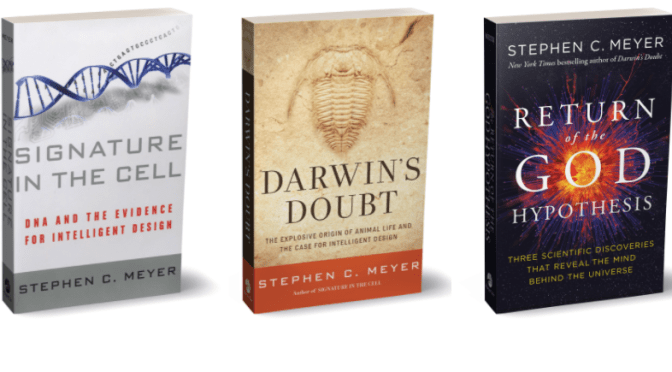
Over 1 million views for intelligent design: Stephen C. Meyer and Piers Morgan

The video below was uploaded about 2 weeks ago, but it already has well over 1 million views. In this video, you will get coverage of 5 arguments for a Creator / Designer: origin of the universe, origin of life, cosmic fine-tuning, sudden origin of new body plans in the fossil record, stellar and planetary habitability and they also mentioned consciousness.

Here is the video:

And the description:

In a lively yet in-depth discussion, Piers Morgan drills down to the core of human existence with Stephen C. Meyer, the prominent ‘intelligent design’ advocate.

In this Piers Morgan Uncensored special, Meyers firmly rejects the idea that a scientific worldview leads to atheism, arguing instead that ‘the universe requires a creator or cause’. When Richard Dawkin’s name is mentioned, Meyer claims that he actually really loves the atheist firebrand and admires his intensity. Lastly, Morgan and Meyers agree that the question of God’s existence is tied to more than just cold hard facts, but also human nature itself.

00.00 – Who is Dr Meyer?
02.23 – Is Darwin Wrong?
06.03 – Scientific evidence for God
15.58 – The Multiverse
19.29 – What is the meaning of life?
22.52 – Atheists’ anger
25.48 – Why is there suffering?

Dr. Stephen C. Meyer directs Discovery Institute’s Center for Science and Culture. He is my favorite Christian scholar. Why? Because he keeps writing books about what the latest scientific evidence tells us about reality. I understand that many theists and atheists want to keep evidence at a distance, and just decide for themselves what they will accept as true, based on their feelings and communities. But for those who like to have true beliefs, then Stephen Meyer is for you. He is basically the Thomas Sowell of the origins debate.

By the way, if you watch this video and you enjoy it, then please share. A lot of people need to start thinking about these issues based on what science has revealed. People who have not thought about these issues need to start grounding our beliefs on reality. And we have to help them.

Are atheists unbiased about the question of God’s existence?

Brian Auten has a book review posted up at Apologetics 315.

The book is “If There’s A God, Why Are There Atheists?”, by theologian R.C. Sproul. R.C. Sproul is one of my favorite theologians. The book in question has a very, very special place in my heart, because I think that it is one of the major reasons why I was able to resist pernicious ideas like religious pluralism and postmodernism for so long. Once you put on the glasses of Romans 1 and see for the first time what man is really doing with respect to God, you can never see things the same again. I’ll say more about this at the end, but let’s see what Brian wrote first.

The review

So often, you hear atheists complaining about religion is nothing but wish-fulfillment or some sort of crutch for people who are frightened by a variety of things. They think that God is invented to solve several problems. 1) how does the world work?, 2) is there meaning to suffering and evil?, 3) why should I be moral?, and 4) what will happen to me and my loved ones when I die?. On the atheistic view, God is just a crutch that people cling to out of weakness and ignorance. But is this really the case?

Sproul starts the book by investigating three atheists who sought to explain religious belief as a result of psychological factors.

Brian writes:

Before tackling the psychology of atheism, Sproul spends a chapter on the psychology of theism, from the perspective of Freud’s question “If there is no God, why is there religion?”11 What follows is an overview of various psychological explanations of theistic belief: Feuerbach’s “religion is a dream of the human mind.”12 Marx’s belief that religion is “due to the devious imagination of particular segment of mankind.”13 And Nietzche’s idea that “religion endures because weak men need it.”14 The author properly reiterates: “We must be careful to note that the above arguments can never be used as proof for the nonexistence of God. They can be useful for atheists who hear theists state that the only possible explanation for religion is the existence of God.”15 That being said, Sproul also reveals what these arguments presume:

Their arguments already presupposed the nonexistence of God. They were not dealing with the question, Is there a God? They were dealing with the question, Since there is no God, why is there religion?16

Sproul points out the weaknesses of each of these approaches and says “there are just as many arguments showing that unbelief has its roots in the psychological needs of man.”

Wow, could that really be true? What are the real reasons why people reject God? Does the Bible have anything to say about what those reasons are?

Brian cites Sproul’s contention:

The New Testament maintains that unbelief is generated not so much by intellectual causes as by moral and psychological ones. The problem is not that there is insufficient evidence to convince rational beings that there is a God, but that rational beings have a natural hostility to the being of God.

[…]Man’s desire is not that the omnipotent, personal Judeo-Christian God exist, but that He not exist.

In Romans 1:18-23, the apostle Paul explains what is really going on:

18The wrath of God is being revealed from heaven against all the godlessness and wickedness of men who suppress the truth by their wickedness,

19since what may be known about God is plain to them, because God has made it plain to them.

20For since the creation of the world God’s invisible qualities—his eternal power and divine nature—have been clearly seen, being understood from what has been made, so that men are without excuse.

21For although they knew God, they neither glorified him as God nor gave thanks to him, but their thinking became futile and their foolish hearts were darkened.

22Although they claimed to be wise, they became fools

23and exchanged the glory of the immortal God for images made to look like mortal man and birds and animals and reptiles.

Do you believe that? I believe that. I have never in my life met an atheist who varied from what Paul is saying here.

On this blog, I have presented many, many arguments for theism in general, and Christian theism in particular:

Sproul explains why atheists cannot allow themselves to live according to the evidence that is presented to them:

The cumulative effect of this knowledge that is clearly seen is to leave men ‘without excuse.’ Herein lies the basis of the universal guilt of man. No one can claim ignorance of the knowledge of God. No one can cite insufficient evidence for not believing in God. Though people are not persuaded by the evidence, this does not indicate an insufficiency in the evidence, but rather an insufficiency in man.

[…]The basic stages of man’s reaction to God can be formulated by means of the categories of trauma, repression, and substitution.

[…]If God exists, man cannot be a law unto himself. If God exists, man’s will-to-power is destined to run head-on into the will of God.

So, it’s pretty clear that there are huge implications to the question of God’s existence, and that the atheist will be affected by these implications when weighing evidence.

Here’s something Thomas Nagel, an excellent atheist philosopher, said:

“In speaking of the fear of religion, I don’t mean to refer to the entirely reasonable hostility toward certain established religions and religious institutions, in virtue of their objectionable moral doctrines, social policies, and political influence. Nor am I referring to the association of many religious beliefs with superstition and the acceptance of evident empirical falsehoods. I am talking about something much deeper–namely, the fear of religion itself. I speak from experience, being strongly subject to this fear myself: I want atheism to be true and am made uneasy by the fact that some of the most intelligent and well-informed people I know are religious believers.

I want atheism to be true and am made uneasy by the fact that some of the most intelligent and well-informed people I know are religious believers. It isn’t just that I don’t believe in God and, naturally, hope that I’m right in my belief. It’s that I hope there is no God! I don’t want there to be a God; I don’t want the universe to be like that.”

(”The Last Word” by Thomas Nagel, Oxford University Press: 1997)”

The rest of the book review, and the book, deals with explaining in detail how atheists respond to an all-good, all-powerful, all-knowing Creator/Designer. I encourage you to click through and read the whole book review. You can read the review, and the book, and then investigate for yourself whether the atheists are effected by this bias against moral accountability.

Nabeel Qureshi: the Quran inspires radical Muslims to commit Islamic terrorism

Dr. Nabeel Qureshi, a former Muslim, explains which verses of the Qu’ran are linked to Islamic terrorism in a USA Today editorial.

Excerpt:

As a Muslim growing up in the United States, I was taught by my imams and the community around me that Islam is a religion of peace. My family modeled love for others and love for country, and not just by their words. My father served in the U.S. Navy throughout my childhood, starting as a seaman and retiring as a lieutenant commander. I believed wholeheartedly a slogan often repeated at my mosque after 9/11: “The terrorists who hijacked the planes also hijacked Islam.”

Yet as I began to investigate the Quran and the traditions of Muhammad’s life for myself in college, I found to my genuine surprise that the pages of Islamic history are filled with violence. How could I reconcile this with what I had always been taught about Islam?

[…]The Quran itself reveals a trajectory of jihad reflected in the almost 23 years of Muhammad’s prophetic career. As I demonstrate carefully in my book, Answering Jihad: A Better Way Forward, starting with peaceful teachings and proclamations of monotheism, Muhammad’s message featured violence with increasing intensity, culminating in surah 9, chronologically the last major chapter of the Quran, and its most expansively violent teaching. Throughout history, Muslim theologians have understood and taught this progression, that the message of the Quran culminates in its ninth chapter.

Surah 9 is a command to disavow all treaties with polytheists and to subjugate Jews and Christians (9.29) so that Islam may “prevail over all religions” (9.33). It is fair to wonder whether any non-Muslims in the world are immune from being attacked, subdued or assimilated under this command. Muslims must fight, according to this final chapter of the Quran, and if they do not, then their faith is called into question and they are counted among the hypocrites (9.44-45). If they do fight, they are promised one of two rewards, either spoils of war or heaven through martyrdom. Allah has made a bargain with the mujahid who obeys: Kill or be killed in battle, and paradise awaits (9.111).

Muslim thought leaders agree that the Quran promotes such violence. Maajid Nawaz, co-founder of the Quilliam Foundation in the United Kingdom, has said, “We Muslims must admit there are challenging Koranic passages that require reinterpretation today. … Only by rejecting vacuous literalism are we able to condemn, in principle, ISIS-style slavery, beheading, lashing, amputation & other medieval practices forever (all of which are in the Quran). … Reformers either win, and get religion-neutral politics, or lose, and get ISIL-style theocracy.” In other words, Muslims must depart from the literal reading of the Quran in order to create a jihad-free Islamic world.

This is not at all to say that most Muslims are violent. The vast majority of Muslims do not live their lives based on chapter 9 of the Quran or on the books of jihad in the hadith. My point is not to question the faith of such Muslims nor to imply that radical Muslims are the true Muslims. Rather, I simply want to make clear that while ISIL may lure youth through a variety of methods, it radicalizes them primarily by urging them to follow the literal teachings of the Quran and the hadith, interpreted consistently and in light of the violent trajectory of early Islam. As long as the Islamic world focuses on its foundational texts, we will continue to see violent jihadi movements.

So, any attempt to engage with Muslims will require us to address the texts that they appeal to when they justify their actions. Both Republicans and Democrats try to gloss over the specific passages of the Qu’ran which are troublesome. They claim that Islam, interpreted literally, is a religion of Peace. And they claim that distorting the words of the Qu’ran results in a Jihadi ideology. That’s not accurate. It’s not distortion of the Qu-ran that is causing the problems, it’s taking those passages literally.

There are troubling passages in the Bible, as well, where God is in a theocratic relationship with the Jewish people and commands them to attack their enemies. But the difference is that those verses are not effective in the present day, for present day Christians. Christians are under a new Covenant with a new High Priest, Jesus. This new covenant tells Christians to love our enemies and to pray for those who persecute us. Are moderate Muslim scholars and Western politicians ready to face the real challenge?