
Darwinist Karl Giberson uses photo-shopped image of baby with tail in evolution debate

Evolution News reports.

Excerpt:

OK, if there was any doubt that Karl Giberson’s tailed-baby photo is a Photoshop creation, that doubt is now dispelled. I emailed the creator of the image, photographer Larry Dunstan, to make sure I hadn’t misunderstood. Yes, confirmed the helpful and candid Mr. Dunstan, it was created with Photoshop using a photo of a tail-free two-week-old baby. The tail is not genuine. It was generated by a computer, not by, as Giberson thought, a “gene for tails.”

The reader who found the source image on the Internet for me, over at Science Photo Library, works in graphic design and 3D modeling. Says reader Ryan, what made him leery was “the lack of shadow from the tail,” and the “framing and composition,” which don’t match what you’d expect from “a photo intended to document a mutation.”

Right. Casey and I had that same gut reaction, but it’s good to have our response confirmed by professionals — again.

[…]Why do I keep harping on this? Only because human origins is an ultimate question and using human “tails” as evidence for common descent is a mainstay of Darwin defenders.

Theistic evolutionist Dr. Giberson is noted for having criticized and broken with other Evangelical Christians over issues having to do with, according to his characterization, intellectual and scientific integrity. See his book The Anointed: Evangelical Truth in a Secular Age.

Is Giberson right to be up on a high horse that way? I’m not a Christian so I don’t have his personal stake in the question. But Giberson, after complaining that my querying his use of this photo was “ad hominem” — which it obviously isn’t — characterizes me (and Casey Luskin) in a way that clearly is ad hominem.

Lest you think I am tricking you about this being used as evidence for evolution, here is Giberson in the Daily Beast reflecting on his debate performance.

Excerpt:

I showed pictures of otherwise healthy humans who had been born with webbed feet and tails. I asked the challenging question: “Why does the human genome contain instructions for the production of features we don’t use?” The scientific explanation is that we inherited these instructions from our tailed ancestors but the instructions for producing them have been shut off in our genomes, which is why Shallow Hal is the only person most people know who has a tail. Sometimes the “ignore these genes” message gets lost in fetal development, however, and babies are born with perfectly formed, even functional tails.

Is he right about any of this?

Evolution News explains that he is not:

For now, here’s a crucial fact: even such so-called “tails” aren’t anything like those found in tailed mammals. That is for the simple reason that “true tails” in humans entirely lack vertebrae — or any kind of bone, cartilage, notochord, or spinal cord. As the aforementioned paper in the Journal of Neurosurgery explains:

In all reported cases, the vestigial human tail lacks bone, cartilage, notochord, and spinal cord. It is unique in this feature.2

Other prominent medical research journals agree:

  • A 2013 paper in the Journal of Child Neurology states: “True tails are boneless, midline protrusion usually attached to the skin of the sacrococcygeal region and capable of spontaneous or reflex motion. They consist of normal skin, connective tissue, muscle, vessels, and nerves and are covered by skin. Bone, cartilage, notochord, and spinal cord are lacking.”3
  • A paper from the Journal of Pediatric Surgery states: “The human vestigial tail lacks bone, cartilage, notochord, and spinal cord. It contains a central core of mature fatty tissue divided into small lobules by thin fibrous septa. Small blood vessels and nerve fibers are scattered throughout. Bundles of striated muscle fibers, sometimes degenerated, tend to aggregate in the center.”4
  • An article in the British Journal of Neurosurgery explains: “A true tail in humans is vestigial and never contains vertebrae in contrast to other vertebrate animals.”5
  • Most striking of all, perhaps, are the words of a famous paper on tails in The New England Journal of Medicine: “When the caudal appendage is critically examined, however, it is evident that there are major morphologic differences between the caudal appendage and the tails of other vertebrates. First of all, the caudal appendage does not contain even rudimentary vertebral structures. There are no well-documented cases of caudal appendages containing caudal vertebrae or an increased number of vertebrae in the medical literature, and there is no zoological precedent for a vertebral tail without caudal vertebrae.”6
  • Finally, an article in Human Pathology explains: “In humans a true tail, is vestigial, however, and never contains vertebrae. … Bona-fide cases of human tails containing bone have not been documented.”7

These observations certainly don’t make it sound like humans can have “perfectly formed, even functional tails.” In fact, it’s difficult to argue that any tail could be called “bona fide” if it isn’t “bone-fied.”

Where did Giberson find the image? In the humor magazine “Cracked”. That’s… chutzpah. I wonder if he used Dilbert comics as evidence in his PhD thesis?

Standard Operating Procedure

I think it’s a bad idea to use images from humor magazines as evidence for your point of view, but I think it’s par for the course with Darwinists, who are still using things like Haeckel’s embryos in science textbooks as evidence of evolution.

Who says? One of the top peer-reviewed science journals “Science“:

Using modern techniques, a British researcher has photographed embryos like those pictured in the famous, century-old drawings by Ernst Haeckel–proving that Haeckel’s images were falsified. Haeckel once admitted to his peers that he doctored the drawings, but that confession was forgotten.

Still used in textbooks, though. It’s “fake, but accurate”.
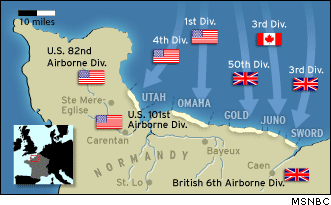
Ronald Reagan’s 40th anniversary D-Day speech: the boys of Pointe du Hoc

June 6, 1944 D-Day Normandy Invasion Map

It’s June 6th, today, and it’s the anniversary of D-Day: the Allied invasion of northern France – the beginning of the end of World War 2. One of the most pivotal events of that day was the assault on German gun emplacements by members of the Army Rangers at a fortified position called “Pointe du Hoc”.

President Ronald Reagan recognized the soldiers who attacked Pointe du Hoc back in 1984:

You can read the full transcript of that speech here.

Ronald Reagan also made the case for gratitude and vigilance:

Here’s the hymn that starts to play at the end:

The Boys of Pointe du Hoc

Here’s a summary of the Pointe du Hoc mission:

[Lt. Col. James Earl] Rudder took part in the D-Day landings as Commanding Officer of the United States Army’s 2nd Ranger Battalion. His U.S. Army Rangers stormed the beach at Pointe du Hoc and, under constant enemy fire, scaled 100-foot (30 meter) cliffs to reach and destroy German gun batteries. The battalion’s casualty rate for this perilous mission was greater than 50 percent. Rudder himself was wounded twice during the course of the fighting. In spite of this, they dug in and fought off German counter-attacks for two days until relieved. He and his men helped to successfully establish a beachhead for the Allied forces.

You can watch a three-clip documentary on it, too: part 1, part 2, part 3.

Although initially, the Rangers did not find the guns where they had expected them, they did find them further back behind the cliffs and destroyed them there, removing a threat to the forces that would be landing later.

What does D-Day mean to Christians in particular?

A Christian friend asked me what she should be thinking about when I sent her one of the videos above, and so I wrote her this to explain why I sent her the video:

To make you close your eyes and think in a more practical way about what it means for someone to sacrifice their lives to save you, of course. What it means to look up cliffs at machine guns, barbed wire and mortars raining death on you and to take a rope in your hands and to climb up a sheer cliff, under heavy fire, in order to save generations yet unborn and freedom itself.

To think about a concrete example helps us to be able to appreciate what Christ did for us in giving his life for us so that we could be free of sin, as well.

This is the insight that drives my entire interest in war and military history, in fact.

What does this mean: “Greater love has no man than this, that a man lay down his life for his friends.”

The more you know about D-Day, the more fearful what Jesus did appears, and the more you can be grateful.

Bullets and shrapnel are scary… and so are nails and lashes. Why on Earth would anyone endure either for me? And what should my response be to it?

I think it is helpful to explain Christianity to those who are not yet Christian, and for Christians to fully appreciate what Christianity is all about.

We were in peril. And now we have been saved. But at a cost.

I think that it’s important for Christians to look to history, art, poetry and music to help them to reflect and comprehend the sacrifice that Christ made for us in dying on the cross to protect us from peril. What must the cross have looked like to Jesus? It must have been something like what the Omaha beach looked like to the Americans landing in Normandy. Jesus saw whips, thorns and nails, and the heroes of Normandy saw 88 mm AT guns, 81 mm mortars and MG42 machine guns. How should you feel about people who face death on your behalf? Think about it.

What do fathers contribute to the development of their children?

Dina tweeted this article from the New York Post.

Excerpt:

Fathers, it turns out, contribute far more to their children than many of us realize.

Those contributions begin during pregnancy, before fathers and their children have even met. Studies show that the death rate of infants whose fathers were not around during pregnancy is nearly four times that of those with engaged dads. And depression in fathers during their partners’ pregnancies — which is more common than most people realize — can increase the child’s lifelong risk of depression.

After birth, children whose fathers play with them, read to them, take them on outings, and care for them have fewer behavioral problems during their early school years. And they have a lower risk of delinquency or criminal behavior as adolescents.

Some of fathers’ contributions are surprising. One might guess, for example, that mothers have more influence than fathers on their children’s language development. Despite the growing number of women in the workforce, mothers still spend more time with children in many families than fathers do.

But that turns out not to be the case. Lynne Vernon-Feagans of the University of North Carolina, who studies language development, has found that when it comes to vocabulary, fathers matter more than mothers.

In middle-class families, she found that parents’ overall level of education — and the quality of child care — were both related to children’s language development. But fathers made unique contributions to children’s language development that went beyond the contributions of education and child care.

When fathers used more words with their children during play, children had more advanced language skills a year later. And that is likely also linked with later success in school.

And when Vernon-Feagans looked at poor families, she found much the same thing. She visited families when a child was 6 months old, 15 months old and 3 years old. She found that fathers’ education and their use of vocabulary when reading picture books to their children at 6 months of age were significantly related to the children’s expressiveness at 15 months and use of advanced language at age 3.

This held true no matter what the mother’s educational level was or how she spoke to the children.

“I do think our children see it as very special when they do book reading with their fathers,” Vernon-Feagans says. “They may listen more and acquire language in a special way.”

Several studies suggest that fathers also have a powerful influence on their daughters’ sexual behavior during adolescence.

This became clear in 2011 when Frayser High School in Memphis, Tenn., attracted national attention for its high pregnancy rate: About one in five of its female students was either pregnant or had recently given birth.

One local official blamed the high pregnancy rate on television shows such as MTV’s “16 and Pregnant” and “Teen Mom.” The official worried that these shows were encouraging Frayser’s female students to have unprotected sex earlier and more often.

That explanation seemed to make sense. But when psychologist Sarah E. Hill of Texas Christian University examined the situation, she noticed another striking fact: One in four households was headed by a single mother. Studies have revealed “a robust association between father absence — both physical and psychological — and accelerated reproductive development and sexual risk-taking in daughters,” she wrote.

The fathers’ absence in so many families was likely more important than what their daughters watched on television.

These are just a few of the many, many studies in recent years that have demonstrated a powerful link between fathers and their children.

It’s a good summary of the research. We all know that research clearly shows that single motherhood is bad for children, generally. The harm is different depending on whether the child is a boy or a girl, but both sexes are harmed by father absence. So then why do we think that same-sex marriage will be good for children? Either the child will be lacking their biological mother or father. In the case of two lesbians, the child they raise will be facing all the problems described in the research on children raised without their fathers. Why is it a good thing to screw over children just so that adults can be more free to be selfish and destructive?