Is there evidence of systemic racism in the United States?

Systemic racism is the idea that people can’t lift themselves out of poverty by making good decisions, because powerful groups in society that hold the poor down, regardless of their decisions. Do you think that America is a place where no matter what choices you make, you’ll never be able to be more prosperous? That’s what the leaders of Black Lives Matter think.

Here’s what Nikole Hannah-Jones, creator of the 1619 Project, says in the New York Times (a former newspaper):

To summarize, none of the actions we are told black people must take if they want to “lift themselves” out of poverty and gain financial stability — not marrying, not getting educated, not saving more, not owning a home — can mitigate 400 years of racialized plundering.

Got that? It doesn’t matter what individual choices a non-white person takes in America, they’re going to be poor. The “systemic racism” of the powerful whites will always keep them down. Single motherhood doesn’t make people poor, and marriage doesn’t make people wealthier. Dropping out of high school doesn’t make you poor, and getting a Masters degree in computer science won’t make you wealthier.

But let’s take a look at the data from the 2019 Census, and see the evidence:
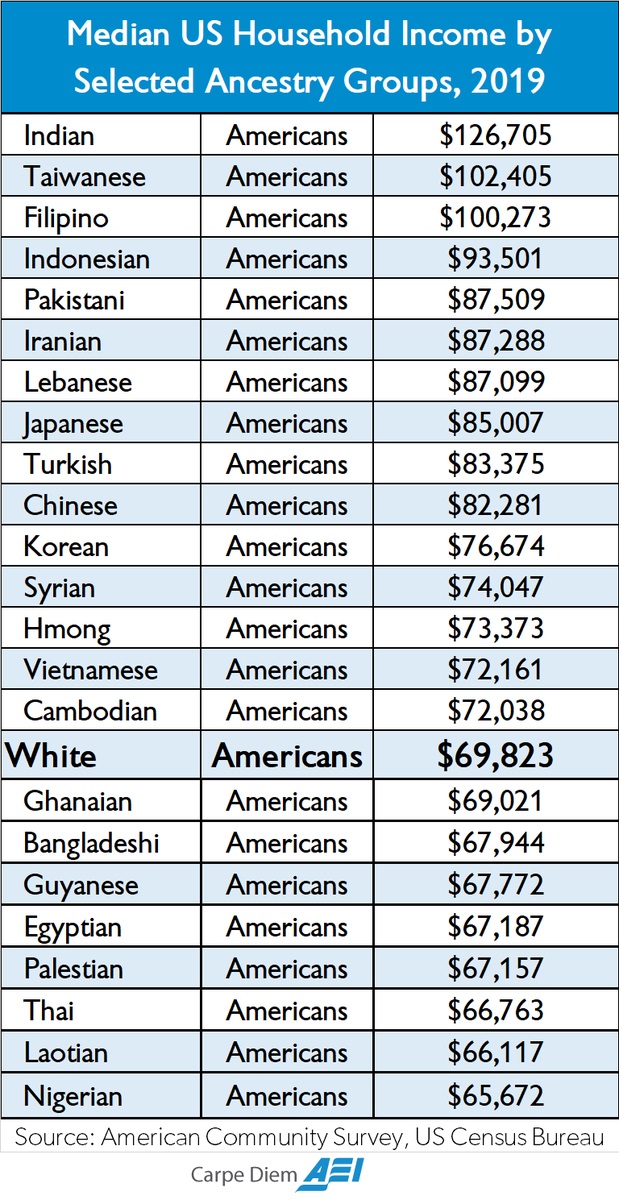
Income By Ethnicity in America

White people are doing a bad job of keeping non-whites down

Well, it looks like at least SOME people of color are able to do well in America despite all the “systemic racism” that keeps non-whites down. And do you know what those non-white groups at the top have in common? They’ve made good decisions, they’ve worked hard, they haven’t blamed other people when they fail, and they’ve saved their money instead of spending it on shiny junk.

Let’s look at some decisions that the non-whites who are prosperous have made, that those further down have not.
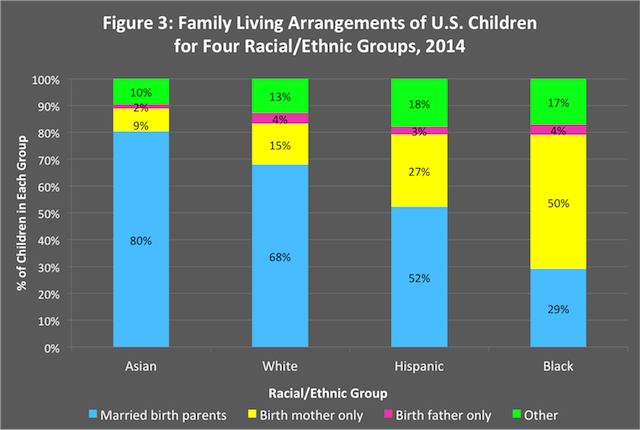
Asians marry before they have children, so the kids have two parentsAsians marry before they have children, so the kids have two parents

Education and marriage

This article is written by the far-left radical Nicholas Kristof, writing in the radically-leftist New York Times (a former newspaper).

Excerpt:

A new scholarly book, “The Asian American Achievement Paradox,” by Jennifer Lee and Min Zhou, notes that Asian-American immigrants in recent decades have started with one advantage: They are highly educated, more so even than the average American. These immigrants are disproportionately doctors, research scientists and other highly educated professionals.

It’s not surprising that the children of Asian-American doctors would flourish in the United States. But Lee and Zhou note that kids of working-class Asian-Americans often also thrive, showing remarkable upward mobility.

[…]There’s also evidence that Americans believe that A’s go to smart kids, while Asians are more likely to think that they go to hard workers… Asian-American kids are allowed no excuse for getting B’s — or even an A-. The joke is that an A- is an “Asian F.”

One reason Asians students do so well is because their parents are usually married:

Strong two-parent families are a factor, too. Divorce rates are much lower for many Asian-American communities than for Americans as a whole, and there’s evidence that two-parent households are less likely to sink into poverty and also have better outcomes for boys in particular.

American blacks have a 73% out-of-wedlock birth rate. A huge difference compared to Asians.

So, when Nikole Hannah-Jones tells you that education and marriage don’t matter, she’s just wrong.

Compound interest

Education and marriage are important, but so is saving your money. The wealthiest people in America are typically the ones who are experts at saving money early, and investing it. They know about the law of compound interest. If you invest money early and leave it alone, then it will grow into a fortune by the time you are read to stop working.

This graph explains compound interest:
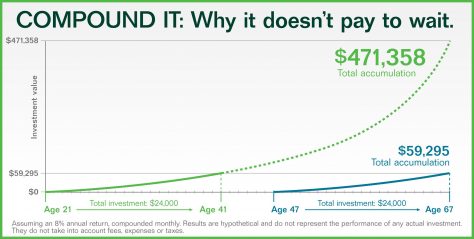
Don't trust people with non-STEM degrees to tell you how to get richInvesting $24,000 from age 21 to 41 vs investing $24000 from age 47 to 67

What does Nikole Hannah-Jones say when she looks at that graph? She doesn’t think that saving money makes a difference to having more or less wealth. She thinks skin color determines whether saving money makes you wealthy or not. The graph clearly shows what we should be recommending to young people of color. They need to stop spending money and start saving it, and the earlier the better. It doesn’t matter what your skin color is, saving money early JUST WORKS.

Similarly, when she says that home ownership doesn’t make you more wealthy, this is just terrible advice. It’s always better to pay down your own mortgage (at least when interest rates are low like they are now) than to pay someone else rent. You have to live somewhere, and paying for your own home is better because it costs about the same as rent, and then you get to keep the home when you’re done paying for it.

Communism

Nikole Hannah-Jones does have a “solution” to disparities in wealth. Her solution is communism. She wants to transfer money from those who earn, to those who don’t. But we already have tried that in the 20st century and it resulted in the deaths of over 100 million people. That’s not my opinion, that’s all documented in a book published by Harvard University Press.
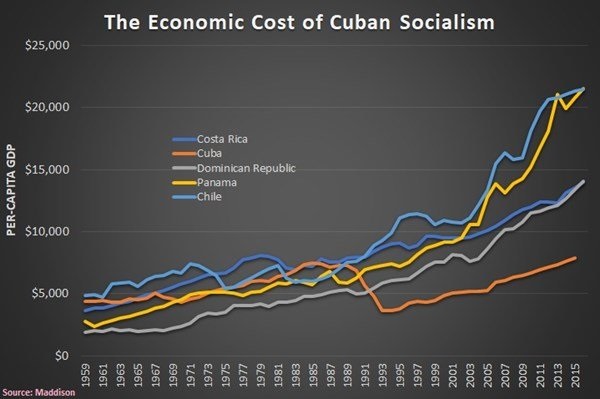
Socialism Communism Countries Per Capita GDP Income

You don’t even have to read the book to know the truth – just look at countries that score low on the Index of Economic Freedom, and compare their GDP per capita to countries that score high on the Index of Economic Freedom. The more communist a nation goes, the less wealth there is for the citizens. That’s why people in Venezuela are eating zoo animals and selling their bodies in prostitution for food, while nearby capitalist countries like Panama and Chile prosper. Nikole Hannah-Jones wants to reduce economic freedom, but we know by looking at other countries that this lowers per-capita GDP.

There’s a lot more than could be said here, but the point is that we need to be telling American blacks to make decisions that match the decisions of other successful non-white communities in America. We need to start teaching young people basic economics so they don’t fall prey to charlatans.


How to respond to an atheist who complains about slavery in the Bible

I often hear atheists going on and on about how the Bible has this evil and that evil. Their favorite one seems to be slavery. Here are three things I say to atheists when they push this objection.

The Bible and slavery

First, you should explain to them what the Bible actually says about slavery. And then tell them about the person responsible for stopping slavery in the UK: a devout evangelical named William Wilberforce.

Here’s an article that works.

Excerpt:

We should compare Hebrew debt-servanthood (many translations render this “slavery”) more fairly to apprentice-like positions to pay off debts — much like the indentured servitude during America’s founding when people worked for approximately 7 years to pay off the debt for their passage to the New World. Then they became free.

In most cases, servanthood was more like a live-inemployee, temporarily embedded within the employer’s household. Even today, teams trade sports players to another team that has an owner, and these players belong to a franchise. This language hardly suggests slavery, but rather a formal contractual agreement to be fulfilled — like in the Old Testament.3

Atheism and moral judgments

Second, inform them that moral values are not rationally grounded on atheism. In an accidental universe, there is no way we ought to be. There is no design for humans that we have to comply with. There are no objective human rights, like the right to liberty (that would block slavery) or the right to life (that would block abortion). Although you may find that most atheists act nicely, the ones who really understand what atheism means and live it out consistently are not so nice.

Famous atheist Richard Dawkins has previously written this:

The total amount of suffering per year in the natural world is beyond all decent contemplation. During the minute that it takes me to compose this sentence, thousands of animals are being eaten alive, many others are running for their lives, whimpering with fear, others are slowly being devoured from within by rasping parasites, thousands of all kinds are dying of starvation, thirst, and disease. It must be so. If there ever is a time of plenty, this very fact will automatically lead to an increase in the population until the natural state of starvation and misery is restored. In a universe of electrons and selfish genes, blind physical forces and genetic replication, some people are going to get hurt, other people are going to get lucky, and you won’t find any rhyme or reason in it, nor any justice. The universe that we observe has precisely the properties we should expect if there is, at bottom, no design, no purpose, no evil, no good, nothing but pitiless indifference.

(“God’s Utility Function,” Scientific American, November, 1995, p. 85)

When atheists like Dawkins talk about morality, you have to understand that they are pretending. To them, morality is just about personal preferences and cultural conventions. They just think that questions of right and wrong are arbitrary. Things that are wrong in one time and place are right in another. Every view is as right as any other, depending on the time and place. That’s atheist morality.

What’s worse than slavery? Abortion!

Third, you should ask the atheist what he has done to oppose abortion. Abortion is worse than slavery, so if they are sincere in thinking that slavery is wrong, then they ought to think that abortion is wrong even more. So ask them what they’ve done to oppose the practice of abortion. That will tell you how sincere they are about slavery.

Here’s atheist Richard Dawkins explaining what he’s done to stop abortion:

That’s right. The head atheist supports killing born children.

Discovery Institute’s new chemistry course for homeschool students!

One of my favorite things to do every week is to listen to Rose’s adventures with the kids in her awesome, awesome church. Unlike practically every church I’ve ever been to, Rose’s church is CRAZY about apologetics. Each week, I get to hear stories from her about how it’s going. The parents write to her, and tell her how the kids are getting into more and better conversations.

Anyway, that brings me to a new course offered by Discovery Institute. You might remember that Discovery Institute does all sorts of research on intelligent design. If you want to know how science is related to your worldview, they are the place to go.

So, without further introduction, here is a link to their latest offering.

It says:

High School Chemistry 1 & 2 is a two-semester online course for homeschool students that covers the fundamentals of chemistry as well as introducing students to the evidence of intelligent design in chemistry. Students will meet with the teacher for 90 minutes online on Tuesdays and Thursdays. Additional time available for drop-in sessions. Space is limited, so register early!

The course runs August 26, 2024 – May 30, 2025, and costs only $350 per semester. CHEAP. and they have a $25 off coupon code.

If this is something that you’re interested in, I would encourage you to take a look at it.

I took a look in the syllabus and it tells who it is for:

Prerequisite(s): Algebra 1

Please Note: It is strongly recommended that students have taken one year of algebra as some chemistry units will
require students to set up and solve algebraic equations and create/interpret graphs

Suggested Grade Level for Student: 11th grade

Please Note: Grade level is not a requirement. The grade level is only suggested as most students will have completed
the prior algebra 1 prerequisite by grade 11.

Please  forward it along to anyone you know who might be interested! I would like to see more young Christians learning about the hard sciences, especially when it is getting harder and harder to find jobs in non-STEM areas, unless you are willing to toe the secular left’s line. That’s why I chose computer science, but I had a 96% in chemistry in grade 11 chemistry. I loved it!