
Study: non-family daycare linked to anti-social behavior in children

From the UK Telegraph.

Excerpt:

Academics at Oxford University discovered that exposure to some forms of early education contributed to bad behaviour and could be linked to emotional problems.

The study, based on an analysis of infants from almost 1,000 families, showed that the strongest influence on children came from within the home itself.

Children raised in poor families with high levels of parental stress or mental health problems were most at risk of developing emotional problems by the time they started school, it emerged.

The research also uncovered trends relating to children who were in formal child care — away from their parents.

The disclosure will revive debate over the best way to raise children amid a surge in the number of under-fives enrolled in nurseries and with childminders in the past 20 years. Figures from the Department for Education show that 441,000 children under five are in day nurseries while another 272,000 are being looked after by childminders.

[…]In the Oxford study, researchers recruited 991 families with children aged three months. Mothers had an average age of 30.

Researchers assessed children at the age of four through questionnaires about their behaviour and emotions completed by teachers and parents. They also observed care provided by mothers and observed non-parental care for at least 90 minutes for those children placed in formal childcare settings.

The report, published in the journal Child: Care, Health and Development, said that “children who spent more time in group care, mainly nursery care, were more likely to have behavioural problems, particularly hyperactivity”.

The study, led by Prof Alan Stein, of Oxford’s Department of Child and Adolescent Psychiatry, found that “spending more time in day care centres, over the total period was a predictor of total problem scores”.

“Children who spent more time in day care centres were more likely to be hyperactive,” it said. “Children receiving more care by childminders were more likely to have peer problems.”

The authors added: “The findings in relation to childminding suggest that it might be out of home care rather than group care that raises the risk of behavioural difficulties.”

The researchers also tracked other forms of early years care and found benefits to different approaches.

They found that children who spent more time in pre-school playgroups – normally for a few hours a day, rather than a full-time nursery – had fewer problems.

More time with a nanny in parents’ own home predicted higher levels of “pro-social behaviour”, showing willingness to help others, it emerged.

The study said: “These findings suggest that interventions to enhance children’s emotional and behavioural development might best focus on supporting families and augmenting the quality of care in the home.”

A study like this will be useful when debating people with open minds, but hardcore feminists and socialists, who want women to work in order to fund bigger government, will not be moved. Because for them, it’s not about evidence. It’s about ideology. That’s why we have to be careful about letting people like that get elected.
How secular leftists misuse science to normalize sexual anarchy

Jay Richards tweeted this article Touchstone magazine.

Here’s part of it:

Here is how the Mead Method works. It has four easily memorized steps. You begin by proving that some behavior is natural, in the sense of being enjoyed by primitive people, who are assumed to be far closer to the basic human realities than we are. As the Chronicle’s writer put it:

Less than 50 years ago, Canela women, who live in Amazonian Brazil, enjoyed the delights of as many as 40 men one after another in festive rituals. When it was time to have a child, they’d select their favorite dozen or so lovers to help their husband with the all-important task. Even today, when the dalliances of married Bar ladies in Colombia and Venezuela result in a child, they proudly announce the long list of probable fathers.

Then you find some way to show that the behavior works. If to our overdeveloped modern eyes it looks like self-indulgence or sluttishness, it is actually a rational and effective way of living. An anthropologist quoted in the article claims that the more possible fathers a child has, the more men will take care of him and his mother. As the writer put it, “Fooling around appears to have helped our ancestral mothers equip their little ones for success—the sexual equivalent of reading to them every night or enrolling in the after-school chess club.”

Having established to your satisfaction that the behavior is not only natural but effective, you then declare that all such behaviors are just social constructions anyway and ours (the modern, still sort of Christian way) is really not nearly so common as we would like to think. To do this the writer quotes an anthropologist who studied tribes in Paraguay and Tanzania, who said, “This model of the death-do-us-part, missionary-position couple is just a tiny part of human history. The patterns of human sexuality are so much more variable.”

At this point, the case is often strengthened by caricaturing the present. That “missionary-position couple” is supposed, I think, to suggest “dull.” It can be strengthened even more by not stopping to ask what the patterns found in history might actually be. Perhaps there are only a few patterns, and contemporary marriage an expression (as it seems to be) of a dominant mode by which human societies try to restrain the destructive effects of human sexual desire and direct it to social ends.

Finally, you imply, without quite saying it, that the primitive behavior would work just as well for us, it being (though a social construction) more natural and all. The writer does this with quotes, like this one from a William Crocker of the Smithsonian Institution: “Multiple lovers, that’s just part of the life. It’s recreation, just like races and running. It’s all done in the spirit of joy and fun.”

The Margaret Mead Method, in either its original or modified form, is a very useful method . . . if you’re a creep. It proves—to the standard of the man with his pants halfway off and the woman who has gotten a better offer than her husband the couch potato will make, anyway—that sexual libertinism is natural and sexual restraint unnatural, and since being natural is always good, you ought to let go and have fun, just like the jolly party girls of the South American tribes.

This is why Coming of Age in Samoa made Mead famous. You want to have an affair with the babe next door? Well, those darling little Samoans living in a state of nature are doing it all the time, and look how happy and fulfilled and innocent they are. Margaret Mead said so. It’s scientific. You feel guilty? You’re a modern man afflicted with Judeo-Christian guilt, but just ignore it—socially constructed and unnatural as it is—and enjoy the pleasures nature and evolution have provided for you.

I am afraid this is the idea these stories almost always promote, whatever insights into the nature of a fallen creation they provide. They begin with reports of young Samoans having free and joyful sex among the palm trees, and end with middle-aged Barney desperately betraying his wife at the Hampton Inn.

Now this is supposed to be a hopeful, helpful blog post, so let me give you some advice.

There are things you can do to get around the older people who try to sell you this in school and in the culture. You have to do your own research, and learn the consequences of getting rid of the rules around sexual conduct before you break them.

First, read Romans 1, and understand that people who are doing evil things feel better about what they are doing if they can get you to approve of it, celebrate it, and subsidize it. So keep that in mind when people are telling you that something wrong is “right”.

Second, understand that people who are teaching you in school often portray themselves one way in class, but in actual fact, their private lives are totally messed up. It’s tempting to give them more respect than they deserve.

Third, it’s good to be think critically about what you see in the culture, and to read history in order to gain a perspective that allows you to judge what is seen as normal in your own time.

Fourth, it’s good to read studies to find out what happens next, should you take some course of action that is “normal”. For example, it’s a very good idea to research the link between the number of premarital sexual partners and divorce rate.

Fifth, you should be skeptical of people who misuse science in order to push an agenda. Just understand where they are going and then see if they might not be abusing science to get there. It happens all the time – just look at how global cooling / global warming has been used to justify increased control of energy development and consumption by government.

Report: UK moms with children as likely to work as women with no children

Stay-at-home moms in the UK at 25%

Dina sent me this stunning article from the UK Daily Mail.

It says:

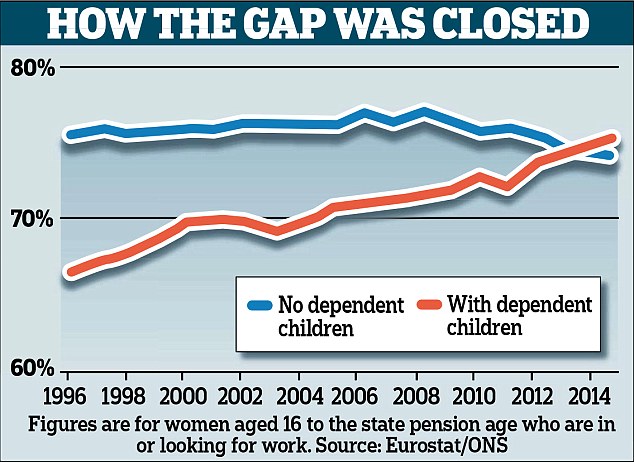
Mothers are now as likely to go out to work as women without children, figures showed yesterday.

The historic landmark reached last year means just one mother in four stays at home to raise children.

Figures from the Office for National Statistics showed 74.1 per cent of mothers with children under 16, or between 16 and 18 if they are still at school, are regarded as ‘participating in the labour market’. 

By comparison, 75 per cent of women without dependent children were either in work or looking for a job last year.

[…]The new estimates are based on the large-scale Labour Force Survey covering women who either have jobs or are unemployed and looking for work. The ONS report said benefit changes that have pressed single parents into looking for work may have influenced the change.

It added: ‘Other government policies, for example to fund 570 hours of free early education childcare a year in England for all three to four-year-olds, will have provided additional incentives to engage with the labour market.’

The biggest change has been among mothers of children under five. In 1996, 1.6 million of them were in the labour market, compared with 2.1 million last year. This represents a rise from 54.5 per cent of mothers of under-fives in work in 1996 to 65 per cent now.

There are three things I want to say about this.

First, it’s undeniable that daycare is not optimal for a child when compared with having a stay-at-home mom for the early years of childhood. That’s not my opinion, it’s a fact. Part of preparing to get married and have kids is understanding what marriage requires and what children need. Don’t rely on the government to provide for your kids, they are only interested in putting you to work so they can get your income taxes. That’s especially true for big-government leftist parties that want to weaken marriage and the traditional family in any case.

Second, it’s undeniable that government programs can make the choice to stay home or not more or less financially feasible. Make sure when you vote that you vote for smaller government and lower taxes. The bigger the government, the less money you have to run your own family game plan. Social programs exist so that the government can buy votes from people by transferring wealth from those who work to those who don’t. If you work and want to have a family, then vote for your family, not for big government.

Third, single men and women need to factor in the costs of a stay-at-home mom into their marriage plan early. Your 20s are not the time for you to waste money on alcohol, parties, contraceptives, and recreational sex with hawt atheists. Your pre-marriage years should be the time when you to get used to hard work and save a nest egg. If the needs of your future children are important to you, then you study STEM subjects or a trade in school, you get a real job after college, you pay off your student loans, and you start saving money for your marriage as soon as possible. Again, you can’t “feel” your way to a good marriage. Recklessness is not going to work.