
This article from CNS News was tweeted by GOP presidential candidate Carly Fiorina.
It says:
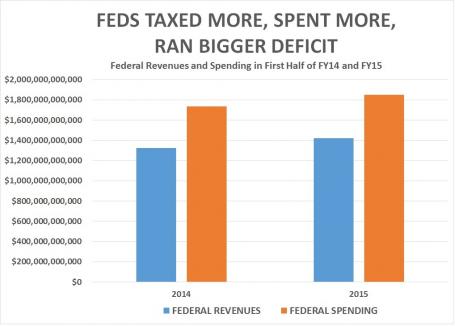
The federal government taxed away more money, spent more money and ran a bigger deficit in the first half of fiscal 2015 than it did in the first half of fiscal 2014, according to the Congressional Budget Office.
“The federal government ran a budget deficit of $430 billion for the first half of fiscal year 2015, CBO estimates–$17 billion more than the shortfall recorded in the same span last year,” the CBO said in its Monthly Budget Review for March 2015, which was published April 8. “Both revenues and outlays were about 7 percent higher than the amounts recorded in the first six months of fiscal year 2014.”
Keep in mind that these deficit numbers are for half a year. In 2007, George W. Bush was running a deficit of $160 billion for an entire year.
And we’re being taxed more, too:
The biggest source of additional tax revenue for the federal government was the individual income tax. In the first six months of fiscal 2014, Americans paid the federal government approximately $585,000,000,000 in individual income taxes. In the first six months of fiscal 2015, Americans paid $642,000,000,000 in individual income taxes—an increase of $57 billion (or 9.7 percent) from fiscal 2014.
What’s the long-term forecast?
The Wall Street Journal has it:
Question: “How close are we from seeing entitlement programs like Medicare, Medicaid, and Social Security come into direct conflict with defense spending priorities? Defense spending is almost 20% of the Fed budget and nearly 60% of discretionary spending. Current cost of health care and an aging population are strong indicators this could happen sooner than later.”
Zumbrun: “I’d say we’re already seeing it now. As Nick noted above, the CBO projects that mandatory spending and spending on interest will climb, but that defense and nondefense discretionary spending will be squeezed. Anyone who doesn’t want to see that happen in the next decade needs some combination of higher revenue, much faster economic growth, or cuts to entitlement programs.
“The budget deal known as sequestration squeezed down both defense and non-defense discretionary spending. If, instead, everyone agreed it was okay to cut entitlements (which they obviously don’t), you wouldn’t have needed to squeeze that down. So I think it’s fair to say these things are already in conflict.”
Question: “Debt as long as partnered with productivity is no problem. From the looks of it, the U.S. might fall as an economy, but is now the time?”
Timiraos: “That’s a good point. One thing that’s a little bit troubling, however, is that estimates of the potential output of the U.S. economy have been revised down. What does that mean exactly? Instead of growing at a 2.7% rate from 2014-18, it now says the economy will grow at a 2.5% rate. That doesn’t sound too bad, but over time, it adds up.”
Question: “The U.S. has so far been capable of keeping its cost of borrowing at a remarkably low level. What about in the long term where it seems likely that servicing the debt will eat up a larger and larger percentage of government expenditures in an age of slowing growth?”
Zumbrun: “There’s actually decent reason to believe that if the economy slows down a lot then interest rates will stay very low. That’s basically the situation in Japan, right? They’re mired in decades of low growth, driven by aging demographics and a central bank that was really timid for a long time, but as a result of their permanently stagnant economy, interest rates are incredibly low. In the U.S., one scenario like this is known as secular stagnation.
Wow, if our economy starts to look like Japan, that will not be good. They have massive deficits, zero economic growth and a looming demographic crisis (few young workers, many older retirees). It’s a very bad situation that’s being masked by low interest rates and massive, massive borrowing.
The Brookings Institute agrees
Lest you think that this is just the conservative take on this, here’s the leftist Brookings Institute, writing about it just last week.
They say:
Debt figures tell part of the story. When the Great Recession hit, the federal debt was equal to about 40 percent of GDP. But to fight the recession, Congress enacted an $800 billion dollar stimulus bill. Stimulus spending, combined with already enacted spending and tax policy, resulted in four years of trillion dollar deficits. As a result, the debt ballooned to 78 percent of GDP in 2013, almost twice the pre-recession level. The annual deficit is now declining at a stately pace, but by 2016 it will begin increasing again, and by 2020 under CBO’s alternative fiscal scenario, we will once again return to annual deficits above a trillion dollars, thereby once again greatly increasing the national debt.
Oh come on – Obama says that he saved the economy, and everyone in the mainstream media agrees.
Did he?
What’s the word for our fiscal situation? Stunning? Shocking? Desperate? In recent testimony before the Senate Budget Committee, Boston University Economics Professor Laurence Kotlikoff, in effect, told the Committee that all of these terms are pathetically inadequate to describe our true fiscal situation. In compelling testimony, Kotlikoff argues that the federal fiscal situation is much worse than the CBO estimates let on. The reason is that CBO’s debt estimates do not take into account the full financial obligations the government is committed to honor, especially for future payments of Social Security, Medicare, and interest on the debt. He asserts that the federal government should help the public understand the nation’s true fiscal situation by using what economists call “the infinite-horizon fiscal gap,” defined as the value of all projected future expenditures minus the value of all projected future receipts using a reasonable discount rate.
If you’re going to be retirement age around 2030, you’d better do two things right now – first, don’t expect any help from the Federal government. I don’t care if you paid into their Ponzi scheme redistribution programs – there is no money for you there. Second, if you’re working till you’re retired, then expect the government to raise taxes even more on you.
Would you expect secularists to care about the next generation when this is the only life they have? I would not. Ideas have consequences.

 WINTERY KNIGHT