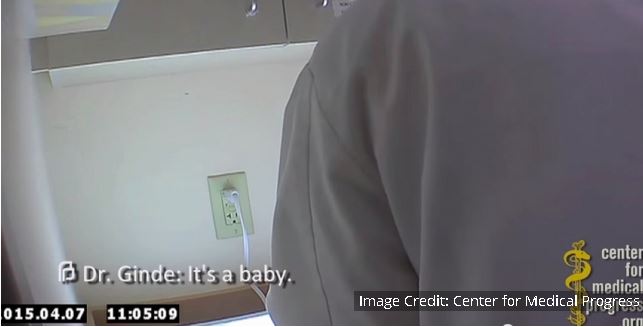
Planned Parenthood executive admits abortion victim is a baby in fourth video

Planned Parenthood's Dr. Savita Yeshawant Ginde says:
Planned Parenthood’s Dr. Savita Yeshawant Ginde says: “it’s a baby”

WARNING: The following video contains mature subject matter. Viewer discretion is advised.

The fourth Planned Parenthood sting video is out, and it’s the most serious one yet.

Anika Smith writes about it at The Stream:

For the second time in a week, the Center for Medical Progress has a new video up featuring undercover footage inside Planned Parenthood.

[…]The setup is a meeting with Dr. Ginde, Planned Parenthood of the Rocky Mountains’ Vice President and Medical Director. Her Planned Parenthood affiliate does over 10,000 abortions a year and has a contract to supply fetal body parts to Colorado State University.

[…]The smoking gun in this video is this statement by Ginde:

Sometimes, if we get, if someone delivers before we get to see them for a procedure, then we are intact.

“Delivers before” means these children are potentially born-alive infants. According to the Center for Medical Progress:

Since PPRM does not use digoxin or other feticide in its 2nd trimester procedures, any intact deliveries before an abortion are potentially born-alive infants under federal law (1 USC 8).

So that would be infanticide then, not mere abortion.

Don’t “get caught” doing this:

[…]Ginde also suggests ways for Planned Parenthood to cover up its sale of aborted body parts. “Putting it under ‘research’ gives us a little bit of an overhang over the whole thing,” Ginde remarks. “If you have someone in a really anti state who’s going to be doing this for you, they’re probably going to get caught.”

With a good lawyer, you won’t get caught:

At one point Ginde seems to suggest that PPRM’s lawyer, Kevin Paul, is helping the affiliate skirt the fetal tissue law: “He’s got it figured out that he knows that even if, because we talked to him in the beginning, you know, we were like, ‘We don’t want to get called on,’ you know, ‘selling fetal parts across states.’” The buyers ask, “And you feel confident that they’re building those layers?” to which Ginde replies, “I’m confident that our Legal will make sure we’re not put in that situation.”

It’s a baby?

The video also features footage inside the lab. It is hard to watch, and many readers will find it disturbing. At one point, there’s a cracking sound of an aborted fetus’s skull, and Dr. Ginde says, “It’s a baby,” as she points out the heart and kidneys and explains that a per-item pricing system is best for them.

It’s a baby boy:

Dr. Ginde and her medical assistants pull out tiny eyeballs, heart, kidneys, stomach and identify the child at the end as “another boy!”

Hmmm. I thought that the Planned Parenthood story we were being told was that this was just “medical tissue”. It’s just a clump of cells, that’s what the Democrats and their allies in the mainstream media tell me. But that’s not what I see in this video. I see people saying “it’s a baby” and “another boy”.

It was a baby boy, and he had a life ahead of him. Maybe he would have gone to school and studied computer science, like me. Maybe he would have cared for his siblings. Maybe he would have met a girl and got married and provided for her. Maybe he would have become a father himself. Maybe, maybe, maybe. It’s never going to happen now, because he’s dead. They killed him. They took away his whole future so that they could have more money for themselves in their present. No one was there to protect him. Not even his own mother wanted to protect him.

Rachel Alexander has a list of “admissions of guilt” in the video in an article up at The Stream. If you are trying to make sense of what this video means, you should read this post.

She concludes:

This fourth video alone provides more than enough evidence that Planned Parenthood is selling fetal body parts not merely to cover costs but for profit, a violation of 42 U.S. Code 289g. It also reveals that when Planned Parenthood  calls their organ harvesting work “research,” this is at least sometimes mere pretense.

Its defenders and friends in the media dutifully repeat those words whenever anyone objects to funding Planned Parenthood. This video will make this ruse much harder to pull off.

If you want to read a good article that summarizes everything that happened this week with these videos, then check out this article from The Federalist by Mollie Hemingway.

Her list:

  1. Injunction On Release Of Potential Upcoming Video
  2. Crisis Communications Firm Helping Planned Parenthood
  3. Planned Parenthood Claims Web Site Attacked, But Was It?
  4. Media Very Interested In Cecil The Lion, But Not Cecile The President Of Planned Parenthood
  5. Hillary Clinton Says Videos Are ‘Disturbing’
  6. Planned Parenthood Poll Mocked
  7. Planned Parenthood Fails To Show Up To Texas Hearing
  8. Trouble for Rocky Mountain Planned Parenthood
  9. #UnplannedParenthood hashtag
  10. Planned Parenthood Mammogram Falsehood Resurrected

One last thing. You’ll recall that our glorious President Barack Obama voted multiple times against a bill that would require doctors to care for babies who were born alive during abortions. So where do you think he stands on “intact” fetuses? And this is the man who so many “pro-life” voters voted for twice in a row. When you meet someone who votes Democrat, you are look at someone who supports everything you see Planned Parenthood doing in these videos. I have been talking to some Democrats about this, and they cannot even look me in the eyes. Make sure you know what you are doing when you cast your vote in elections. You will have to answer for it on that day.

New software calculates the probability of generating functional proteins by chance

Apologetics and the progress of science

Here’s an article sent to me by JoeCoder about a new computer program written by Kirk Durston.

About Kirk:

Kirk Durston is a scientist, a philosopher, and a clergyman with a Ph.D. in Biophysics, an M.A. in Philosophy, a B.Sc. in Mechanical Engineering, and a B.Sc. in Physics. His work involves a significant amount of time thinking, writing and speaking about the interaction of science, theology and philosophy within the context of authentic Christianity. He has been married for 34 years to Patti and they have six children and three grandchildren. He enjoys landscape photography, antiques of various types, wilderness canoeing and camping, fly fishing, amateur astronomy, reading, music, playing the saxophone (alto), and enjoying family and friends.

Kirk grew up on a cattle and grain farm in central Manitoba, Canada, where he spent countless hours wandering around on his own in the forest as a young boy, fascinated with the plants and animals that are native to that region of the province. Throughout his teen years he spent six days a week in the summer working as a farm hand with cattle and grain. He left his father’s farm at the age of 19 to go to university.

Canada? Can anything good come out of Canada? Oh well, at least he’s not from Scotland. Anyway, on to the research, that’s what we care about. Code!

Summary of the article:

  • Biological life requires proteins
  • Proteins are sequences of amino acids, chained together
  • the order of amino acids determines whether the sequence has biological function
  • sequences that have biological function are rare, compared to the total number of possible sequences
  • Durston wrote a program to calculate the number of the probability of getting a functional sequence by random chance
  • The probability for getting a functional protein by chance is incredibly low

With that said, we can understand what he wrote:

This program can compute an upper limit for the probability of obtaining a protein family from a wealth of actual data contained in the Pfam database. The first step computes the lower limit for the functional complexity or functional information required to code for a particular protein family, using a method published by Durston et al. This value for I(Ex) can then be plugged into an equation published by Hazen et al. in order to solve the probability M(Ex)/N of ‘finding’ a functional sequence in a single trial.

I downloaded 3,751 aligned sequences for the Ribosomal S7 domain, part of a universal protein essential for all life. When the data was run through the program, it revealed that the lower limit for the amount of functional information required to code for this domain is 332 Fits (Functional Bits). The extreme upper limit for the number of sequences that might be functional for this domain is around 10^92. In a single trial, the probability of obtaining a sequence that would be functional for the Ribosomal S7 domain is 1 chance in 10^100 … and this is only for a 148 amino acid structural domain, much smaller than an average protein.

For another example, I downloaded 4,986 aligned sequences for the ABC-3 family of proteins and ran it through the program. The results indicate that the probability of obtaining, in a single trial, a functional ABC-3 sequence is around 1 chance in 10^128. This method ignores pairwise and higher order relationships within the sequence that would vastly limit the number of functional sequences by many orders of magnitude, reducing the probability even further by many orders of magnitude – so this gives us a best-case estimate.

There are only about 10^80 particles in the entire physical universe – 10^85 at the most. These are long odds. But maybe if we expand the probabilistic resources by buying more slot machines, and we pull the slot machine lever at much faster rate… can we win the jackpot then?

Nope:

What are the implications of these results, obtained from actual data, for the fundamental prediction of neo-Darwinian theory mentioned above? If we assume 10^30 life forms with a fast replication rate of 30 minutes and a huge genome with a very high mutation rate over a period of 10 billion years, an extreme upper limit for the total number of mutations for all of life’s history would be around 10^43. Unfortunately, a protein domain such as Ribosomal S7 would require a minimum average of 10^100 trials, about 10^57 trials more than the entire theoretical history of life could provide – and this is only for one domain. Forget about ‘finding’ an average sized protein, not to mention thousands.

So even if you have lots of probabilistic resources, and lots of time, you’re still not going to get your protein.

Compare these numbers with the 1 in 10^77 number that I posted about yesterday from Doug Axe. There is just no way to account for proteins if there is no intelligent agent to place the amino acids in sequence. When it comes to writing code, writing blog posts, writing music, or placing Scrabble letters, you need an intelligence. Sequencing amino acids into proteins? You need an intelligence.

New study: women seeking to have a child should start before age 32

Brain vs Heart, from: theawkwardyeti.com

Dina sent me this sobering piece of research from the New Scientist which is perfect for all the young feminists who have been taught in college that marriage should be put off, and women can easily get pregnant after age 40.

Excerpt:

It’s a question many people will ask themselves at some point in their lives: when should I start a family? If you know how many children you’d like, and whether or not you would consider, or could afford, IVF, a computer model can suggest when to start trying for your first child.

Happy with just one? The model recommends you get started by age 32 to have a 90 per cent chance of realising your dream without IVF. A brood of three would mean starting by age 23 to have the same chance of success. Wait until 35 and the odds are 50:50 (see “When to get started”).

The suggestions are based on averages pulled from a swathe of data so don’t give a personal prediction. And of course, things aren’t this simple in real life – if only family size and feelings about IVF were the only factors to consider when planning a family. But the idea behind the model is to help people make a decision by condensing all the information out there into an accessible form.

“We have tried to fill a missing link in the decision-making process,” says Dik Habbema at Erasmus University in Rotterdam, the Netherlands, one of the creators of the model. “My son is 35 and many of his friends have a problem deciding when to have children because there are so many things they want to do.”

It’s a scenario that will be familiar to many; the age at which people have their first child has been creeping up over the last 40 or so years. For example, the average age at which a woman has her first child is 28 in the UK and has reached 30 in Italy, Spain and Switzerland. In the US, the birth rate for women in their 20s has hit a record low, while the figures for those over 35 have increased over the last few decades.

The decision is more pressing for women thanks to their limited supply of eggs, which steadily drop in quantity and quality with age. Female fertility is thought to start declining at 30, with a more significant fall after the age of 35.

[…]The new model incorporates data from studies that assess how fertility naturally declines with age. The team took information on natural fertility from population data collected over 300 years up to the 1970s, which includes data on 58,000 women.

I have often tried to talk to young women about the need to get their lives in gear. I advise them to work summers during high school, obtain a STEM degree in university, minimize borrowing money by going to community college for the generic prerequisites, don’t have premarital sex, get a job related to their STEM field straight out of college, pay off their debts, move out of their parents’ house, start investing from the first paycheck, marry between age 25-30, and then start having children after the first two “stabilizing” years of marriage. This is sound advice, rooted in my careful reconnaissance of the things that human beings care about and need in their old age. This advice is not bullying, it comes from reading many, many relevant papers. It comes from putting the knowledge gained from reading the papers into practice, and seeing results where appropriate.

I am giving you the numbers. Straight out of a peer-reviewed study. Don’t follow your heart. Don’t listen to your friends. Follow the science. Make your decisions within the boundaries of reality. God will not save you from foolish decisions.

Related posts