Obama borrowed $10 trillion and all we got was this horrible jobs report

They told me if I voted Republican, we'd lose jobs, and they were right!
What kind of economic growth can you get from a community organizer?

Wow, you would think that there would be some organic economic growth after Obama added $10 trillion to the national debt, but the September jobs report looks more like a forecast for recession than anything else.

The Daily Signal reports:

The Bureau of Labor Statistics’ September jobs report showed unexpected weakness in the labor market.

The payroll survey showed that employers created only 142,000 jobs in September. The economy created only 167,000 net new jobs a month in the 3rd quarter—a substantial drop from the 231,000 jobs a month pace in the 2nd quarter.

The numbers are even worse for private-sector job growth. Large expansions in government hiring boosted the August and September figures. Private-sector job growth dropped from 220,000 net new jobs a month in the 2nd quarter to 138,000 in the 3rd quarter.

[…]The Household survey reported that the unemployment rate remained constant at 5.1 percent in September. Unfortunately, this happened only because almost 600,000 Americans left the labor force. People not looking for work do not count as unemployed, so the unemployment rate remained unchanged.

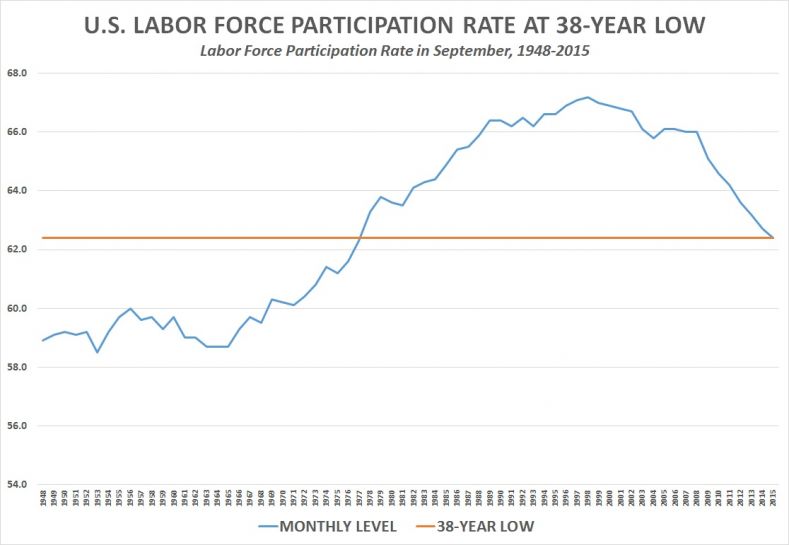
However, the labor force participation rate dropped another 0.2 percentage points to 62.4 percent—its lowest level since 1977.

[…][T]he September report follows a disappointing August report. Revisions also showed that employers created 60,000 fewer jobs in July and August than previously estimated.

CNS News says that the number of Americans not in the workforce is at 94,610,000. The Weekly Standard says we are going in reverse: ” For the last three months, average job growth comes in at 167,000. Nearly 100,000 below the average for 2014. We are going in reverse.” and “Of the 142,000 new jobs, 24,000 are in government. ”

The manufacturing sector is hardest hit, as Investors Business Daily explains:

The anemic September jobs report was bad news for anyone hoping that the economy had turned a corner. But it was even worse news for manufacturing, which is on a two-month losing streak.

Manufacturing shed 9,000 jobs last month on top of the 18,000 lost in August, completely erasing the gains made so far this year. Since January 2013, the industry has gained only 338,000.

All this flies in the face of President Obama’s repeated promise in 2012 that if reelected, he would create 1 million new manufacturing jobs by the end of his second term. Obama said that these new jobs would “put middle-class people back to work.” To make it happen, he promised to aggressively pursue corporate tax reform and unfair trade practices by China, set up new community-college/employer partnerships and create up to 20 “manufacturing innovation institutes.”

Since then, he’s done little if any of it.

The problem is big government regulations:

A study by the National Association of Manufacturers found that regulations cost the industry nearly $20,000 per worker in 2012. At smaller firms, the cost is almost $35,000 per worker.

It’s only getting worse, as new or impending regulations on CO2 emissions, smog, etc. threaten hundreds of thousands of manufacturing jobs.

Investors Business Daily says:

The biggest decline in the workforce has not been among the elderly, but the young, who just aren’t jumping into starter jobs at the normal rate.

[…]The workweek shrank again — to 34.5 hours — largely due to the rise of part-time hiring. Thank you, ObamaCare.

Obamacare forces employers to make workers part-time, or else pay more to employ them if they stay full-time. It’s a real genius-level policy.

More:

Can we finally repeal the law requiring employers to provide health benefits to workers once they log 30 hours of work in a week? Workers can’t pay their bills and feed their families with 28-hour paychecks.

Wages, which made decent gains over the previous several months, actually ticked down in September. So we are working less, for less.

This is no accident; it’s policy-induced slow growth.

It’s fitting that we get a disappointing jobs report in the very week that the administration says it will move forward with a new ozone containment rule that the National Association of Manufacturers says will be one of the biggest job-killing regulations in American history.

Obama still won’t allow the Keystone Pipeline, or the exporting of oil, which would be a major job producer. He won’t cut the corporate tax, or roll back ObamaCare rules hindering employment. His grandiose plans to save the planet come before putting Americans to work.

This is serious. I know that a lot of people in the media, in academia, in Hollywood, etc. think that you can tax and regulate your way to prosperity with laws like Obamacare, but it’s not true. Massive expansions of government and massive borrowing depress economic growth and job creation. Jobs come from entrepreneurs, and entrepreneurs do not like what they have seen from the government in the last 7 years under these Democrats.


Bible study: the importance of gratitude, and making moral judgments

Bible study that hits the spot

First, I’ll start with a passage that makes it clear that it’s good for Christians to make moral judgments when people do evil things.

2 Samuel 12:1-12:

1 And the Lord sent Nathan to David. He came to him and said to him,“There were two men in a certain city, the one rich and the other poor.

2 The rich man had very many flocks and herds,

3 but the poor man had nothing but one little ewe lamb, which he had bought. And he brought it up, and it grew up with him and with his children. It used to eat of his morsel and drink from his cup and lie in his arms, and it was like a daughter to him.

4 Now there came a traveler to the rich man, and he was unwilling to take one of his own flock or herd to prepare for the guest who had come to him, but he took the poor man’s lamb and prepared it for the man who had come to him.”

5 Then David’s anger was greatly kindled against the man, and he said to Nathan,“As the Lord lives, the man who has done this deserves to die,

6 and he shall restore the lamb fourfold, because he did this thing, and because he had no pity.”

7 Nathan said to David, “You are the man! Thus says the Lord, the God of Israel, ‘I anointed you king over Israel, and I delivered you out of the hand of Saul.

8 And I gave you your master’s house and your master’s wives into your arms and gave you the house of Israel and of Judah. And if this were too little, I would add to you as much more.

9 Why have you despised the word of the Lord, to do what is evil in his sight? You have struck down Uriah the Hittite with the sword and have taken his wife to be your wife and have killed him with the sword of the Ammonites.

10 Now therefore the sword shall never depart from your house, because you have despised me and have taken the wife of Uriah the Hittite to be your wife.’

11 Thus says the Lord, ‘Behold, I will raise up evil against you out of your own house. And I will take your wives before your eyes and give them to your neighbor, and he shall lie with your wives in the sight of this sun.

12 For you did it secretly, but I will do this thing before all Israel and before the sun.’”

So, in this case Uriah had done his best to help David to achieve David’s goals, even going so far as to fight for him against his enemies. And how did David repay him? David repaid him by orchestrating his death and stealing his wife. Uriah only had the one wife, and David had lots of wives. But that didn’t stop David from going after Uriah’s one wife – he just would not be satisfied. How did Nathan respond to this? Nathan went to David and made a moral judgment (verbal) against David. David responded well and said he was sorry. But that didn’t get him out of punishment. A bit later in the book, David shows that he really is sorry for what he did. He doesn’t try to get into a discussion about it with Nathan do determine whether he did something wrong to Uriah – he knows that he has done wrong. Although he got his forgiveness in exchange for his repentance, he still got hammered by God for what he did to Uriah. I guess God would have hammered him even more had he not repented at all, though.

Second passage, this one about being grateful. If someone you know has helped you out, then you should let the good thing they have done for you change your character – change the way that you treat others.

Matthew 18:21-35:

21 Then Peter came up and said to him, “Lord, how often will my brother sin against me, and I forgive him? As many as seven times?”

22 Jesus said to him, “I do not say to you seven times, but seventy-seven times.

23 “Therefore the kingdom of heaven may be compared to a king who wished to settle accounts with his servants.

24 When he began to settle, one was brought to him who owed him ten thousand talents.

25 And since he could not pay, his master ordered him to be sold, with his wife and children and all that he had, and payment to be made.

26 So the servant fell on his knees, imploring him, ‘Have patience with me, and I will pay you everything.’

27 And out of pity for him, the master of that servant released him and forgave him the debt.

28 But when that same servant went out, he found one of his fellow servants who owed him a hundred denarii, and seizing him, he began to choke him, saying, ‘Pay what you owe.’

29 So his fellow servant fell down and pleaded with him, ‘Have patience with me, and I will pay you.’

30 He refused and went and put him in prison until he should pay the debt.

31 When his fellow servants saw what had taken place, they were greatly distressed, and they went and reported to their master all that had taken place.

32 Then his master summoned him and said to him, ‘You wicked servant! I forgave you all that debt because you pleaded with me.

33 And should not you have had mercy on your fellow servant, as I had mercy on you?’

34 And in anger his master delivered him to the jailers, until he should pay all his debt.

35 So also my heavenly Father will do to every one of you, if you do not forgive your brother from your heart.”

What is really bad is when you treat someone well by performing X for them… assisting them financially, helping them to find a mate, helping them to achieve success, getting them a job, giving them gifts, serving them somehow, etc. and then they come back and actually undermine you in the exact same area where you helped them. That’s the really bad situation that you want to avoid. If someone helps you by doing X, make sure that you don’t turn around and hurt them by doing (not X) back to them – hurting them in the very area where they tried to help you.

I’m going to try to tie these two passages together. Imagine how this ingratitude would work in the David and Uriah case. Suppose Uriah helped David somehow to try to win the heart of a woman he really liked. Then David turns around and steals Uriah’s wife in response to being helped. You don’t want to be that guy who responds to kindness by doing the exact opposite of how you were helped. I think it’s important to respect the abilities of the people who help you and let the gratitude you should feel for them change your character. Don’t respond to them by doing the exact opposite for them or others that they did for you. And if you see someone doing that, give them the Nathan treatment – “you are the man!”. Awesome. Don’t be the guy who won’t make a moral judgment because he wants to be friends with David, even over the dead body of Uriah.

How the presence and quality of fathers affects belief in God

Does government provide incentives for people to get married?
A father in the home helps children to reconcile love and moral boundaries

Here’s an article by Paul Copan which points out how father presence/absence and father quality affects belief and disbelief in God.

Excerpt:

Seventh, the attempt to psychologize believers applies more readily to the hardened atheist.It is interesting that while atheists and skeptics often psychoanalyze the religious believer, they regularly fail to psychoanalyze their ownrejection of God. Why are believers subject to such scrutiny and not atheists? Remember another feature of Freud’s psychoanalysis — namely, an underlying resentment that desires to kill the father figure.

Why presume atheism is the rational, psychologically sound, and default position while theism is somehow psychologically deficient? New York University psychology professor Paul Vitz turns the tables on such thinking. He essentially says, “Let’s look into the lives of leading atheists and skeptics in the past. What do they have in common?” The result is interesting: virtually all of these leading figures lacked a positive fatherly role model — or had no father at all.11

Let’s look at some of them.

  • Voltaire(1694–1778): This biting critic of religion, though not an atheist, strongly rejected his father and rejected his birth name of François-Marie Arouet.
  • David Hume(1711–76): The father of this Scottish skeptic died when Hume was only 2 years old. Hume’s biographers mention no relatives or family friends who could have served as father figures.
  • Baron d’Holbach(1723–89): This French atheist became an orphan at age 13 and lived with his uncle.
  • Ludwig Feuerbach (1804–72): At age 13, his father left his family and took up living with another woman in a different town.
  • Karl Marx(1818–83): Marx’s father, a Jew, converted to being a Lutheran under pressure — not out of any religious conviction. Marx, therefore, did not respect his father.
  • Friedrich Nietzsche(1844–1900): He was 4 when he lost his father.
  • Sigmund Freud(1856–1939): His father, Jacob, was a great disappointment to him; his father was passive and weak. Freud also mentioned that his father was a sexual pervert and that his children suffered for it.
  • Bertrand Russell(1872–1970): His father died when he was 4.
  • Albert Camus(1913–60): His father died when he was 1 year old, and in his autobiographical novel The First Man, his father is the central figure preoccupation of his work.
  • Jean-Paul Sartre(1905–80): The famous existentialist’s father died before he was born.12
  • Madeleine Murray-O’Hair (1919–95): She hated her father and even tried to kill him with a butcher knife.
  • We could throw in a few more prominent contemporary atheists not mentioned by Vitz with similar childhood challenges:
  • Daniel Dennett (1942–): His father died when he was 5 years of age and had little influence on Dennett.13
  • Christopher Hitchens (1949–): His father (“the Commander”) was a good man, according to Hitchens, but he and Hitchens “didn’t hold much converse.” Once having “a respectful distance,” their relationship took on a “definite coolness” with an “occasional thaw.” Hitchens adds: “I am rather barren of paternal recollections.”14
  • Richard Dawkins (1941–): Though encouraged by his parents to study science, he mentions being molested as a child — no insignificant event, though Dawkins dismisses it as merely embarrassing.15

Moreover, Vitz’s study notes how many prominent theists in the past — such as Blaise Pascal, G.K. Chesterton, Karl Barth, and Dietrich Bonhoeffer — have had in common a loving, caring father in their lives.16

Not only is there that anecdotal evidence, but there is also statistical evidence.

Excerpt:

In 1994 the Swiss carried out an extra survey that the researchers for our masters in Europe (I write from England) were happy to record. The question was asked to determine whether a person’s religion carried through to the next generation, and if so, why, or if not, why not. The result is dynamite. There is one critical factor. It is overwhelming, and it is this: It is the religious practice of the father of the family that, above all, determines the future attendance at or absence from church of the children.

If both father and mother attend regularly, 33 percent of their children will end up as regular churchgoers, and 41 percent will end up attending irregularly. Only a quarter of their children will end up not practicing at all. If the father is irregular and mother regular, only 3 percent of the children will subsequently become regulars themselves, while a further 59 percent will become irregulars. Thirty-eight percent will be lost.

If the father is non-practicing and mother regular, only 2 percent of children will become regular worshippers, and 37 percent will attend irregularly. Over 60 percent of their children will be lost completely to the church.

Let us look at the figures the other way round. What happens if the father is regular but the mother irregular or non-practicing? Extraordinarily, the percentage of children becoming regular goesupfrom 33 percent to 38 percent with the irregular mother and to 44 percent with the non-practicing, as if loyalty to father’s commitment grows in proportion to mother’s laxity, indifference, or hostility.

[…]In short, if a father does not go to church, no matter how faithful his wife’s devotions, only one child in 50 will become a regular worshipper. If a father does go regularly, regardless of the practice of the mother, between two-thirds and three-quarters of their children will become churchgoers (regular and irregular). If a father goes but irregularly to church, regardless of his wife’s devotion, between a half and two-thirds of their offspring will find themselves coming to church regularly or occasionally.

A non-practicing mother with a regular father will see a minimum of two-thirds of her children ending up at church. In contrast, a non-practicing father with a regular mother will see two-thirds of his children never darken the church door. If his wife is similarly negligent that figure rises to 80 percent!

The results are shocking, but they should not be surprising. They are about as politically incorrect as it is possible to be; but they simply confirm what psychologists, criminologists, educationalists, and traditional Christians know. You cannot buck the biology of the created order. Father’s influence, from the determination of a child’s sex by the implantation of his seed to the funerary rites surrounding his passing, is out of all proportion to his allotted, and severely diminished role, in Western liberal society.

Basically, anyone who doesn’t have a benevolent, involved father is going to have an enormously difficult time believing that moral boundaries set by an authority are for the benefit of the person who is being bounded. The best way to make moral boundaries stick is to see that they apply to the person making the boundaries as well – and that these moral boundaries are rational, evidentially-grounded and not arbitrary. It is therefore very important to children to be shepherded by a man who studied moral issues (including evidence from outside the Bible) in order to know how to be persuasive to others. If you want your child to be religious and moral, you have to pick a man who is religious and moral. And it can’t just be a faith commitment that he makes, he can just lie about that. Women ought to check whether men are bound to what they believe by checking what they’ve read. A man usually acts consistently with what he believes, and beliefs only get formed when a man informs himself through things like reading.

A child’s relationship with God begins before he/she is even born. It begins with his/her mother’s ability to control herself and choose the right man for the job of being a father. Note that superficial qualities like “deep voice”, “broad shoulders”, “expensive shoes”, “likes dogs” and “makes me laugh” have no bearing on a man’s ability to commit and lead on moral/spiritual issues. Christians don’t really do a good job of showing the practical consequences of bad choices to women in the church. The ones I talk to impress on me how “unpredictable” men are, so that they are justified in choosing one that they like based on tingles, and hoping it will work out. We should be telling women that poor choices with men are wrong, and it leads to fatherlessness and abortion.