
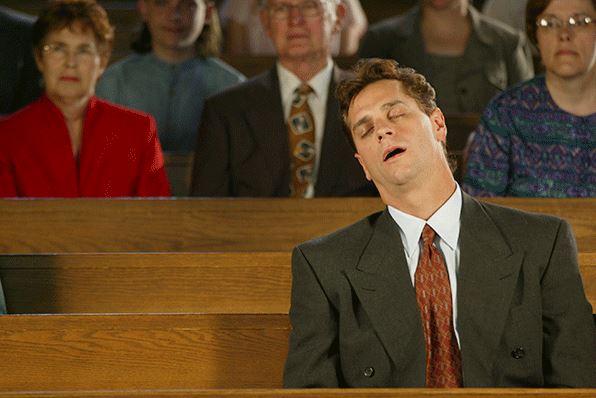
New York church makes space for non-Christians to ask questions

Church sucks, that's why men are bored there
Is church boring? How can you make it more interesting for people?

This is from the radically leftist New York Times, of all places.

It says:

When Craig Ellis was growing up, he picked up the sort of adventure book meant for a boy looking to serve God. The book, “Shadow of the Almighty,” told the story of Jim Elliot, a young American evangelist killed while doing mission work in Ecuador.

The narrative of this Christian martyr did for Mr. Ellis what a superhero comic might have done for his peers: It got him pondering purpose, struggle and sacrifice. The book also provided a model for how a Christian should spread the news of salvation while working in treacherous territory, at great personal risk.

Very little in “Shadow of the Almighty,” however, prepared Mr. Ellis for where he stood on a recent Tuesday, in a room with industrial carpet and a dropped ceiling at Redeemer Presbyterian Church on the Upper West Side of Manhattan, where people lined up on Sunday morning are more likely awaiting a table for brunch than taking communion.

Mr. Ellis, 39, welcomed the dozen men and women seated before him. “This is a space,” he said, “for people who consider themselves non-Christian and are coming in from the outside.”

His weekly sessions, called the WS Café in a reference to the neighborhood, are at a new frontier of evangelism, one that seeks converts among a fervent and growing number of atheists in this country. The sessions started in September as a push by Redeemer Presbyterian’s prominent pastor, the Rev. Tim Keller, to preach the gospel to skeptics.

How are they doing it?

By not quoting the Bible as if it were inerrant to people who don’t think it is. But using evidence from outside the Bible to explain what’s in the Bible.

More:

On that recent Tuesday evening, Mr. Ellis, the pastor’s assistant, was sharing a lectern with the Rev. Bijan Mirtolooi, the assistant pastor for the 83rd Street church. In the chairs around them sat people like Frank Ying, 33, who works for a technology start-up. Brought up in the Dallas area by immigrant parents who had been raised amid the official atheism of the People’s Republic of China, Mr. Ying tried exploring Christianity with his high school classmates, even accompanying them to megachurches, only to be put off by their fundamentalism.

“You have all these questions,” he recalled. “And you have all these long, drawn-out conversations. ‘What do you believe? How much of the Bible do you take literally?’ And these people stop short and say, ‘You’ve just got to have faith.’ But I’ve always been more pragmatic, so that wasn’t good enough.”

Mr. Ying heard about Redeemer Presbyterian from a few acquaintances after moving to Manhattan several years ago. He dipped his toe slowly, watching a YouTube video of Dr. Keller in conversation with a journalist and a historian, emissaries of the secular world. By now, Mr. Ying is a regular at the WS Café, not because he believes, but because his doubts get heard.

Each session has a central topic, and on the recent Tuesday it was about why Jesus needed to be crucified. As part of framing a wide-open conversation, a list of quotations on the subject even included this zinger from Mr. Hitchens: “I find something repulsive about the idea of vicarious redemption.”

Mr. Ellis and Mr. Mirtolooi cited popular culture (movies like “The Revenant,” “Inside Out”) and real-life examples (the way a parent sacrifices free time to raise a child) in order to make palpable the concept of suffering leading to the remission of sin. Very deliberately, they did not lean heavily on Scripture.

“The difference with the Café is what you’re using as your authorities,” Mr. Ellis said later. “Typically, in a Christian class, the Bible is your authenticity. To this group, the Bible is just another book. You can use it, but it’s just one piece of the puzzle. You rely on those your listeners would find credible — scientists, philosophers, authors — and you show how Christianity makes sense.”

[…]The point of their exchange was not winning a soul now as much as keeping a mind open to the possibility someday. “Now I find that I’m very comfortable going to church on a Sunday, listening to the sermons,” Mr. Ying said. “I can explore more and not have religious people put down their foot and say, ‘This is how it is.’ ”

This reminds me of the conversation I had when I went to work for a tech start-up right out of college. You had to have a graduate degree to work in this company. I remember talking to a buy who had a PhD from Northwestern, and my boss who had his undergrad from UIUC and his Masters from Purdue. I had just answered one of their questions, and then apologized for taking the conservative point of view – hoping I hadn’t offended them. I said “I’m a fundamentalist”. And the PhD guy said, “you’re not a fundamentalist. You have your view, but you know all the other views, too”.

I think that in the workplace or in the school, it’s important to know all the other views, too. We don’t want to play into this stereotype that the secular leftists have of us. We should be able to sit still and listen, and put their view forward better than they can themselves. You won’t learn how to do that in church, though. Church teaches you to only be able to talk to people about your faith if they assume that the Bible is the inerrant Word of God (which it is, but non-Christians don’t believe that!) You have to learn how to speak to non-Christians effectively on your own, by reading and watching debates. Sad, but true.


What happens when Christians vote to put secular government in charge of health care?

Canada Election 2015: Socialists in red, Communists in Orange, Conservatives in blue

No need to wonder, just look north to Canada. Wesley J. Smith explains in First Things.

Excerpt:

Last year, the Canadian Supreme Court created a right to euthanasia and assisted suicide. To qualify for death, the court ruled unanimously, one must be a competent adult with a medically diagnosed condition causing “irremediable suffering”—a circumstance wholly determined by the patient and including “psychological suffering.”

The decision went well beyond mere legalization. Indeed, the court manufactured an enforceable legal right for qualified patients to receive what Canadian policymakers are euphemistically calling “medical aid in dying” (MAID).

But what about doctors opposed to euthanasia? The court left with Parliament and the medical colleges (associations) the decision of whether and how to accommodate doctors with conscience objections, granting a one-year (now extended) period within which to enact laws to govern the practice. Since then, civil liberties groups, provincial medical colleges, and official government commissions have urged Parliament … to pass laws that would coerce doctors who are religiously or philosophically opposed to euthanasia to cooperate actively in mercy killings by forcing them to procure death doctors for their patients.

But isn’t there a “Constitution” in Canada? Yes, but it’s interpreted by unelected judges:

All of this would seem to fly in the face of Canada’s 1982 Charter of Rights and Freedoms,which states, “Everyone has the fundamental freedom of conscience and religion.” Illustrating the utter lack of regard that secularized Canada now has for religious liberty, the Canadian Civil Liberties Association—that country’s counterpart to the ACLU—applauded the parliamentary committee’s call to stomp upon religious conscience as a “promising step forward.”

Doctors aren’t the only ones threatened with religious persecution under Canada’s looming euthanasia regime. Provincial and federal commissions have both recommended that nurses, physician’s assistants, and other such licensed medical practitioners be allowed to do the actual euthanizing under the direction of a doctor.

Voting for a single-payer health care system, such as the one praised by Donald Trump, makes the situation much worse:

Even Catholic and other religious nursing homes and hospices may soon be required by law to permit euthanasia on their premises, for the federal commission recommended that federal and provincial governments “ensure that all publicly funded health care institutions provide medical assistance in dying.” That is a very broad category. Canada has a single-payer, socialized healthcare financing system that permits little private-pay medical care outside of nursing homes. Not only that, but as Alex Schadenberg, director of the Canada-based Euthanasia Prevention Coalition told me, “religiously-affiliated institutions [in Canada] have become the primary care facilities for elderly persons, those requiring psychiatric care, and dying persons. They are now being told that as a condition of providing those services they will be required to permit doctors to kill these very patients by lethal injection. If they refuse, they will find themselves in a showdown with the government.”

The more people who opt to kill themselves, the less the government has to pay in health care. Naturally, the secular government looks at euthanasia as a great way to cut the costs of taxpayers who have paid into the single-payer system their whole lives, and now want to make withdrawals. If the government kills them now, they get to keep all the money, and not give any of it back.

The rights to religious liberty and conscience protections are put at risk everywhere that the secular government takes over the private sector. Christians need to be careful what they vote for at election time. Small government is best for religious liberty and conscience protections.

Evaluating the evidence for and against common descent

A conflict of worldviews

An article from Evolution News that takes a statement from an evolutionist who supports common descent, and then then refutes it point by point.

Here’s the case for common descent:

UCA is now supported by a wealth of evidence from many independent sources, including: (1) the agreement between phylogeny and biogeography; (2) the correspondence between phylogeny and the palaeontological record; (3) the existence of numerous predicted transitional fossils; (4) the hierarchical classification of morphological characteristics; (5) the marked similarities of biological structures with different functions (that is, homologies); and (6) the congruence of morphological and molecular phylogenies.

(Douglas L. Theobald, “A formal test of the theory of universal common ancestry,” Nature, Vol. 465:219-222 (May 13, 2010).)

And here’s a response to each of those points from the Evolution News post:

  • (1) Phylogeny and biogeography don’t always agree.
  • (2) Phylogeny and paleontology don’t always agree.
  • (3) Transitional fossils are often missing (or the “predicted” transitional fossils fall apart on closer inspection).
  • (4) Hierarchical classifications often fail.
  • (5) “Homologous” structures often have different developmental pathways or different structures often have “homologous” developmental pathways.
  • (6) Morphological and molecular phylogenies are often incongruent.

Before I read this post, I only knew about 3, 4, 5 and 6.

A related podcast

Casey Luskin did a good podcast explaining a problem with two kinds of evidence commonly used to argue for common ancestry.

Details:

On this episode of ID the Future, Casey Luskin takes a keen-eyed look at Darwin’s tree of life and finds that common descent, far from being confirmed by the data, is actually contradicted by it, as New Scientist pointed out in their cover story, “Why Darwin was wrong about the tree of life.”

Listen in to learn how the data is challenging Darwinist assumptions, and check out “A Primer on the Tree of Life” for more information.

The MP3 file is here.

The paper linked above seems to be exactly what he read out loud in the podcast.

Here is one section from the paper that summarizes everything:

One authoritative review paper by Darwinian leaders in this field stated, “As morphologists with high hopes of molecular systematics, we end this survey with our hopes dampened. Congruence between molecular phylogenies is as elusive as it is in morphology and as it is between molecules and morphology.”

Another set of pro-evolution experts wrote, “That molecular evidence typically squares with morphological patterns is a view held by many biologists, but interestingly, by relatively few systematists. Most of the latter know that the two lines of evidence may often be incongruent.“

The two methods of determining ancestry are “often incongruent”. What I am looking for in order to be convinced of common ancestry is substantial agreement between morphological phylogenies and molecular phylogenies. I don’t see that, so I am still skeptical of common ancestry. Especially with all the examples of convergence that I keep finding out about.