New study: galactic habitable zone depends on fine-tuning of cosmological constant

The galactic habitable zone (GHZ) is shown in green against a spiral galaxy
The galactic habitable zone (GHZ) is shown in green superimposed on a spiral galaxy

This is going to be old news to readers of this blog who are familiar with the Michael Strauss, Walter Bradley and Guillermo Gonzalez lectures on habitability and fine-tuning. But, it’s nice to see these ideas show up in one of the most presitigious peer-reviewed science journals in the world (if not the most presitigious).

Here’s the article from Science. (H/T Gunter)

It says:

Scientists have known for several years now that stars, galaxies, and almost everything in the universe is moving away from us (and from everything else) at a faster and faster pace. Now, it turns out that the unknown forces behind the rate of this accelerating expansion—a mathematical value called the cosmological constant—may play a previously unexplored role in creating the right conditions for life.

That’s the conclusion of a group of physicists who studied the effects of massive cosmic explosions, called gamma ray bursts, on planets. They found that when it comes to growing life, it’s better to be far away from your neighbors—and the cosmological constant helps thin out the neighborhood.

“In dense environments, you have many explosions, and you’re too close to them,” says cosmologist and theoretical physicist Raul Jimenez of the University of Barcelona in Spain and an author on the new study. “It’s best to be in the outskirts, or in regions that have not been highly populated by small galaxies—and that’s exactly where the Milky Way is.”

Jimenez and his team had previously shown that gamma ray bursts could cause mass extinctions or make planets inhospitable to life by zapping them with radiation and destroying their ozone layer. The bursts channel the radiation into tight beams so powerful that one of them sweeping through a star system could wipe out planets in another galaxy. For their latest work, published this month in Physical Review Letters, they wanted to apply those findings on a broader scale and determine what type of universe would be most likely to support life.

The research is the latest investigation to touch on the so-called anthropic principle: the idea that in some sense the universe is tuned for the emergence of intelligent life. If the forces of nature were much stronger or weaker than physicists observe, proponents note, crucial building blocks of life—such fundamental particles, atoms, or the long-chain molecules needed for the chemistry of life—might not have formed, resulting in a sterile or even completely chaotic universe.

Basically, the best place for a galaxy that permits complex, embodied life to exist is one where you can pick up enough heavy elements from dying stars nearby, but not be in an area that is so crowded by stars that you will be murdered by intense gamma radiation when they die.

The cosmological constant has to be set just right that we spread out enough to make space between spiral arms for life-permitting solar systems, but no so spread out that we cannot pick up the heavy elements we need for a metal-rich star, a moon, and the bodies of the intelligent agents themselves.

More:

As it turns out, our universe seems to get it just about right. The existing cosmological constant means the rate of expansion is large enough that it minimizes planets’ exposure to gamma ray bursts, but small enough to form lots of hydrogen-burning stars around which life can exist. (A faster expansion rate would make it hard for gas clouds to collapse into stars.)

Jimenez says the expansion of the universe played a bigger role in creating habitable worlds than he expected. “It was surprising to me that you do need the cosmological constant to clear out the region and make it more suburbanlike,” he says.

Remember, this is only one of many characteristics that must obtain in order for a have a location in the universe that can support complex, embodied life of any conceivable kind.

Let’s review the big picture

Time for me to list out some of the things that are required for a galaxy, solar system and planet to support complex embodied life. Not just life as we know it, but life of any conceivable kind given these laws of physics.

  • a solar system with a single massive Sun than can serve as a long-lived, stable source of energy
  • a terrestrial planet (non-gaseous)
  • the planet must be the right distance from the sun in order to preserve liquid water at the surface – if it’s too close, the water is burnt off in a runaway greenhouse effect, if it’s too far, the water is permanently frozen in a runaway glaciation
  • the solar system must be placed at the right place in the galaxy – not too near dangerous radiation, but close enough to other stars to be able to absorb heavy elements after neighboring stars die
  • a moon of sufficient mass to stabilize the tilt of the planet’s rotation
  • plate tectonics
  • an oxygen-rich atmosphere
  • a sweeper planet to deflect comets, etc.
  • planetary neighbors must have non-eccentric orbits

It’s not easy to make a planet that supports life. For those who are interested in reaching out to God, he has left us an abundance of evidence for his existence – and his attention to detail.

And remember, these requirements for a habitable planet are downstream from the cosmic fine-tuning of constants and quantities that occurs at the Big Bang. No point in talking about the need for plate tectonics if you only have hydrogen in your universe. The habitability requirements are a further problem that comes after the fine-tuning problem.

Resources

The best book to read on this topic is “The Privileged Planet“, by Guillermo Gonzalez and Jay W. Richards. The latter is one of my absolute favorite Christian scholars, a real renaissance man. If the book is too much, there is a DVD by the same name that covers everything you need to know at a high level. Just FYI, Gonzalez made the cover of Scientific American in 2001, for his research on habitable zones. This is real evidence you can discuss with anyone, anywhere.

You can also watch the DVD for FREE on YouTube. Not sure how long that will be there. If you like it, buy the DVD, so you can show your friends.

Related posts

Who won the debate last night? Winners and losers from the Fox News debate

Ted Cruz explains policy to little girl who wants to be President

Ted Cruz explains public policy to little girl who wants to be President

The Weekly Standard, which I think favors Rubio slightly over Ted Cruz, posted this:

What Cruz did at the debate was make three parallel cases:

  1. Trump is a fraud who can’t be trusted to keep his word.
  2. Trump is not either conservative or Republican in any meaningful way.
  3. Trump actually is the corruption that he decries.

He advanced these arguments not one at a time, but by interweaving them with specific attacks:

* He positively crushed Trump on the use of foreign labor at Mar-a-Lago. He didn’t just bring up the fact that hundreds of applicants applied for these jobs but that Trump prefers to hire foreigners instead, but included Trump’s line from the last post-debate interview where he claimed that these were jobs American workers couldn’t and wouldn’t do.

* He thoroughly prosecuted Trump on the question of Trump’s off-the-record New York Times interview, which Trump steadfastly refuses to release.

* At the end of the segment on Trump University—where Trump’s best defense was telling voters that they should “wait a few years” to see whether or not he committed fraud, Cruz flashed in with a rapier: “Megyn, let me ask the voters at home, is this the debate you want playing out in the general election?” It was brutal.

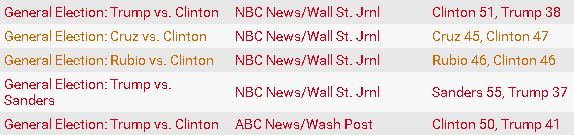
* When Trump went to his poll numbers—as he always does—Cruz was ready. Trump touted a terrible CNN poll showing him at 49 percent support. Cruz waited for Trump to double down and defend the integrity of the poll. And then he noted that this same poll also showed Trump losing to Clinton and Cruz beating her.

* When the Second Amendment came up, Trump made a gauzy statement of general support. Cruz then dropped the hammer:

It is easy for political candidates to have rhetoric and say, “I support the Second Amendment.” But you cannot say that and at the same time say what Donald just said, which is that on the question of Supreme Court nominees he wants to compromise and reach a middle ground with Harry Reid and Chuck Schumer. That’s what he said in the last debate. . . . And I would point out, Harry Reid and Chuck Schumer are both Democrats that Mr. Trump has written checks to repeatedly. Any justice that those two sign off on is going to be a left-wing judicial activist who will undermine religious liberty, and we are one vote away from the Heller decision being overturned, which would effectively erase the Second Amendment from the Bill of Rights. Amendment rights, but when you say you’d compromise with Harry Reid, you put that in jeopardy.

* Cruz’s most devastating line was probably this summation:

I understand the folks who are supporting Donald right now. You’re angry. You’re angry at Washington, and he uses angry rhetoric. But for 40 years, Donald has been part of the corruption in Washington that you’re angry about. And you’re not going to stop the corruption in Washington by supporting someone who has supported liberal Democrats for four decades, from Jimmy Carter to John Kerry to Hillary Clinton. You’re not going to stop the corruption and the cronyism by supporting someone who has used government power for private gain.

The question is what Cruz’s performance gets him. Maybe nothing. The terrain ahead could simply be too tough. But maybe not.

Watch this:

Someone has been teaching Cruz how to speak more concisely. Ted and Marco didn’t attack each other much last night, just like in the last debate. And it worked!

Red State, which is a grassroots conservative web site whose contributors back all different candidates, said:

WINNERS

Senator Ted Cruz: Tonight’s big winner was clearly and indisputably Ted Cruz. Cruz showed the most substance and had the strongest answers. His line about charging Snowden with treason, like his answers on ethanol before the Iowa caucus, showed he’s able to give tough, definitive answers to questions that are controversial even within the party. His touting of his Supreme Court credentials was not only a great case but a timely one.

And when Megyn Kelly eviscerated Trump over his disastrous Trump University failure, it seemed the smoking corpse couldn’t possibly suffer more abuse. But Ted Cruz stepped in and in a few sentences buried that corpse, salted the earth, and wiped the name and location from this history books. Utterly. Destroyed.

But best of all was that Cruz masterfully avoided being in the line of fire, and above the fray in Trump and Rubio’s heated exchanges. Sometimes that doesn’t play well. Sometimes it makes you the winner. This is one of the latter times.

Senator Marco Rubio: Rubio was also a winner tonight. He has proved beyond the shadow of doubt how weak Donald Trump is before attacks on his tremendous, yuge vanity. He crumples. He falls apart. He talks about his ding dong. The extent to which Marco can easily send Trump into a panic by mentioning his hands or tan is just a shadow of how easily the Democrats will handle him. They won’t have to mention policy. Just his hair. Or his stump fingers. He’ll fall apart.

Marco also crushed Trump’s lack of substance on foreign policy, asking him if he would ever offer any policy details in answer to a foreign policy question. Predictably, Trump responded by taking a petty swipe at Rubio. Yet another point for Marco and against Donald.

LOSERS

Donald Trump: Trump is the obvious, clear loser tonight. It wasn’t even close. He was clownish, he changed his mind over the course of the debate, he had his butt handed to him over and over by both Marco and Ted. He was found to be making false statements, his economic policy was proved not only to be a disaster, but it was shown that he himself couldn’t even articulate it, much less a defense of it. He couldn’t even muster a strong response to the Romney question. On the scale of fail he hit a solid ten: total dumpster fire.

Except for one thing. Donald promised to support the nominee of the party no matter who it is. That was a good line for him, even if he doesn’t mean it, and will play well for him.

And Erick Erickson, another grassroots conservative, says at The Resurgent that Cruz was the clear winner of the debate:

Wow. That was one heck of a debate performance by Ted Cruz. That was just amazing. He ran circles around Trump. Trump looked like he was worn out. He was low energy. He was a loser.

In the last debate, Rubio was assisted by Cruz. In this debate, Cruz was assisted by Rubio. It shows what a unity ticket between the two could do.

It was a remarkable performance that had Cruz and Rubio shaking hands during commercial break.

Tonight was Ted Cruz’s night and it was a nearly flawless debate on his part.

PJ Media listed out 5 of Cruz’s best moments in the debate.

Here’s one of them:

5. Detroit…Has Been Utterly Decimated By Failed Left-Wing Policies Although most of Cruz’s standout moments came in opposition to Trump, one of his finest successes centered around discussing the city of Detroit. “Detroit is a great city, with a magnificent legacy, that has been utterly decimated by 60 years of failed left-wing policies,” Cruz declared. He praised Detroit for “funding the arsenals of democracy” in World War II, and added that “in the 1960s, Detroit was the Silicon Valley of America — it had the highest per capita income in the country.” Then the kicker: “And then for 50 years, left-wing Democrats have pursued destructive tax policies, weak crime policies, and have driven the citizens out.” Cruz then detailed how he would bring manufacturing jobs back to the U.S. and Detroit specifically. This strong answer bolstered Cruz in the eyes of Luntz’s focus group, scoring a 96 percent.

Trump tried to get Marco and Ted off his chest by citing GOP primary poll numbers, but Cruz had an answer for that, too. Trump cited a poll from CNN showing him in the lead. Cruz responded by pointing out that the CNN poll also shows Trump losing to Hillary Clinton by 8 POINTS. The same poll shows Cruz beating Hillary Clinton head-to-head. I have never met a Trump supporter who was aware of these head-to-head polls that show Trump losing to Clinton. But the liberal media is well aware of them, and that’s why they are so supportive of Trump – they want the weakest candidate to be the Republican nominee.

One of the differences between Trump and Cruz is that Trump talks about himself and makes promises without providing details. He oversimplifies problems, and has more confidence than experience. Cruz talks about specific policies and the results of those policies in different times and places. He actually knows what works and what doesn’t work, and has a record of solving actual problems.

Darwinian fundamentalists threaten boycott of science journal for paper mentioning “Creator”

The Church of Naturalism
The Church of Naturalism says turn or burn, heretic!

So, there was a peer-reviewed paper that appeared in the PLOS peer-reviewed journal that made reference to a Creator in the abstract. The scientific work of the paper had no problems.

I saved a copy of the post and the comments. Let’s look at some of the comments.

Comments by editors of the journal

Michael Sears:

The article should be retracted and the handling editor should be dismissed. As an Editor for this journal, I am appalled.

Ricard Sol:

I think that pretending to defend a creationist argument (non-science) in a science journal raises serious doubts about the whole enterprise. The paper should be retracted. As a PLOS ONE editor I believe accepting this situation would seriously damage our credibility.

Dante Chialvo:

[…]I am ashamed that the journal staff, the editor responsable for the paper, the reviewers, all ignored this more than obvious red flag resulting on a creationist argument embedded on a scientific paper. I will consider resigning unless exemplary actions are taken by Plos.

Angel Sánchez:

As I have said in a separate post, I will resign as an editor of PLOS ONE if this paper is not retracted immediately. PLOS ONE is a scientific journal and I don’t want to have anything to do, not even my name related to a journal tha publishes about superstition and supernatural entities. I will stop editing and I will stop submitting, and I’ll recommend everybody never to submit again to PLOS ONE. I hope we don’t have to go there.

So, you can see that science – as the naturalists conduct it – is not really the search for truth, no holds barred. It’s the attempt to explain nature without reference to a Creator and Designer. Whatever the experiments show must conform to a philosophical assumption (a religion), called naturalism. And the religion of naturalism determines what can and cannot be accepted as science. You can see the same principle at work in the denial of the Big Bang cosmology despite evidence such as the cosmic microwave background radiation, the light element abundances, and the redshifting of light from distant galaxies. Science has shown we live in a created universe that began about 13.7 billion years ago, but here we have atheists in denial of science sitting in positions of power deriding the Creator who has been revealed by experimental science. That’s the power of the naturalistic dogma. And it turns out that the most powerful argument for Darwinian evolution is this: “believe it, or I’ll have you fired, and ruin your career”. This is how Darwinism propagates from old to young – through coercion, and not through real science.

Other comments

Zach Throckmorton:

As others have noted, utilization of an intelligent design creationism framework for explaining human anatomy is not acceptable for a scientific journal.

Jorge Soberon:

I find the use of religious language in a scietific paper totally unacceptable. I will be watching this paper closely, and distributing it to colleagues. If PLOS ONE does not do something about it, like asking the authors to retratct the paper, or at the very least publishing an explanation, I will stop reviewing papers for PLOS ONE. I do hope the editors of PLOS ONE realize what a huge mistake was to accept publication of a paper with this wording. It says a lot about the care with which a paper is edited.

Adam Hartstone-Rose:

This article proves that there is something SERIOUSLY wrong with the journal. If the paper isn’t retracted, my students, collaborators and I will have no choice but to refrain from submitting to this once respectable journal. I’m embarrassed for you and embarrassed that some of my proudest papers are in your journal.

[…]This requires a ballistic reaction, not a considered “looking into” the problem!

Enrico Petretto:

This is outrageous. If PLOS ONE does not do something about it, i.e., ask the authors to retract the paper, and in any case, if the paper isn’t retracted, my students, collaborators and I will have no choice but to refrain from considering (i..e, reading, reviewing and citing) papers published in PLOS ONE.

Luigi Maiorano:

Quote totally!! outrageous is the minimum! I published 3 of my papers in PlosOne, but I will never do it again. I’m actually telling all my students and colleagues to boycott the journal and never consider it again!

Jean-Michel Heraud:

I have no knowledge to judge this article…

[…]I would recommend to the editor of the journal to exclude definitely the two reviewers that have accepted this manuscript.

Oliver Rauhut:

As noted by many comments below, this is not a matter of inappropriate wording! This rather seems to be a (successfull) attempt to place an intelligent design argument in a (so far) respected scientific journal. Thus, the only solution is the immediate retraction of this paper! Unless this step has been done, my workgroup and me will refrain from publishing further papers in PLoS!

Harry Noyes:

Changing Creator to Nature will not solve the problem since it still implies a fundamental misunderstanding of evolution. That is there is no design process, no outcome is foreseen. Anything that works better tends to have a selective advantage but that is not a product of design it is a product of selection working on random events. The paper clearly needs a substantive rewrite quite apart from the concerns raised about the significance of the results raised by other comments.

Carl Schmidt:

A more important issue is the review process that allowed such nonsense as “Creator” to appear in a journal purportedly devoted to science.

The article has now been retracted.

Evolution News comments:

This would seem to bear out a remark by Chinese paleontologist J.Y. Chen, recounted in Darwin’s Doubt, “In China we can criticize Darwin, but not the government; in America, you can criticize the government, but not Darwin.”

So what’s really behind all this fascism?

Consider this quote from famous population geneticist (and Darwinian fundamentalist) Richard Lewontin. And note that he equates science with his chosen religion of naturalism, he doesn’t accept science in the traditional sense of the word, where there is no metaphysical baggage.

He says:

Our willingness to accept scientific [i.e. – naturalistic] claims that are against common sense is the key to an understanding of the real struggle between science [i.e. – naturalism] and the supernatural. We take the side of science [i.e. – naturalism] in spite of the patent absurdity of some of its constructs, in spite of its failure to fulfill many of its extravagant promises of health and life, in spite of the tolerance of the scientific [i.e. – naturalistic] community for unsubstantiated just-so stories, because we have a prior commitment, a commitment to materialism. It is not that the methods and institutions of science [i.e. – naturalism] somehow compel us to accept a material explanation of the phenomenal world, but, on the contrary, that we are forced by our a priori adherence to material causes to create an apparatus of investigation and a set of concepts that produce material explanations, no matter how counter-intuitive, no matter how mystifying to the uninitiated. Moreover, that materialism is absolute, for we cannot allow a Divine Foot in the door.

“Billions and Billions of Demons” by Richard Lewtontin. (Link)

“A priori” means before seeing the facts, before seeing the evidence.

And what is behind the choice of naturalism as the preferred religion? Consider this quote from atheist philosopher Thomas Nagel.

He says this:

“In speaking of the fear of religion, I don’t mean to refer to the entirely reasonable hostility toward certain established religions and religious institutions, in virtue of their objectionable moral doctrines, social policies, and political influence. Nor am I referring to the association of many religious beliefs with superstition and the acceptance of evident empirical falsehoods. I am talking about something much deeper–namely, the fear of religion itself. I speak from experience, being strongly subject to this fear myself: I want atheism to be true and am made uneasy by the fact that some of the most intelligent and well-informed people I know are religious believers.

I want atheism to be true and am made uneasy by the fact that some of the most intelligent and well-informed people I know are religious believers. It isn’t just that I don’t believe in God and, naturally, hope that I’m right in my belief. It’s that I hope there is no God! I don’t want there to be a God; I don’t want the universe to be like that.”

(”The Last Word” by Thomas Nagel, Oxford University Press: 1997)

The days of Isaac Newton are long gone, and another Newton will not emerge while the Naturalistic Church is in power. And it’s a taxpayer-funded church, too. Think about that next time you vote for bigger or smaller government.

Positive arguments for theism