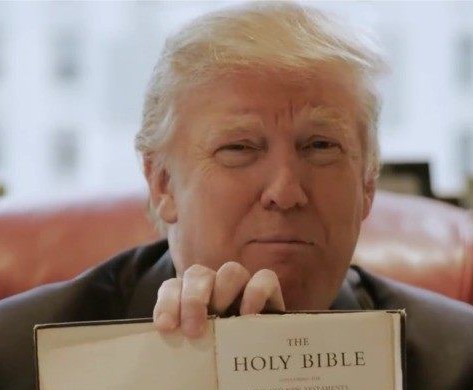
Trump donated to group that promotes homosexuality to 5-year-olds

Donald Trump and his friends, the Clintons

So I blogged a bit about Trump on Monday, listing out all of his positions, and I want everyone to understand what I think of people who vote for Trump.

What I infer that Trump supporters believe:

  • They are in favor of adultery and frivolous divorce, they don’t think it’s anything that needs to be repented of.
  • They think that a person can be a Christian without ever having read the Bible or attended a theologically-sound church.
  • They think that constantly bragging about wealth is consistent with Christianity.
  • They are in favor of abortion through all 9 months of pregnancy, including partial-birth abortion.
  • They are in favor of funding Planned Parenthood, because they do “wonderful things”.
  • They are in favor of using taxpayer money to bailout banks.
  • They are in favor of tariffs, which raise prices for consumers.
  • They are in favor of using government to seize private property to benefit private businesses.
  • They think that dictators who murder journalists and dissenters are “strong leaders”.
  • They support single-payer universal healthcare, even though this leads to rationing and waiting lists in Canada and the UK.
  • They support making “forward motion” on the gay agenda.
  • They think that someone who fails constantly at business, including four bankruptcies and lawsuits claiming fraud is a “successful businessman”.
  • They think that someone who donates huge amounts of money to Democrats like Harry Reid, Nancy Pelosi and Hillary Clinton is sincere when he speaks conservative-sounding words, while having nothing at all in the way of a conservative record.
  • They think that Bush lied us into the Iraq war, and that WMDs were never found in Iraq.
  • They think in the Israeli-Palestinian conflict, there is no right or wrong party.
  • They don’t want to condemn white supremacy or David Duke.
  • They want to see radical pro-abortion judges nominated to the Supreme Court of the United States.
  • They belief that taxpayer money should be distributed to certain businesses that lobby the government for handouts, e.g. – the ethanol lobby.

I assume that Trump supporters agree with most or even all of these things, and surprisingly, under questioning, they often admit to it.

And here’s the latest thing that I assume most Trump voters support – promoting homosexuality to 5-year-olds in the public schools.

Life Site News explains:

Donald Trump donated $30,000 to homosexual activists, including a $20,000 grant to an organization that promoted “fisting” to middle school students, recommended books excusing homosexual pedophilia, and proclaimed its mission is “promoting homosexuality” in the public schools to children as early as kindergarten.

According to a 990 form filed with the IRS, the Donald J. Trump Foundation donated $20,000 to the Gay, Lesbian, and Straight Education Network (GLSEN) in 2012 and another $10,000 to Gay Men’s Health Crisis.

Kevin Jennings founded GLSEN (originally the Gay and Lesbian School Teachers Network) in 1990. He and other homosexual teachers formed Gay-Straight Alliances (GSAs) nationwide and drew up curricula that began shaping children’s values in accordance with the LGBT perspective from the age of five.

GLSEN has been upfront about its goals and desire for mainstream respectability. In 1997, Jennings said, “I can envision a day when straight people say, ‘So what if you’re promoting homosexuality?’”

GLSEN recommends children face “saturation” in its viewpoint beginning in kindergarten. GLSEN activist Jaki Williams taught a workshop on “Inclusive Kindergartens” at a 1997 regional conference. “Children in the kindergarten age are ‘developing their superego’…That’s when the saturation process needs to begin,” Williams, a New York teacher, said.

They go into all the details of what GLSEN does. They basically market homosexuality to young children in the schools, when their parents are not there to counter any of it.

I will mention one thing from the post – “fisting”, since it has to do with the Planned Parenthood that Trump and all of his supporters support:

But at the 2001 GLSEN conference, Planned Parenthood distributed “fisting kits.”

Why else would people be supporting him for President when there are more conservative candidates like Ted Cruz, who have a proven record?

By they way, I actually asked one of my evangelical Christian friends who is a Trump supporter whether he supported the practice known as “fisting”. He never denied it. I’m not sure if that means that he and all the other Trump supporters are engaging in fisting with each other, or whether they merely donate money to encourage others to do it, or whether they just support it verbally. It seems to me that it has to be something along those lines.

I’ll never forget how one Trump supporter implied that there was something wrong with my chastity after I asked him whether adultery was wrong. That’s why I just assume that Trump supporters are into all the same stuff he is. I think now that Trump’s record is out in the open, it’s safe to assume that they know about these things and support them.

My candidate is Ted Cruz:

How to get kissed: Heidi Cruz helping her husband

Ted Cruz married one woman – a Harvard Business graduate, who works harder than practically anyone reading this blog. That’s why he chose her – for her ability and character. Does character matter to Christians and conservatives any more? Or are we all in for the hedonistic Playboy Sexual Revolution culture, now?

Related posts

After a poor Super Tuesday showing, is it time for Marco Rubio to drop out?

GOP primary delegate count after Super Tuesday

I actually thought that grassroots conservative leader Erick Erickson was a supporter of Rubio for the longest time, but I guess he did pretty badly in the Super Tuesday primaries, because now Erickson is calling for him to drop out, and accept the Vice Presidency.

Erickson writes:

I have tried very hard to be neutral in the race between Ted Cruz and Marco Rubio. They are both friends. But reality dawns. Rubio has won only a single state (Minnesota), and even then not all the delegates, and tells us we must wait until Florida on March 15th. Cruz is already winning states more solidly and leads in delegates.

In 1980, as the nation was falling apart, Ronald Reagan as the outsider and George H. W. Bush as the insider were willing to set aside personal and policy differences to unite for the good of the country. Reagan had attacked Bush on his illegal immigration position. Bush had coined the term “voodoo economics” to describe Reagan’s economic policies. But they overcame that, they united, and they not only beat Jimmy Carter, but a third party bid by John Anderson.

It is time for Rubio to accept he will not be the nominee. He keeps telling us he will pay the bill tomorrow, but tomorrow has not yet come and he is behind by double digits in his home state.

It is time for Ted Cruz to accept we need a unity ticket and for Rubio to agree to be Cruz’s Vice Presidential pick, uniting the outsider and insider factions of the party and stopping Trump in the process.

Cruz has won three states. Rubio won Minnesota with split delegates. The non-Trump faction has the delegates to stop Trump. But now there must be unity.

It is time to divide the map, combine the campaigns, and fight Trump state by state all the way to the convention as if a single ticket.

True, Rubio will say the map moving forward is more favorable to him. But that excludes voter expectations and perceptions. The reality is that Cruz is winning states, Rubio is not, and together they could dominate. Outside groups should concentrate all fire on Trump while Cruz and Rubio show the country that they can pull America from the brink.

Ted Cruz has stopped Trump in three states. It is time for Team Rubio to acknowledge that.

Actually, Ted Cruz has stopped Trump in FOUR states. Alaska also went for Cruz, but those results came out after Erickson’s post was already posted. That’s 4 states to Rubio’s 1.

I used to blog a lot about Marco Rubio, before he championed the 2013 amnesty. I remember the moment I discovered that he was one of the Gang of Eight like most people remember where they were on 9/11. I remember the story, and the picture of Rubio standing in with radical leftists Republican moderates like John McCain and Lindsay Graham. People who had stabbed us in the back so many times before on important things like Supreme Court judicial nominations. I remember thinking: “what is Marco doing with them?”

That was the end of my interest in Marco Rubio. And he’s not going to win this election, given his record on amnesty and so many other liberal policies and priorities. If Donald Trump stands for anything, he stands for border security. And Marco Rubio is the opposite of that. There is just no way that Marco Rubio would be able to get the support of the Republican electorate. He’s even down 20 points in his home state of Florida. Trump’s popularity is due in large part because of the betrayal of moderate, establishment Republicans like Marco Rubio.  The Washington elites need to realize that this time it is their turn to fall in line with Cruz, even if they can’t fall in love with Cruz.

When Rubio was elected to political office, he authored an amnesty bill, he supported the failed Libya invasion, he gave in-state tuition to illegal immigrants, he weakened border security, he authored a bill to remove the due process rights of men falsely accused of rape on campus, he skipped votes to defund Planned Parenthood, he has a billionaire pro-gay-marriage donor, and is very friendly with gay activists who are opposed to religious liberty and conscience protections for Christians, and so on. We can’t have the Republican nominee be a liberal moderate in the mold of Bob Dole, John McCain and Mitt Romney. The establishment has had a good long run at ignoring the base and now it’s come to an end. We need a real conservative this time: Ted Cruz.

Why does God let people suffer? Why is there so much evil in the world?

I have a key that will unlock a puzzling mystery

I just wanted to draw your attention to this 4 page essay by Joe Manzari, which is the best darn summary of the state of the art on the problems of evil and suffering I have seen. The problem of evil is an objection to the existence of God based on the presence of evil or suffering in the world. The arguments basically infer that if God is all-good and all-powerful, then there should not be any evil or suffering.

There are two kinds of problem of evil.

The Logical/Deductive Problem of Evil:

The first kind is called “the deductive problem of evil” or “the logical problem of evil”. An exampel of evil would be Saddam Hussein murdering some journalist who told the truth about him. This version of the problem of evil tries to introduce a logical contradiction between the attributes of God and the presence of evil, like this:

(1) God exists.
(2) God is omnipotent.
(3) God is omniscient.
(4) God is omni-benevolent.
(5) Evil exists.
(6) A good being always eliminates evil as far as it can.
(7) There are no limits to what an omnipotent being can do.

In order to avoid a contradiction, we need to explain how there could still be evil, since the conclusion of this argument is that there should not be any evil!So how are we going to get out of this mess? The solution is to attack premises 6 and 7.

Premise 6 is false because in order to eliminate human evil, you would have to eliminate free will. But eliminating free will is worse than allowing it, because good things like love are impossible without free will.

It is in response to this proposition that the Free Will Theodicy of G. W. Leibniz applies. God, valuing man’s freedom, decided to provide him with a will that was free to choose good over evil, rather than constraining his will, allowing him to choose only good.

Premise 7 is false because there are limits on what an omnipotent being can do. God cannot perform contradictory things, because contradictory things are impossible. God cannot make a married bachelor. Similarly, God cannot force free creatures to do his will.

In the same manner that God cannot create a square circle, he cannot make someone freely choose to do something. Thus, if God grants people genuine freedom, then it is impossible for him to determine what they will do. All that God can do is create the circumstances in which a person can make free choices and then stand back and let them make the choices.

One last point. In order to solve the problem of natural evil for this argument, you can point out that free will requires predictable and regular natural laws in order to make free will meaningful. Natural laws mean that individuals can predict what will happen when they act, allowing for moral responsibility. More on that next time.

Inductive/Probabilistic Problem of Evil

There is a second version of the problem of evil, though, which is more dangerous than the first. This is the one you see being argued in debates, whereas the first version is not used because it has been defused as seen above. Here is the second one:

(1) If God exists, gratuitous evil does not exist.
(2) Gratuitous evil exists.
(3) Therefore, God does not exist.

This argument tries to argue that while God may have some reason for allowing free will, there are other evils in the world that are not the result of human action that God has no reason for permitting. Theists usually like to argue that God has morally-sufficient reasons for allowing some evil in the world, in order for the character of humans to develop through suffering and endurance. But what about gratuitous evil, which doesn’t have any point?

Consider the case of a fawn running in the forest, who falls and breaks his leg. Ouch! Then a forest fire starts and the poor fawn suffocates to death in the smoke. Why would God allow this poor small animal suffer like that? And notice that there is no morally sufficient reason for allowing it, because no human knows about this and so no human’s character or relationship with God is impacted by it.

The solution to this problem is to deny premise 2. (You can also deny 1 if you want). The problem with premise 2 is that the atheist is claiming to know that some instance of evil really is gratuitous. But since they are making the claim to know, they have to be able to show that God’s permission of that evil achieves nothing. But how do they know 2 is true?

The problem with 2 is that the atheist is not in a position to know that the permission of some evil X really doesn’t achieve anything. This is because the atheist cannot look forward into the future, or see into other places, in order to know for certain that there is no morally sufficient reason for allowing God’s allowing evil X to occur. But since the atheist argues based on premise 2, he must be able to show that premise 2 is more probable than not.

Manzari’s article also argues why apparently gratuitous evil is less problematic for Christians in particular, because of certain Christian doctrines. He lists four doctrines that make the apparently gratuitous evil that we observe more compatible with an all-good, all-powerful God.

  1. The chief purpose of life is not happiness, but the knowledge of God.
    Some of the things that we experience may wreck our feelings of contentment, but we need to remember that God may be permitting those troubles in order to remind us not to get too comfortable with life on earth, and to think ahead to the after-life. And remember, even Jesus learned endurance through suffering. His suffering was not pointless and neither is ours.
  2. Mankind is in a state of rebellion against God and God’s purposes.
    We humans seem to be on a dead run away from God, trying to keep our autonomy by knowing as little about him as possible. Part of knowing God is knowing what he designed us to do – to love him and to love others. And so, the less we know about God, the more we stray from his design for our lives.
  3. God’s purpose is not restricted to this life but spills over beyond the grave into eternity.
    Sometimes it seems as if our sufferings really are catastrophic, but when you realize that you are offered eternal life without any suffering after you die, the sufferings of this life are a lot less upsetting than they would be if this life was all we had.
  4. The knowledge of God is an incommensurable good.
    This one is the biggest for me. Knowing God and knowing his actual character by studying the historical Jesus is a wonderful counterbalance for all the problems and sufferings of this life. A little bit of historical study reveals that Jesus was not spared the worst kind of suffering in his life, making it is a lot easier for us to bear with whatever God allows us to face.

In section 3, Manzari shows how you can also argue against this version of the problem by supplying evidence for God, such as from the big bang, the fine-tuning, the origin of life, the origin of free will, the origin of the first living organism, the origin of the mind, the sudden emergence of phyla in the fossil record, molecular machines, irreducible complexity, the resurrection miracle, and the objective morality argument.

The argument goes like this:

(1) If God exists, gratuitous evil does not exist.
(2) God exists.
(3) Therefore, gratuitous evil does not exist.

Just support 2 with some evidence, and you win, especially when they can’t support their claim to know that gratuitous evil exists.

The Argument for God from Evil

In the paper, Manzari actually makes an argument for God from evil. That’s right. Far from disproving God, the presence of evil (a departure from the way things out to be), actually affirms God’s existence. How?

(1) If God does not exist, then objective moral values do not exist.
(2) Evil exists.
(3) Therefore, objective moral values do exist.
(4) Therefore, God exists.

That’s right. If evil exists in any sense such that it is not a personal or cultural preference, then objective morality exists. If objective morality exists, then there is an objective moral lawgiver. Game over. If the atheist backtracks and says that the existence of evil is just his opinion or his cultural preference, then this standard does not apply to God, and you win again. Game over again.

So, although the problems of evil look pretty tough, they are actually easy. The toughest part of evil and suffering is the emotional problem. I could tell you stories about what I’ve been through… but then, that’s why the arguments matter. You can hold your position under tremendous fire when you have the arguments and evidence to ground you.