
Economist Walter Williams explains how to not be poor

Economist Walter Williams

Here is his article on wealth and poverty on Creators.

First, there is no real poverty in the United States:

There is no material poverty in the U.S. Here are a few facts about people whom the Census Bureau labels as poor. Dr. Robert Rector and Rachel Sheffield, in their study “Understanding Poverty in the United States: Surprising Facts About America’s Poor”, report that 80 percent of poor households have air conditioning; nearly three-quarters have a car or truck, and 31 percent have two or more. Two-thirds have cable or satellite TV. Half have one or more computers. Forty-two percent own their homes. Poor Americans have more living space than the typical non-poor person in Sweden, France or the U.K. What we have in our nation are dependency and poverty of the spirit, with people making unwise choices and leading pathological lives aided and abetted by the welfare state.

Second, the “poverty” is not caused by racism, but by poor choices:

The Census Bureau pegs the poverty rate among blacks at 35 percent and among whites at 13 percent. The illegitimacy rate among blacks is 72 percent, and among whites it’s 30 percent. A statistic that one doesn’t hear much about is that the poverty rate among black married families has been in the single digits for more than two decades, currently at 8 percent. For married white families, it’s 5 percent. Now the politically incorrect questions: Whose fault is it to have children without the benefit of marriage and risk a life of dependency? Do people have free will, or are they governed by instincts?

There may be some pinhead sociologists who blame the weak black family structure on racial discrimination. But why was the black illegitimacy rate only 14 percent in 1940, and why, as Dr. Thomas Sowell reports, do we find that census data “going back a hundred years, when blacks were just one generation out of slavery … showed that a slightly higher percentage of black adults had married than white adults. This fact remained true in every census from 1890 to 1940”? Is anyone willing to advance the argument that the reason the illegitimacy rate among blacks was lower and marriage rates higher in earlier periods was there was less racial discrimination and greater opportunity?

Third, avoiding poverty is the result of good choices:

No one can blame a person if he starts out in life poor, because how one starts out is not his fault.

If he stays poor, he is to blame because it is his fault. Avoiding long-term poverty is not rocket science. First, graduate from high school. Second, get married before you have children, and stay married. Third, work at any kind of job, even one that starts out paying the minimum wage. And finally, avoid engaging in criminal behavior. It turns out that a married couple, each earning the minimum wage, would earn an annual combined income of $30,000. The Census Bureau poverty line for a family of two is $15,500, and for a family of four, it’s $23,000. By the way, no adult who starts out earning the minimum wage does so for very long.

Fourth, what stops people from making good choices is big government:

Since President Lyndon Johnson declared war on poverty, the nation has spent about $18 trillion at the federal, state and local levels of government on programs justified by the “need” to deal with some aspect of poverty. In a column of mine in 1995, I pointed out that at that time, the nation had spent $5.4 trillion on the War on Poverty, and with that princely sum, “you could purchase every U.S. factory, all manufacturing equipment, and every office building. With what’s left over, one could buy every airline, trucking company and our commercial maritime fleet. If you’re still in the shopping mood, you could also buy every television, radio and power company, plus every retail and wholesale store in the entire nation”. Today’s total of $18 trillion spent on poverty means you could purchase everything produced in our country each year and then some.

Walter Williams is one of my two favorite economists, the other being Thomas Sowell. By sheer coincidence, they both happen to have grown up poor, and they both happen to be black. They understand what causes poverty very well. I recommend their books to you if you want to understand economics.
Reversing the American trend of borrowing and spending too much

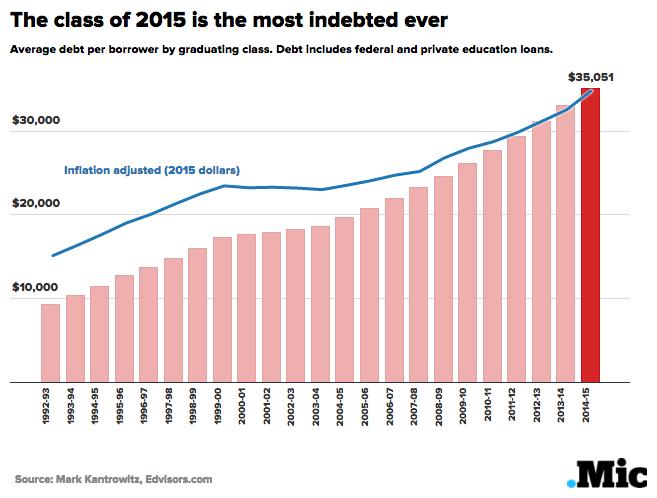
Average college debt is now up to $35,000 and usually for a useless non-STEM degree
Average debt is now up to $35,000, often for a useless non-STEM degree

First, the problem, using this article from New Zealand. It is authored by a self-made millionaire to young people.

Excerpt:

A young property tycoon has hit out at Generation Y claiming they need to stop travelling and spending money on overpriced food if they want to save for their first home.

Tim Gurner, 35, is worth nearly half a billion dollars since buying his first investment property at the age of 19.

The Melbourne millionaire believes it’s time his generation change their spending and lifestyle habits.

“When I was trying to buy my first home, I wasn’t buying smashed avocado for $19 and four coffees at $4 each,” he told Channel Nine’s 60 Minutes program.

“We’re at a point now where the expectations of younger people are very, very high. They want to eat out every day, they want travel to Europe every year.

“This generation is watching the Kardashians and thinking that’s normal – thinking owning a Bentley is normal.”

And how did the millennials respond? With immature, ignorant rebellion:

Gurner’s comments have been met with a backlash on social media will many criticising how he started out in the property – with a loan from his grandfather.

One social media comment read: “Maybe the new home buyers would stand more of a chance if they were given 34K by their grandad… that’s a fair few smashed avos.’

Another added: ‘Nice if you can get it,’ while one commented: ‘Much like Trump’s dad gave him a “small loan of $1Mil.’

Of course, the average college graduate HAS actually borrowed that much money (see graphic above), but they just preferred to blow it all on alcohol, birth control and a degree in English literature.

Speaking of a degree in English literature…

This woman complained to her boss because she wasn’t making enough money. She graduated with a non-STEM degree (English literature), and lives in one of the most expensive cities in America. (The cities that are all run by leftist Democrats who love to spend money on public works and welfare). She didn’t even have roommates to split the rent!

I see this in so many young people – complete disregard for the future in order to have fun, thrills and frivolous travel right now. And all their same-age friends support their decision-making. Young people don’t listen to grown-ups who have experience and real achievements. They listen to their friends. I know one woman who literally flew off to be a missionary in Europe for two years, on the advice of two Christian students, neither of which had ever worked a full-time job or saved money. They were proudly living off their parent’s incomes into their late-20s, and she looked to them for advice on education, career and finances.

Low-income earners can still save money

You don’t have to have a great job to make choices that lead to growing your wealth.

Here is an article from Business Insider about how to build wealth on a minimum wage salary.

Excerpt:

Here are the key expenses that someone on minimum wage can consider cutting, to make an immediate impact:

  • Moving to a more affordable city can cut living expenses considerably. It’s hard to accumulate wealth in Manhattan or San Francisco, but is much more likely in Buffalo or Memphis.
  • Eliminate commuting. Cars are expensive, and it is possible to get a place close enough to work to bike.
  • Cut some wires, particularly cable. After all, it’s 2017 – just go with internet and Netflix.
  • Don’t eat out, unless it’s absolutely necessary.
  • Skip most purchases of new clothes. Instead, make thrift stores your new best friend, and don’t be afraid to mend holes in clothing.
  • Cut expensive activities, and rediscover that the best things in life are free. Playing many sports can be free (or cheap), and public libraries are free (or cheap).

Once that’s done – it’s all about investing in yourself.

The Obama administration set interest rates low for the last eight years, encouraging people to borrow more and more money – money that they could not pay back. Thankfully, the private sector has ways of encouraging people to save money.

This article is from the far-left The Atlantic.

Excerpt:

Late last summer, Dawn Paquin started keeping her money on a prepaid debit card from Walmart instead of in a traditional checking account. The wages from her factory job—she works from 9 p.m. to 5 a.m., inspecting blades on industrial bread-slicing machines—now go directly onto the Visa-branded card, which she can use like a regular debit card, though unlike most debit cards, it is not linked to a checking or savings account.

[…]The card is more convenient, Paquin said, and she doesn’t have to worry about monthly statements; she tracks her money, and pays all her bills, with the card’s associated phone app.

[…]In a 2015 Federal Reserve Board survey, 46 percent of respondents reported that they would have trouble coming up with $400 in an emergency; living paycheck to paycheck is now a commonplace middle-class experience. So while Paquin noticed that her Walmart MoneyCard app asked her from time to time whether she wanted to “stash” some money, she didn’t bother to figure out what that actually meant, let alone respond.

Then, late last year, she got an email saying that a “prize savings” feature had been added to her card. If she kept some of her balance in a virtual “vault,” meaning that it would not show up in her available funds, she would be eligible to win a cash prize in a monthly drawing—up to $1,000. Every dollar in the MoneyCard Vault would equal an entry in that month’s drawing. This caught her interest. A prize would go a long way toward her being able to buy a car. It also made her focus on what all those “stash” requests were about. “Oh, cool, this can work as a savings account, too,” she remembers realizing. So when she got paid, she started setting aside “10 bucks, 20 bucks, whatever I could.”’

[…]The program was launched to a limited number of MoneyCard holders in August, offering 500 prizes a month—one for $1,000, the rest $25 each. In December, the company reported that the number of Vault users had grown more than 130 percent, to more than 100,000, and that the average savings had grown from $413 to $572, a 38 percent increase.

Paquin actually did end up winning the $1000 prize for stashing some of her earnings. And she saved most of it, of course. Because she learned from the incentives.

William Lane Craig and atheist Daniel Dennett discuss cosmology and fine-tuning

British Spitfire and German Messerschmitt Me 109 locked in a dogfight
British Spitfire and German Messerschmitt Bf 109 locked in a dogfight

A friend of mine mentioned that she met a girl who was raised Christian, who is now an atheist, and who thought that atheist Daniel Dennett was the bee’s knees when it came to philosophy of religion. So I thought I would re-post something related to Dennett for my friend.

Here is audio of a very interesting exchange between William Lane Craig and leading atheist Daniel Dennett.

This audio records a part of the Greer-Heard debate in 2007, between prominent atheist Daniel Dennett and lame theistic evolutionist Alister McGrath. Craig was one of the respondents, and this was the best part of the event. It is a little bit advanced, but I have found that if you listen to things like this over and over with your friends and family, and then try to explain it to non-Christians, you’ll get it.

By the way, this is mostly original material from Craig, dated 2007, and he delivers the speech perfectly, so it’s entertaining to listen to.

Craig presents three arguments for a Creator and Designer of the universe:

  • the contingency argument
  • the kalam cosmological argument
  • the teleological argument

He also discusses Dennett’s published responses to these arguments, and that’s what I want to focus on, since most of you are already familiar with Craig’s philosophical arguments for the existence of God.

Dennett’s response to Craig’s paper

Here is my snarky paraphrase of Dennett’s reponse: (this is very snarky, because Dennett was just awful)

  • Craig’s three arguments are bulletproof, the premises are plausible, and grounded by the best cutting edge science we know today.
  • I cannot find anything wrong with his arguments right now, but maybe later when I go home it will come to me what’s wrong with them.
  • But atheism is true even if all the evidence is against it today. I know it’s true by my blind faith.
  • The world is so mysterious, and all the science of today will be overturned tomorrow so that atheism will be rational again. I have blind faith that this new evidence will be discovered any minute.
  • Just because the cause of the beginning of time is eternal and the cause of the beginning of space is non-physical, the cause doesn’t have to be God.
  • “Maybe the cause of the universe is the idea of an apple, or the square root of 7”. (HE LITERALLY SAID THAT!)
  • The principle of triangulation might have brought the entire physical universe into being out of nothing.
  • I don’t understand anything about non-physical causation, even though I cannot even speak meaningful sentences unless I have a non-physical mind that is causing my body to emit the meaningful sentences in a non-determined manner.
  • Alexander Vilenkin is much smarter than Craig and if he were here he would beat him up good with phantom arguments.
  • Alan Guth is much smarter than Craig and if he were here he would beat him up good with phantom arguments.
  • This science stuff is so complicated to me – so Craig can’t be right about it even though he’s published about it and debated it all with the best atheists on the planet.
  • If God is outside of time, then this is just deism, not theism. (This part is correct, but Craig believes that God enters into time at the moment of creation – so that it is not a deistic God)
  • If deism is true, then I can still be an atheist, because a Creator and Designer of the universe is compatible with atheism.
  • I’m pretty sure that Craig doesn’t have any good arguments that can argue for Christianity – certainly not an historical argument for the resurrection of Jesus based on minimal facts, that he’s defended against the most prominent historians on the planet in public debates and in prestigous books and research journals.

This is a very careful treatment of the arguments that Dr. Craig goes over briefly during his debates. Recommended.

Positive arguments for Christian theism