Category Archives: Polemics

New poll: few Millennials describe belief in God as “very important”

Beliefs of millennials and boomers

I saw a very interesting article that compared the attitudes of young people about things like patriotism, religion, freedom, etc. The numbers are very discouraging.

So, here’s the article from the Washington Examiner:

The importance of patriotism, faith in God, and having children is significantly lower among millennials and Generation Z, compared to previous generations.

In a new poll conducted by the Wall Street Journal and NBC News, nearly 80% of people aged 55-91 said being patriotic is important to them, while only 42% of millennials and Generation Z, or those aged 18-38, said the same. Thirty percent of millennials and Generation Z said religion was important, compared to the over 75% of baby boomers, with just over 30% of millennials and Generation Z saying it was important to have children.

Areas where the younger generations had placed higher importance compared to boomers were tolerance for others and self-fulfillment, with financial security being almost tied between the two age groups.

I’m sure that everyone has seen other polls showing the decline of Christianity, especially in mainline and Catholic churches. Evangelicals are declining less, but they are still declining.

The reason I linked to this post is because I’ve noticed that some Christians don’t really think that there is anything to be concerned about. Everything is working fine, they say. Whatever we’re doing right now must be working, because there is no decline. We’re winning, and if you think otherwise, then you’re just complaining.

Well, I don’t really know why there is this decline, all I can do is speak from my experiences. I’ve met people through my blog who did lose their faith in college, and I’ve met ex-Christians in my office, too. I asked them what the problem was, and it seems to be that when they were growing up, they often bullied into behaving like a Christian without being able to ask any questions about whether it was true. And then as soon as they got to college away from their parents and pastors, they just dumped the whole thing.

I remember listening to an amazing lecture a while back by Dr. Scott Waller. I think it was a lecture he gave for the Stand to Reason “Masters Series in Christian Thought” in 2003. The lecture was about Postmodernism in the University. Postmodernism is the view that there are no true or false views, especially with “soft” issues like religion and morality. In the lecture, he talked about how a father had sent his devout Christian son to university, and the son had returned an atheist after one semester. I remember Dr. Waller quoting the son telling his parents “I have come to think of my time growing up in this house as the dark period of my life”. The father was very upset. So Dr. Waller told him what to do. He said, you’re going to need to read a few books on the most common questions that your son has, and then work through the answers with him. And he made a little pile of books about common questions that college students ask, and pushed the pile across the table to the father. And the father pushed the books back across the table to Dr. Waller, and said “well, I don’t have time for reading so many books… but could you just talk to him instead?”

Another thing that seems to cause a lot of young people to  leave the faith in college is sex. Now if I were trying to convince someone to be responsible about sex, I’d try to show them studies and statistics to explain why there really are best practices to relationships and marriage. For example, I’d might show them that the number of premarital sex partners increases marital instability, or that sliding into cohabitation early tends to make marriages less stable. But this takes a bit of work, and you have to work through it with the young people. I just don’t know if parents really reason with their kids like this. But in churches, I’ve noticed that trying to make an argument using evidence isn’t very popular. To me, if I were trying to be convincing to someone about something, I would use evidence. It’s just natural to me to make a case if I’m trying to be persuasive. But making a case just hasn’t been a really big priority in the churches I’ve attended.

So, I guess if I had to give any advice to parents of children, or pastors in churches, it would be that Christianity is in decline, and we need to do more than just order people to memorize Bible verses and creeds, go to church, etc. It’s hard for me to know what’s really going on in everyone’s home, and in everyone’s church. But I don’t think that whatever we’re doing in our homes and churches is working to convince young people that belief in God is very important.

New study: As Christianity declines, so do stable relationships and marriage

Man and woman working on a computer upgrade
Man and woman working on a computer upgrade together

Mark Regnerus is a sociologist at the University of Texas, Austin. He publishes a lot of his books with Oxford University Press. So, his research methods are generally seen as reliable. I noticed that he had done a survey of views on religion, sexuality and marriage in 2018, and he published a popular level article about it earlier this week. I think it’s worth taking a look at his findings.

He writes:

Let me offer a word about the survey. I call it the American Political and Social Behavior survey, which interviewed 5,285 Americans in November 2018, just days after the midterm election. The data collection was conducted by Ipsos… a research firm with a very strong record of generating high-quality data for academic projects.

Here are his findings:

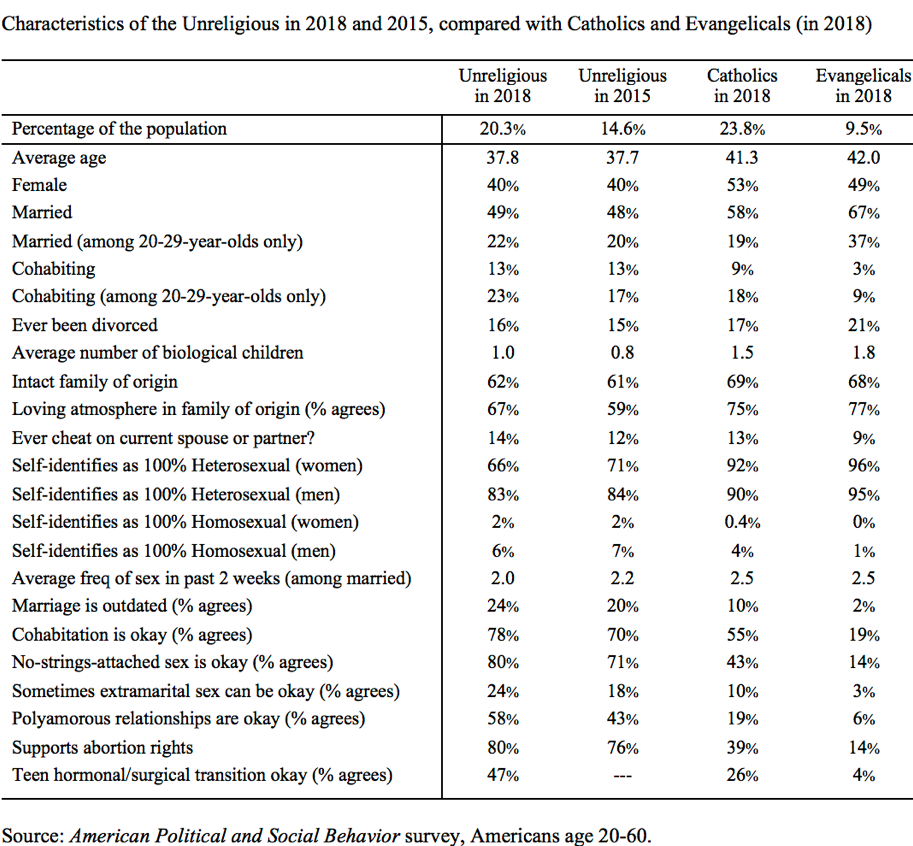
Views of unreligious, Catholic and evangelical Americans
Views of unreligious, Catholic and evangelical Americans (click to expand)

This is interesting:

Even when I limit the group to respondents below age thirty—which is just north of the median age at marriage in the United States—it is notable that 22 percent of the unreligious are married and 23 percent are currently cohabiting, not radically different from the 19 and 18 percent of Catholics that are married and cohabiting, respectively. For comparison, 37 and 9 percent of younger evangelicals are married and cohabiting, respectively. The cohabiting habits of the unreligious, however, have shifted—note the uptick in cohabitation—six percentage points in just under four years. That amounts to a 35 percent increase. Since it’s unlikely that the unreligious have recently changed their minds about the morality or pragmatics of living together, my bet is in the other direction: cohabiting leads many to no longer identify as religious at all.

Got that part in bold? Their attitudes are changing because of their sexual behaviors. So, if you want to reverse the decline of Christianity, we’re going to need to come up with some arguments and evidence to counter the sexual revolution. And on this blog, we’ve done that many times, looking at studies showing the future instability of marriages that occur after cohabitation. I’ve never heard a church preach on that, though. And it’s not something that even many Christian apologists focus on. Most Christian apologists, particularly the women, tend to focus on soft arguments,. They stay away from arguments about morality, because it’s divisive and abrasive to their desired audience. However, if the goal is persuading people that Christianity is a viable worldview, then we need to focus more on sexuality.

More Regnerus:

[O]n each of seven attitude measures I examined, the unreligious are notably more permissive than even the spiritual-but-not-religious (not shown). Nearly 80 percent of unreligious Americans agree (or strongly agree) that cohabitation is okay, no-strings-attached sex is okay, and abortion should be a legal right. This is all unsurprising. But even some of the more radically “progressive” attitudes demonstrate strong support among the unreligious: 24 percent agree that it is “sometimes permissible for a married person to have sex with someone other than his/her spouse.” (I thought perhaps women would differ from men here, but they didn’t—or at least not by much.) Although few Americans are actually in polyamorous living arrangements, the unreligious would support them should someone choose such an arrangement; 58 percent of them agreed that “it is okay for three or more consenting adults to live together in a sexual/romantic relationship,” a percentage that is far more supportive than Catholics or evangelicals. Among the latter, only 6 percent thinks polyamory could be okay.

A more interesting theme, however, is the surge in support for such alternatives. On each statement, note the rise in agreement that has occurred in just under four years. Polyamory tops the list—a 35-percent leap in the share of unreligious who now endorse polyamorous arrangements (from 43 to 58 percent). Even support for extramarital affairs grew by one-third (from 18 to 24 percent). The unreligious aren’t alone here. Catholics, too, have witnessed liberalization in attitudes. Evangelical numbers display a more modest uptick, and from lower starting points.

The non-religious people in my office who were raised Christian like to tell me that the existence of the Christian God isn’t important to them, because they can achieve marriage via cohabitation, and behave like good people without the need for any sort of framework to rationally ground it. They think that you can just pull out God, and the marriage will stay the same. They expect the people they start relationships with to act on Christian morality, even if the worldview was rejected as superstitious nonsense. But as you can see from the data, removing God has an enormous effect on the person’s ability to be stable and faithful.  The truth is that when you take out the vertical relationships with God, then the blueprint for the relationship becomes completely different. Relationships used to be seen as an enterprise where each person’s primary commitment was to lead and protect their spouse before delivering them to God with faith intact. Now, relationships are contingent on continuous happiness.

More Regnerus:

Only 66 percent of unreligious women say they are “100% Despite the permissive reputation of the unreligious, their actual marital sexual frequency is lower than that of Catholic and evangelical couples—at two instances in the past two weeks. As has been documented extensively in the past few years, the frequency of sex among American couples—whether cohabiting or married—has been declining at statistically significant rates. This pattern has not spared the godless.

I think this is interesting. I believe that men are facing an epidemic of sex-withholding from their wives, and I have an idea why that is. Today, women most commonly use sex to “jump start” a relationship with men who they perceive as “high value”, but who refuse to commit to them. This behavior is not focused on men who have commitment abilities, e.g. – provider, moral leader, spiritual leader, accurate worldview rooted in logic and evidence. Instead, most women use sex to get men who have the appearance of high value, e.g. – tall, tattoos, piercings, violent tendencies, exciting, fun, etc. Having established that pattern over and over with no-commitment bad boys, they marry someone who they see as beneath them, and then withhold sex. Commitment isn’t worthy of sex. It’s the man’s appearance and entertainment value that makes him worthy of sex. The comparison of this low-quality man to previous partners makes women more likely to initiate divorce for “unhappiness” later on.

Reminder: lack of border security will eventually lead to unrestricted abortion

Can you be pro-life and vote Democrat? Well, as we saw in the Democrat debates, all the Democrat candidates were in favor of open borders. And illegal immigrants tend to vote for higher taxes and more government, in order to get benefits from government provided by high-producing taxpayers. The net result of importing millions of big government voters is unrestricted abortion.

Here’s a nice article from Catholic journalist John Zmirak, who is so conservative that I could swear he’s a evangelical Protestant.

He writes:

I wrote this a long time ago: “Immigration decides whether America will be saved. Abortion determines whether it deserves to be.”

That sums up most of my politics. Not because I don’t care about other issues. Of course I do. But these two are what you might call “existential.” And they are also connected.

You see, the immigration issue decides a lot of others. In fact, it’s the tipping point for most of the topics conservatives care about. This for a simple and bluntly practical reason: Most immigrants vote Democrat.

[…]In many states that last year elected a pro-life, pro-family member of the Senate or the House, the vote margins were relatively close, and Hispanics voted two-to-one in favor of the pro-abortion Democrats. Had the voting rolls been padded with recently legalized immigrants … how many of these seats would still be in the hands of liberal Democrats who favor abortion on demand for all nine months (if need be, paid for by the taxpayer), gay “marriage,” explicit sex education and countless other measures that violate the most fundamental premises of the natural law?

[…][Let’s say we] grant amnesty — the full rights of citizenship, including the right to vote, collect government benefits and use affirmative action at the expense of (for instance) impoverished white male war veterans — to the estimated 10-12 million illegal immigrants in America. We would be adding at the very least 6.3-8 million liberal, pro-abortion voters. No, these recent illegals need not, by the laws of physics, vote for liberal, pro-abortion Democrats. But that is how they will vote, and anyone who tells you otherwise is lying.

[…][N]ew arrivals overwhelmingly tend to vote liberal and pro-choice. … Don’t believe us? Ask the Pew Research Center, which found in 2012:

“Hispanics are more likely than the general public to say they would rather have a bigger government which provides more services than a smaller government which provides fewer services.

“Some 75% of Hispanics hold this view; just 19% say they prefer a smaller government. By contrast, just 41% of the public at large voice support for a bigger government.

“Support for a larger government is highest among immigrant Latinos, with 81% holding this view.”

What’s really interesting to me in what he wrote is how he talked about how Roman Catholics, who are supposed to be pro-life, are actually in favor of abortion, because of their support for illegal immigration.

Hold on to your hats, this is very strong medicine, especially for Catholics:

The U.S. Catholic bishops, who beckon these immigrants into the country and profit from their arrival, could help. They could make it a priority to evangelize such new Americans on their duty to vote for just laws that preserve innocent life. Instead of voting for their own perceived tribal and economic interests (i.e. more free money from the government). No sign of the bishops attempting that, alas.

[…]As I’ve pointed out here before, the bishops collected 40% of their budget last year from federal contracts for non-profits. Most of those contracts were for serving immigrants. So their bottom line is at stake. Likewise filling the pews, since 40% of U.S.-born Catholics leave the Church and never come back. Immigrants briefly warm their empty seats, before leaving too. So immigration is a bottom line, life-or-death issue for these bishops. Abortion’s only a life and death issue to the babies. And the bishops don’t get a check from the feds for each baby saved.

Maybe if we could figure out some kind of bounty like that, we’d see the bishops fighting as hard for unborn babies as most do for de facto open borders.

What I found most interesting is how rank-and-file Catholics are more likely to vote Democrat than Republican. And that’s especially true of Catholic women.

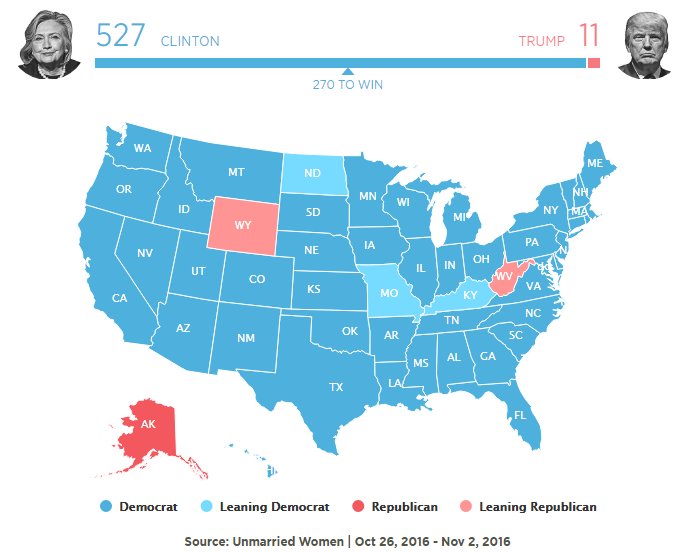
SurveyMonkey election poll cross tabs for unmarried women Nov 2016

Especially Catholic women

Here are the results from a recent survey of Catholic women:

According to America’s nationally representative survey of Catholic women, 55 percent of Catholic women who intend to vote in 2018 plan to vote for Democrats, while 37 percent plan to vote for Republicans. Three-quarters of all Catholic women intend to vote in 2018.

[…]Overall, the survey found that 59 percent of Catholic women are Democrats or lean Democratic, whereas 38 percent are Republican or lean Republican. (Those numbers decrease to 41 percent Democratic and 24 percent Republican without “leaners.”)

I’m not sure if these Democrat-voting Catholic women realize the long-term consequences of their voting on issues like abortion, but they should. At least, they should if they hope to get married, because marriage-minded men probably aren’t interested in marrying a woman who favors murdering innocent people as an “antidote” to reckless, premarital sex. No marriage-minded man would put a woman who supports abortion with her voting in charge of his children.