Category Archives: Polemics

Has Christianity held back the progress of science? What about Galileo?

First, here’s an article from the peer-reviewed journal Nature, probably the best peer-reviewed journal on science in the world.

The article is written by James Hannam. He has a PhD in the History and Philosophy of Science from the University of Cambridge and is the author of The Genesis of Science: How the Christian Middle Ages Launched the Scientific Revolution (published in the UK as God’s Philosophers: How the Medieval World Laid the Foundations of Modern Science).

Excerpt:

Few topics are as open to misunderstanding as the relationship between faith and reason. The ongoing clash of creationism with evolution obscures the fact that Christianity has actually had a far more positive role to play in the history of science than commonly believed. Indeed, many of the alleged examples of religion holding back scientific progress turn out to be bogus. For instance, the Church has never taught that the Earth is flat and, in the Middle Ages, no one thought so anyway. Popes haven’t tried to ban zero, human dissection or lightening rods, let alone excommunicate Halley’s Comet. No one, I am pleased to say, was ever burnt at the stake for scientific ideas. Yet, all these stories are still regularly trotted out as examples of clerical intransigence in the face of scientific progress.

Admittedly, Galileo was put on trial for claiming it is a fact that the Earth goes around the sun, rather than just a hypothesis as the Catholic Church demanded. Still, historians have found that even his trial was as much a case of papal egotism as scientific conservatism. It hardly deserves to overshadow all the support that the Church has given to scientific investigation over the centuries.

That support took several forms. One was simply financial. Until the French Revolution, the Catholic Church was the leading sponsor of scientific research. Starting in the Middle Ages, it paid for priests, monks and friars to study at the universities. The church even insisted that science and mathematics should be a compulsory part of the syllabus. And after some debate, it accepted that Greek and Arabic natural philosophy were essential tools for defending the faith. By the seventeenth century, the Jesuit order had become the leading scientific organisation in Europe, publishing thousands of papers and spreading new discoveries around the world. The cathedrals themselves were designed to double up as astronomical observatories to allow ever more accurate determination of the calendar. And of course, modern genetics was founded by a future abbot growing peas in the monastic garden.

But religious support for science took deeper forms as well. It was only during the nineteenth century that science began to have any practical applications. Technology had ploughed its own furrow up until the 1830s when the German chemical industry started to employ their first PhDs. Before then, the only reason to study science was curiosity or religious piety. Christians believed that God created the universe and ordained the laws of nature. To study the natural world was to admire the work of God. This could be a religious duty and inspire science when there were few other reasons to bother with it. It was faith that led Copernicus to reject the ugly Ptolemaic universe; that drove Johannes Kepler to discover the constitution of the solar system; and that convinced James Clerk Maxwell he could reduce electromagnetism to a set of equations so elegant they take the breathe away.

Given that the Church has not been an enemy to science, it is less surprising to find that the era which was most dominated by Christian faith, the Middle Ages, was a time of innovation and progress. Inventions like the mechanical clock, glasses, printing and accountancy all burst onto the scene in the late medieval period. In the field of physics, scholars have now found medieval theories about accelerated motion, the rotation of the earth and inertia embedded in the works of Copernicus and Galileo. Even the so-called “dark ages” from 500AD to 1000AD were actually a time of advance after the trough that followed the fall of Rome. Agricultural productivity soared with the use of heavy ploughs, horse collars, crop rotation and watermills, leading to a rapid increase in population.

I hope this will set the record straight – Judeo-Christian monotheism created the enterprise of experimental science.

Positive arguments for Christian theism

Tactical Faith will live-stream the responses to the Craig-Carroll debate on Saturday

The schedule of events for Saturday is on the Greer-Heard web site.

Saturday, Feb. 22nd, 2014 schedule: (ALL TIMES CENTRAL)

9:00 a.m. Tim Maudlin, ”Cosmology, Theology and Meaning”

10:00 a.m. Robin Collins, “God and the Fine-tuning of the Universe for Discovery”

11:00 a.m. Lunch (New Orleans Style Red Beans & Rice) Cafeteria

12:30 p.m. Alex Rosenberg, “How Physics Fakes Design, and Makes Things Difficult for Theism”

1:30 p.m. James Sinclair, “Cosmology and Cosmologists Within the ‘Does God Exist’ Question”

2:30 p.m. Concluding Comments from Sean Carroll and William Lane Craig

For Eastern times, add an hour.

Click here for the the live-stream. Note: You have to click on this link and go back to the main page each time a response ends, because the youtube link is different for each response.

Is there a recording?

I do have a recording of last night’s debates, but I’m not posting it unless I get permission.

Quick thoughts on the debate:

Carroll was as good of a speaker as Craig in terms of style. Very easy to listen to, very quick on his feet, very civil. There was no clear winner on style.

It was difficult to assess the truth value of scientific points being made, especially for the layperson. I explained a few of them in my posts earlier this week, but I think laypeople might struggle with them if they are hearing about these things for the first time.

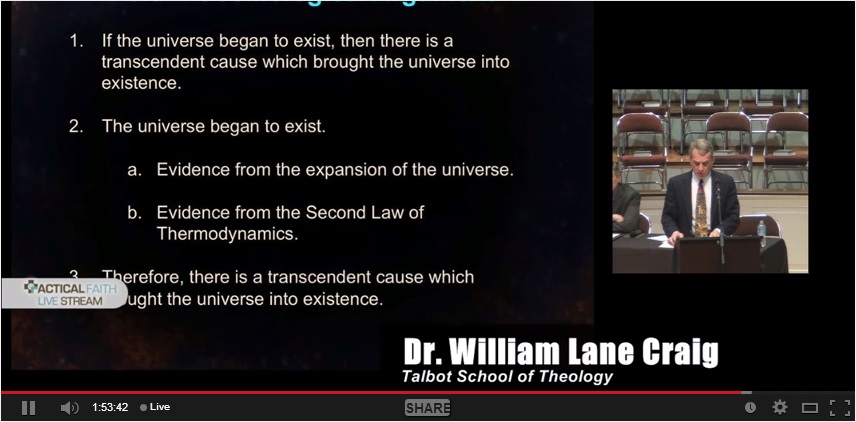
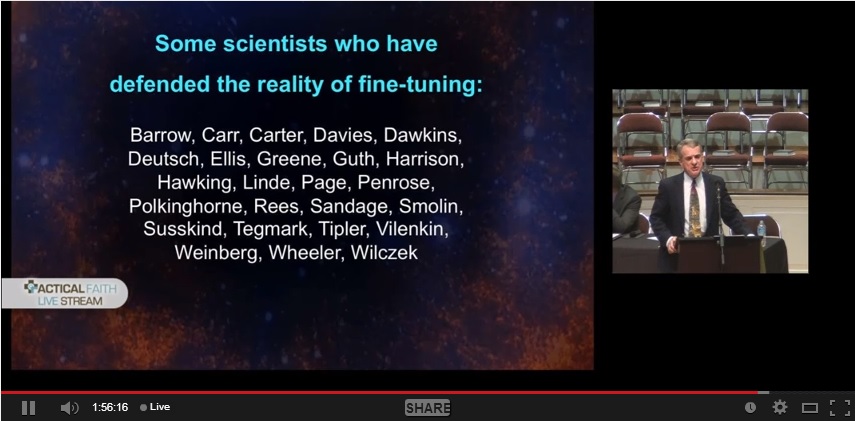
A couple of Craig’s slides: (click for larger images)

Slide 1 of 2:

Dr. Craig slide #1 of 2

Slide 2 of 2:

Dr. Craig slide #2 of 2

Quick summary: (this is not complete, because I couldn’t get everything they were saying noted)

Dr. Craig defended two arguments: 1) the kalam cosmological argument and the fine-tuning argument.

Dr. Craig supported the origin of the universe with 1) the expansion of the universe and 2) the second law of thermodynamics.

Dr. Craig said that the BGV theorem supports a beginning for the universe.

Dr. Craig said that the consensus of scientists did not accept Carroll’s naturalistic cosmology, quoting Stephen Hawking in support.

Dr. Craig said that multiverse models fall victim to the Boltzmann brain problem, where we should observe Boltzmann brains coming into existence and then phasing out again far more probably than embodied minds. But we observe embodied minds, and no Boltzmann brains.

Dr. Carroll said that science cannot study metaphysical questions.

Dr. Carroll said that science is about making models that may or may not be consistent with the experimental data.

Dr. Carroll said that the BGV theorem does not support a beginning for the universe.

Dr. Carroll proposed 17 alternative cosmologies, but did not provide a shred of scientific evidence for any of them, the way that Craig did for the standard model.

Dr. Carroll refuted Dr. Craig’s citation of Stephen Hawking, and Craig yielded the point.

Dr. Carroll speculated that science might progress to the point where the fine-tuning can be explained without an intelligent cause, and he gave an example of where that happened (inflation).

Dr. Craig argued that all 17 of the models suggested by Carroll either conflicted with evidence, had serious problems or did require a beginning.

Dr. Craig argued that Carroll’s own model required a beginning.

Dr. Craig argued that Carroll’s own model fell victim to the Boltzmann brain problem.

Dr. Craig argued that Carroll’s own model violated the second law of thermodynamics.

Dr. Craig re-stated his point that the baby universe spawning in Carroll’s model was speculative and incomplete, and cited Christopher Weaver’s work.

Dr. Carroll denied that things that pop into being out of nothing require a transcendent cause.

Dr. Carroll reiterated that science can only make naturalistic models, and that he did not have to answer questions about ultimate causes.

Dr. Carroll showed a photo of Alan Guth expressing his opinion that the universe is “probably” eternal. No evidence was given for this assertion.

Dr. Carroll said that the fine-tuning was not done in an optimal way, because one fine-tuned value was lower than it needed to be, and it should be exactly what it needed to be if God did it.

Dr. Carroll said that a finely-tuned universe is more probably in naturalism than in theism, because God can do anything he wants and doesn’t need a fine-tuned universe.

Dr. Carroll said he would stop defending his model now, and would instead defend Aguirre-Gratton.

Dr. Craig gave three reasons why the universe popping into being out of nothing requires a transcendent cause.

First, he said that nothing cannot cause anything to happen, because nothing is nothing.

Second, he said that if things pop into being out of nothing, then why don’t we see it happening all the time with other things.

Third, he said that we have no reason to dismiss the causal principle, especially when it is the basis of scientific inquiry and has been so fruitful in the progress of science.

Dr. Craig reiterated that baby universes in Carroll’s model would be dominated by Boltzmann brains, and we don’t observe that.

Dr. Craig said that even on the quantum gravity models that Carroll mentioned, there would still be a beginning.

Dr. Carroll said that Craig mustn’t say “popped into being” but instead that “there was a first moment of time”.

Dr. Carroll said that his model does indeed violate the second law of thermodynamics “YES!”.

At this point Carroll stopped talking about the topic of the debate and started expressing personal opinions about religion. It’s funny how often atheists do this in debates.

Dr. Carroll said that most theists don’t believe in God because of cosmology, but because of community and feelings.

Dr. Carroll said that science had learned a lot in the last 2000 years, so theism was false.

Dr. Carroll said that most philosophers don’t think that God exists, so theism was false.

Dr. Carroll said microscopes and telescopes were absent 2000 years ago, so theism was false.

Dr. Carroll said that religion should be about community and feelings, not about what is true.

Conclusion:

My conclusion was that Carroll lost because he is just satisfied to throw theories out and not to argue that they are true by citing evidence. Carroll never seemed to be interested in finding out what is true, but instead he just wanted to tell a story that didn’t include God, and assert that by Occam’s Razor, his story was a better explanation. I am not impressed with theoretical speculations, although the layperson might be. I kept waiting for him to respond to Craig’s points about how his model was falsified by experimental evidence and observations, e.g. – the Boltzmann brains or the baby universe generation, and he never cited the evidence I wanted him to cite. Craig did have some evidence for his views, but he could have been stronger in making his case. He could have shown the e-mail from Vilenkin that stated that he had understood the BGV theorem, and was using it correctly, for example.

For me the winning side comes down to evidence. The standard model is the standard model because of scientific evidence. Until that evidence is overturned, then speculative models are of no interest to anyone who is evidence-driven. Speculations are not science. A philosophical presupposition of metaphysical naturalism is not science.

The nice thing is that Robin Collins, one of Craig’s respondents, went deep into the science of the fine-tuning, especially on one of my favorite data points, the cosmic microwave background radiation. The paper he presented is now posted on his web site (H/T Christian Apologetics Alliance). I posted about the CMBR before in my post about particle physicist Michael Strauss lecture on cosmology and fine-tuning at Stanford University and the his more recent lecture at the University of Texas. Note that Strauss is an experimental physicist, not a theoretical physicist like Carroll.

Unfortunately, naturalistic respondent Tim Maudlin said nothing at all of value, choosing to use his time to speak about the evils of the coal industry and the threat of global warming, despite the fact that the IPCC says there has been no significant global warming in the past 17 years.

The last two respondents have started speaking. I’m expecting the philosopher Alex Rosenberg to stay away from the science, and then we’ll hear from the experimental scientist James Sinclair. Rosenberg spoke on Darwinian evoloution being incompatible with theism, and it was interesting, but off topic for this debate. James Sinclair is speaking now, and is giving a technical paper on cosmology.

I may be posting a more accurate summary sometime next week, especially if they release either the audio or the video. If not, this will be it.

UPDATE: here’s another review by Randy Everist of Possible Worlds blog. He explains the back-and-forth over Boltzmann brains and the BGV theorem in more detail.

Ready for the Craig-Carroll debate? review the BGV theorem and quantum tunneling

UPDATE: My brief summary of the Craig-Carroll debate is now posted. I may do a longer one next week if they release audio/video. Otherwise, the short summary will be it.

In the debate between William Lane Craig and Peter Millican, William Lane Craig presented the arguments for theism, including his standard Kalam cosmological argument which asserts that the universe had a beginning. The atheist, Peter Millican, raised several objections to the notion of a beginning to the universe. But Craig was able to establish the beginning of the universe by appealing to something called the Borde-Guth-Vilenkin theorem. This theorem is new – but it is worth learning about.

First, let’s review Craig’s cosmological argument:

A1) The origin of the universe

  1. The universe began to exist.
  2. If the universe began to exist, then the universe has a transcendent cause.
  3. The universe has a transcendent cause.

The origin of the universe is confirmed by philosophical arguments and scientific evidence.

There cannot be an actual infinite number of past events, because mathematical operations like subtraction and division cannot be applied to actual infinities.

The Borde-Guth-Vilenkin (BGV) proof shows that every universe that expands must have a space-time boundary in the past. That means that no expanding universe, no matter what the model, can be eternal into the past.

Even speculative alternative cosmologies do not escape the need for a beginning.

The cause of the universe must be transcendent and supernatural. It must be uncaused, because there cannot be an infinite regress of causes. It must be eternal, because it created time. It must be non-physical, because it created space. There are only two possibilities for such a cause. It could be an abstract object or an agent. Abstract objects cannot cause effects. Therefore, the cause is an agent.

So he appealed to the Bord-Guth-Vilenkin theorem right from the start in order to guarantee a space-time boundary in the past – i.e., a beginning of the universe, which is his premise 1.

Ok, now let’s take a look at some videos on this theorem.

The Borde-Guth-Vilenkin theorem, explained

From the Craig-Millican debate:

The BGV theorem also came up in the Craig-Krauss debate:

See my summary of the Craig-Krauss debate for more. I also wrote about after the debate, where it was shown that Krauss misrepresented the BGV theory to favor naturalism. So that’s why we all need to be familiar with what it says and how it is misrepresented by naturalists in debates. That will prepare us to understand what is happening in tonight’s debate.

I also expect quantum tunneling to come up in tonight’s debate, and here is a clip from Dr. Craig’s first debate with Lawrence Krauss at North Carolina State University.

Further study

If you would like to read a nice LONG article about Craig’s cosmological argument, just check this post I wrote a while back. And it even contains a nice peer-reviewed paper that Craig wrote for an Astrophysics journal – and the abstract is online on Springer.