
Category Archives: Polemics

The best explanation for the design of bird wings is intelligent design

A great post from Evolution News about my favorite animals in the whole world – BIRDS!

Excerpt:

How hard can it be to make a flexible wing flap for an airplane? Almost all aircraft today use rigid wings with rigid landing flaps. They work, but they waste fuel. German engineers embarked on a mission to reduce kerosene consumption by 6%: “integrating flexible landing devices into aircraft wings is one step towards that target,” a news item from Fraunhofer says. They’ve named the project SARISTU, for Smart Intelligent Aircraft Structures.

Birds are way ahead of them:

While birds are able to position their feathers to suit the airflow, aircraft wing components have so far only been rigid. As the name suggests, landing flaps at the trailing edge of the wing are extended for landing. This flap, too, is rigid, its movement being limited to rotation around an axis. This is set to change in the SARISTU project. “Landing flaps should one day be able to adjust to the air flow and so enhance the aerodynamics of the aircraft,” explains Martin Schüller, researcher at the Fraunhofer Institute for Electronic Nano Systems ENAS in Chemnitz. (Emphasis added.)

What are some of the challenges in building a flexible wing?

  1. Knowing where to flex: The flap can’t be flexible all over, or it would be hard to control. The designers made “five hard and three soft zones, enclosed within a silicon skin cover extending over the top.”
  2. Finding stretchy skin: When the soft zone moves, the skin of the aircraft has to stretch with it. “The mechanism that allows the landing flap to change shape can only function if the skin of the landing flap can be stretched as it moves, a problem tackled by researchers from the Fraunhofer Institute for Manufacturing Technology and Advanced MaterialsIFAM in Bremen.”
  3. Covering the air gap: “Any gap between the flap and the fixed aircraft wingwould cancel out any positive effect,” the article notes. “This led us to develop an elastic connecting element, and this work already covers everything from the chemical makeup to the process technology andmanufacture of the component,” an engineer says.
  4. Designing the material to tolerances: “The mechanism sits underneath the soft zones, the areas that are most distended. While the novel design is noteworthy, it is the material itself that stands out, since the flexible parts are made of elastomeric foam that retain their elasticity even attemperatures ranging from minus 55 to 80 degrees Celsius.”

No feathers, but it’s a start. The team showed off their prototype at the ILA Berlin Air Show in May. Apparently it was not quite ready for takeoff:

When the prototype takes off for the first time it will benefit from a development known as SARISTU, a deformable wing which is currently the subject of intensive research by Fraunhofer Gesellschaft. In future the landing flaps will be designed to adapt in flight to the air flow conditions, thereby always ensuring the best possible aerodynamics.

We celebrate this advance, but you know where we’re going. Birds had it all figured out long ago: the right shape, the right material, the control of airflow, and much more. As Dr. Timothy Standish says in the film Flight: The Genius of Birds, “Feathers do a number of jobs remarkably well.” They are individually controllable, they flex, they insulate, they save on weight, and they can handle the temperature requirements of avian flight. That’s just a partial list achievements in powered flight that surpass anything man has yet designed.

If you want to get hold of that DVD on “Flight” that they mentioned, it’s right here on Amazon.com. I highly recommend it.

I also highly recommend owning birds – because if you work really hard at caring for one for a long time, they might grow to trust you. There is nothing quite like a tiny little bird trusting you enough to let you gently pull open his or her wing for a closer look at how it works:
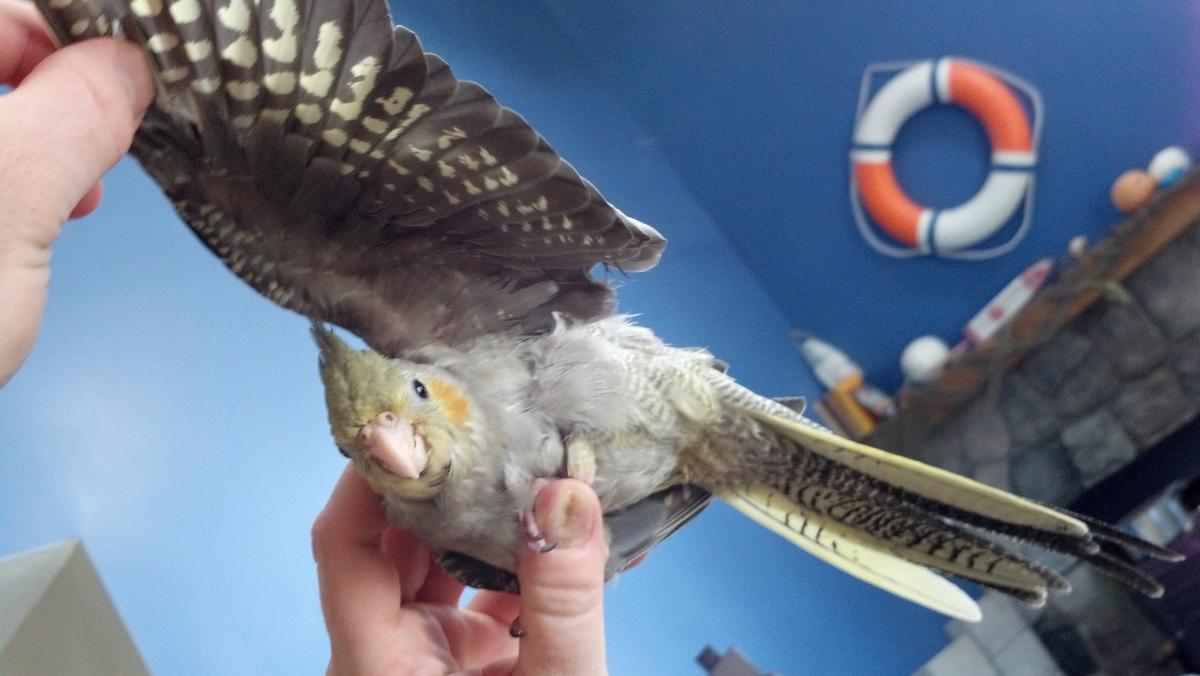
Cockatiel lets a trusted friend see her wing
Awww! Cockatiel lets a trusted friend see under her wing

There’s more to birds than just well-designed wings. There’s a well-designed heart in there, too! That might even be more amazing than the design of the wing. It is to me.

Note: although this post does not provide a rigorous case for intelligent design, that can be found by looking at the work of Stephen C. Meyer on the origin of life and on the Cambrian explosion. The books that demonstrate the superiority of the intelligent design hypothesis are “Signature in the Cell” and “Darwin’s Doubt“. If you’d like to see a good popular-level presentation of intelligent design related to the origin of life, click here for a lecture.

Kevin DeYoung: five questions for Christians who support same-sex marriage

The five questions are in this TGC post.

The list:

  1. On what basis do you still insist that marriage must be monogamous?
  2. Will you maintain the same biblical sexual ethic in the church now that you think the church should solemnize gay marriages?
  3. Are you prepared to say moms and dads are interchangeable?
  4. What will you say about anal intercourse?
  5. How have all Christians at all times and in all places interpreted the Bible so wrongly for so long?

I want to focus on questions 3 and 4, because they show that the same-sex marriage side is not “nice”. They are not taking their position in order to promote goodness.

Take a look:

3. Are you prepared to say moms and dads are interchangeable?

It is a safe assumption that those in favor of gay marriage are likely to support gay and lesbian couples adopting children or giving birth to children through artificial insemination. What is sanctioned, therefore, is a family unit where children grow up de facto without one birth parent. This means not simply that some children, through the unfortunate circumstances of life, may grow up without a mom and dad, but that the church will positively bless and encourage the family type that will deprive children of either a mother or a father. So are mothers indispensable? Is another dad the same as a mom? No matter how many decent, capable homosexual couples we may know, are we confident that as a general rule there is nothing significant to be gained by growing up with a mother and a father?

4. What will you say about anal intercourse?

The answer is probably “nothing.” But if you feel strongly about the dangers of tobacco or fuss over the negative affects of carbs, cholesterol, gmo’s, sugar, gluten, trans fats, and hydrogenated soybean oil may have on your health, how can you not speak out about the serious risks associated with male-male intercourse. How is it loving to celebrate what we know to be a singularly unhealthy lifestyle? According to the Journal of the American Medical Association, the risk of anal cancer increases 4000 percent among those who engage in anal intercourse. Anal sex increases the risk of a long list of health problems, including “rectal prolapse, perforation that can go septic, chlamydia, cyrptosporidosis, giardiasis, genital herpes, genital warts, isosporiasis, microsporidiosis, gonorrhea, viral hepatitis B and C, and syphilis” (quoted in Reilly, 55). And this is to say nothing of the higher rates of HIV and other health concerns with disproportionate affects on the homosexual community.

Read the whole thing.

Are same-sex unions the same as heterosexual married unions?

I’ve written before about the differences between same-sex unions and opposite sex married couples.

Here’s a post from Canon and Culture on the same topic by social scientist Glenn Stanton.

He finds two differences.

First, instability:

[T]he research is strong and numerous enough that a recent and very provocative Atlantic cover story on what straights could learn from gay marriage couldn’t ignore it. Liza Mundy, the article’s author, doesn’t appear to have a conservative bone in her body, yet she is fair and straight-up honest with the research on the nature of committed same-sex relationships.

[…]Mundy explains that studies have found “higher dissolution rates among same-sex couples” in Scandinavia – one of the world’s most gay-friendly cultures — than married heterosexual couples. This study, published in Demography, found that even though same-sex couples enter their legal unions at older ages — a marker related to greater relational stability – male same-sex marriages break up at twice the rate of heterosexual marriages.  And the break-up rate for lesbians? A stunning 77% higher  than the same-sex male unions! When controlling for possible confounding factors, the “risk of divorce for female partnerships actually is more than twice than that for male unions.”

[…]A study of two generations of British couples (one born 1958, the other 1970) in same-sex cohabiting, opposite-sex cohabiting and opposite-sex marriage relationships found the same-sex relationships dramatically more likely to break up than the opposite-sex cohabiting and married relationships.

According to that British study, only 25% of same-sex co-habitating couples are intact after  8 years. The stability number for married couples after 8 years is 82%. That’s a big difference.

But there’s more:

Other studies – conducted by celebrated lesbian scholars – find notable instability in lesbian homes, even those with children. The current National Longitudinal Lesbian Family Study (NLLFS) found “a significant difference” in family dissolution rates when comparing lesbian with mother/father headed families, 56% and 36% respectively. (p. 1201)

Another research study by two celebrated gay-friendly scholars, highlights a major comparative study between hetero and lesbian homes where, in the 5-year period of the study, 6 of the 14 lesbian mother-headed homes had broken up compared to only 5 of the 38 mom/dad headed homes. (p. 11) These scholars creatively explains that this stability imbalance is likely due to the “high standards lesbians bring to their intimate unions…” (p.12)

Ever heard of lesbian bed death?

And Mundy points something else predictable in lesbian relationships. In fact, its consistency has earned it a name in the LGBT community: lesbian bed death. Seriously.  This is the truth that sexual interest and frequency in many long-term lesbian relationships tends to decline considerably and even die over the years.

Usually, in relationships, men tend to be the ones who want more frequent sex. What happens when you have no aggressors and two gatekeepers? Lesbian bed death.

Next up, something common in male homosexual relationships: infidelity.

Stanton writes:

A noted 2010 study on non-monogamy in long-term gay relationships by two gay-affirming scholars — the Couples Study — observes in their report’s first sentence: “…non-monogamous relationships are very common in the gay community…” Their data showed that of the non-monogamous, long-term couples in their study, 42 percent made an arrangement for outside-sexual relationships within the first three months of the relationship’s beginning and by the end of the first year, that number increased to 49 percent. At the seventh anniversary mark, an additional 24 percent of gay couples adopted such agreements. So such agreements are increasingly made as these relationships grow longer.

The Atlantic piece is notes this as well; explaining that after the AIDS crisis, “gay male couples are more monogamous than they used to be, but not nearly to the same degree as other kinds of couples.” One study Mundy cites asked those in various relationships whether they had any agreed-upon rules permitting extra-curricular activities. The differences were astonishing. Only 4% of male/female couples had them compared to 40% of gay men in legally recognized unions and 49% in long-term cohabiting unions.

Another widely respected investigation, found that only a third of gay couples had monogamous agreements and truly honored them with no outside sex. In fact, it found that in the openly nonmonogamous gay relationships, the frequency of extra-dyadic sex from its start ranged from 2 to a whopping 2,500 separate incidents. The median was a remarkable 41.5 extracurricular incidents since the relationship’s beginning. Frequency in the last year was startling was well, ranging from 0 to 350 occurrences of outside sex, with a median of 8 incidences in the last twelve months. Even those who pledged true monogamy, the range was from 1 to 63 “slip-ups” with a median of 5. Five “slip-ups” are not slip-ups. The corresponding numbers for men in heterosexual marriages are microscopic in comparison.

So what does all this mean?

It means that if you are interested in a definition of marriage that involves stability and marital fidelity, then you shouldn’t be in favor of legalizing gay marriage. When you open up the term marriage to include relationships that seem to be very unstable and/or very unfaithful, you change the definition of marriage. Marriage means life-long married love. If we just turn around and call any association of adults “marriage”, then we are losing the distinctiveness of marriage in the process. Think about it. We did the same thing in the previous redefinition of marriage (no-fault divorce) which attacked the permanence of marriage. Marriage has a specific meaning and we should not be redefining it every few years for the benefit of selfish adults.