
Category Archives: Polemics

How do atheists try to accommodate the Big Bang in their worldview?

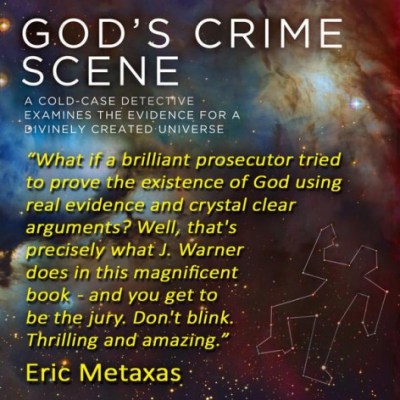
J. Warner Wallace: God's Crime Scene
J. Warner Wallace: God’s Crime Scene

OK, so J. Warner Wallace has a new book out and it’s about science and God. I know, because I saw pictures of his reading list, that he has read tons and tons of atheists like Carl Sagan, Lawrence Krauss and so on.

He’s writing about some of the things he learned from all this reading on his blog, and I wanted to link to something about Lawrence Krauss trying to accommodate the Big Bang within his worldview of atheism.

Wallace writes:

One of the key pieces of evidence in the universe is simply it’s origin. If our universe began to exist, what could have caused it’s beginning? How did everything (all space, time and matter) come into existence from nothing? One way atheist physicists have navigated this dilemma has simply been to redefine the terms they have been using. What do we mean when we say “everything” or “nothing”? At first these two terms might seem rather self-explanatory, but it’s important for us to take the time to define the words. As I’ve already stated, by “everything” we mean all space, time and matter. That’s right, space is “something”; empty space is part of “everything” not part of “nothing”. For some of us, that’s an interesting concept that might be hard to grasp, but it’s an important distinction that must be understood. When we say “nothing”, we mean the complete absence of everything; the thorough non-existence of anything at all (including all space time and matter). These two terms, when defined in this way, are consistent with the principles of the Standard Cosmological Model, but demonstrate the dilemma. If everything came from nothing, what caused this to occur? What is the non-spatial, atemporal, immaterial, uncaused, first cause of the universe? A cause of this sort sounds a lot like a supernatural Being, and that’s why I think many naturalists have begun to redefine the terms.

Lawrence Krauss, Arizona State University Professor (School of Earth and Space Exploration and Director of the Origins Initiative) wrote a book entitled, “A Universe from Nothing: Why There Is Something Rather than Nothing”. As part of the promotion for the book, Krauss appeared on the Colbert Report where he was interviewed by comedian Stephen Colbert. During the interview, Krauss tried to redefine “nothing” to avoid the need for a supernatural first cause:

“Physics has changed what we mean by nothing… Empty space is a boiling, bubbling brew of virtual particles popping in and out of existence… if you wait long enough, that kind of nothing will always produce particles.” (Colbert Nation, June 21st, 2012)

Now if you’re not careful, you might miss Krauss’ subtle redefinition. In describing the sudden appearance of matter (“particles”), Krauss assumes the prior existence of space (“empty space”) and time (“if you wait long enough”). If you’ve got some empty space and wait long enough, matter appears. For Krauss, the “nothing” from which the universe comes includes two common features of “everything” (space and time), and something more (virtual particles). This leaves us with the real question: “Where did the space, time and virtual particles come from (given all our evidence points to their origination at the beginning of our universe)?” Krauss avoids this inquiry by moving space and time from the category of “something” to the category of “nothing”.

If you’ve got a teenager in your house, you might recognize Krauss’ approach to language. I bet you’ve seen your teenager open the refrigerator door, gaze at all the nutritious fruits and vegetables on the shelves, then lament that there is “nothing to eat.”

I used to say that when I was a teenager, but I grew out of it. I didn’t go on the Comedy Channel and try to convince everyone that what I was saying about the refrigerator was scientific.

Anyway, here is a debate between William Lane Craig and Lawrence Krauss, if you want to see how Krauss defends his “refrigerator has nothing to eat” view of cosmology. I know everybody and even many Christians all think that we have something to hide when it comes to science, but if you would just watch these debates, you would see that there is nothing to fear from science at all. We own it.

Meanwhile, I want to show you that this is not at all rare among atheists.

Look, here is Peter Atkins explaining how he makes the Big Bang reconcile with his atheism – and notice that it’s a completely different view than Krauss:

So, just who is this Peter Atkins, and why is he a good spokesman for atheism?

From his Wikipedia bio.

Peter William Atkins (born August 10, 1940) is an English chemist and a fellow and professor of chemistry at Lincoln College of the University of Oxford. He is a prolific writer of popular chemistry textbooks, including Physical Chemistry, 8th ed. (with Julio de Paula of Haverford College), Inorganic Chemistry, and Molecular Quantum Mechanics, 4th ed. Atkins is also the author of a number of science books for the general public, including Atkins’ Molecules and Galileo’s Finger: The Ten Great Ideas of Science.

[…]Atkins is a well-known atheist and supporter of many of Richard Dawkins’ ideas. He has written and spoken on issues of humanism, atheism, and what he sees as the incompatibility between science and religion. According to Atkins, whereas religion scorns the power of human comprehension, science respects it.

[…]He was the first Senior Member for the Oxford Secular Society and an Honorary Associate of the National Secular Society. He is also a member of the Advisory Board of The Reason Project, a US-based charitable foundation devoted to spreading scientific knowledge and secular values in society. The organisation is led by fellow atheist and author Sam Harris.

Now watch that 6-minute video above. Peter Atkins thinks that nothing exists. He thinks he doesn’t exist. He thinks that you don’t exist. This is how atheism adapts to a world where the Big Bang creation event is fact.

I think Peter Atkins should join Lawrence Krauss on the Comedy Channel and present that view. I would laugh. Wouldn’t you?

What are the historical arguments for the empty tomb story?

I wanted to go over this article by William Lane Craig which includes a discussion of the empty tomb, along with the other minimal facts that support the resurrection.

The word resurrection means bodily resurrection

The concept of resurrection in use among the first converts to Christianity was a Jewish concept of resurrection. And that concept of resurrection is unequivocally in favor of a bodily resurrection. The body (soma) that went into the grave is the body (soma) that came out.

Craig explains what this means with respect to the fast start of Christian belief:

For a first century Jew the idea that a man might be raised from the dead while his body remained in the tomb was simply a contradiction in terms. In the words of E. E. Ellis, “It is very unlikely that the earliest Palestinian Christians could conceive of any distinction between resurrection and physical, ‘grave emptying’ resurrection. To them an anastasis without an empty grave would have been about as meaningful as a square circle.”

And:

Even if the disciples had believed in the resurrection of Jesus, it is doubtful they would have generated any following. So long as the body was interred in the tomb, a Christian movement founded on belief in the resurrection of the dead man would have been an impossible folly.

It’s significant that the belief in the resurrection started off in the city where the tomb was located. Anyone, such as the Romans or Jewish high priests, who wanted to nip the movement in the bud could easily have produced the body to end it all. They did not do so, because they could not do so, although they had every reason to do so.

There are multiple early, eyewitness sources for the empty tomb

Paul’s early creed from 1 Corinthians 15:3-7, dated to within 5 years of the crucifixion, implies the empty tomb.

Craig writes:

In the formula cited by Paul the expression “he was raised” following the phrase “he was buried” implies the empty tomb. A first century Jew could not think otherwise. As E. L. Bode observes, the notion of the occurrence of a spiritual resurrection while the body remained in the tomb is a peculiarity of modern theology. For the Jews it was the remains of the man in the tomb which were raised; hence, they carefully preserved the bones of the dead in ossuaries until the eschatological resurrection. There can be no doubt that both Paul and the early Christian formula he cites pre-suppose the existence of the empty tomb.

The dating of the resurrection as having occurred “on the third day” implies the empty tomb. The date specified for the resurrection would have been the date that the tomb was discovered to be empty.

The phrase “on the third day” probably points to the discovery of the empty tomb. Very briefly summarized, the point is that since no one actually witnessed the resurrection of Jesus, how did Christians come to date it “on the third day?” The most probable answer is that they did so because this was the day of the discovery of the empty tomb by Jesus’ women followers. Hence, the resurrection itself came to be dated on that day. Thus, in the old Christian formula quoted by Paul we have extremely early evidence for the existence of Jesus’ empty tomb.

A few quotes from atheist historians not from Dr. Craig’s article: (thanks to Eric of Ratio Christi OSU)

Michael Goulder (Atheist NT Prof. at Birmingham) “…it goes back at least to what Paul was taught when he was converted, a couple of years after the crucifixion.” [“The Baseless Fabric of a Vision,” in Gavin D’Costa, editor, Resurrection Reconsidered (Oxford, 1996), 48.]

Gerd Lüdemann (Atheist Prof of NT at Göttingen): “…the elements in the tradition are to be dated to the first two years after the crucifixion of Jesus…not later than three years… the formation of the appearance traditions mentioned in I Cor.15.3-8 falls into the time between 30 and 33 CE.” [The Resurrection of Jesus, trans. by Bowden (Fortress, 1994), 171-72.]

Robert Funk (Non-Christian scholar, founder of the Jesus Seminar): “…The conviction that Jesus had risen from the dead had already taken root by the time Paul was converted about 33 C.E. On the assumption that Jesus died about 30 C.E., the time for development was thus two or three years at most.” [Roy W. Hoover, and the Jesus Seminar, The Acts of Jesus, 466.]

The early pre-Markan burial narrative mentions the empty tomb. This source pre-dates Mark, the earliest gospel. The source has been dated by some scholars to the 40s. For example, the atheist scholar James Crossley dates Mark some time in the 40s. (See the debate below)

The empty tomb story is part of the pre-Markan passion story and is therefore very old. The empty tomb story was probably the end of Mark’s passion source. As Mark is the earliest of our gospels, this source is therefore itself quite old. In fact the commentator R. Pesch contends that it is an incredibly early source. He produces two lines of evidence for this conclusion:

(a) Paul’s account of the Last Supper in 1 Cor. 11:23-5 presupposes the Markan account. Since Paul’s own traditions are themselves very old, the Markan source must be yet older.

(b) The pre-Markan passion story never refers to the high priest by name. It is as when I say “The President is hosting a dinner at the White House” and everyone knows whom I am speaking of because it is the man currently in office. Similarly the pre-Markan passion story refers to the “high priest” as if he were still in power. Since Caiaphas held office from AD 18-37, this means at the latest the pre-Markan source must come from within seven years after Jesus’ death. This source thus goes back to within the first few years of the Jerusalem fellowship and is therefore an ancient and reliable source of historical information.

So we are dealing with very early sources for the empty tomb.

Lack of legendary embellishments

The empty tomb narrative in the gospels lacks legendary embellishments, unlike later 2nd century forgeries that originated outside of Jerusalem.

The eyewitness testimony of the women

This is the evidence that has been the most convincing to skeptics, and to me as well.

The tomb was probably discovered empty by women. To understand this point one has to recall two facts about the role of women in Jewish society.

(a) Woman occupied a low rung on the Jewish social ladder. This is evident in such rabbinic expressions as “Sooner let the words of the law be burnt than delivered to women” and “Happy is he whose children are male, but woe to him whose children are female.”

(b) The testimony of women was regarded as so worthless that they were not even permitted to serve as legal witnesses in a court of law. In light of these facts, how remarkable must it seem that it is women who are the discoverers of Jesus’ empty tomb. Any later legend would certainly have made the male disciples to discover the empty tomb. The fact that women, whose testimony was worthless, rather than men, are the chief witnesses to the empty tomb is most plausibly accounted for by the fact that, like it or not, they were the discoverers of the empty tomb and the gospels accurately record this.

The earliest response from the Jewish high priests assumes the empty tomb

This report from Matthew 28 fulfills the criteria of enemy attestation, although Matthew is not the earliest source we have. Oh, well.

In Matthew 28, we find the Christian attempt to refute the earliest Jewish polemic against the resurrection. That polemic asserted that the disciples stole away the body. The Christians responded to this by reciting the story of the guard at the tomb, and the polemic in turn charged that the guard fell asleep. Now the noteworthy feature of this whole dispute is not the historicity of the guards but rather the presupposition of both parties that the body was missing. The earliest Jewish response to the proclamation of the resurrection was an attempt to explain away the empty tomb. Thus, the evidence of the adversaries of the disciples provides evidence in support of the empty tomb.

Note how careful Craig is not to imply that the guard tradition is historical, because we can’t prove the guard as a “minimal fact”, since it doesn’t pass the standard historical criteria.

See it used in a debate

You can see the arguments made and defended from criticism in this debate with the atheist scholar James Crossley.

This my favorite resurrection debate.

Are Christians cherry-picking which verses to obey from the Old Testament?

Here’s a wonderful article from Peter Saunders.

The challenge:

An argument frequently advanced by those attempting to defend homosexual practice is that Christians ‘cherry pick’ the commands in the Bible – that is, they chose to emphasise some commands while ignoring others.

The Old Testament may forbid homosexual acts (Leviticus 18:2; 20:13) but it also forbids eating seafood without fins and scales (Leviticus 11:9-12; Deuteronomy 14:9, 10).

So how can Christians then justify upholding laws on sexual morality whilst at the same time ignoring the food laws from the very same books of the Bible? Why may they eat shellfish but not be allowed to have sex outside marriage? Isn’t this inconsistent and hypocritical?

The solution is that God enters into “covenants” with his people, and the terms of those covenants change.

Especially dietary laws:

The answer to this question lies in an understanding of biblical covenants.

A covenant is a binding solemn agreement made between two parties. It generally leaves each with obligations. But it holds only between the parties involved.

There are a number of biblical covenants: Noahic, Abrahamic, Sinaitic (Old), Davidic and New.

Under the Noahic covenant, which God made with all living human beings (Genesis 9:8-17), people were able to eat anything:

‘Everything that lives and moves about will be food for you. Just as I gave you the green plants, I now give you everything’ (Genesis 9:3).

But under the Sinaitic (Old) Covenant, which God made with the nation of Israel, people were able to eat certain foods, but not others.

Jesus clearly created a new covenant with his followers, where the dietary laws are lifted:

Jesus said that he had come to fulfil the ‘Law and the Prophets’ (Matthew 5:17; Luke 24:44). He would establish this new covenant with new laws, with himself as high priest based on his own sacrificial death on the cross.

This new covenant would completely deal with sin (Hebrews 10:1-18) and protect all those who put their faith in him from God’s wrath and judgement…

[…]‘In the same way, after the supper (Jesus) took the cup, saying, “This cup is the new covenant in my blood, which is poured out for you”’ (Luke 22:20). ‘…we have been made holy through the sacrifice of the body of Jesus Christ once for all’ (Hebrews 10:10)

People would come under the protection of this new covenant, not by virtue of belonging to the nation of Israel, but through faith in Christ. In fact the function of the Old Testament Law (Sinaitic covenant) was to point to Christ as its fulfilment.

[…]So what then did Christ say about foods? He pronounced all foods clean for his followers to eat:

‘ “Don’t you see that nothing that enters a person from the outside can defile them?  For it doesn’t go into their heart but into their stomach, and then out of the body.” (In saying this, Jesus declared all foods clean.) He went on: “What comes out of a person is what defiles them.  For it is from within, out of a person’s heart, that evil thoughts come—sexual immorality, theft, murder,  adultery, greed, malice, deceit, lewdness, envy, slander, arrogance and folly.  All these evils come from inside and defile a person.” (Mark 7:18-23)

Jesus was making that point that under the new covenant God required purity of the heart. Internal thoughts and attitudes were as important as external actions.

So, for Christians, the dietary / ceremonial laws don’t apply, but the moral laws do apply. Food is OK for Christians, but sexual immorality – which includes premarital sex and adultery – are NOT OK for Christians.

I think sometimes when you are talking to people whose motivation is just to get rid of any objective moral law entirely, they tend to ask questions without really wanting a good answer. This is especially true when it comes to the morality of sex. They ask the question not to get an answer, but to justify getting rid of the moral rules governing sexuality. The answers are there for people who are willing to respect God in their decision-making. The answers are not found only by people who have a reason to not want to find them.