
Category Archives: Polemics

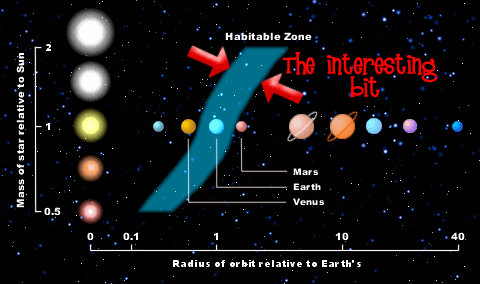
Fine-tuning the habitable zone: tidal-locking and solar flares

Circumstellar Habitable Zone

Here’s an article from Evolution News that talks about liquid water and tidal locking, but it has even more factors that need to be fine-tuned for habitability.

Excerpt:

Stars with masses of 0.1-0.5 solar mass make up 75 percent of the stars in our Milky Way galaxy.6 These represent the red dwarfs, the M class. But these stars have low effective temperatures, and thus emit their peak radiation at longer wavelengths (red and near-infrared).7 They can have stable continuously habitable zones over long time scales, up to 10 billion years, barring other disruptions. It is also easier to detect terrestrial sized planets around them.8 But a serious problem with red dwarf stars in the K and M classes is their energetic flares and coronal mass ejection events. Potentially habitable planets need to orbit these stars closer, to be in these stars’ habitable zones. Yet the exposure to their stellar winds and more frequent and energetic flares becomes a serious issue for habitability. Because of these stars’ smaller mass, ejections get released with more violence.9 Any planet’s atmosphere would be subject to this ionizing radiation, and likely expose any surface life to much more damaging radiation.10 The loss of atmospheres in these conditions is likely, but the timescales are dependent on several factors including the planet’s mass, the extent of its atmosphere, the distance from the parent star, and the strength of the planet’s magnetic field.11 To protect its atmosphere for a long period, like billions of years, a planet with more mass and thus higher gravity could hold on to the gases better. But this larger planet would then hold on to lighter gases, like hydrogen and helium, and prevent an atmosphere similar to Earth’s from forming.12 Another consequence is that the increased surface pressure would prevent water from being in the liquid phase.13

So again, you need to have a huge, massive star in order to hold the planet in orbit over LONG distances. If it’s a short distance, you not only have the tidal-locking problem, but you also have this solar activity problem (flares, coronal ejections).

But wait! There’s more:

Another stellar parameter for advanced life has to do with UV (ultra-violet) radiation. The life-support star must provide just enough UV radiation, but not too much. UV radiation’s negative effects on DNA are well known, and any life support body must be able to sustain an atmosphere to shield them. Yet the energy from UV radiation is also needed for biochemical reactions. So life needs enough UV radiant to allow chemical reactions, but not so much as to destroy complex carbon molecules like DNA. Just this flux requirement alone requires the host star have a minimum stellar mass of 0.6 solar masses, and a maximum mass of 1.9 solar masses.14

So the ultra-violet radiation that is emitted has to be finely-tuned. (I’m guessing this assumes some sort of chemical origin-of-life scenario)

Still more:

Another requirement for habitable planets is a strong magnetic field to prevent their atmosphere from being lost to the solar winds. Planets orbiting a red dwarf star are also more affected by the star’s tidal effects, slowing the planet’s rotation rate. It is thought that strong magnetic fields are generated in part by the planet’s rotation.15 If the planet is tidally braked, then any potential for a significant magnetic field is likely to be seriously degraded. This will lead to loss of water and other gases from the planet’s atmosphere to the stellar winds.16 We see this in our solar system, where both Mercury and Venus, which orbit closer to the Sun than Earth, have very slow rotation rates, and very modest magnetic fields. Mercury has very little water, and surprisingly, neither does Venus. Even though Venus has a very dense atmosphere, it is very dry. This is due to UV radiation splitting the water molecules when they get high in the atmosphere, and then the hydrogen is lost to space, primarily, again, by solar wind.17

You have to hold on to your umbrella (atmosphere), or you get hit with dangerous rain (solar winds).

So a few more factors there, and remember, this is just the tip of the iceberg when it comes to circumstellar habitability constraints.

Does the word atheism mean “a lack of belief in God”?

Making sense of the meaning of atheism

First, let’s see check with the Stanford University Encyclopedia of Philosophy.

Excerpt:

‘Atheism’ means the negation of theism, the denial of the existence of God.

Stanford University is one of the top 5 universities in the United States, so that’s a solid definition. To be an atheist is to be a person who makes the claim that, as a matter of FACT, there is no intelligent agent who created the universe. Atheists think that there is no God, and theists think that there is a God. Both claims are objective claims about the way the world is out there, and so both sides must furnish forth arguments and evidence as to how they are able to know what they are each claiming.

Philosopher William Lane Craig has some thoughts on atheism, atheists and lacking belief in God in this reply to a questioner.

Question:

In my discussions with atheists, they  are using the term that they “lack belief in God”. They claim that this is different from not believing in God or from saying that God does not exist. I’m not sure how to respond to this. It seems to me that its a silly word-play and is logically the same as saying that you do not believe in God.
What would be a good response to this?
Thank you for your time,

Steven

And here is Dr. Craig’s full response:

Your atheist friends are right that there is an important logical difference between believing that there is no God and not believing that there is a God.  Compare my saying, “I believe that there is no gold on Mars” with my saying “I do not believe that there is gold on Mars.”   If I have no opinion on the matter, then I do not believe that there is gold on Mars, and I do not believe that there is no gold on Mars.  There’s a difference between saying, “I do not believe (p)” and “I believe (not-p).”   Logically where you place the negation makes a world of difference.

But where your atheist friends err is in claiming that atheism involves only not believing that there is a God rather than believing that there is no God.

There’s a history behind this.  Certain atheists in the mid-twentieth century were promoting the so-called “presumption of atheism.” At face value, this would appear to be the claim that in the absence of evidence for the existence of God, we should presume that God does not exist.  Atheism is a sort of default position, and the theist bears a special burden of proof with regard to his belief that God exists.

So understood, such an alleged presumption is clearly mistaken.  For the assertion that “There is no God” is just as much a claim to knowledge as is the assertion that “There is a God.”  Therefore, the former assertion requires justification just as the latter does.  It is the agnostic who makes no knowledge claim at all with respect to God’s existence.  He confesses that he doesn’t know whether there is a God or whether there is no God.

But when you look more closely at how protagonists of the presumption of atheism used the term “atheist,” you discover that they were defining the word in a non-standard way, synonymous with “non-theist.”  So understood the term would encompass agnostics and traditional atheists, along with those who think the question meaningless (verificationists).  As Antony Flew confesses,

the word ‘atheist’ has in the present context to be construed in an unusual way.  Nowadays it is normally taken to mean someone who explicitly denies the existence . . . of God . . . But here it has to be understood not positively but negatively, with the originally Greek prefix ‘a-’ being read in this same way in ‘atheist’ as it customarily is in . . . words as ‘amoral’ . . . . In this interpretation an atheist becomes not someone who positively asserts the non-existence of God, but someone who is simply not a theist. (A Companion to Philosophy of Religion, ed. Philip Quinn and Charles Taliaferro [Oxford:  Blackwell, 1997], s.v. “The Presumption of Atheism,” by Antony Flew)

Such a re-definition of the word “atheist” trivializes the claim of the presumption of atheism, for on this definition, atheism ceases to be a view.  It is merely a psychological state which is shared by people who hold various views or no view at all.  On this re-definition, even babies, who hold no opinion at all on the matter, count as atheists!  In fact, our cat Muff counts as an atheist on this definition, since she has (to my knowledge) no belief in God.

One would still require justification in order to know either that God exists or that He does not exist, which is the question we’re really interested in.

So why, you might wonder, would atheists be anxious to so trivialize their position?  Here I agree with you that a deceptive game is being played by many atheists.  If atheism is taken to be a view, namely the view that there is no God, then atheists must shoulder their share of the burden of proof to support this view.  But many atheists admit freely that they cannot sustain such a burden of proof.  So they try to shirk their epistemic responsibility by re-defining atheism so that it is no longer a view but just a psychological condition which as such makes no assertions.  They are really closet agnostics who want to claim the mantle of atheism without shouldering its responsibilities.

This is disingenuous and still leaves us asking, “So is there a God or not?”

So there you have it. We are interested in what both sides know and what reasons and evidence they have to justify their claim to know. We are interested in talking to people who make claims about objective reality, not about themselves, and who then go on to give reasons and evidence to support their claims about objective reality. There are atheists out there that do make an objective claim that God does not exist, and then support that claim with arguments and evidence. Those are good atheists, and we should engage in rational conversations with them. But clearly there are some atheists who are not like that. How should we deal with these “subjective atheists”?

Well, my advice is to avoid them. They are approaching religion non-cognitively. When you engage in serious discussions with people about God’s existence, you only care about what people know and what they can show to be true.

What historical evidence is there to support the post-mortem appearances of Jesus?

Eric Chabot of Ratio Christi Ohio State University has a great post up about the post-mortem appearances of Jesus.

The post contains:

  • a list of the post-mortem resurrection appearances
  • quotations by skeptical historians about those appearances
  • alternative naturalistic explanations of the appearances
  • responses to those naturalistic explanations

Although there is a lot of research that went into the post, it’s not very long to read. The majority of scholars accept the appearances, because they appear in so many different sources and because some of those sources are very early, especially Paul’s statement of the early Christian creed in 1 Corinthians 15:3-7, which is from about 1-3 years after Jesus was executed by the Romans. Eric’s post lists out some of the skeptical scholars who the appearances, and you can see how they allude to the historical criteria that they are using. (If you want to sort of double-check the details, I blogged about how historians investigate ancient sources before)

Let’s take a look at some of the names you might recognize:

E.P. Sanders:

That Jesus’ followers (and later Paul) had resurrection experiences is, in my judgment, a fact. What the reality was that gave rise to the experiences I do not know. “I do not regard deliberate fraud as a worthwhile explanation. Many of the people in these lists were to spend the rest of their lives proclaiming that they had seen the risen Lord, and several of them would die for their cause. Moreover, a calculated deception should have produced great unanimity. Instead, there seem to have been competitors: ‘I saw him first!’ ‘No! I did.’ Paul’s tradition that 500 people saw Jesus at the same time has led some people to suggest that Jesus’ followers suffered mass hysteria. But mass hysteria does not explain the other traditions.” “Finally we know that after his death his followers experienced what they described as the ‘resurrection’: the appearance of a living but transformed person who had actually died. They believed this, they lived it, and they died for it.”[1]

Bart Ehrman:

It is a historical fact that some of Jesus’ followers came to believe that he had been raised from the dead soon after his execution. We know some of these believers by name; one of them, the apostle Paul, claims quite plainly to have seen Jesus alive after his death. Thus, for the historian, Christianity begins after the death of Jesus, not with the resurrection itself, but with the belief in the resurrection.[2]

Ehrman also says:

We can say with complete certainty that some of his disciples at some later time insisted that . . . he soon appeared to them, convincing them that he had been raised from the dead.[3]

 Ehrman also goes onto say:  

Historians, of course, have no difficulty whatsoever speaking about the belief in Jesus’ resurrection, since this is a matter of public record.[4]

Why, then, did some of the disciples claim to see Jesus alive after his crucifixion? I don’t doubt at all that some disciples claimed this. We don’t have any of their written testimony, but Paul, writing about twenty-five years later, indicates that this is what they claimed, and I don’t think he is making it up. And he knew are least a couple of them, whom he met just three years after the event (Galatians 1:18-19).[5]

Marcus Borg

The historical ground of Easter is very simple: the followers of Jesus, both then and now, continued to experience Jesus as a living reality after his death. In the early Christian community, these experiences included visions or apparitions of Jesus. [8]

The references to Paul are because of the early creed he records in 1 Corinthians 15:3-7, and his conversations with the other eyewitnesses in Galatians. Eric has another post where he goes over that early creed, and it is something that every Christian should know about. It’s really kind of surprising that you never hear a sermon on that early creed in church, where they generally sort of assume that you believe everything in the Bible on faith. But skeptical historians don’t believe in the post-mortem appearances by faith – they believe it (in part) because of 1 Corinthians 15:3-7.

If you want to see a Christian scholar make the case for the resurrection appearances in a debate, then here is a post I wrote with the video, audio and summary of the William Lane Craig vs James Crossley debate on the resurrection.