

Category Archives: Polemics

Luke Barnes reviews Victor Stenger’s critique of cosmic fine-tuning

Apologetics and the progress of science

Victor Stenger is a famous “Internet Infidel” atheist, but what makes him different is that he is has a PhD in physics. He wrote a book published by the atheist publisher Prometheus Press where he explains why he thinks that the universe is not fine-tuned for embodied sentient life.

An Australian physicist named Luke Barnes decided to write a response to his book, and the response is summarized (without the math!) on Uncommon Descent. Barnes has a PhD in Astronomy from Cambridge. He did postdoctoral research in Switzerland at the Institute for Astonomy, and now he is doing more postdoctoral research at the University of Sydney . The response that he wrote does not talk about God, or explanations of why the fine-tuning happened. I have no idea where his convictions are on any of that, because his response just talks about the fine-tuning itself from a scientific point of view.

Here’s how Uncommon Descent explains Barnes’ response.

Summary:

Professor Victor Stenger is an American particle physicist and a noted atheist, who popularized the phrase, “Science flies you to the moon. Religion flies you into buildings”. Professor Stenger is also the author of several books, including his recent best-seller, The Fallacy of Fine-Tuning: How the Universe is Not Designed for Humanity (Prometheus Books, 2011). Stenger’s latest book has been received with great acclaim by atheists: “Stenger has demolished the fine-tuning proponents,” writes one enthusiastic Amazon reviewer, adding that the book tells us “how science is able to demonstrate the non-existence of god.”

Well, it seems that the great Stenger has finally met his match. Dr. Luke A. Barnes, a post-doctoral researcher at the Institute for Astronomy, ETH Zurich, Switzerland, has written a scathing critique of Stenger’s book. I’ve read refutations in my time, but I have to say, this one is devastating.

In his paper, Dr. Barnes takes care to avoid drawing any metaphysical conclusions from the fact of fine-tuning. He has no religious axe to grind. His main concern is simply to establish that the fine-tuning of the universe is real, contrary to the claims of Professor Stenger, who asserts that all of the alleged examples of fine-tuning in our universe can be explained without the need for a multiverse.

Dr. Barnes’ ARXIV paper, The Fine-Tuning of the Universe for Intelligent Life (Version 1, December 21, 2011), is available online, and I shall be quoting from it below. Since the paper is quite technical at times, I’ve omitted mathematical equations and kept the references to physical parameters to a minimum, since I simply wish to give readers an overview of what Dr. Barnes perceives as the key flaws in Professor Stenger’s book.

First, the abstract:

The fine-tuning of the universe for intelligent life has received a great deal of attention in recent years, both in the philosophical and scientific literature. The claim is that in the space of possible physical laws, parameters and initial conditions, the set that permits the evolution of intelligent life is very small. I present here a review of the scientific literature, outlining cases of fine-tuning in the classic works of Carter, Carr and Rees, and Barrow and Tipler, as well as more recent work. To sharpen the discussion, the role of the antagonist will be played by Victor Stenger’s recent book The Fallacy of Fine-Tuning: Why the Universe is Not Designed for Us. Stenger claims that all known fine-tuning cases can be explained without the need for a multiverse. Many of Stenger’s claims will be found to be highly problematic. We will touch on such issues as the logical necessity of the laws of nature; objectivity, invariance and symmetry; theoretical physics and possible universes; entropy in cosmology; cosmic inflation and initial conditions; galaxy formation; the cosmological constant; stars and their formation; the properties of elementary particles and their effect on chemistry and the macroscopic world; the origin of mass; grand unified theories; and the dimensionality of space and time. I also provide an assessment of the multiverse, noting the significant challenges that it must face. I do not attempt to defend any conclusion based on the fine-tuning of the universe for intelligent life. This paper can be viewed as a critique of Stenger’s book, or read independently.

Here’s a quote that I wanted to put out there from the paper about how widely accepted fine-tuning is among scientists:

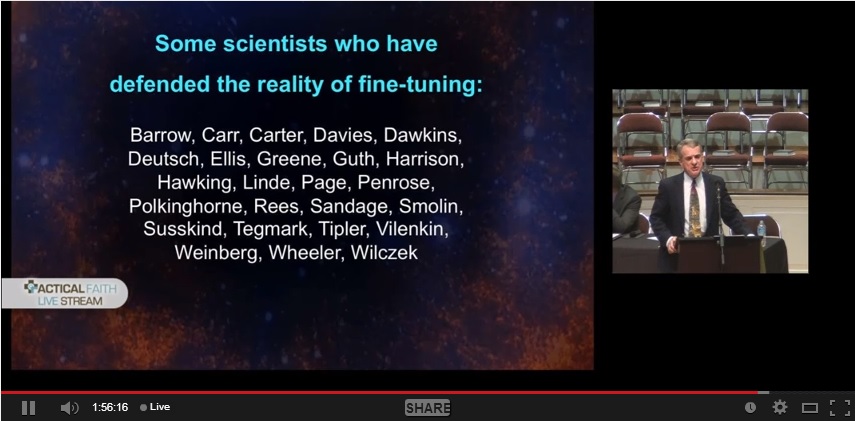
There are a great many scientists, of varying religious persuasions, who accept that the universe is fine-tuned for life, e.g. Barrow, Carr, Carter, Davies, Dawkins, Deutsch, Ellis, Greene, Guth, Harrison, Hawking, Linde, Page, Penrose, Polkinghorne, Rees, Sandage, Smolin, Susskind, Tegmark, Tipler, Vilenkin, Weinberg, Wheeler, Wilczek. They differ, of course, on what conclusion we should draw from this fact. Stenger, on the other hand, claims that the universe is not fine-tuned.

That is a very diverse list. I know that Sandage, Ellis, Page, Tipler and Polkinghorne are theists. But I also know that Weinberg, Rees, Hawking, Greene, and Dawkins are atheists. So scientists all across the spectrum of worldview admit that the fine-tuning is real.

Now, let’s look at Barnes’ paper and see why Victor Stenger disagrees with the view of those scientists.

1) Stenger doesn’t show why the entropy at the beginning of the universe isn’t a case of fine-tuning:

Entropy

We turn now to cosmology. The problem of the apparently low entropy of the universe is one of the oldest problems of cosmology. The fact that the entropy of the universe is not at its theoretical maximum, coupled with the fact that entropy cannot decrease, means that the universe must have started in a very special, low entropy state. (p. 23)

Let’s return to Stenger’s proposed solution… Stenger takes it for granted that the universe is homogeneous and isotropic. We can see this also in his use of the Friedmann equation, which assumes that space-time is homogeneous and isotropic. Not surprisingly, once homogeneity and isotropy have been assumed, Stenger finds that the solution to the entropy problem is remarkably easy.

We conclude that Stenger has not only failed to solve the entropy problem; he has failed to comprehend it. He has presented the problem itself as its solution. Homogeneous, isotropic expansion cannot solve the entropy problem – it is the entropy problem. Stenger’s assertion that “the universe starts out with maximum entropy or complete disorder” is false. A homogeneous, isotropic spacetime is an incredibly low entropy state. Penrose (1989) warned of precisely this brand of failed solution two decades ago… (p. 26)

2) Stenger responds to calculations showing the need for fine-tuning by speculating that future calculations will overturn the ones we have now:

The Cosmological Constant, Lambda

The cosmological constant problem is described in the textbook of Burgess & Moore (2006) as “arguably the most severe theoretical problem in high-energy physics today, as measured by both the difference between observations and theoretical predictions, and by the lack of convincing theoretical ideas which address it”. A well-understood and well-tested theory of fundamental physics (Quantum Field Theory – QFT) predicts contributions to the vacuum energy of the universe that are [approx.] 10^120 times greater than the observed total value. Stenger’s reply is guided by the following principle:

Any calculation that disagrees with the data by 50 or 120 orders of magnitude is simply wrong and should not be taken seriously. We just have to await the correct calculation. [FOFT p. 219]

This seems indistinguishable from reasoning that the calculation must be wrong since otherwise the cosmological constant would have to be fine-tuned. One could not hope for a more perfect example of begging the question. More importantly, there is a misunderstanding in Stenger’s account of the cosmological constant problem. The problem is not that physicists have made an incorrect prediction. We can use the term dark energy for any form of energy that causes the expansion of the universe to accelerate, including a “bare” cosmological constant (see Barnes et al., 2005, for an introduction to dark energy). Cosmological observations constrain the total dark energy. QFT [quantum field theory – VJT] allows us to calculate a number of contributions to the total dark energy from matter fields in the universe. Each of these contributions turns out to be 10^120 times larger than the total. There is no direct theory-vs.-observation contradiction as one is calculating and measuring different things. The fine-tuning problem is that these different independent contributions, including perhaps some that we don’t know about, manage to cancel each other to such an alarming, life-permitting degree. This is not a straightforward case of Popperian falsification. (pp. 34-35)

3) Stenger doesn’t consider the full range of values when deciding if something is fine-tuned or not:

Protons, Neutrons, Electrons

We turn now to the relative masses of the three most important particles in our universe: the proton, neutron and electron, from which atoms are made. Consider first the ratio of the electron to the proton mass, … of which Stenger says: “…we can argue that the electron mass is going to be much smaller than the proton mass in any universe even remotely like ours.” [FOFT p. 164] (p. 50)

The fact that Stenger is comparing the electron mass in our universe with the electron mass in universes “like ours” is all the evidence one needs to conclude that Stenger doesn’t understand fine-tuning. The fact that universes like ours turn out to be rather similar to our universe isn’t particularly enlightening. (p. 50)

Finally, and most importantly, note carefully Stenger’s conclusion. He states that no fine-tuning is needed for the neutron-proton mass difference in our universe to be approximately equal to the up quark-down quark mass difference in our universe. Stenger has compared our universe with our universe and found no evidence of fine-tuning. There is no discussion of the life-permitting range, no discussion of the possible range of [mass(neutron) – mass(proton)] (or its relation to the possible range of [mass(down quark) – mass(up quark)], and thus no relevance to fine-tuning whatsoever. (p. 51)

Those are just a few of the examples in the paper, highlighted in the Uncommon Descent article (emphasis theirs).

Barnes’ paper has now been published in a peer-reviewed journal. The journal is published by Cambridge University.
Sean Carroll debates William Lane Craig on cosmology and God’s existence

Here’s the video of the debate:

Carroll was as good of a speaker as Craig in terms of style. Very easy to listen to, very quick on his feet, very civil. There was no clear winner on style.

It was difficult to assess the truth value of scientific points being made, especially for the layperson. I explained a few of them in my posts earlier this week, but I think laypeople might struggle with them if they are hearing about these things for the first time.

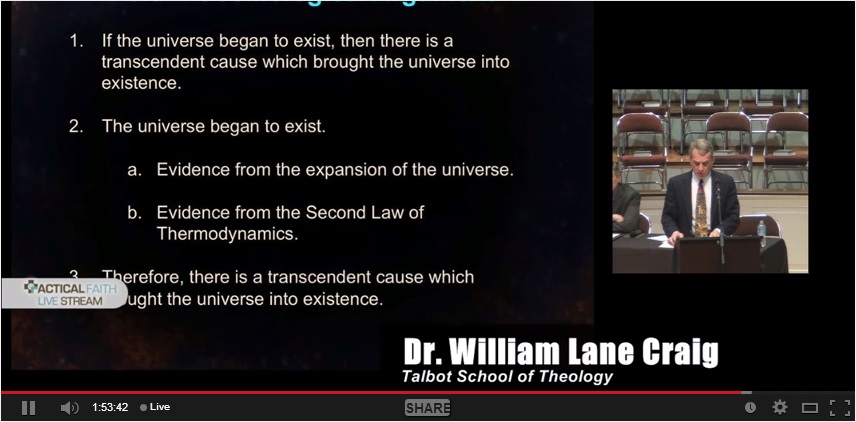
A couple of Craig’s slides: (click for larger images)

Slide 1 of 2:

Dr. Craig slide #1 of 2

Slide 2 of 2:

Dr. Craig slide #2 of 2

Quick summary: (this is not complete, because I couldn’t get everything they were saying noted)

Dr. Craig defended two arguments: 1) the kalam cosmological argument and the fine-tuning argument.

Dr. Craig supported the origin of the universe with 1) the expansion of the universe and 2) the second law of thermodynamics.

Dr. Craig said that the BGV theorem supports a beginning for the universe.

Dr. Craig said that the consensus of scientists did not accept Carroll’s naturalistic cosmology, quoting Stephen Hawking in support.

Dr. Craig said that multiverse models fall victim to the Boltzmann brain problem, where we should observe Boltzmann brains coming into existence and then phasing out again far more probably than embodied minds. But we observe embodied minds, and no Boltzmann brains.

Dr. Carroll said that science cannot study metaphysical questions.

Dr. Carroll said that science is about making models that may or may not be consistent with the experimental data.

Dr. Carroll said that the BGV theorem does not support a beginning for the universe.

Dr. Carroll proposed 17 alternative cosmologies, but did not provide a shred of scientific evidence for any of them, the way that Craig did for the standard model.

Dr. Carroll refuted Dr. Craig’s citation of Stephen Hawking, and Craig yielded the point.

Dr. Carroll speculated that science might progress to the point where the fine-tuning can be explained without an intelligent cause, and he gave an example of where that happened (inflation).

Dr. Craig argued that all 17 of the models suggested by Carroll either conflicted with evidence, had serious problems or did require a beginning.

Dr. Craig argued that Carroll’s own model required a beginning.

Dr. Craig argued that Carroll’s own model fell victim to the Boltzmann brain problem.

Dr. Craig argued that Carroll’s own model violated the second law of thermodynamics.

Dr. Craig re-stated his point that the baby universe spawning in Carroll’s model was speculative and incomplete, and cited Christopher Weaver’s work.

Dr. Carroll denied that things that pop into being out of nothing require a transcendent cause.

Dr. Carroll reiterated that science can only make naturalistic models, and that he did not have to answer questions about ultimate causes.

Dr. Carroll showed a photo of Alan Guth expressing his opinion that the universe is “probably” eternal. No evidence was given for this assertion.

Dr. Carroll said that the fine-tuning was not done in an optimal way, because one fine-tuned value was lower than it needed to be, and it should be exactly what it needed to be if God did it.

Dr. Carroll said that a finely-tuned universe is more probably in naturalism than in theism, because God can do anything he wants and doesn’t need a fine-tuned universe.

Dr. Carroll said he would stop defending his model now, and would instead defend Aguirre-Gratton.

Dr. Craig gave three reasons why the universe popping into being out of nothing requires a transcendent cause.

First, he said that nothing cannot cause anything to happen, because nothing is nothing.

Second, he said that if things pop into being out of nothing, then why don’t we see it happening all the time with other things.

Third, he said that we have no reason to dismiss the causal principle, especially when it is the basis of scientific inquiry and has been so fruitful in the progress of science.

Dr. Craig reiterated that baby universes in Carroll’s model would be dominated by Boltzmann brains, and we don’t observe that.

Dr. Craig said that even on the quantum gravity models that Carroll mentioned, there would still be a beginning.

Dr. Carroll said that Craig mustn’t say “popped into being” but instead that “there was a first moment of time”.

Dr. Carroll said that his model does indeed violate the second law of thermodynamics “YES!”.

At this point Carroll stopped talking about the topic of the debate and started expressing personal opinions about religion. It’s funny how often atheists do this in debates.

Dr. Carroll said that most theists don’t believe in God because of cosmology, but because of community and feelings.

Dr. Carroll said that science had learned a lot in the last 2000 years, so theism was false.

Dr. Carroll said that most philosophers don’t think that God exists, so theism was false.

Dr. Carroll said microscopes and telescopes were absent 2000 years ago, so theism was false.

Dr. Carroll said that religion should be about community and feelings, not about what is true.

Conclusion:

My conclusion was that Carroll lost because he is just satisfied to throw theories out and not to argue that they are true by citing evidence. Carroll never seemed to be interested in finding out what is true, but instead he just wanted to tell a story that didn’t include God, and assert that by Occam’s Razor, his story was a better explanation. I am not impressed with theoretical speculations, although the layperson might be. I kept waiting for him to respond to Craig’s points about how his model was falsified by experimental evidence and observations, e.g. – the Boltzmann brains or the baby universe generation, and he never cited the evidence I wanted him to cite. Craig did have some evidence for his views, but he could have been stronger in making his case. He could have shown the e-mail from Vilenkin that stated that he had understood the BGV theorem, and was using it correctly, for example.

For me the winning side comes down to evidence. The standard model is the standard model because of scientific evidence. Until that evidence is overturned, then speculative models are of no interest to anyone who is evidence-driven. Speculations are not science. A philosophical presupposition of metaphysical naturalism is not science.

If you want to see a good lecture on scientific evidence related to cosmology, then there is the particle physicist Michael Strauss lecture on cosmology and fine-tuning at Stanford University and his more recent lecture at the University of Texas. Note that Strauss is an experimental physicist, not a theoretical physicist like Carroll.

Here’s another review of the debate by Randy Everist of Possible Worlds blog. He explains the back-and-forth over Boltzmann brains and the BGV theorem in more detail.

Greg Koukl debates Michael Shermer on God, atheism, meaning and morality

The full transcript of a debate between Michael Shermer, editor of Skeptic magazine, and Greg Koukl, president of Stand to Reason. This debate occurred on Hugh Hewitt’s radio show, and was moderated by Hugh Hewitt.

HH = Hugh Hewitt
GK = Greg Koukl
MS = Michael Shermer

Here is a 32-page PDF with the full debate transcript.

And here’s an excerpt:

GK: Right. Actually, the big question here, Hugh, is whether it’s possible to be good without God. Now I’m not talking about whether it’s possible to be good without a belief in God. I certainly think that’s possible, but be good without God. And the answer to that question hinges entirely on precisely what you mean by good. And so I was going to give an illustration. So a man drags a young girl into the alley, he sexually abuses her, strangles here, and tosses her into the dustbin. Is that act wrong? Now I think everybody listening is going to admit it is wrong. But here is the real question. What do we mean when we say that that act of rape and abuse and murder is wrong? Are we describing the action itself, the object? Are we saying that the object, the rape, the murder, has a quality of being wrong, and therefore, wherever that rape goes, the wrongness follows it, just like your height, 6’ 2”, or whatever it is, is an objective quality of you. Wherever you go, your height follows you in the same way. Does the wrongness follow the rape? Well, if it’s a quality of the rape, if it’s an objective quality of the rape, then it does. And it doesn’t matter what people think about it, or what cultures decides, or what your evolutionary conditioning is. The rape is still wrong. The other alternative is that you’re not talking about the rape. You’re talking about yourself. You’re talking about your genetic conditioning. You’re talking about your culture’s decision about that kind of thing. And if that’s the case, then the truth of the wrongness of the rape is simply in the individual or the subject. And this is why philosophers distinguish between ethical objectivism and ethical subjectivism. Now there’s lots of different subjectivisms in ethics. But simply put, if you’re an ethical subjectivist, you’re a relativist. And actual ethics don’t exist. Ethics are an illusion. If you conclude that ethics are an illusion, there’s lots of different ways to explain it. Michael’s written a really great book, I think, called The Science Of Good And Evil. I’ve read most of it, and it’s well written, and it’s very compelling. But it’s a description about how the illusion of ethics has taken place. If you want to go that route, you’re welcome to go that route. But what you can’t do is you can’t then talk about morality as if it’s objective when your explanations are subjective. So this is a problem that I think all atheists, including Michael, have to solve. Are ethics objective or relative? And if they’re relative, then how can we make moral judgments that are meaningful on other people?

HH: Michael Shermer?

MS: Wow, let’s just get right into it. Well, I don’t think it’s quite so black and white. That is to say I think there are provisional moral truths that exist whether there’s a God or not. In other words, it’s wrong, morally, absolutely morally wrong to rape and murder. And that would be true whether there was a God or not. In other words, if…is God saying that it’s wrong because it’s really wrong, and He’s instructing us in his Holy Scripture that it’s wrong? Or is it only wrong because He said so? And if it turned out there wasn’t a God, would that make it okay? And my answer is no, it really is wrong, whether God says it’s wrong or not. That is to say I think it really exists, a real, moral standard like that. Why? Well, because first, you could ask the person who is being affected, we should always ask the moral recipient of the act, how do you feel about being raped or murdered or stolen from or lied to. And the moral actor will tell you, it doesn’t matter whether, if I could use a current example, I haven’t any idea if Tiger Woods and his wife are religious or not. But you can just ask his wife whether it was morally right or wrong, and she’ll tell you. It doesn’t matter whether there’s a God or not. It’s wrong. And so that’s the first principle. Just ask. Ask the moral recipient of whether it’s right or wrong. But I think Greg’s after something deeper, that is to say is there something even deeper still behind the moral actor’s feelings about how they’re treated. And the answer is yes, I think so. We’re a social species. We don’t live in isolation. We live as members of a group. And as such, there’s no possible way our group could survive, be cohesive, be a unit of any kind of solidarity against other groups, or against a harsh environment. If there were too much violations of social norms, that is if there were constant lying and cheating and raping and murdering, there’s no way a social group could hang together. And as such, as we all know, we’re very tribal. We’re tribal against other groups, but within our groups, we’re very pro-social, altruistic, cooperative. We have a good and evil in our nature. So to this extent, I find myself interesting often in agreement with my conservative friends on most of the things they consider morally, moral truths. That is, we share the same moral values, even though I come at it from a different perspective.

HH: Greg?

GK: Yeah, I’m actually not after something deeper here, Michael. At least to start out the discussion, I’m trying to be as simple and clear and precise as possible, because it’s very easy to weave together a bunch of things that sound persuasive, but turn out to be different things. Like for example, Darwinian evolution, which is a materialistic process, and here I mean the blind watchmaker thesis, the neo-Darwinian synthesis, natural selection working on mutations, and a kind of a cultural evolution that Michael has just referred to as we work together as a group to survive as a group. Those are two entirely different things. One is materialistic, Darwinian, the other one is intelligent design, quite frankly, where the group gets together and makes some determinations to encourage some behavior and discourage others. What I’m trying to do is to be able to answer the question that came up initially, is God necessary for morality, which Michael denies. It’s to say well, what is it that morality, that we’re trying to describe? It is either objective, and therefore an immaterial obligation that applies to certain behaviors, or it is subjective. The things that Michael described were variously subjective, evolutionary elements, subjective cultural elements, but then he affirmed that we all have good and evil in our nature, or an awareness of that. I agree with that entirely. We all are aware of those things. That’s why even if we don’t believe in God, we can still know morality and follow it. The question is what accounts for real, genuine objective morality?

HH: One minute to the break, Michael Shermer.

MS: I’m not arguing for cultural evolution. I’m actually arguing as part of our, what you described as materialistic, natural selection, Darwinian evolution, that it’s not enough to just pretend or fake being a good group member. You actually have to believe it, feel it, and live it. So what I’m arguing is that natural selected certain moral sentiments, as Adam Smith called them, moral feelings, an actual empathy, Adam Smith talked about, we actually empathize with somebody else, we can put ourselves into their shoes and feel their pain, I’m arguing that’s very real. It’s every bit as real a part of our evolutionary heritage as our eyes and our hands.

– – – –

HH: Michael Shermer, when we went to break, you were saying that evolutionary biology has produced a real morality.

MS: Yeah, I think really, Adam Smith had it right in his very first book, The Theory Of Moral Sentiments, long before Darwin, that we actually have in our biological nature, our human nature, the capacity to feel other people’s pain. He called it empathy, we think of it often either as empathy or sympathy. That is, we really do connect to other people. A lot of good research on this now, brain scans, you can show somebody a little video of somebody they know, or have feelings for, getting pricked with a pin, and the same areas of their brain light up, the pain receptors, as in the person getting the pin prick. In other words, we have an evolved tendency to really be deeply, emotionally connected to our fellow group members. And that’s why I say groups like World Vision, where you want to adopt a child, it doesn’t help to show a picture of 10,000 starving African kids. What does affect us is one child, a picture of one child with a little biography. That’s how you get people to adopt a child to donate. The reason for that is because essentially they’re tricking the brain, our brains into making that stranger an honorary family member, an honorary within group member, which is why I argue that free trade is one of the best ways of defusing normal tribal tensions between people. It makes them honorary friends, honorary members. Well, what’s going on there is we’re tricking the brain into sort of this evolutionary rule of thumb – be nice to people that are like you and that are related to you, and that you know, and that are fellow group members, and don’t do what our natural tendency is, is to be tribal and xenophobic against those other guys. And free trade is one of the best things you can do for that. So I’m arguing that’s actually tapping something deep within us.

HH: Greg Koukl?

GK: Yeah, basically, I agree with Mike completely here. We do have this tendency, and it seems to be universal among humankind. The question is, what is that tendency, actually? And what is the best way to explain it? And I see like a handful of significant problems with using evolution to explain morality. The first one is that evolution is a materialistic process. And here, I’m going back to an original point, and I don’t want people to lose it. There is no way that you can take molecules, and reorganize them in any fashion, over any length of time, and have pop out of the mixture an objective moral principle that’s immaterial, and that applies to human beings. All you’re going to get is a reorganization of the molecules. And what they can produce, and this is what Mike has done in his book, and he mentioned just s few moments ago, they can produce sentiments. They can produce feelings. They can produce behavior. But this leads us to the second problem of using evolution to explain morality, is that morality is more than sentiments, feelings and behavior. Morality entails things like motive and intention. I mean, you could have a guy walk into a garage, walk out with a hose, and is that wrong? Well, it depends. Is it his hose or somebody else’s hose? Did he intend to take the other person’s hose? Is he borrowing the hose? So we can see here are elements that are part of the moral thing that needs to be explained, that are immaterial, and therefore the Darwinian explanation can’t even in principle go there. It can’t do that job. But here’s the worst problem. Regardless of what our sentiments happen to be regarding moral actions, we can feel good or feel bad or whatever, the problem is that morality is prescriptive, not merely descriptive. That is it tells us not just what we did, but what we ought to have done in the past, and what we ought to do in the future. That is not something that any Darwinian mechanism can describe, because nothing about my biology can inveigh upon me to act a certain way for moral reasons in the future. It doesn’t tell me why I should be good tomorrow. This is a huge difference between these two views, the descriptive and the prescriptive. Prescriptive is part of morality, and can’t even, in principle, be explained by an evolutionary materialistic system.

HH: Michael Shermer, I’ll give you a start on that. We have about 45 seconds to the break, so you may want to…we’ll come back after the break and pick up. But what’s your start to that?

MS: Well, the start would be that again, let’s not think of evolution just as nature red and tooth and claw, and it’s nasty, brutish and short, but that in fact, we have this whole other social evolution. And I’m not talking about cultural evolution where we consciously make decisions, but subconsciously, because it’s in part of our nature to actually, seriously, deeply feel for other people and their actions, and the consequences of our actions, so that we actually have a sense of right and wrong that we’re born with, but then culture taps into and tweaks, one way or the other.

– – – –

HH: Michael Shermer, when we went to break, Greg had made the argument that the Darwinian model simply cannot explain immaterial concepts like morality, that there’s just no way you can rearrange the molecules to get there. You’re saying well, yes you can.

MS: Yeah, I think so, because if we think of morality as another suite of emotions that are involved with other people’s behaviors, the consequences of our actions, how we feel about them, how people feel about us when we do these things, that’s as every bit as important a biological part of our nature as anything else we talk about. So let’s take a real simple emotion. When you’re hungry, nobody does any calculations about the caloric input/output ratios of eating an apple versus an ice cream, although now it’s posted on the walls for us to see. But we just feel hungry, and we feel hungry for certain kinds of foods. The feeling of hunger is a proxy for something else. Evolution’s done the calculating for us. You need food, so we’re going to, your hypothalamus is going to secrete these certain chemicals that causes your stomach to rumble and so on. When you’re attracted to somebody else, a member of the opposite sex, nobody does the calculation by, let’s say, a man finds a woman attractive who has a .67 hip to waist ratio, and an hourglass figure, although that is pretty much universal. Nobody walks about with calipers taking measurements of who they’re going to want to date or ask out. You just look around, and you just go wow, I really find this woman attractive. It’s a feeling you have, okay? So those are kind of simple emotions, but sliding up the scale, the moral emotions are really no different. When I lie to somebody, I’ve violated a social norm, and they respond in a very angry, hostile way. So those emotions that we both share, guilt, shame, anger, disgust, involved a social relationship that whether it was a norm violation, those are the kinds of emotions that are just like hunger and sexual attraction that are built into us by nature, by evolution. Or, if you wish, this is how God created the moral sentiments, just like He created everything else in the universe, through a process of nature. I think that’s equally reasonable to argue. So I don’t see that it has to be an atheistic viewpoint versus a theistic viewpoint to get to our moral sentiments. Why couldn’t God have used evolution to create the moral sentiments as I’ve described them?

GK: Yeah, well, you don’t actually believe that, I know, Mike, so this is kind of like adding God to the soup, you know, if it makes people feel better. But the basic argument is that evolution all by itself can do the trick. And I think if your listeners are listening carefully, what they’re going to hear is Mike has just described, and if I’m being unfair to your assessment here, let me know, Mike, that moral feelings are simply that. They are sophisticated emotions that do some work for us for survival, and even on a group level. Now there’s a name for this. It’s called emotivism. A.J. Ayer, the famous atheist, offered this description of morality. It’s a relativistic scheme of morality. Morality doesn’t actually exist, Ayer argued. There is no objective right or wrong. Rape isn’t wrong itself. What happens is, we have feelings about it, and we express it in moral language, but rape isn’t really wrong. So your listeners are going to have to ask themselves the questions. When they just survey their own moral senses, and we all have access to this, do we want to believe that scientists have figured out that really what we’re doing is feeling sophisticated, complicated emotions, and that the emotions are in us, and we are not seeing anything about the action? Or does it seem like rape is wrong? Look, when I say rape is wrong, I’m talking about the rape. When I say liver is awful, I’m talking about me. I’m talking about my own tastes and preferences. It’s interesting, as Michael has given his explanation, though, that he’s doing, and I don’t know if you are aware of this, Michael, but you’re doing the very thing that I kind of warned against. You give a description of the foundations of morality that turn out to be relativistic, but then there’s a smuggling of a more objectivistic morality in the back door, like when Michael says you don’t have to do what your nature tells you to do, in other words, what you’ve been programmed by evolution to do. You can kind of rise above that. Well, now we’re talking about a morality that isn’t dictated by evolution, but a morality that we can employ through our acts of will, to rise above this kind of brutish evolutionary morality. And that sounds suspiciously like the very thing that I’m talking about here.

MS: But I don’t mean, there’s nothing to rise above by itself. Yes, we have to say rise above our tribal instincts to be xenophobic when we meet somebody who’s a stranger, who’s different from us. We all struggle against that, particularly in a black and white America, where there’s always been this underlying tension. Indeed, so culture helps us do that – education, travel, diversity of exposure to different people. That makes you a little more tolerant. Okay, but I’m not talking about that. What I’m talking about is tapping into the good part of our nature, the fact that in addition to that xenophobic tribalism we have, we also have this other side that almost never gets discussed in evolutionary…even in evolutionary circles, you’ll still hear evolutionary biologists talking about, in a way that Huxley did, and Herbert Spencer did in Darwin’s own time, that we have to somehow struggle mightily against our genes to overcome that nasty tendency we have to want to rape, kill, pillage and destroy. Well no, actually, we have this whole other side that’s just as genetically programmed into our nature. And the point of culture – education, politics, economics and so on, is to tap into the better angels of our nature as Lincoln said.

GK: Okay, here’s the question I have for you, Michael, then. You’ve identified that really, we have good and we have bad. That’s part of, under your terms, that’s part of our genetic nature, and we can choose to tap into what you call the good side. Why ever should we do such a thing if there is not a higher standard that directs our action to the better side, your words, than the bad side, your words, if really, ultimately, they are both the result of a genetic evolution, and from outside terms, neither is better than the other. Why should we do that, Michael?

MS: Yeah, well I don’t see how entering God into the equation changes that problem at all.

GK: Well, that’s the next step. What I’m trying to show is that the should comes from the outside, and if we can demonstrate that, then we can ask…

Read the rest by click here to get the PDF.