Category Archives: News

William Lane Craig debates Daniel Came: Does God exist?

Dr. Craig's opening speech summary slide
Dr. Craig’s opening speech summary slide

The video of the debate was posted by ReasonableFaith.org – Dr. Craig’s organization. This debate occurred in March 2017 at the University of Dublin, in Ireland.

The video: (91 minutes)

My non-snarky summary is below.

Dr. Craig’s opening speech

Two claims:

1. There are good reasons to think that theism is true.
2. There are not comparably good reasons to think that atheism is true.

Five reasons for God’s existence:

1. The beginning of the universe
– actual infinite past is mathematically impossible
– BGV theorem: any universe that is on balance expanding in its history (like ours) cannot be past eternal

2. Fine-tuning of cosmic quantities and constants
– slight changes to quantities and constants prevent a universe from supporting complex embodied life
– the multiverse response of atheists conflicts with observations, e.g. the Boltzmann Brains problem

3. Objective moral values
– God’s existence is required to ground objective moral values and duties

4. Minimal facts case for the resurrection of Jesus
– there are good reasons to accept the most widely accepted facts about the historical Jesus (empty tomb, appearances, early widespread belief in the resurrection)
– the best explanation of these minimal facts is that God raised Jesus from the dead

5. Experience God directly
– in the absence of any defeaters to belief in God, a person can experience God directly

Dr. Daniel Came’s opening speech

1. The hiddenness of God
– if God wants a personal relationship with us, and a relationship with God would be the greatest good for us
– God ought to reveal himself to us, but he does not  reveal himself to many people, the “non-resistant non-believers”

2. The inductive problem of evil
– many evil events occur that are pointless – there is no morally sufficient reason why God would allow them to occur
– examples: animal suffering, children born with disease, tsunamis
– the theistic response to this is that humans are not in a position to know whether there are morally sufficient reasons, due to our limitations of knowing the consequences
– but this ripple effect defense has 4 possible outcomes, 3 of which don’t do the job of justifying

Dr. Craig’s first rebuttal

1. The hiddenness of God
– God’s goal is not to make his existence known, but to draw them into a love relationship
– it’s speculative that overt displays of God’s existence would draw people to him in a love relationship, they might resent his bullying
– atheist would have to prove that God could draw more people into a love relationship with him by revealing himself more overtly

2. The inductive problem of evil
– as humans, we are not in a position to know for certain that any apparently pointless evil really is pointless
– William Alston article: 6 limitations of human knowing make it impossible to judge that an evil is actually “pointless”
– Dr. Came says that there are 4 possibilities for the ripple effects, and since 3 are bad, it’s likely that there are not morally sufficient reasons for a apparently pointless evil
– it is logically fallacious to assert probability conclusions without knowing the probabilities of those 4 options
– there is actually an argument from evil: since the problem of evil requires an objective standard of good and evil by which to measure, and God is the only possible ground of objective morality, then pressing the problem of evil actually requires the atheist to assume God, in order to ground this objective moral standard

Dr. Came’s first rebuttal

3. Objective moral values
– there are naturalistic theories of moral realism where objective moral duties and objective moral values exist in a naturalistic universe
– I’m not saying that any of them are correct, but there are many theories about object morality in a naturalistic universe

There are naturalistic theories for all of the 5 arguments that Dr. Craig presented. It is Dr. Craig’s responsibility to present those naturalistic theories and prove that they are not as good as his explanations. I’m not going to defend (or even name!) a single naturalistic theory for any of these 5 arguments by Dr. Craig.

Dr. Craig’s explanations for the 5 evidences he gave can’t be admitted, because we have to know how God did something in naturalistic terms before we can know that God did it supernaturally. Explanations are only valid if they are naturalistic.

1. The beginning of the universe
– naturalism explains how the universe expands after it came into being, so that explains how it came into being
– the God explanation, that God created the universe out of nothing, is not admissible, because it is not naturalistic
– how does God, as an unembodied mind interact with the physical world?
– the only agency that we know about is human agents, and we have bodies, so how could God perform actions without having a body?

The theistic hypothesis does not make any predictions, but naturalism makes lots of testable predictions. God could do anything, so he is not constrained and is therefore untestable. We can’t infer God as an explanation in principle because we can’t predict what is more probable if God exists than if he does not.

2. Fine-tuning of cosmic quantities and constants
– the university was not set up to make embodied intelligence plausible, because the vast majority of the universe is hostile to life
– there are models of the multiverse that escape the Boltzmann Brains problem that Dr. Craig raised

Dr. Craig’s second rebuttal

Some of Dr. Craig’s arguments are deductive (e.g. – the beginning of the universe, objective moral values), so that the conclusion follows from the premises if the premises are true. The resurrection passes the standard tests for historical explanations.

1. The beginning of the universe
– the whole point of the argument is that there is no naturalistic explanation for an ultimate beginning of the universe

2. Fine-tuning of cosmic quantities and constants
– the whole point of the argument is that there is no naturalistic explanation for a design of the universe to support life
– he has to prove that intelligences has to be attached to bodies
– human beings are non-physical minds united to physical bodies
– naturalistic attempts to explain mental operations fail
– the arguments prove that unembodied minds exist
– the vast expanse of the universe is required in order to form the galaxies, stars and heavy elements needed for complex life
– why expect that the entire universe should be small, or that life would be everywhere?
– a non-fine-tuned world is more likely in the multiverse, and in a multiverse, we are more likely to have a Boltzmann brain world than a world with complex, embodied life
– Dr. Came has not advanced any naturalistic explanation for the fine-tuning

3. Objective moral values
– non-theistic ethical theories cannot account for the ontological foundations of objective moral values and duties
– atheistic theories of moral realism simply assume objective moral values out of thin air
– it is especially hard to find any basis for objective moral duties in the absence of God

Dr. Came’s second rebuttal

5. Religious experience
– Dr. Craig should not bring up religious experience in a debate where arguments and evidence are central
– people who have dreams, hallucinations and psychotic delusions could appeal to religious experience
– religious experience is by no means universal, and it is possible to doubt it

3. Objective moral values
– there are lots of atheists who hold to objective moral values
– Dr. Craig has to explain how God grounds objective moral values and duties
– Dr. Craig has to explain why atheist moral realist theories don’t work to ground objective moral values and duties

1. The beginning of the universe
– Dr. Craig claims that something can’t come from nothing, that’s not an argument
– there are numerous models that don’t require an absolute beginning of the universe
– Dr. Craig cites the BGV theorem, but Guth (one of the authors) says that only the inflation has a beginning, not the whole universe

Dr. Craig’s conclusion

1. The beginning of the universe
– on theism, there is an efficient cause, but no material cause, for the origin of the universe
– on atheism, there is neither an efficient cause nor a material cause, for the origin of the universe: that’s worse!
– if he thinks that there are models of the universe that don’t require a beginning, then let him name a viable eternal model of the universe
– he never refuted the mathematical argues against an infinite past

2. Fine-tuning of cosmic quantities and constants
– nothing to refute

3. Objective moral values
– God is a better ground for morality than humans, because he is ultimate, and not contingent and arbitrary
– God is a being who is worthy of worship, and therefore command his creatures with moral duties

4. Minimal facts case for the resurrection of Jesus
– nothing to refute

5. Religious experience
– only justified because there are no defeaters to it

1. The hiddenness of God
– atheist has to show that if God’s existence were more obvious, that it would result in more people being drawn to him

2. The inductive problem of evil
– Dr. Came’s argument was logically fallacious, and makes errors in probability theory

Dr. Came’s conclusion

Sometimes, people can’t prove something, but lack of evidence is a justification for doubting it, e.g. – werewolves.

If none of Craig’s arguments work, then it follows that it is not rational to believe that God exists, and it is rational to believe that God does not exist.

Atheists shouldn’t have a burden of proof for what they know, only theists have a burden of proof for what they know.

My thoughts

One quick point. If life were common everywhere then atheists would infer that God wasn’t involved in it. Period. “Life is everywhere, so it’s common, why do we need a designer?” they’d say. I agree with Dr. Came about denouncing religious experience in a formal debate. I don’t like when Dr. Craig brings this up, but I see why he does it – he’s an evangelist, and that’s a good thing, too. I just worry about how it looks to atheists, although it’s good for sincere seekers. I’m not the one on the stage, though, Dr. Craig is.

I think the point about more overt revealing by God would annoy people and make them turn away. Think of how gay people respond to the suggestion that there is anything wrong with them, with rage, vandalism, threats, coercion, attempts to get you to lose your job and business, and using government as a weapon to fine and imprison you. It’s really obvious to me that more God does not mean more love of God. For those who don’t want God, the hiddenness is respect for their choice to put pleasure above the search for truth. (I mean the gay activists – I have great sympathy for people who struggle with same-sex unwanted attractions because they were impacted by a failed bond with their parent of the same sex as they are).

Whenever I meet people like Dr. Came, I always urge them to keep investigating and pursuing truth, because they will find it if they are sincerely seeking after God. Some atheists do sincerely seek God, but I don’t know any who haven’t found him. I’m not sure if that’s because those atheists who claim to be non-resistant and rational are in fact resistant and non-rational, or what the real reason is. If you believe the Bible, all unbelief is non-rational and resistant (see Romans 1). Regarding the werewolves, we don’t have any good arguments for werewolves, we do have good arguments for God. Dr. Came didn’t refute the arguments that Craig raised, nor did his own arguments for atheism work. And there are many, many more arguments (origin of life, Cambrian explosion, habitability-discoverability, molecular machines) that Craig did not raise, too.
How well is socialized health care working in Britain?

The National Health Service is government-run socialist health care

Back in 2009, a radical leftist named Paul Krugman wrote about the health care system in Britain. As a leftist, it’s his view that government-run health care is better than free market health care. Basically, he thinks that people get better health care if it’s run like the US Postal Service is run, instead of how Amazon.com is run.

Let’s see what he says in the far-left extremist New York Times:

In Britain, the government itself runs the hospitals and employs the doctors. We’ve all heard scare stories about how that works in practice; these stories are false. Like every system, the National Health Service has problems, but over all it appears to provide quite good care while spending only about 40 percent as much per person as we do. By the way, our own Veterans Health Administration, which is run somewhat like the British health service, also manages to combine quality care with low costs.

And what about the people who say that the NHS doesn’t provide quality health care, despite getting a huge portion of the all the taxes that are collected in Britain?

At this point, all that stands in the way of universal health care in America are the greed of the medical-industrial complex, the lies of the right-wing propaganda machine, and the gullibility of voters who believe those lies.

Every bad story that you’ve ever heard about socialized health care is a lie, and you’re gullible if you believe those lies.

Well, see, now I’m confused. Because if I turn the page of the New York Times from an editorial to a news story, I read this:

At some emergency wards, patients wait more than 12 hours before they are tended to. Corridors are jammed with beds carrying frail and elderly patients waiting to be admitted to hospital wards. Outpatient appointments were canceled to free up staff members, and by Wednesday morning hospitals had been ordered to postpone nonurgent surgeries until the end of the month.

Cuts to the National Health Service budget in Britain have left hospitals stretched over the winter for years, but this time a flu outbreak, colder weather and high levels of respiratory illnesses have put the N.H.S. under the highest strain in decades.

The situation has become so dire that the head of the health service is warning that the system is overwhelmed.

[…]“The N.H.S. waiting list will grow to five million people by 2021,” Mr. Stevens said in an impassioned speech to health care leaders in November. “That is one million more people, equivalent to one in 10 of us, the highest number ever.”

Over the past week, hospitals have increasingly declared “black alerts,” an admission that they are unable to cope with demand, the health service confirmed, without releasing numbers. Most hospitals have been unable to meet emergency-ward targets of seeing patients within four hours because of a shortage of beds and staff.

Britain spends billions and billions of pounds on health care every year, but it’s never enough. And British citizens already pay far more in taxes than Americans, who get much better care.

Sometimes, statistics are not as good as a good horror story…  On this blog, I’ve written about dozens of NHS horror stories. But Paul Krugman says they are all lies, including this one from the same New York Times article:

“There’s no real system or order; it’s a jungle in here,” said Nancy Harper, who had accompanied her 87-year-old grandmother, who was lying down and complaining of excruciating pain in her lower back.

“It’s been more than five hours,” Ms. Harper said. “We get to the front of the queue and then someone more ill comes in and we get pushed back. It’s outrageous.”

The UK Telegraph had some more information about the NHS health care system:

Every hospital in the country has been ordered to cancel all non-urgent surgery until at least February in an unprecedented step by NHS officials.

The instructions on Tuesday night – which will see result in around 50,000 operations being axed – followed claims by senior doctors that patients were being treated in “third world” conditions, as hospital chief executives warned of the worst winter crisis for three decades.

[…]Trusts have also been told they can abandon efforts to house male and female patients in separate wards, in an effort to protect basic safety, as services become overwhelmed.

50,000 scheduled surgeries canceled. If this were private sector health care, then the patients would have some recourse. But when the government is running health care, good luck trying to sue them for pain and suffering. They’ve already got your money from taxes, too – you can’t get it out to go somewhere else for surgery.

Although this seems horrifying to Americans, this is pretty standard all year round for Canadians, who have a true single payer health care system. According to the Fraser Institute, the average Canadian family pays about $12,000 in taxes for their free health care. And when they need things like MRIs or knee replacements, they have to wait for months. The average wait time there for “medically necessary treatment” is 21.2 weeks. Medically  Necessary Treatment. When I ask for an MRI in America, I get in the same week that I call.

When conservatives like me oppose government-run health care, it’s because we have looked carefully at government-run health care as it exists in comparable countries, and we have decided that it does not work. Progressives need to take a look at reality in countries like Britain and Canada. How well does it work? How much does it cost? It’s no good making policy decisions with feelings instead of facts.

Radical feminism changes men’s perceptions of women in the workplace

Radical feminists complain a lot about sexism, but damage is self-inflicted

Lately, we’ve seen an outburst of radical feminism as more women have been equating actual rape and sexual assault with sexist comments or clumsy passes. How does this change how women are perceived in the workplace?

Here’s an article from Medium (H/T Tracy) by an anonymous male feminist.

The first point is about how women handle disagreement, compared to men:

When James Damore was asked for feedback from his supervisor and internally circulated his google memo, it got leaked, he got fired and women stayed at home the next Day because “for emotional reasons”

A ten page summary of data and analysis from Damore was enough to “emotional distress” the women at the company.

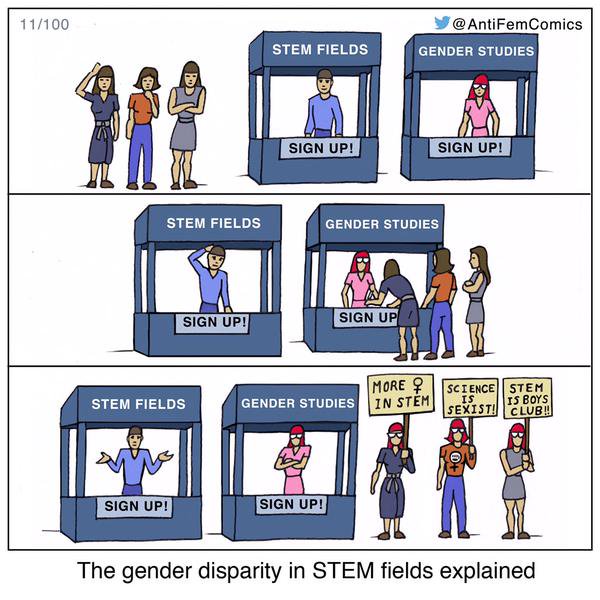
This lack of resilience and self-control disrupts the workplace, and results in lost productivity. If it turns into a lawsuit, the costs are even higher. This is in addition to women having fewer STEM degrees than men, working fewer hours than men, and taking months leave for pregnancy. Not to mention preferential hiring and promoting of women to meet government-mandated quotes.

Second point, is increased hostility to men.

Look at this tweet from a writer at Teen Vogue:

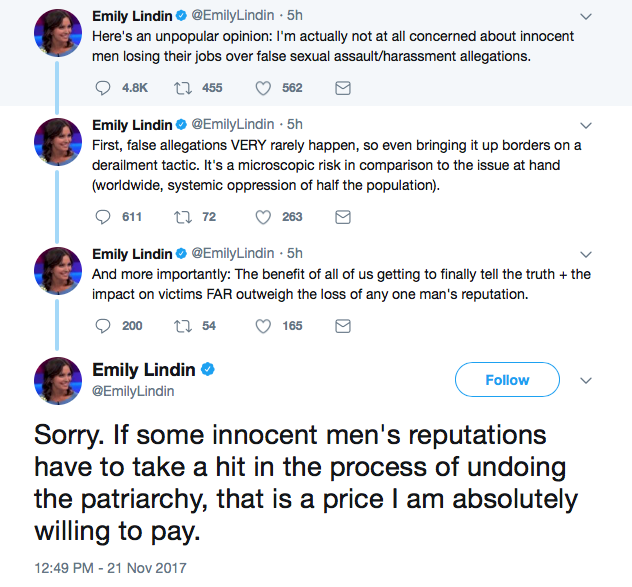
Emily Lindin, a mainstreatm writer with a degree in music history, tweets her hatred of men
Emily Lindin, a mainstream writer with a degree in music history, tweets her misandry

She has 23,000 followers on Twitter – this woman is mainstream. I looked into her background a bit. No mention of a father at home, and a self-confessed “slutty” lifestyle from her early teens onward. Her entire writing career seems to be to attack everyone who disagrees with her promiscuity.

Feminism, as an ideology, does not allow women to prefer men who exhibit traditional masculine characteristics: providing, protecting, moral and spiritual leadership, chastity, fidelity. That’s “sexist”. So what’s left? Get drunk and have sex with the hot bad boys, since evaluating a man’s character is “sexist”. Then promote false accusations and misandry to get revenge against the hot bad boys you freely chose. This will only get worse as more radical feminists waste their 20s on hot bad boys, and raise more fatherless girls when they become single mothers by choice, in their 30s.

Do men want to work with women who hate men and make false accusations against people they disagree with? I’m a conservative, Christian, pro-life virgin. I disagree with all premarital sex. If this woman worked with me and found out my views, she would almost certainly get me fired. As more and more women come under the influence of angry radical feminists, men will have the perception that women hate them. That’s bad for the minority of non-progressive women, but it’s just safer to avoid any woman once the radical feminist views become the majority.

Another article from Medium (H/T Wes) makes a third point about how conservatives are treated by liberal women in the workplace. The article is written by a female senior software engineer, who promotes STEM to women and the elderly. She is a self-described “moderate conservative”.

Excerpt:

On September 27, 2017, I decided to attend the Atlanta Google Women Techmakers’ event “Idea Jam Session,” which was hosted at TechSquare Labs in Atlanta. At that time, I was still an active member of Women Who Code, the Atlanta GDG, and Google Women Techmakers and, perhaps naively, I just assumed that I had every right to attend the event like any other member of the group because I had not been banned.

Upon arriving at the event, Maggie immediately asked me to leave the room. At the door, she informed me that she would be extremely uncomfortable if I remained a member of the community because some of the views that I had expressed on Twitter are “very harmful to gender equality”. She then asked Daniel Sabeo, the event coordinator at TechSquare Labs, to escort me from the facility. I was deeply upset at being publicly humiliated, but left willingly without causing any disruption.

Two days later, I got an email from TechSquare Labs. Daniel had discussed the incident with Allen Nance, Paul Judge, and Rodney Sampson, the owners of the facility, and he informed me that they had collectively decided to ban me and my company from using their venue or attending any of their events because they were concerned about the “safety” of their members. I later learned from a fellow developer that Maggie had, in fact, told various people that I’d been stalking her.

[…]The following week, Martin Omander, GDG program manager for North America, formally banned me from the Google Developer Group and Google Women Techmakers and, again, declined to provide me with any details of the complaints against me or the rules that I’d allegedly violated.

How many women are likely to attack conservatives in the workplace?

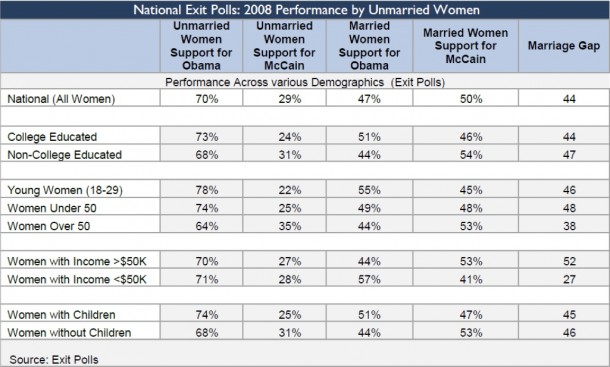
Young, unmarried women voted 78% to 22% for Obama in 2008, according to exit polls.

Exit polls from the 2008 Obama vs McCain election
Exit polls from the 2008 Obama vs McCain election: unmarried women voters only

Obama voted against banning infanticide multiple times as a state senator in Illinois. 78% of young, unmarried women voted for him anyway. Women who graduate from college in non-STEM fields are especially progressive. In my experience, most young, unmarried women form their views by adapting to the dominant views of their community. On campus, their community is usually progressive. In my experience, men are more likely to construct a worldview through reasoning and evaluating evidence.

In my experience, young, unmarried progressive women are progressive because they want taxpayer-funded abortions, taxpayer-funded contraception, no-fault divorce, single mother welfare, student-loan forgiveness, etc. Taxpayer-funded bailouts for problems caused by their own free choices. They feel that if society is paying for something, then it’s “normal” and they don’t have feel guilty about making poor choices. Their primary concern about politics is being able to do what they feel like without anyone disapproving. Everything bad that happens is “unexpected”, and so society should have to pay for it.

Most men rightly disagree with leftist policies, because men believe in personal responsibility. But if men think that they will be falsely charged or otherwise sanctioned for being conservative, then it makes sense for them to not speak to women at all. Again, that’s bad for the minority of young, unmarried conservative women, but it’s safer to just avoid the risk. Especially as radical feminism becomes the dominant view among young, unmarried women. The point is that men are going to have to hide their political views from MOST young, unmarried women in the office, because progressive ones seem to be very intolerant of the conservative views that most men hold.

I don’t even speak to young, unmarried women about religion and politics in the workplace. It doesn’t matter if we have the same views or not. Feeling offended and going full totalitarian is just too widespread. The rational choice for men is to disengage. I can have conversations safely about religion and politics with men, even if they disagree with me. I realize that this isn’t fair to the minority of young, unmarried conservative women who are safe to talk to, but it’s just too dangerous to risk it.