ONE of the most controversial pieces of legislation ever undertaken by the Holyrood Parliament has been approved by MSPs. The Scottish Parliament voted by 82 to 32 with four abstentions to pass the Hate Crime and Public Order Bill.
[…]Conservative spokesperson on justice Liam Kerr MSP said the bill went too far, arguing: “The bill contains no defence regarding private conversations in people’s own homes. The police could come to someone’s home, having received a report of their having stirred up hate around the dinner table, and could take witness statements from those present, which, presumably, could include their children.”
So, I follow a lot of bills like this in a variety of countries, and I don’t think I’ve ever seen one that went this far to discourage free expression. And I’ve seen some very bad bills. Basically, if you have a conversation in your home or in your own yard that someone is offended by, it’s a criminal offense. Armed police will come into your house, breaking in if necessary. They will interrogate everyone present, and they will take anything that might contain information about your “hateful” views to be used in evidence against you. Like the Conservative MSP said, they will even ask your children what you said if order to get you arrested and jailed.
Can you imagine trying to have a conversation with a non-Christian in your home about Christian views on abortion or sexuality in Scotland? You couldn’t. You couldn’t even have a conversation with your wife or your kids. You couldn’t discuss something you disagree with that you saw on television. Or that your children learned in the schools. You couldn’t do your job as a husband and father, in short. And you couldn’t even speak about these things in church (or at work) for fear of saying the wrong thing to the wrong person. How are you suppose to defend your faith, explain your Christian convictions, or lead your family? But you still have to pay taxes to the people who make these laws – and to the police who will arrest and imprison you. Then run your lives. You get the bill.
If you like legislation like this, keep voting for the Democrats. They’ll get it done for you. And if you focus on mean tweets (or whatever else the mainstream news media dangles in front of your face) instead of policy, then you’ll get laws like this, too. Politics matters. You have a worldview to put into practice, and laws like this Scottish law will make it impossible for you to achieve your goals.
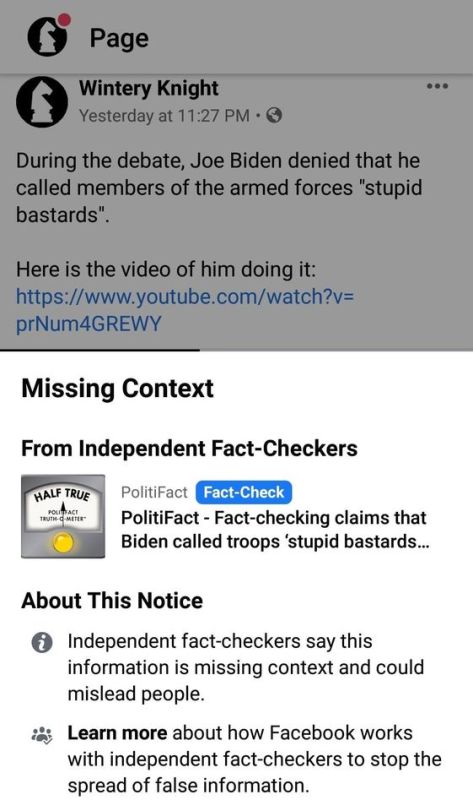
Politifact is a web site run by some left-wing journalists at the Tampa Bay Times. As you might expect from academic studies of media bias, their content might as well be written by the Democrat Party. But it’s not enough to just declare Politifact a Democrat propaganda operation – I need to actually give you details and examples. And so I will, in the rest of this post.
Let’s start with two recent examples, then I’ll show you the worst example of media bias I have ever seen from Politifact.
On Tuesday, Politifact, which purports to be a neutral fact-checking website but in fact leans heavily to the left, got caught protecting a member of the Democratic Party: Democratic Missouri Sen. Claire McCaskill.
Politifact took issue with the ad from The Senate Leadership Fund, a pro-Republican super PAC, that claimed that McCaskill said “normal people” could afford private planes.
[…]After they were corrected, Politifact acknowledged the mistake, writing,
Initially, we published this fact-check with a rating of False, because based on the video available, it did not appear that McCaskill was talking about private planes. After publication, we received more complete video of the question-and-answer session between McCaskill and a constituent that showed she was in fact responding to a question about private planes, as well as a report describing the meeting. We re-assessed the evidence, archived the original version here, and published the version you see here with a new rating of Half True. We apologize for the error.
Daily wire also linked to some more failed Politifact “fact checks”: here, here, and here.
Arizona Senate Race
Politifact also screwed up their fact-check for the Arizona Senate race.
PolitiFact incorrectly labeled it “mostly false” that Democratic Senate candidate Kyrsten Sinema “protested troops in a pink tutu” during its live fact-check of the Arizona Senate debate Monday night.
It’s an established fact that Sinema, a former Green Party activist who co-founded an anti-war group, wore a pink tutu at one of the multiple anti-war protests she attended in 2003.
“While we were in harm’s way, she was protesting our troops in a pink tutu,” Republican candidate Martha McSally, a former Air Force fighter pilot, said during Monday night’s debate.
Here’s their Politifact’s evaluation of McSally’s claim:
Who are you going to believe? Politifact, or your own eyes?
And here’s the photo of Kyrsten Sinema, protesting the troops, in a pink tutu:
Anti-war Democrat Senate candidate Kyrsten Sinema in a pink tutu
The Daily Caller notes:
A 2003 Arizona State University news article at the time described Sinema wearing “something resembling a pink tutu” at one of the protests.
[…]Sinema openly associated with fringe elements of the far-left during her anti-war activism.
She promoted an appearance by Lynne Stewart, a lawyer who was convicted of aiding an Islamic terrorist organization, in 2003.
Sinema also reportedly partnered with anarchists and witches in her anti-war activism and said she did “not care” if Americans wanted to join the Taliban.
Colonel Martha McSally, as I’ve blogged about before, is a former U.S. Air Force A-10 fighter pilot, and squadron commander. She logged a lot of hours leading actual combat missions against America’s enemies – the sorts of people who sell and rape Yazidi girls. She fought them.
And now for the big one: Politifact’s fact-checking of Obamacare.
Obama’s claims about Obamacare
Avik Roy, health care policy expert at Forbes magazine, wrote about Politifact’s assessment of Obama’s promise to Americans about keeping their health plans after Obamacare.
In 2008, before the presidential election, PolitiFact rated Obama’s claims about Obamacare “True”:
Roy writes: (links removed)
On October 9, 2008, Angie Drobnic Holan of PolitiFact published an article using the site’s “Truth-O-Meter” to evaluate this claim: “Under Barack Obama’s health care proposal, ‘if you’ve got a health care plan that you like, you can keep it.’”
And she concluded:
[…]…people who want to keep their current insurance should be able to do that under Obama’s plan. His description of his plan is accurate, and we rate his statement True.”
Roy notes:
PolitiFact’s pronouncements about Obamacare were widely repeated by pro-Obama reporters and pundits, and had a meaningful impact on the outcome of the election. Indeed, in 2009, PolitiFact won the Pulitzer Prize for its coverage of the 2008 campaign.
Here’s the screen capture from 2008:
Politifact says that everyone who likes their health care plan can keep it
Before the election, it’s true! And Obama got re-elected, because people believed that. But what happened after the election?
In 2013, after the 2012 election, PolitiFact rated Obama’s claims about Obamacare “Pants On Fire”:
Roy writes: (links removed)
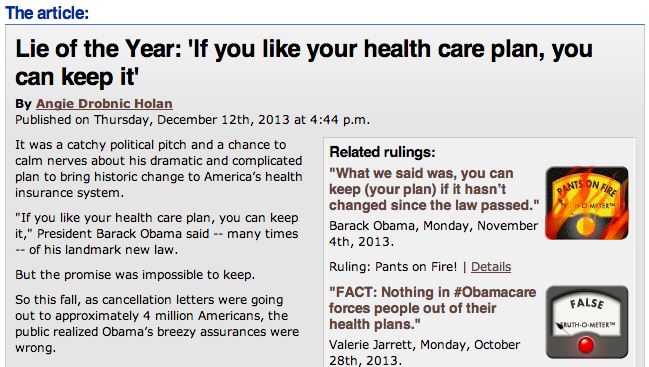
On December 12, [2013] the self-appointed guardians of truth and justice at PolitiFact named President Obama’s infamous promise—that “if you like your health care plan, you can keep it”—its 2013 “Lie of the Year.”
[…][N]one of the key facts that made that promise “impossible” in 2008 had changed by 2013. The President’s plan had always required major disruption of the health insurance market; the Obamacare bill contained the key elements of that plan; the Obamacare law did as well. The only thing that had changed was the actual first-hand accounts of millions of Americans who were losing their plans now that Obamacare was live.
And the screen capture from 2013:
Politifact said one thing before the election, and the opposite afterwards
So when Politifact rates a statement by a Democrat as true, what they really mean is that it’s pants-on-fire-false, but it’s election time so they don’t say that. It’s not like the critical assessments of Obamacare from health policy experts were not out there between 2007-2012. I know, because I blogged on every study and report on the predicted effects of the law that I could find. But the intellectually lazy journalism-major clowns at Politifact couldn’t be bothered to read those studies and reports.
Unbelievable’s radio show featured a discussion with former Christian Dan Barker, the founder and co-President of the Freedom From Religion Foundation.
I thought that I would make some general comments about why I think that many people leave the Christian faith, and what you should be careful of in order to avoid following in Dan Barker’s footsteps, specifically.
Basically, there are four major reasons why people leave Christianity.
They want to do something immoral with impunity. This type of person wants to do something immoral that is forbidden by Christianity, like pre-marital sex or getting drunk in clubs with friends. They dump Christianity in order to have freedom to seek happiness in this life.
They want to make decisions based on their emotions, rather than wisdom. This type of person thinks that God’s job is to save them when they act irresponsibly. When God disappoints them by not make their recklessness “work out”, they leave the faith.
They want to be loved by people, not by God. This type of person thinks that Christianity is a tool that they can use to become popular. When they first try to articulate the gospel in public, they find that people don’t like them as much, and they feel bad about offending people with exclusive truth claims that they cannot back up using logic and evidence. So, they water down Christianity to get along with non-Christians. Finally, they jettison Christianity completely. This happens to a lot of young Christians the moment they hit college / university.
They don’t want to learn to defend their faith. This type of person is asked questions by skeptics that they cannot answer. Usually this happens when people go to university after growing up in the shelter of the Church. The questions and peer pressure make them feel stupid. Rather than investigate Christianity to see if it’s true, they drop it, so they can be thought of as part of the “smart” crowd.
Now listen to the discussion and see if you can identify some of these factors from Barker’s own carefully-prepared words. He is trying very hard to make himself look honest and moderate, because he wants Christians to be sympathetic with his story and his motives for leaving Christianity. But I think that there is enough in his statements to construct a different hypothesis of why he left Christianity.
I’ve grouped the data by risk factor. Some of this is my interpretation of his real motivations, based on my experience dealing with former-Christians.
Non-rational, emotional approach to Christianity
he was raised in a devout Christian family where he probably wouldn’t have faced skeptical questions
he converted to Christianity at age 15 as a result of a religious experience, not a serious investigation
his idea of God was probably idealized and uninformed, e.g. – a loving God who wants us to be happy
he wandered around from church to church preaching, with no fixed address or source of income
he earned money by collecting “love offerings” from churches where he performed his music
he wrote Christian songs and Christian musicals, but nothing substantive on apologetics and theology
he worked in three churches known for being anti-intellectual and fundamentalist
there’s no evidence that of any deep study of philosophy, science and history during this time
Desire to gain acceptance from non-Christians
he began to notice that some people were uncomfortable with sin and Hell
he began to avoid preaching about sin and Hell in order to make these people comfortable
he watered-down the gospel to focus on helping people to be happy in this life
his manic approach to Christian ministry was challenged by the “real life” needs of his growing family
he met liberal pastors while performing his music in their churches
he found it difficult to disagree with them because they seemed to be “good” people
he watered down his message further in order to appeal to people across the theological spectrum
Ignorance of Christian apologetics
he began to think that if there are many different views of religion, then no view can be correct
he was not intellectually capable of using logic and evidence to test these competing claims to see which was true
he decided to instead re-interpret Christian truth claims as non-rational opinions, so they could all be “valid”
he became a theological liberal, abandoning theism for an impersonal “ground of being”
he embraced religious pluralism, the view that all religions are non-rational and make no testable truth claims
he began to see God as a “metaphor” whose purpose is to make people have a sense of meaning and purpose
he jettisoned God completely and focused more on helping people find meaning and morality apart from God
seems to think that religion is about having a “great life”, and felt that you can have a “great life” without religion
seems to think that religion is about being “good”, and felt that you can be “good” without religion
religion makes people feel bad by telling them what to do instead of letting them do anything they want
religion makes people feel bad by telling them what is true, instead of letting them believe whatever they want
religion makes people feel bad by telling them that God will hold them accountable for their beliefs and actions
So what do I think happened?
Barker was generating an income from donations from churches where he entertained them. Gradually, his family grew to the point where conservative churches were not enough to support him. He had to change his message to appeal to liberal churches in order to cast a wider net.
He seems to have thought that Christianity is about having his needs met and being liked by others. I think he wanted to feel good and to make people feel good with his preaching and singing. But Christianity is not a feel-good religion. It’s not a tool to make people like you. He seems to have become aware that the exclusive claims of Christianity made other people feel offended, so he cut them out. Christian apologists learn how to provide evidence for claims that non-Christians find offensive or hard to believe, but Dan hadn’t studied philosophy, science or history so he couldn’t defend it. It’s hard to speak unpopular truths when you have nothing to back it up except your music composing. Eventually, Dan just quit making the truth claims entirely.
I also think money was a factor. It seems to me that it would have hurt his career and reduced his invitations from liberal churches if he had kept up teaching biblical Christianity. In order to appeal to a wider audience, (like many Christian singers do – e.g. – Amy Grant, Jars of Clay, etc.), he would have felt pressured to water down the unpleasant parts of his preaching and singing. Lacking apologetics skill, he instead abandoned his message. He needed to account for his family’s needs and “real life”, and exclusive truth claims and Hell-talk would have reduced his ability to do that. It seems to me that he should have scaled back his extreme schedule of preaching and singing, and instead gotten a steady job so that he could afford “real life” and a family without being pressured into altering his message. The Christian life requires a certain amount of wisdom that Dan did not have.
Life isn’t a fairy tale. God isn’t there to reward risky behavior. We need to be more shrewd about financial matters so that we have the ability to not care about what people think of us. Look at this blog. I work all day as a senior software engineer with two degrees in computer science, so that I don’t have to rely on donations. Additionally, I save most of what I make in case a tragedy strikes. Since I am financially secure, I can say what I think, and disregard anyone who wants me to change my message because they are offended. Becoming a Christian isn’t a license to behave irrationally and immaturely with money. For some people, (like William Lane Craig), stepping out in faith works. But if it doesn’t work, it’s better to retreat and re-trench, rather than to compromise your message for money.
I actually met someone like Dan Barker recently. She grew up in an anti-intellectual hippy Christian home. Her mother came from a good family, and decided on a whim to marry a non-Christian. Like Barker, the family exalted feelings and irrational expectations of miracles from God for “fearless” acts. She got herself into trouble with alcohol and promiscuity in her 20s, by making emotional decisions and mixing with the wrong crowd. Her way of fixing this was to fly off on a one-year missions trip, wrecking her resume and finances. Now, she is in her late 30s, unmarried, and literally blaming Jesus for putting too many demands on her that she doesn’t have time for, e.g – morning quiet time. This causes her to feel guilty, and make her want to reject Christianity. She had no intellectual conception of basic core doctrines like God’s existence or Jesus’ resurrection, which might have acted as a bulwark against her emotions. When I explained to her how I had structured my education and career so that I could have an influence without testing God, she seemed bored and said that I was too “fearful”.
This is apparently widespread, especially among anti-intellectual denominations. Another ex-Pentecostal atheist woman I heard about from people who knew her when she was young decided to drop out of college to travel around North America doing pro-life work. When she found herself penniless, unmarried and without children in her mid-30s, she decided to have a baby out of wedlock. The government will pay for it, she said. Rather than trying to justify this decision as a Christian, she blamed God for not making her madness “work out”. She is now an atheist, because God did not reward her decision to live “fearlessly” for him with a husband and children. It was all God’s fault. There is a whole subculture within Christianity, where the pursuit of fun and thrills can be masked with pious language, and all talk of prudence and restraint is seen as cowardice and lack of faith.
The Christian life requires a certain level of intelligence, a certain level of practical wisdom, and a certain level of self-control and discipline. Make sure that you don’t walk away from God because of your own bad choices.


 Politifact is a web site run by some left-wing journalists at the



 WINTERY KNIGHT