The verdict seems unanimous. From presidential speeches to role-playing games, the crusades are depicted as a deplorably violent episode in which thuggish Westerners trundled off, unprovoked, to murder and pillage peace-loving, sophisticated Muslims, laying down patterns of outrageous oppression that would be repeated throughout subsequent history. In many corners of the Western world today, this view is too commonplace and apparently obvious even to be challenged.
But unanimity is not a guarantee of accuracy. What everyone “knows” about the crusades may not, in fact, be true. From the many popular notions about the crusades, let us pick four and see if they bear close examination.
The four myths:
Myth #1: The crusades represented an unprovoked attack by Western Christians on the Muslim world.
Myth #2: Western Christians went on crusade because their greed led them to plunder Muslims in order to get rich.
Myth #3: Crusaders were a cynical lot who did not really believe their own religious propaganda; rather, they had ulterior, materialistic motives.
Myth #4: The crusades taught Muslims to hate and attack Christians.
Here’s the most obvious thing you should know. The Crusades were defensive actions:
In a.d. 632, Egypt, Palestine, Syria, Asia Minor, North Africa, Spain, France, Italy, and the islands of Sicily, Sardinia, and Corsica were all Christian territories. Inside the boundaries of the Roman Empire, which was still fully functional in the eastern Mediterranean, orthodox Christianity was the official, and overwhelmingly majority, religion. Outside those boundaries were other large Christian communities—not necessarily orthodox and Catholic, but still Christian. Most of the Christian population of Persia, for example, was Nestorian. Certainly there were many Christian communities in Arabia.
By a.d. 732, a century later, Christians had lost Egypt, Palestine, Syria, North Africa, Spain, most of Asia Minor, and southern France. Italy and her associated islands were under threat, and the islands would come under Muslim rule in the next century. The Christian communities of Arabia were entirely destroyed in or shortly after 633, when Jews and Christians alike were expelled from the peninsula.6 Those in Persia were under severe pressure. Two-thirds of the formerly Roman Christian world was now ruled by Muslims.
What had happened? Most people actually know the answer, if pressed—though for some reason they do not usually connect the answer with the crusades. The answer is the rise of Islam. Every one of the listed regions was taken, within the space of a hundred years, from Christian control by violence, in the course of military campaigns deliberately designed to expand Muslim territory at the expense of Islam’s neighbors. Nor did this conclude Islam’s program of conquest. The attacks continued, punctuated from time to time by Christian attempts to push back. Charlemagne blocked the Muslim advance in far western Europe in about a.d. 800, but Islamic forces simply shifted their focus and began to island-hop across from North Africa toward Italy and the French coast, attacking the Italian mainland by 837. A confused struggle for control of southern and central Italy continued for the rest of the ninth century and into the tenth. In the hundred years between 850 and 950, Benedictine monks were driven out of ancient monasteries, the Papal States were overrun, and Muslim pirate bases were established along the coast of northern Italy and southern France, from which attacks on the deep inland were launched. Desperate to protect victimized Christians, popes became involved in the tenth and early eleventh centuries in directing the defense of the territory around them.
If you asked me what are the two best books on the Crusades, I would answer God’s Battalions: The Case for the Crusades by Baylor professor Rodney Stark and The Concise History of the Crusades by Professor Thomas F. Madden. If you get this question a lot from atheists, then I recommend you pick these up. Anything by Rodney Stark is useful for Christians, in fact.
I often hear atheists going on and on about how the Bible has this evil and that evil. Their favorite one seems to be slavery. Here are three things I say to atheists when they push this objection.
The Bible and slavery
First, you should explain to them what the Bible actually says about slavery. And then tell them about the person responsible for stopping slavery in the UK: a devout evangelical named William Wilberforce.
We should compare Hebrew debt-servanthood (many translations render this “slavery”) more fairly to apprentice-like positions to pay off debts — much like the indentured servitude during America’s founding when people worked for approximately 7 years to pay off the debt for their passage to the New World. Then they became free.
In most cases, servanthood was more like a live-inemployee, temporarily embedded within the employer’s household. Even today, teams trade sports players to another team that has an owner, and these players belong to a franchise. This language hardly suggests slavery, but rather a formal contractual agreement to be fulfilled — like in the Old Testament.3
Atheism and moral judgments
Second, inform them that moral values are not rationally grounded on atheism. In an accidental universe, there is no way we ought to be. There is no design for humans that we have to comply with. There are no objective human rights, like the right to liberty (that would block slavery) or the right to life (that would block abortion). Although you may find that most atheists act nicely, the ones who really understand what atheism means and live it out consistently are not so nice.
Famous atheist Richard Dawkins has previously written this:
The total amount of suffering per year in the natural world is beyond all decent contemplation. During the minute that it takes me to compose this sentence, thousands of animals are being eaten alive, many others are running for their lives, whimpering with fear, others are slowly being devoured from within by rasping parasites, thousands of all kinds are dying of starvation, thirst, and disease. It must be so. If there ever is a time of plenty, this very fact will automatically lead to an increase in the population until the natural state of starvation and misery is restored. In a universe of electrons and selfish genes, blind physical forces and genetic replication, some people are going to get hurt, other people are going to get lucky, and you won’t find any rhyme or reason in it, nor any justice. The universe that we observe has precisely the properties we should expect if there is, at bottom, no design, no purpose, no evil, no good, nothing but pitiless indifference.
(“God’s Utility Function,” Scientific American, November, 1995, p. 85)
When atheists like Dawkins talk about morality, you have to understand that they are pretending. To them, morality is just about personal preferences and cultural conventions. They just think that questions of right and wrong are arbitrary. Things that are wrong in one time and place are right in another. Every view is as right as any other, depending on the time and place. That’s atheist morality.
What’s worse than slavery? Abortion!
Third, you should ask the atheist what he has done to oppose abortion. Abortion is worse than slavery, so if they are sincere in thinking that slavery is wrong, then they ought to think that abortion is wrong even more. So ask them what they’ve done to oppose the practice of abortion. That will tell you how sincere they are about slavery.
Here’s atheist Richard Dawkins explaining what he’s done to stop abortion:
That’s right. The head atheist supports killing born children.
If there’s one area where I feel comfortable leading a woman, it’s education, career and finances. I wasn’t born in the USA, so it was quite a struggle to know how to navigate education, career and finances. But I did it, and I learned how to do it. And I like to share what I learned with Christian women, so that they don’t end up with a useless degree and a bunch of student loan debt.
Here’s a story about a woman I didn’t advise, reported by the far-left Business Insider:
Maria had a goal to teach at a university full-time. Today, she “absolutely” regrets pursuing that goal.
While Maria’s undergraduate education, which she completed in 2001, was funded through scholarships and Pell grants, she knew more advanced degrees would give her a leg up in university teaching — especially as a woman in the industry. So she pursued a master’s degree and a PhD, the latter of which took seven years to complete.
[…]Now, at 48 years old, Maria’s student-loan balance is $430,000…
[…]As a full-time human resources representative and part-time adjunct professor in Michigan, Maria now makes a five-figure salary while supporting her 15-year-old daughter on her own, with very minimal child support from the father.
[…]Of her total student-debt load, more than $70,000 is interest that accumulated while her student-loan payments were on hold, during which she cashed out her 401k and lived on unemployment benefits.
[…]Maria even filed for bankruptcy in 2018
I don’t recommend doing a degree in non-STEM fields, they don’t pay. I don’t recommend spending 7 years with no income for a PhD. But notice how society gives her free money to subsdize these poor decisions. She got free scholarships, Pell grants, child support, unemployment benefits. The article doesn’t mention if she got alimony, too. And she filed for bankruptcy… screwing her creditors out of what she owed them. Who knows what other social programs and tax benefits she got? While other women do STEM degrees, work in the private sector, marry and stay married, she’s been doing life on easy mode, passing off the costs of her poor decisions to the people around her. I don’t want women to make decisions that impose costs on their neighbors.
And now, she wants to get a bailout from taxpayers:
The Education Department recently announced reforms to PSLF, which included going back over denied applications and payments to the program. So there’s a chance that Maria may earn a quicker route to loan forgiveness. But with her current financial outlook, she’s not confident she can complete the program and wants President Joe Biden to do more to help millions of borrowers with debt burdens.
The article notes that teachers and other public sector “workers” can default on their loans and pass the costs along to taxpayers:
Maria does not work enough hours to qualify for the Public Service Loan Forgiveness (PSLF) program, which forgives student debt for public servants, like teachers, after ten years of qualifying payments.
Just understand that if society pays women to make poor decisions with their education, careers and finances, then more women will do it. That raises the costs on the men that pay taxes for this, reducing their ability to get married and conceive children. If men are paying for this woman’s mistakes, they can’t pay for their own marriage and parenting plans.
By the way, the author of the first Business Insider article, is a recent journalism graduate (expensive university) living in expensive Washington, D.C.. She advocates for bailouts through her journalism. She probably has massive student loan debt, too. It seems like choosing easy non-STEM majors, going into debt, then hoping for a bailout from socialism is quite common.
According to far-left Yahoo News, women hold two thirds of the $1.4 trillion outstanding student loan debt:
Women hold nearly two-thirds of the outstanding student debt in the U.S., according to the American Association of University Women. And, they have a harder time paying off their debt compared to men. Prior to the student loan forbearance period, 70% of men made at least their required minimum monthly loan payments, while only half (54%) of women said the same, a recent survey by D.A. Davidson found.
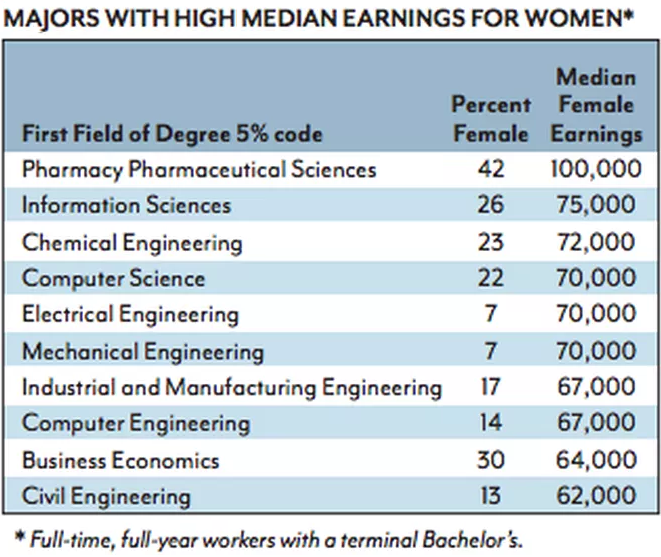
Young women today don’t like to have to “settle” for a lower cost college in a city with a lower cost of living. Like the Business Insider reporter, they want the Sex in the City lifestyle. So they go live in an expensive city, and run up debt doing useless degrees at an expensive university. And sometimes overseas! As you can see from the chart below, women avoid hard STEM degrees. But those programs are hard for a reason – they pay more money.
The best majors for women to avoid student loan debt
My thoughts
What I wanted to do here is report to you what happens when I try to coach young women about their decisions in education, career and finances. And keep in mind, I’m doing this from a position of starting out in a foreign country, earning a BS and MS in computer science, graduating debt-free and working 22 years full-time. I had a $1.3 million net worth by age 45 (including the new construction home I bought for cash). So I have achievements here.
I run into the student loan debt problem while dating Christian women for marriage. Christian women seem to be even less likely to do hard degrees than women on average. You see a lot of art, music, English, journalism, etc. degrees there. I show them that student loans are a risk factor for divorce, and they also set back the plan to stop paying rent and start having children. I also show them which majors pay the most.
Here’s what I usually get in response:
Women think that they will be an exception to all studies and reports showing that the likely consequences of their actions.
One woman dismissed the need to clean up her finances because God decided what degrees I would have, and how much I would earn, so I had no authority to advise her from my experience.
Other women say that I am only doing what makes me happy, and they must do that too. (Note: I cried in second year calculus after failing the first test).
I advised a 29-year-old woman with $25K of student loan debt and was working as a waitress to take a job I found her as an IT project manager. She said “No! Being a waitress is the easiest job I’ve ever had!”
A 30-year-old woman with $23K in student loan debt wanted to do a Masters degree in Europe. I told her to pay off her loans first. She got two useless Masters degrees in Europe, and never worked again.
I’m told that there is no rush to get out of debt to afford children, because women can have children in their 40s.
I’m told that it will be fine for the children if she has to work to pay off her debts, because daycare and public schools work better for children than stay-at-home moms and homeschooling.
I’m told that the $30 trillion national debt and bailouts for student loans, etc. are no big deal because the government can just print more money.
I’m told that I can fix her financial problems by working harder and longer. One of my friends actually married a woman with $200K in student loan debt in order to get his green card, so some men take this deal.
I’m told that too much planning feels bad, and I need to be more spontaneous and adventurous. One woman literally said “I don’t want to make decisions based on fear”.
A famous Christian apologist woman (not WIA) told me that I can’t judge a woman who has student loans because if God forgives a woman, then a man can’t exclude her from marriage.
I’m not going to run a marriage that way. I have goals.
Men can’t afford BOTH bailouts AND marriage
So, my point is that we have a real problem with figuring out how to get women to make better decisions about education, career and finance. I want to help them. I really do. Because we are $30 trillion in debt now, and we simply don’t have enough money to keep bailing out people for student loans. And the problem will only get worse, as the younger generation of losers keeps making poor decisions and demanding that someone else pay for their mistakes.
Men don’t marry women who are bad with money. Money is one of the biggest causes of divorce, and divorce is a financial disaster for men because of anti-male divorce courts.