Category Archives: News

Are atheists unbiased about the question of God’s existence?

Brian Auten has a book review posted up at Apologetics 315.

The book is “If There’s A God, Why Are There Atheists?”, by theologian R.C. Sproul. R.C. Sproul is one of my favorite theologians. The book in question has a very, very special place in my heart, because I think that it is one of the major reasons why I was able to resist pernicious ideas like religious pluralism and postmodernism for so long. Once you put on the glasses of Romans 1 and see for the first time what man is really doing with respect to God, you can never see things the same again. I’ll say more about this at the end, but let’s see what Brian wrote first.

The review

So often, you hear atheists complaining about religion is nothing but wish-fulfillment or some sort of crutch for people who are frightened by a variety of things. They think that God is invented to solve several problems. 1) how does the world work?, 2) is there meaning to suffering and evil?, 3) why should I be moral?, and 4) what will happen to me and my loved ones when I die?. On the atheistic view, God is just a crutch that people cling to out of weakness and ignorance. But is this really the case?

Sproul starts the book by investigating three atheists who sought to explain religious belief as a result of psychological factors.

Brian writes:

Before tackling the psychology of atheism, Sproul spends a chapter on the psychology of theism, from the perspective of Freud’s question “If there is no God, why is there religion?”11 What follows is an overview of various psychological explanations of theistic belief: Feuerbach’s “religion is a dream of the human mind.”12 Marx’s belief that religion is “due to the devious imagination of particular segment of mankind.”13 And Nietzche’s idea that “religion endures because weak men need it.”14 The author properly reiterates: “We must be careful to note that the above arguments can never be used as proof for the nonexistence of God. They can be useful for atheists who hear theists state that the only possible explanation for religion is the existence of God.”15 That being said, Sproul also reveals what these arguments presume:

Their arguments already presupposed the nonexistence of God. They were not dealing with the question, Is there a God? They were dealing with the question, Since there is no God, why is there religion?16

Sproul points out the weaknesses of each of these approaches and says “there are just as many arguments showing that unbelief has its roots in the psychological needs of man.”

Wow, could that really be true? What are the real reasons why people reject God? Does the Bible have anything to say about what those reasons are?

Brian cites Sproul’s contention:

The New Testament maintains that unbelief is generated not so much by intellectual causes as by moral and psychological ones. The problem is not that there is insufficient evidence to convince rational beings that there is a God, but that rational beings have a natural hostility to the being of God.

[…]Man’s desire is not that the omnipotent, personal Judeo-Christian God exist, but that He not exist.

In Romans 1:18-23, the apostle Paul explains what is really going on:

18The wrath of God is being revealed from heaven against all the godlessness and wickedness of men who suppress the truth by their wickedness,

19since what may be known about God is plain to them, because God has made it plain to them.

20For since the creation of the world God’s invisible qualities—his eternal power and divine nature—have been clearly seen, being understood from what has been made, so that men are without excuse.

21For although they knew God, they neither glorified him as God nor gave thanks to him, but their thinking became futile and their foolish hearts were darkened.

22Although they claimed to be wise, they became fools

23and exchanged the glory of the immortal God for images made to look like mortal man and birds and animals and reptiles.

Do you believe that? I believe that. I have never in my life met an atheist who varied from what Paul is saying here.

On this blog, I have presented many, many arguments for theism in general, and Christian theism in particular:

Sproul explains why atheists cannot allow themselves to live according to the evidence that is presented to them:

The cumulative effect of this knowledge that is clearly seen is to leave men ‘without excuse.’ Herein lies the basis of the universal guilt of man. No one can claim ignorance of the knowledge of God. No one can cite insufficient evidence for not believing in God. Though people are not persuaded by the evidence, this does not indicate an insufficiency in the evidence, but rather an insufficiency in man.

[…]The basic stages of man’s reaction to God can be formulated by means of the categories of trauma, repression, and substitution.

[…]If God exists, man cannot be a law unto himself. If God exists, man’s will-to-power is destined to run head-on into the will of God.

So, it’s pretty clear that there are huge implications to the question of God’s existence, and that the atheist will be affected by these implications when weighing evidence.

Here’s something Thomas Nagel, an excellent atheist philosopher, said:

“In speaking of the fear of religion, I don’t mean to refer to the entirely reasonable hostility toward certain established religions and religious institutions, in virtue of their objectionable moral doctrines, social policies, and political influence. Nor am I referring to the association of many religious beliefs with superstition and the acceptance of evident empirical falsehoods. I am talking about something much deeper–namely, the fear of religion itself. I speak from experience, being strongly subject to this fear myself: I want atheism to be true and am made uneasy by the fact that some of the most intelligent and well-informed people I know are religious believers.

I want atheism to be true and am made uneasy by the fact that some of the most intelligent and well-informed people I know are religious believers. It isn’t just that I don’t believe in God and, naturally, hope that I’m right in my belief. It’s that I hope there is no God! I don’t want there to be a God; I don’t want the universe to be like that.”

(”The Last Word” by Thomas Nagel, Oxford University Press: 1997)”

The rest of the book review, and the book, deals with explaining in detail how atheists respond to an all-good, all-powerful, all-knowing Creator/Designer. I encourage you to click through and read the whole book review. You can read the review, and the book, and then investigate for yourself whether the atheists are effected by this bias against moral accountability.

Feminists outraged over NFL player who believes in marriage, right to life

Commenter Craig alerted me to this story about an NFL player who defended traditional marriage and opposed abortion in a commencement speech. He’s getting a lot of trouble from the secular left. Let’s see the story, and then I’ll comment about what message this sends good men about value proposition of marriage and parenting.

Here’s the story from the Christian Post:

Kansas City Chiefs kicker Harrison Butker urged Catholic college graduates last weekend to reject the “Church of nice,” calling out President Joe Biden and other Catholics who support abortion and other practices that run counter to the teachings of the faith politically.

[…]Butker used his speech to highlight how “bad policies and poor leadership have negatively impacted major life issues.”

“Things like abortion, [in-vitro fertilization], surrogacy, euthanasia as well as a growing support for degenerate cultural values and media all stem from the pervasiveness of disorder,” Butker said. “Our own nation is led by a man who publicly and proudly proclaims his Catholic faith but at the same time is delusional enough to make the sign of the cross during a pro-abortion rally.”

“He has been so vocal in his support for the murder of innocent babies that I’m sure to many people, it appears that you can be both Catholic and pro-choice,” he added. “He is not alone. From the man behind the COVID lockdowns to the people pushing dangerous gender ideologies onto the youth of America, they all have a glaring thing in common: They are Catholic.”

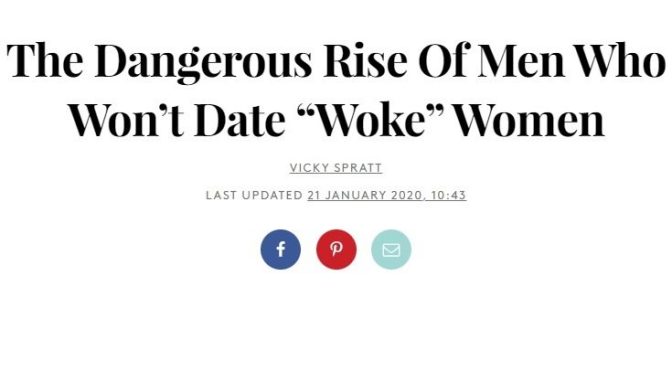
There’s been a huge response to these comments from the secular left. They are enraged. They don’t want to have to conform their desires to any sort of specification for marriage that might limit their narcissistic hedonism. And they certainly don’t want to be burdened with the needs of children that they create through their reckless recreational sex.

Here are my thoughts:

First, the only kinds of men who are willing to marry and have kids today are men who have traditional views, including supporting natural marriage and protecting unborn children from reckless, selfish adults. So, if a woman wants to get married, then she has one option – to choose a traditional man. And in order to find a traditional man, a woman has to encourage men through her actions to be traditional, lest the supply of these men dry up.

Sadly, most young, unmarried women today are under a delusion. They think that they can behave non-traditionally, and still find a traditional man to marry them after their selfish, reckless youth. That might have been true in the past, when the culture was Christian, but it’s not true in an age of secularism and feminism. And the reason why is simple.

All men today – good and bad – understand that marriage is an enormous risk and threat to their freedom and prosperity. They have heard the stories about no-fault divorce laws, false accusations, outrageous alimony and child support payments, biased courts, denial of visitation and even IMPRISONMENT. The only reason they would marry is if they were able to find a traditional woman who not only opposed feminism, but had a long public record of fighting against it. Not just words, but many, many years of public opposition to atheism, feminism, and socialism. That is the only kind of woman who might have a chance at marriage today. Good men today don’t believe that women can magically change from non-traditional to traditional at age 30 (or later). We know that shotgun conversions are unlikely to be sincere, or to last. We know that a woman’s past actions are a more accurate guide to her beliefs than her words. And no amount of shaming and blaming of men by pious conservative leaders is going to change that fact.

But families, churches, and society in general are not producing women who respect traditional men. 75% of young women today vote for policies that are opposed by good men. No one has the courage to tell young women that hatred of good men today is NOT compatible with marriage tomorrow.

Instead, pro-marriage leaders  think that good men should just be forced (by shaming) to forgive feminists for their poor decisions. Good men should just have to make the lives of women who hate them “work out”. Unfortunately for these pro-marriage people, good men have got the message. Good men look at stories like this, and realize that society hates men who have strong views on religion and morality. And that hatred extends from birth, through school, into the workplace, into laws, and into the courts.

It seems crazy to think that young women feel entitled to protection and provision in a marriage, even as they expect retain their opposition to male leadership. But that is universal today – non-traditional women who despise good men, expect to get all the benefits of a traditional man, with none of the responsibilities, expectations or obligations of traditional marriage. Only a stupid man would choose a non-traditional woman who hates him and hates his traditional views. And yet this is what the pro-marriage crowd expects men to do. They see men as 100% expendable.

The worst mistake you can make when defending the Christian worldview

So, this is just an advice post for doing apologetics.

Here are three situations I’ve run into while doing apologetics in the last month.

First situation. I was talking with a lady who is an atheist. I had a copy of “God’s Crime Scene” in my hand, and she asked me about it. I told her that it was a book written by the guy who solved the homicide case that I asked her to watch on Dateline. She remembered – it was the two-hour special on the woman who was killed with a garrotte. She pointed at the book and said “what’s in it?” I said, it has 8 pieces of evidence that fit better with a theistic worldview than with an atheistic one, and some of them scientific. Her reply to me was – literally – “which denomination do you want me to join?”

Second situation. I was talking with a friend of mine who teaches in a Catholic school. She was telling that she got the opportunity to talk to her students about God, and found out that some of them were not even theists, and many of them had questions. So she asked them for questions and got a list. The list included many hard cases, like “what about the Bible and slavery” and “why do Christians oppose gay marriage?” and so on.

Third situation. Talking to a grad student about God’s existence. I’m laying out my scientific arguments for her, holding up the peer-reviewed papers for each discovery. I get to the Doug Axe paper on protein folding probabilities, and she holds up her hand. One question: “Am I going to Hell?”

So think about those three situations. In each case, the opponent is trying to reject Christianity by jumping way, way ahead to the very end of the process. When you do Christian apologetics, you do not take the bait and jump to the end of the process dealing with nitty gritty details until you have made your case for the core of the Christian worldview using your strongest evidence. Let me explain.

So, your strongest evidence as a Christian are the scientific arguments, along with the moral argument. Those would include (for starters) the following:

  1. kalam cosmological argument
  2. cosmic fine-tuning
  3. galactic and stellar habitability
  4. origin of life / DNA
  5. molecular machines / irreducible complexity
  6. the moral argument

The problem I am seeing today is that atheists are rejecting discussions about evidence because they think that all we are interested in is getting them to become Christians. Well, yes. I want you to become a Christian. But I know perfectly well what that entails – it entails a change of life priorities. Both of the women I spoke to are living with their boyfriends, and the kids in the Catholic school just want to have fun. None of them wants to believe in a God who will require self-denial, self-control, and self-sacrifice. Nobody wants God to be in that leader position in their lives. Christianity is 100% reversed from today’s me-first, fun-seeking, thrill-seeking, fear-of-missing-out travel spirit of the age.

So, how to answer all these late-game questions? The answer is simple. You don’t answer any late-game questions until the person you are talking with accounts for the widely-accepted data in your list. These are things that have got to be accepted before any discussion about minor issues like one angel vs two angels at the empty tomb can occur. When we discuss all the basic issues where the evidence is the strongest, then we can go on to discuss issues where the evidence is debatable, then finally, in the last bits before the end, we can discuss these other kinds of questions.

How to explain why this process must be followed to the person who asks specific questions about minor issues? Simple. You explain that your goal is not to get them to become a Christian right now. That you want to let them believe anything thing they want. That’s right. They can believe anything they want to believe. As long as what they believe is consistent with the evidence. And what I am going to do is give them the evidence, and then they can believe whatever they want – so long as it’s consistent with the evidence.

So, for example, I’m going to tell them 3 pieces of evidence for a cosmic beginning of the universe: the expanding universe (redshift), the cosmic microwave background radiation, and the light element abundances. That’s mainstream science that shows that the universe came into being out of nothing, a finite time in the past. And I will charge them not to believe in any religion that assumes that the universe has always been here. For example, Mormonism is ruled out, they believe in eternally existing matter. See how that works? Hey, Ms. Atheist. You can believe anything you want. As long as what you believe is consistent with the evidence. 

I think this approach of not letting them rush you to the end at the beginning is important for two reasons. First, we can get our foot in the door to talk about things that are interesting to everyone, in a non-stressed environment. Everyone can talk about evidence comfortably. Second, we show that we hold our beliefs because we are simply letting evidence set boundaries for us on what we are allowed to believe. We can’t believe not-Christianity, because not-Christianity is not consistent with the evidence. And you start with the most well-supported evidence, and eliminate worldviews that are falsified by the most well-supported evidence. Atheism actually gets falsified pretty quickly, because of the scientific evidence.

So, that’s my advice. Had a friend of mine named William try this out about a week ago. It went down like this:

William to me:

This guy I know messaged me and bragged for a while about how easy he can dismantle Christianity. He said: “present the gospel to me as you understand it. I’ll simply ask questions to demonstrate it is not worth your belief.”

WK to William:

First of all, he isn’t allowed to just sit there and poke holes in your case, he has to present a positive case for atheism. Second, don’t discuss Christianity with him at all until you first discuss the evidence for theism – start with the good scientific evidence.

And William wrote this to his friend:

The way I’m wired is that I process all competing theories and go with the best one. By doing a comparative analysis of worldviews I find that Christian theology easily explains the most about the world I find myself living in.

I’m pretty sure that a God of some sort exists because of the scientific evidence for the origin of the universe and the fine tuning in physics. From there I find it quite intuitive that if a God went through the trouble of creating and tuning a universe for life that this God likely has some sort of interest in it and has revealed Himself to humanity in some way.

From there I can look at the major world religions and compare them to see which one explains the past and the present the best. Christianity easily comes out on top.

And then a few days later, I got this from William:

I finally got the agnostic to tell me what he thinks about origin and fine tuning. When I started pointing out that his views were unscientific, he blew a gasket, called me dishonest and told me he didn’t want to discuss anything further.

And that’s where you want to be. Cut off all discussions where the challenger tries to jump to the end and get you to debate the very last steps of your case. Present the strongest evidence for your core claims, and get him to account for this evidence within his own worldview. Lead the discussion with public, testable evidence. All warfare depends on picking the terrain, weapons and tactics that allow you to match your strength against your opponent’s weakness.