I collected together a few articles below connecting the Democrat party and the Biden administration to the attempt on Trump’s life. Each article makes a different point that was significant to me.
Democrat party’s attempt to take away Trump’s security detail: (Daily Caller)
Months before the shooting at former President Trump’s rally in Butler, Pennsylvania, on Saturday, Democratic Mississippi Rep. Bennie Thompson introduced a bill in April that would have removed Trump’s Secret Service detail.
The Disgraced Former Protectees Act was introduced by Democratic Mississippi Rep. Bennie Thompson of the House Committee on Homeland Security in April, with the bill aiming to remove “Secret Service protection for those who have been sentenced to prison following conviction for a Federal or State felony,” according to a press release from April. In light of the shooting at Trump’s rally, the importance of the Secret Service protection given to former presidents was demonstrated for all to see.
Biden hate speech inciting violence against Trump: (Politico)
A defiant President Joe Biden insisted to his donors on Monday that he is “done talking about the debate” and implored the party to ignore any further distractions and direct its attention back to Donald Trump.
“We need to move forward. Look, we have roughly 40 days til the convention, 120 days til the election. We can’t waste any more time being distracted,” Biden said in a private call with donors Monday, according to a recording obtained by POLITICO.
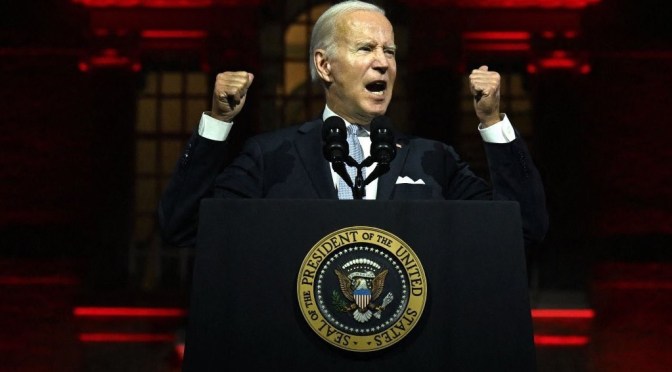
“I have one job, and that’s to beat Donald Trump. I’m absolutely certain I’m the best person to be able to do that. So, we’re done talking about the debate, it’s time to put Trump in a bullseye,” Biden said.
Biden says that Trump is a threat to democracy: (Toronto Sun)
Just two weeks earlier, Biden told supporters that Trump was a threat to America’s existence.
“Donald Trump is a genuine threat to this nation. That is not hyperbole. He’s a threat to our freedom. He’s a threat to our democracy,” Biden said, adding that he wouldn’t let Trump destroy America just before the 250th anniversary of the Declaration of Independence.
The corporate news media tried to cover for the Democrat party: (Daily Caller)
Multiple corporate media outlets initially did not report that shots were fired at a campaign rally featuring former President Donald Trump in Butler, Pennsylvania, on Saturday.
[…]Screenshots of corporate media sites showed that they did not initially report the shots in their headlines.
“Secret Service rushes Trump off stage after popping noises heard at his Pennsylvania rally,” a headline from NBC News said, according to a screenshot posted on X by Drew Holden.
“Trump whisked off stage in Pennsylvania after loud noises rang through the crowd,” a Los Angeles Times headline read, according to another screenshot Holden posted.
CNN tried to portray it as Trump’s fault: “Secret Service rushes Trump off stage after he falls at rally.”
Congerssman Steve Scalise, a previous victim of Democrat domestic terrorism, spoke up in the Wall Street Journal:
House Majority Steve Scalise (R., La.,) who was himself seriously injured during a shooting in 2017, criticized Democratic leaders’ political rhetoric in his statement Saturday night. The shooter in the 2017 attack, who was killed by police, had belonged to several anti-Republican groups and volunteered for Sen. Bernie Sanders’s presidential campaign. There was no immediate information Saturday about who the shooter was or the motivation behind the attack.
“For weeks Democrat leaders have been fueling ludicrous hysteria that Donald Trump winning re-election would be the end of democracy in America,” Scalise said in a statement. “Clearly we’ve seen far left lunatics act on violent rhetoric in the past. This incendiary rhetoric must stop.”
Time will tell about whether this case is similar to the plot to kidnap the Governor of Michigan: (Washington Times)
Defense attorneys wanted jurors to see more communications between FBI handlers, undercover agents and paid informants who had fooled Fox and Croft and got inside the group. They argued that any plan to kidnap Whitmer was repeatedly pushed by those government actors.
But at the 2022 trial, U.S. District Judge Robert Jonker greatly restricted the use of certain text messages and audio recordings under his interpretation of evidence rules.
“Trials are about telling your story, giving your narrative, trying to persuade,” Croft’s appellate lawyer, Timothy Sweeney, told the 6th U.S. Circuit Court of Appeals, which posts audio on its website.
“When you’re denied the ability to use the rules of evidence where they benefit you, that is an unfair trial. … This case needs to be reversed and sent back for a new trial for that reason,” Sweeney said.
He might have Judge Joan Larsen on his side. She was the most aggressive on the three-judge panel, at one point seeming incredulous with the government’s stance on an important legal precedent at play in the appeal.
“Oh, come on,” she told Assistant U.S. Attorney Nils Kessler. “Really?”
Larsen said defense lawyers wanted jurors to see that “government informants were just pounding” Fox and Croft.
“Make a plan, make a plan, make a plan – you’re just sitting around. You’re all talk, you’re no action, make a plan,” she said. “Surely that’s relevant.”
That article is from June 2024, so we are still waiting on answers in that case. Given what we know about the FBI’s involvement in pushing the Steele dossier to influence an election, and the statements of elite national security people denying that the Hunter Biden laptop was real, anything is possible. Don’t count on Democrats to have any morality, they’re atheists, and atheists cannot rationally ground morality. When objective morality goes against their self-interest, they choose their self-interest. That’s why 100 million people died as a result of godless communism in the last century. These people are not like William Wilberforce. The Christian worldview comes up with “free the slaves” and “let the babies live” and “adults should stay married and love their children”. The atheist worldview comes up with “anybody who threatens my power has to be arrested, tortured and sent to a forced labor camp to die of starvation”.
Certainly it looks like the Biden administration Secret Service acted strangely. They either failed to do their jobs, or they intentionally did not do their jobs. Was this a consequence of Democrat DEI policies or typical government incompetence, or was this similar to the case of FBI agents vowing to stop Trump from becoming President?
“[Trump’s] not ever going to become president, right? Right?!” Page texted Strzok in August 2016.
“No. No he won’t. We’ll stop it,” Strzok responded.
This isn’t the first time that violence like this has been committed against Republicans by Democrats. After all, if your most sacred belief is in abortion, then any kind of violence is possible. Abortion is the act of murdering an unborn child that you created with your own actions, in order to avoid having to lose your happiness. The people who have them value reckless, irresponsible sex more than they value taking responsibility to care for the most innocent and needy human beings. If that’s your core view, then anything is possible. You literally have no morals. And those are the types of people who are running federal law enforcement today. They focus on pre-dawn raiding the homes of peaceful pro-life demonstrators, while ignoring gun violence against Republicans from their allies in the Democrat party. That’s what sin does to a person.
Be effective and influential: