
Category Archives: Commentary

Is Christianity intended to provide you with health, wealth and happiness?

Bible study that hits the spot

I don’t have any friends who believe that Christianity is supposed to give them health, wealth and happiness. I mentor one girl from Africa, and she is always telling me that it is only Western Christians who think that suffering and evil is unexpected for Christians. Anyway, Lindsay shared this post about the so-called “prosperity gospel”, and so I am linking to it and excerpting something for me to comment on.

Here’s the post on the Gospel Coalition.

It says:

I am a pastor in a small village about 500 kilometers west of Nairobi—in Kenya’s sugar belt region. For the better part of my adult life, I was a Pentecostal/charismatic/Word of Faith preacher. But the day came when my faith made no sense at all.

I first heard the gospel as a young man, though the message contained false advertising about a Jesus who would meet all my needs and fulfill all my dreams. Remaining unsaved would lead to a life of misery, sickness, and poverty, I was told. It appeared logical, then, to embrace Christ and step into a world of limitless blessing.

I wanted all God had for me, and I zealously rose to become a herald of the message I had received—which I later learned is Word of Faith teaching some call the “prosperity gospel.” I knew of no other gospel. I believed God was good, and this meant nothing uncomfortable came from him.

I learned to deal with Satan for causing anything negative in my life. Spiritual warfare was ingrained in me. As part of the “God class,” as Word of Faith teachers say, I had absolute authority to create my own world through positive thinking and faith-based confessions.

I believed God’s will included health and wealth, which I could call into existence by faith. Anything less should be repudiated. If all else failed, I could engage the heavenly language of angels—praying in tongues—to bypass Satan and the hosts of darkness.

Do you believe any of that?

Well, the pastor goes on to explain all the terrible things that happened to him – and these are the most difficult experiences that can happen to anyone. How did he respond to God allowing all these bad things happening to him?

Well, pretty badly at first:

Without answers, we were dismayed with God, whose ways no longer made sense to us. Though faith became a mirage, we kept up appearances, trying to pretend we didn’t despair. Yet inwardly we felt doubtful, hopeless, even cursed.

How could we reconcile these bad things with a good God? Our Word of Faith teaching instructed us to dismiss Job’s suffering as a consequence of his negative confession: “The LORD gave, and the LORD has taken away” (Job 1:21). But how could we make sense of Paul himself falling sick (Gal. 4:13) and yet rejoicing in his afflictions (2 Cor. 12:10)? How could we continue to reconcile this portrait with modern “super-apostles” who market health and wealth in their books, DVDs, and mega-meetings?

In my faith crisis and anger at God, I vowed to quit the ministry. I felt like a fraud for preaching a “gospel” that did not work. God had become an enigma, and faith a labyrinth. Yet the passage of time and the routine activities of Churchianity soothed our restless minds—for a while.

But then this happened:

My friend asked me to translate in Swahili as Billy delivered a message in English. The topic, “justification by faith alone through the imputed righteousness of Christ,” sounded ridiculous to me. Onstage for one awkward hour, I forced myself to deliver words I believed were unbiblical and heretical. But the sovereign Lord worked in my heart, calling forth reason through an inner witness to the truths proclaimed. The Holy Spirit planted sufficient doubt about the system I’d defended.

Over the next three weeks I felt tortured by God for my errors, which became apparent with every Bible text I once thought supported my beliefs. The same verses now looked different, affirming Billy’s message.

[…]Though I didn’t understand the fine points of theology, my conversion was decisive. Enthralled by Christ, who bids his own to “take up his cross daily and follow me” (Luke 9:23), I now felt that “the sufferings of the present time are not worth comparing with the glory that is to be revealed to us” (Rom. 8:18).

I guess I should say the obvious – I have no idea how you would get the idea that you can coerce God into giving you health, wealth and prosperity. This is such an immature view of God. Anyone who has ever been involved in any kind of serious enterprise knows that the best people are the ones who stick to the mission through thick and thin, and just keep on fighting through the hunger, suffering, sickness and other setbacks. And that’s everywhere in the Bible. For goodness sake: Jesus was obedient to God to the point of suffering torture and giving his life as a sacrifice to save others from their rebellion against God. How do you get health, wealth and happiness from that?

But more than that, this makes me think of when I was young and first exposed to the Christian message. Far from being something that pushed me away from Christianity, the Bible’s message of suffering with honor, and doing the moral thing regardless of happy outcomes, really resonated with me. It is very real world. In this world, it is rare that doing the right thing works out for you. In fact, there should be some area of your life where you are missing something that you really want and need. Consider that a joy, because when you are poor and hungry sad and meek, that’s when you are most like the people in the Bible who had to experience these things while remaining faithful and obedient. For me, not being married and not being a father is my empty hole that will never be filled. I get asked about it a lot by my co-workers, and they know I am not happy about it, but they also know I am still faithful even if my needs are not met.

These are my two favorite passages in the Bible:

1 Corinthians 4:2:

1 This is how one should regard us, as servants of Christ and stewards of the mysteries of God.

2 Moreover, it is required of stewards that they be found faithful.

3 But with me it is a very small thing that I should be judged by you or by any human court. In fact, I do not even judge myself.

4 For I am not aware of anything against myself, but I am not thereby acquitted. It is the Lord who judges me.

Matthew 5:13:

10 “Blessed are those who have been persecuted for the sake of righteousness, for theirs is the kingdom of heaven.

11 “Blessed are you when people insult you and persecute you, and falsely say all kinds of evil against you because of Me.

12 Rejoice and be glad, for your reward in heaven is great; for in the same way they persecuted the prophets who were before you.

13 “You are the salt of the earth; but if the salt has become tasteless, how can it be made salty again? It is no longer good for anything, except to be thrown out and trampled under foot by men.

14 “You are the light of the world. A city set on a hill cannot be hidden;

15 nor does anyone light a lamp and put it under a basket, but on the lampstand, and it gives light to all who are in the house.

The Bible doesn’t shy away from suffering and evil. That’s part of the normal Christian life. And how you respond to lack and suffering and evil is a powerful signal to the watching world about what Christianity is all about. It’s not about feelings. It’s not about community. It’s not about impressing people with how much you know, or how accomplished you are, or how much stuff you have. It’s about putting truth above all, and learning obedience to God in Christ, no matter what happens to you.

From a practical point of view, I do recommend making good decisions so that you don’t experience unnecessary suffering, though. Be wise, but resolute. If you are careful to make yourself defensible to unexpected setbacks, not only will you be able to endure them, but you will be strong to help others endure them, too. The goal is to not let go of God because unmet desires and dashed expectations.

Ryan T. Anderson lectures on marriage and why it matters

Marriage and family
Marriage and family

Here’s the lecture:

About the speaker:

Ryan T. Anderson researches and writes about marriage and religious liberty as the William E. Simon Fellow at The Heritage Foundation. He also focuses on justice and moral principles in economic thought, health care and education, and has expertise in bioethics and natural law theory.

Anderson, who joined the leading Washington think tank’s DeVos Center for Religion and Civil Society in 2012, also is the editor of Public Discourse, the online journal of the Witherspoon Institute of Princeton, N.J.

Anderson’s recent work at Heritage focuses on the constitutional questions surrounding same-sex “marriage.” He is the co-author with Princeton’s Robert P. George and Sherif Girgis of the acclaimed book “What Is Marriage? Man and Woman: A Defense” (Encounter Books, December 2012).

The lecture starts at 7:20 in. The lecture ends at 49:35. There are 32 minutes of Q&A.

Introduction:

  • When talking about marriage in public, we should talk about philosophy, sociology and public policy
  • Gay marriage proponents need to be pressed to define what marriage is, on their view
  • Every definition of marriage is going to include some relationships, and exclude others
  • It’s meaningless to portray one side as nice and the other mean
  • Typically, marriage redefiners view marriage as a more intense emotional relationship
  • Marriage redefiners should be challenged in three ways:
  • 1) Does the redefined version of marriage have a public policy reason to prefer only two people?
  • 2) Does the redefined version of marriage have a reason to prefer permanence?
  • 3) Does the redefined version of marriage have a reason to prefer sexual exclusivity?
  • Also, if marriage is just about romance, then why is the state getting involved in recognizing it?
  • The talk: 1) What marriage is, 2) Why marriage matters, 3) What are the consequences of redefining marriage?

What marriage is:

  • Marriage unites spouses – hearts, minds and bodies
  • Marriage unites spouses to perform a good: creating a human being and raising that human being
  • Marriage is a commitment: permanent and exclusive
  • Male and female natures are distinct and complementary

The public purpose of marriage:

  • to attach men and women to each other
  • to attach mothers and fathers to their children
  • there is no such thing as parenting, there is only mothering and fathering
  • the evidence shows that children benefit from mothering and fathering
  • boys who grow up without fathers are more likely to commit crimes
  • girls who grow up without fathers are more likely to have sex earlier
  • Children benefit from having a mother and a father
  • can’t say that fathers are essential for children if we support gay marriage, which makes fathers optional
  • without marriage: child poverty increases, crime increases, social mobility decreases, welfare spending increases
  • when government encourages marriage, then government has less do to – stays smaller, spends less
  • if we promote marriage as an idea, we are not excluding gay relationships or even partner benefits
  • finally, gay marriage has shown itself to be hostile to religious liberty

Consequences redefining marriage:

  • it undermines the norm in public like that kids deserve a mom and a dad – moms and dads are interchangeable
  • it changes the institution of marriage away from the needs of children, and towards the needs of adults
  • it undermines the norm of permanence
  • we learned what happens when marriage is redefined before: with no-fault divorce
  • no-fault divorce: after this became law, divorce rates doubled – the law changed society
  • gay marriage would teach society that mothers and fathers are optional when raising children
  • if marriage is what people with intense feelings do, then how can you rationally limit marriage to only two people?
  • if marriage is what people with intense feelings do, then if other people cause intense feelings, there’s no fidelity
  • if marriage is what people with intense feelings do, then if the feelings go away, there is no permanence
  • the public policy consequences to undermining the norms of exclusivity and permanence = fatherless children and fragmented families
  • a final consequences is the decline and elimination of religious liberty – e.g. – adoption agencies closing, businesses being sued

We’re doing very well on abortion, but we need to get better at knowing how to discuss marriage. If you’re looking for something short to read, click here. If you want to read a long paper that his book is based on.

Related posts

What is wrong with electing an atheist to be President?

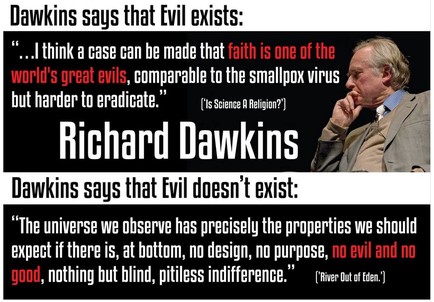
Richard Dawkins says faith is hard to eradicate, but some atheists have tried
Richard Dawkins says faith is evil and hard to eradicate, but some atheists have tried

One way to decide whether to be concerned or not, is to look at famous atheist leaders of the past, and to see whether they did a good job of protecting basic human rights.

One of the most famous atheists who ran a country was Mao Zedong, who ran China from 1958 to 1962. His reign was called
“The Great Leap Forward”.

The far-left Washington Post recently had a news article about Mao:

Who was the biggest mass murderer in the history of the world? Most people probably assume that the answer is Adolf Hitler, architect of the Holocaust. Others might guess Soviet dictator Joseph Stalin, who may indeed have managed to kill even more innocent people than Hitler did, many of them as part of a terror famine that likely took more lives than the Holocaust. But both Hitler and Stalin were outdone by Mao Zedong. From 1958 to 1962, his Great Leap Forward policy led to the deaths of up to 45 million people – easily making it the biggest episode of mass murder ever recorded.

Historian Frank Dikötter, author of the important book Mao’s Great Famine recently published an article in History Today, summarizing what happened:

[…]It is not merely the extent of the catastrophe that dwarfs earlier estimates, but also the manner in which many people died: between two and three million victims were tortured to death or summarily killed, often for the slightest infraction. When a boy stole a handful of grain in a Hunan village, local boss Xiong Dechang forced his father to bury him alive. The father died of grief a few days later. The case of Wang Ziyou was reported to the central leadership: one of his ears was chopped off, his legs were tied with iron wire, a ten kilogram stone was dropped on his back and then he was branded with a sizzling tool – punishment for digging up a potato.

The basic facts of the Great Leap Forward have long been known to scholars. Dikötter’s work is noteworthy for demonstrating that the number of victims may have been even greater than previously thought, and that the mass murder was more clearly intentional on Mao’s part, and included large numbers of victims who were executed or tortured, as opposed to “merely” starved to death. Even the previously standard estimates of 30 million or more, would still make this the greatest mass murder in history.

Some may say that the root of this mass murder is communism, but you can’t do these mass murders if you expect to encounter a God on the other side of death whose design for each of his human creatures was for them to love God, and love their neighbor as themselves.

In any case, opposition to religion is a cornerstone of communism, as this article by professor of political science Paul Kengor explains:

As Mikhail Gorbachev aptly stated, the Soviet communist state carried out a comprehensive “war on religion.” 1 He lamented that the Bolsheviks, his predecessors, even after the civil war ended in the early 1920s, during a time of “peace,” had “continued to tear down churches, arrest clergymen, and destroy them. This was no longer understandable or justifiable. Atheism took rather savage forms in our country at that time.” 2

The Soviet Union, reflective of the communist world as a whole, was openly hostile to religion and officially atheist; it was not irreligious or unreligious, with no stance on religion, but took the position that there was no God. Moreover, that atheism translated into a form of vicious anti-religion that included a systematic, often brutal campaign to eliminate belief. This began from the outset of the Soviet communist state and still continues in various forms in communist countries to this day, from China to North Korea to Cuba.

The roots of this hatred and intolerance of religion lie in the essence of communist ideology. Marx dubbed religion the “opiate of the masses,” and opined that, “Communism begins where atheism begins.” 3Speaking on behalf of the Bolsheviks in his famous October 2, 1920 speech, Lenin stated matter-of-factly: “We do not believe in God.” Lenin insisted that “all worship of a divinity is a necrophilia.” 4 He wrote in a November 1913 letter that “any religious idea, any idea of any God at all, any flirtation even with a God is the most inexpressible foulness … the most dangerous foulness, the most shameful ‘infection.’” James Thrower of the University of Virginia (a Russia scholar and also a translator) says that in this letter the type of “infection” Lenin was referring to was venereal disease. 5

“There can be nothing more abominable than religion,” wrote Lenin in a letter to Maxim Gorky in January 1913. 6 On December 25, 1919, Christmas Day, Comrade Lenin issued the following order, in his own writing: “To put up with ‘Nikola’ [the religious holiday] would be stupid—the entire Cheka must be on the alert to see to it that those who do not show up for work because of ‘Nikola’ are shot.” 7 Under Lenin, this was not an isolated occurrence.

Along with Trotsky, Lenin became involved in the creation of groups with names like the Society of the Godless, also known as the League of the Militant Godless, which was responsible for the dissemination of anti-religious propaganda in the USSR. 8 This institutionalized bigotry continued to thrive under Lenin’s disciples, most notably Stalin, and even under more benign leaders like Nikita Khrushchev.

This atheism was endemic to the communist experiment. Even those communists unable to secure political power—and thus lacking the ability to persecute believers—still did their best to persecute the teachings of organized religion and ridicule the idea of the existence of God. Even in America, it was no surprise to stroll by a city newsstand and catch bold front-page headlines like this in the Daily Worker, the communist organ published by CPUSA: “THERE IS NO GOD.” 9 Communists were proud of their atheism, and militant about it.

[…]“Religion is poison,” as Mao Tse-Tung was said to have stated.

The ideas expressed in these quotations of atheist leaders are pretty much every atheist will sign off on, as long as you don’t tell them who said it. These are normal atheist views of religion, and the hatred is especially strong against Christianity.

Richard Dawkins on atheism, morality, free will and human rights

Let’s take a look at what atheist leader Josef Stalin did during his rule of Russia in the 1920s and 1930s.

The Library of Congress offers this in their “Soviet Archives exhibit”:

The Soviet Union was the first state to have as an ideological objective the elimination of religion. Toward that end, the Communist regime confiscated church property, ridiculed religion, harassed believers, and propagated atheism in the schools. Actions toward particular religions, however, were determined by State interests, and most organized religions were never outlawed.

The main target of the anti-religious campaign in the 1920s and 1930s was the Russian Orthodox Church, which had the largest number of faithful. Nearly all of its clergy, and many of its believers, were shot or sent to labor camps. Theological schools were closed, and church publications were prohibited. By 1939 only about 500 of over 50,000 churches remained open.

Let’s see more from a peer-reviewed journal article authored by Crispin Paine of the University College, London:

Atheist propaganda and the struggle against religion began immediately after the Bolsheviks seized power in 1917. While social change would, under Marxist theory, bring religion to disappear, Leninists argued that the Party should actively help to eradicate religion as a vital step in creating ‘New Soviet Man’. The energy with which the Party struggled against religion, though, varied considerably from time to time and from place to place, as did its hostility to particular faith groups. The 1920s saw the closure of innumerable churches and synagogues (and to a lesser extent mosques) and the active persecution of clergy and harassment of believers.

An article from the pro-communism Marxist.com web site says this about Stalin:

During the ultra-left period of forcible collectivisation and the Five Year Plan in Four an attempt was made to liquidate the Church and its influence by government decree. Starting in 1929 churches were forcibly closed and priests arrested and exiled all over the Soviet Union. The celebrated Shrine of the Iberian Virgin in Moscow – esteemed by believers to be the “holiest” in all Russia was demolished – Stalin and his Government were not afraid of strengthening religious fanaticism by wounding the feelings of believers as Lenin and Trotsky had been! Religion, they believed, could be liquidated, like the kulak, by a stroke of the pen. The Society of Militant Atheists, under Stalin’s orders, issued on May 15th 1932, the “Five Year Plan of Atheism” – by May 1st 1937, such as the “Plan”, “not a single house of prayer shall remain in the territory of the USSR, and the very concept of God must be banished from the Soviet Union as a survival of the Middle Ages and an instrument for the oppression of the working masses.”!

If atheism is true, there is no objective morality out there to make anything you do objectively wrong, and no one to judge you when you die. Humans are just accidental machines produced by random, undirected evolution in a random, undesigned universe. You won’t be able to ground human rights and objective moral obligations in a universe like that.