Category Archives: Commentary

The logical contradictions in Richard Dawkins’ worldview

From Uncommon Descent. (H/T ECM)

Excerpt:

In River out of Eden : A Darwinian View of Life Richard Dawkins wrote:

The universe we observe has precisely the properties we should expect if there is, at bottom, no design, no purpose, no evil and no good, nothing but blind, pitiless indifference. As that unhappy poet A.E. Housman put it: ‘For Nature, heartless, witless Nature Will neither care nor know.’ DNA neither cares nor knows. DNA just is. And we dance to its music.

In a 2007 New Scientist/Greenpeace Science debate, Dawkins said:

Far from being the most selfish, exploitative species, Homo sapiens is the only species that has at least the possibility of rebelling against the otherwise universally selfish Darwinian impulse . . . If any species in the history of life has the possibility of breaking away from short term selfishness and of long term planning for the distant future, it’s our species. We are earth’s last best hope even if we are simultaneously, the species most capable of destroying life on the planet. But when it comes to taking the long view, we are literally unique. Because the long view is not a view that has ever been taken before in whole history of life. If we don’t plan for the future, no other species will . . .

Well, which is it? Is there right and wrong or isn’t there? Are we selfish or aren’t we? Do we have free will or don’t we?

Is this why Dawkins refuses to debate William Lane Craig? Is his schtick just about selling books to gullible atheists who don’t understand the laws of logic?

Related posts

Learn more about intelligent design

Mark Driscoll explains what men are supposed to do

Mark Driscoll writes this article. (H/T Mary)

Excerpt:

When the man is trying to subdue and harness everything under his dominion to do what he desires for it to do, and it all fights against him, it teaches him about God: The ground is doing to the man what the man does to the Lord. The man asks, “Why is this so hard? Why is everything fighting me? Why is it in rebellion?” And God says, “Because you’ve sinned, and you’re doing the same thing to me.” So the man starts to understand the gospel as he’s working. The more a man works and takes responsibility, and becomes a husband and a father, and buys a home, and runs a business, the more likely he is to make sense out of the gospel. Because he’ll feel what it’s like to have something rebel against you when you’re trying to bring order out of chaos.

This will remind him that he is that way toward God, that he is thorns and thistles, and that God is trying to cultivate him. It brings a man to a place of humility. What this means for the men: Everything you try and do is going to be hard. Some men think, “Well, I’ll just find a woman, kids, job, house, or new car that won’t be a lot of work. But, they don’t make those! Nothing comes that way. Everything on this planet is a fixer-upper. And men are going to have to work hard to cultivate those things.

I think this is something women need to understand about Christian men. When men try to change you to be more Christ-like and more effective, it’s not because we don’t like you – it’s because we do like you. We don’t try to teach apologetics to fishes, and we don’t try to turn feminists into fiscal conservatives and foreign policy hawks. We work on you like we would work on F-14 Tomcats. Because you’re valuable and awesome. And what happens to your worldview matters, ultimately. It’s not judging, it’s serving.

It might be worth checking out chapter 3 of C.S. Lewis’ “The Problem of Pain” as well, where he explains divine benevolence as a process in which the lover perfects the beloved, because he cares that the beloved is perfect. That’s why the best women are the ones who let you lead them.

And a little more Driscoll:

Men are built to learn and receive knowledge, and cultivate the mind and the soul by reading, learning, thinking. Not just in abstract concepts, but in practical life. Most men are practical theologians. They want to know about how to make money and work and life and have friendship and defend and have honor and nobility and dignity, all the themes of the Father to the Son in Proverbs.

And that’s why guys like me are always pushing women to learn more about the mechanics of marriage, economics, counter-terrorism, legal firearm ownership, etc. We are trying to live out what the Bible says here in the real world. And that means thinking about how the real world works. What really helps the poor? Cutting taxes, or raising the minimum wage? What really deters terrorists? A carrier battle group parked next to a rogue nation, or canceling missile defense programs?

Now I’m going to be silly to draw comments from Mary.

Regarding Driscoll himself – I like Driscoll, but I think he is a big frightened feminist coward when it comes to holding women accountable for their own choices. I think he is soft on his Bible and theology. You know, he has a flock to maintain and it’s probably like three-quarters women, so he might have to twist the Scriptures here and there in order to fix the blame on men for the bad things that women freely choose to do. Still, you might get something out of his article, even though I think his theology is Unitarian or Episcopalian or something. Oh wait, I remember – he’s Catholic. Oh, I mean he’s Calvinist. I get those two mixed up all the time because they’re so similar. He probably voted for Obama, too. Can anything good come out of King County?

UPDATE: I am totally kidding in that last paragraph. Please everyone comment saying they are not offended so ECM will know that Christians don’t get offended that much.

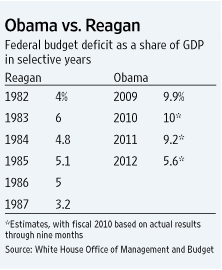
Comparison of budget deficit and GDP under Reagan and Obama

Here’s a nice article from the Wall Street Journal.

Excerpt:

Democrats have been running Congress for nearly four years, and President Obama has been at the White House for 18 months, so it’s not too soon to ask: How’s that working out? One devastating scorecard came out Friday from the White House, in the form of its own semi-annual budget review.

The message: Tax revenues are smaller, spending is greater, and the deficits are thus larger than the White House has been saying. No wonder it dumped the news on the eve of a sweltering mid-July weekend.

[…]As a share of the economy, the White House now says the deficit in fiscal 2010, which ends on September 30, will be even larger than in 2009: 10%. That’s after a full year of economic growth, given that the recovery began last summer. More remarkable still, the deficit will barely fall in fiscal 2011, declining only to 9.2% of GDP in the second year of a recovery that ought to be gaining steam.

Let’s compare Obama and Reagan.

To put this in historical context, consider the nearby table that compares deficits as a share of GDP under Presidents Reagan and Obama. The 1981-82 recession was comparable in severity to the one Mr. Obama inherited and reached similar heights of unemployment. The deficits that resulted from that recession were the source of huge political consternation, with Democrats, the press corps and even some senior Reagan aides insisting that only a huge tax increase could save the country from ruin.

Yet as the table shows, the Reagan deficits never reached more than 6% of GDP, and that happened only in 1983, the first year of economic recovery. As the 1980s expansion continued, the deficits fell, especially as the pace of spending slowed in the latter part of Reagan’s second term.

[…]The Obama deficits are double that, and more than one-third higher than even the Gipper’s worst year. What explains this? Part of it is that Democrats are simply spending much more, sending outlays as a share of GDP above 25% for the first time since World War II. The White House now says outlays will be higher in 2011, at 25.1% of GDP, than at the height of the stimulus in 2009 and 2010.

[…]The other explanation for the record Obama deficits is that revenues have been so anemic, thanks to the lackluster economic recovery. In the Reagan years, revenues as a share of GDP never fell lower than 17.3%, despite (or we would say because of) his pro-growth tax cuts. In 2010, by contrast, the White House now says tax revenues will hit an astonishing low of 14.5% of GDP, rising only to 15.8% in 2011, even with the huge tax increase that hits on January 1, 2011.

Tax cuts worked, and government spending failed. Next time, let’s do what works – not what feels good.