Category Archives: Commentary

How can you figure out what God wants you to do?

Here’s a wonderful post on decision making and the will of God posted on Neil’s blog. Neil links to another post where someone is trying to figure out what God wants him to do.

Excerpt:

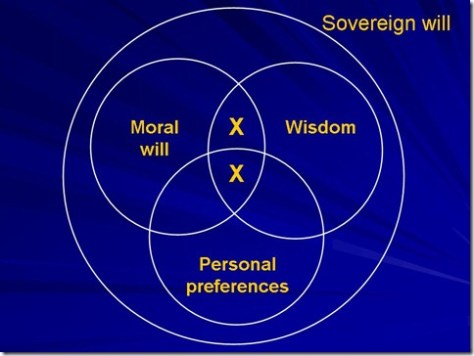
Really short version: Aside from direct and clear personal revelation from God, you don’t have access to his sovereign will when making decisions.  Therefore you must look at other factors.  If it isn’t moral, don’t do it.  If it is moral but not wise, don’t do it.  If it is moral and wise, then use your personal preferences.

Using this model you can end up with a wise and biblical decision, but you have avoided the traps of the “God told me to ____” routine.  People who run around saying that God told them this and that convey a super-spirituality that can leave less mature believers wondering if they really have a relationship with God (i.e., “God doesn’t tell me every little thing to do, so maybe I don’t really know him.”).

He has a helpful picture posted as well:
This is actually a very important topic for me, because I like making plans and making good decisions. I like being the quarterback or squad leader of my own life. I like to pick objectives and then make plans to achieve them. (Nothing too exotic, just simple stuff like saving money or reading more books)

Actually, I really oppose the idea that God has a magical fairy tale will for each person that will make them happy and fulfilled. For me, life isn’t like that. I don’t expect God to lead me along like a child at a scavenger hunt. I expect to survey the battlefield where I am and then do something to make a difference. There are lots of things you can do that will please God. Should you focus on your career and sponsor apologetics conferences? Or should you use your spare time preparing Sunday school lessons? There are lots of good things you could do to please God. Your job is to pick the one that will be the most effective. It doesn’t matter if it makes you happy, it only matters if it’s effective and if you are good at it.

Who is Rifleman Dodd?

A while back, I was busily working my way through the U.S. Marine Corps Official Reading List, and I came across a book by C.S. Forester called Rifleman Dodd, or alternatively titled Death to the French. It’s a work of historical fiction that takes place during the Napoleonic wars. The story is about a British marksman named Dodd, who is cut off from his own lines during a withdrawal maneuver. He is subsequently left to fend for himself behind enemy lines. An ordinary man might be full of despair and forget about his mission entirely. But Dodd is no ordinary man. Not only does he find a way to survive by finding food to eat, water to drink and places to sleep, but he also tries to remember his orders and to think about what he can do to advance the cause of his General, the Duke of Wellington.

Here’s an excerpt from a gritty book review:

It’s about a green-coated British infantry rifleman in the Napoleonic Wars, an age when rifles were a novelty and most of the army was red-coated and carried muskets. Private Matthew Dodd gets separated from his regiment during a retreat and finds himself stranded behind enemy (French) lines in Portugal. With the occasional aid of some natives, but mostly on his own, he harasses the French with his rifle and tries to prevent them from building a bridge across the Tagus River. It’s a remarkable tale of survival and solitary achievement, of a rank-and-file soldier who lives by his wits and slowly learns to make plans without orders, and shows leadership qualities and a knowledge of warfare.

I think we’re in the same situation as Dodd.

There is no point in us looking for breadcrumb trails to happiness at this point. That’s not the point of Christianity. The point of Christianity is friendship with God, imitation of Christ, honoring moral obligations, self-sacrificial love for your neighbor (and even your enemies!), and dedication to the truth – whether anyone else likes you or not. It’s not supposed to make you happy, and it’s not necessarily going to be a normal life like everyone else has. Things may not work out the way you’d like them to.

We seem to be making such a big deal about compassion and forgiveness in the Christian life these days – such a big emphasis on our feelings. Almost like we have forgotten that we have obligations to our friend – and his objectives. A relationship doesn’t mean that one person completely disregards the character and goals of the other person and then is automatically granted forgiveness whenever they want it. That’s not a friendship – that’s using someone else for your own ends. Maybe it’s time to remember what this is all about.

If you think the Rifleman Dodd story sounds good to you, you should definitely buy the “Horatio Hornblower” DVDs and watch them. It’s like Band of Brothers only with twice the morality and wisdom. There’s a neat scene in there where Horatio has to suffer to protect someone who rebelled against him. We need to remember to be like that. Those are our orders.

What is the conservative plan for taking care of the poor?

Here’s is the Heritage Foundation explaining what conservatives would do to solve the problem of poverty.

Excerpt:

Since 1964, the U.S. has spent $15.9 trillion on means-tested welfare programs. After adjusting for inflation, welfare spending is 13 times higher today than it was in 1965. Welfare spending has grown more rapidly than Social Security, Medicare, education, and defense. And what do we have to show for these efforts? According to the Census Bureau, a record high 3.7 million Americans fell into poverty in 2009. The out-of-wedlock birthrate is now 40% and the African American out-of-wedlock birthrate is 72%. When the War on Poverty began the out-of-wedlock birthrate was just 7%.

The collapse of marriage is the root cause of child poverty in the U.S. today. It is far past time to reboot our poverty programs to promote work and encourage marriage in order to control costs and promote greater self-reliance. Among Rector’s recommendations:

  • Slowing the growth of the welfare state: Congress needs to establish reasonable fiscal constraints within the welfare system. Once the current recession ends, aggregate welfare spending should be rolled back to pre-recession levels. After this rollback has been completed, the growth of welfare spending should be capped at the rate of inflation.
  • Promoting personal responsibility and work: Able-bodied welfare recipients should be required to work or to prepare for work as a condition of receiving aid. Food stamps and housing assistance, two of the largest programs for the needy, should be aligned with the TANF program to require able-bodied adults to work or to prepare for work for a minimum of 30 hours per week.
  • Ending the welfare marriage penalty and encouraging marriage in low-income communities: Current means-tested welfare programs penalize low-income recipients who get married; these anti-marriage penalties should be reduced or eliminated.

During the administration of President Bill Clinton, conservatives successfully reformed one welfare program in the 1990s: replacing the old Aid to Families with Dependent Children (AFDC) with the new Temporary Assistance to Needy Families (TANF). But President Barack Obama’s failed economic stimulus gutted those reforms. And his budget proposal would spend $10.3 trillion on means-tested welfare over the next decade. Before the current rise in poverty, that was enough to give $250,000 to each person currently living in poverty in the U.S., or $1 million for a poor family of four. Our nation can’t afford another 10 years of failed War on Poverty thinking.

You can read more about this issue in this Townhall.com column by Walter Williams, which explains everything you need to do to avoid being poor, and to avoid making your kids poor.

Excerpt:

Avoiding long-term poverty is not rocket science. First, graduate from high school. Second, get married before you have children, and stay married. Third, work at any kind of job, even one that starts out paying the minimum wage. And, finally, avoid engaging in criminal behavior. If you graduate from high school today with a B or C average, in most places in our country there’s a low-cost or financially assisted post-high-school education program available to increase your skills.

Most jobs start with wages higher than the minimum wage, which is currently $5.15. A man and his wife, even earning the minimum wage, would earn $21,000 annually. According to the Bureau of Census, in 2003, the poverty threshold for one person was $9,393, for a two-person household it was $12,015, and for a family of four it was $18,810. Taking a minimum-wage job is no great shakes, but it produces an income higher than the Bureau of Census’ poverty threshold. Plus, having a job in the first place increases one’s prospects for a better job.

The Children’s Defense Fund and civil rights organizations frequently whine about the number of black children living in poverty. In 1999, the Bureau of the Census reported that 33.1 percent of black children lived in poverty compared with 13.5 percent of white children. It turns out that race per se has little to do with the difference. Instead, it’s welfare and single parenthood. When black children are compared to white children living in identical circumstances, mainly in a two-parent household, both children will have the same probability of being poor.

Here’s more Walter Williams: (2 minutes)

And some Thomas Sowell: (4.5 minutes)

Walter Williams and Thomas Sowell are my two favorite economists.

Is there a Tea Party faction within the Christian Church? Who is it?

Did someone say "Tea Party?"

Consider this report by a non-Christian who attended the recent “On Guard” conference in Dallas, Texas. (H/T Melissa of Hard-Core Christianity)

Excerpt:

Over the weekend, I attended the On Guard Conference 2010, a Christian apologetics conference. Before you read any further I must quickly explain my history with Christianity.

Back in high school, I was holy rollin’ like a 80-year-old on a Rascal. I  knew for sure I was going into the ministry and was entirely prepared to spend the rest of my life in the service of God. Several things happened about which I would write a book (and might one day). The short version is, my church was populated with small-minded, bigots. The church split twice and once because of a situation I was involved in. A poor black woman living out of an old rusted mustang barely survived two lots down while the church sent money to missionaries in Honduras. By the time the church had sucked my soul from me and spit me out, I turned my back on it all.

Fast forward to now. I have two children and I live in Texas. They will be exposed to Christianity in some form. We visited many churches (and synagogues since they are technically Jewish) and nothing appealed to me. The primary problem I have is that traditional worship is a broken record, especially when handled by Southern Baptists. There is only so much of the same catch-phrases, slogans, and cliches I can take before I hit toxic cynicism. The other problem I have is with modern worship. There is only so much canned slides, unfamiliar songs, and slick (but only re-purposed traditional) sermons I stomach. Where others claim tradition, I claim “rut”. I was on the other side long enough to see all of these things as meaningless.

I kept myself at such a distance from religion for so long, that aplogetics is entirely new to me. Christian apologetics is a discipline (and I would argue a culture as well) within Christianity where Christians defend their faith through logic, reason, and even science. Yeah, I know, sounds crazy. But here’s the kicker:

In my entire life, not once have I ever seen or heard a Christian say these words: “I’m not afraid for anyone to question me about my faith. I have nothing to hide [intellectually].”

Keep in mind, growing up Southern Baptists means growing up knowing very little about your own faith and spending time around other people who are openly hostile to those who don’t believe the same way.

For me, I don’t know what I believe anymore. I feel burned by a long history of disappointments by my own faith. In a nutshell, God to me is very similar to my own father. He came around, did his business and is long gone. I don’t and probably will never believe God is much more than a designer who set up some sophisticated systems that still work today but has moved on to other interests. I frankly think it’s absurd to believe God takes the time to help somebody have the strength to make it through a job interview while somewhere else around the world a child is sold into a life of sex slavery. But I digress.

So my attendance at the conference is me intrigued by the kind of intellectual topics presented because that’s not the Christianity I know or see on TV.

He summarizes the conference and then ends with this:

So the conference was great. So great in fact it occurred to me if actual mainstream Christianity was like that instead of the feelings-based judgment frontal assault I grew up with, I might have never left the church. However, the conference seemed to be geared toward two types: believers (meaning Christians who want to defend their faith) and atheists, who comprise the main apologetics boogie man. “Atheist” was used constantly to refer to the kind of people they needed to stay prepared for.

As a guy who lost his faith long ago, I never doubted God’s existence.  However, since I think he is a deadbeat dad, I have many questions and am looking for meaning without being convinced God is real. My struggle with faith has lasted me about 25 years. I would like to have seen a session on reconciling the Bible as a whole. For instance if Intelligent Design is really using science as I heard, how do they address the Adam and Eve question? I also would like someone like Dr. Moreland to discuss why he gets three angels and conversations with God directly when clearly God never bothered with me to begin with.

The premise on which they build many of their arguments is their belief. I don’t have that. So while I enjoyed the conference overall, I walked out of there with more questions. But isn’t that kind of the point? For the first time in over two decades, I felt mentally stimulated by a religious event. In that, I’m intrigued.

And what do we learn from this?

Well, I will try to be civil, but what I really want to do is rant against the postmodernism, irrationality, mysticism, pietism, relativism, inclusivism, universalism, hedonism, etc. that has got us to a point where something like 70% of young Christians who grow up in the church abandon it as soon as they go off to college. The church is a club that is run by people who want nothing to do with the honest questions of people who are less interested in feelings, intuitions, amusement and community and more interested in truth. And we are failing these honest questioners, because we are too busy having fun and feeling happy.

I have a very good idea of why the church is losing all of it’s young people. And we need a tea party revolution in the church to get people to come back.

So here’s my stand:

  • The church believes that belief in God’s existence is divorced from logic and evidence, but I believe that God’s existence is knowable, rational and supported by publicly-accessible evidence
  • The church thinks that people become Christians because they like Christianity, but I believe that people become Christians when they think Christianity is true
  • The church believes you can seek happiness without caring about the moral law, and their job is to make you feel accepted no matter what you do, but I believe that we need to set out clear moral boundaries and explain to people using non-Biblical evidence what damage is caused if those boundaries are broken
  • The church believes that reading the Bible and attending church as therapeutic, but I think that the Bible and church are for clarifying my obligations in my relationship with God and for setting out the broad goals that I will use when I develop my life plan to meet those goals by solving problems using my talents in the way that *I* think is most effective – and my plan doesn’t involve making you feel happy, by the way
  • The church thinks that the Christian life consists of singing, praying and not disagreeing with anyone or thinking that we are right about anything, but I think we should get off our duffs and start studying to think about how our Christian convictions apply to the world around us in every area of life, from politics to economics to foreign policy to marriage and parenting and beyond
  • The church believes that Christianity is true for them while other religions work for other people, but I believe that religions are assessed by whether they are true or not – and that other religions can be mistaken where they make false claims
  • The church believes that evangelism is done without using apologetics or focusing on truth, but I think we should all be prepared by watching debates, holding open forums, hosting speakers and conferences, and generally training ourselves to engage with the outside world in the realm of ideas
  • The church thinks Christianity is a faith tradition, but I think Christianity is a knowledge tradition

Anyway, check out these other posts for more snarky defiance.

Mentoring

Apologetics advocacy