All posts by Wintery Knight

https://winteryknight.com/

Atheist Lawrence Krauss offers the best argument against Christianity

Richard Dawkins on atheism, morality, free will and human rights

Although there are some pretty smart atheists out there, none is smarter than the venerable Lawrence Krauss. Well, Krauss has been thinking about atheism quite a bit since his debate with William Lane Craig, and he’s come up with an argument that simply can’t be defeated.

Buzzfeed reports on Krauss’ new argument against Christian theism:

When Melody Hensley first met Lawrence Krauss, she was a 29-year-old makeup artist at a department store, and he was one of her intellectual idols. She ran an atheist website in her spare time and had just started volunteering for the Center for Inquiry (CFI), a nonprofit group committed to promoting science and reason above faith. She was hoping to build a career in the burgeoning “skeptics” movement, and Krauss was one of its brightest luminaries.

At a CFI event in November 2006, Krauss asked Hensley for her card, and later, as she was leaving, asked her if she was “of age.” She brushed off the odd question, excited to meet a star skeptic. When he later emailed to invite her to dinner, she accepted.

“I didn’t care if he flirted with me, I just wanted to be around somebody important, and I also wanted to get a job in this field,” Hensley told BuzzFeed News. “I thought I could handle myself.”

They made a plan to eat in the restaurant at the Washington, DC, hotel where Krauss was staying, Hensley recalled. But first he asked her to come up to his room while he wrapped up some work. He seemed in no rush to leave, she said, ordering a cheese plate and later champagne, despite her suggestion that they go down to dinner.

Then, Hensley said, Krauss made a comment about her eye makeup, and got very close to her face. Suddenly, he lifted her by the arms and pushed her onto the bed beneath him, forcibly kissing her and trying to pull down the crotch of her tights. Hensley said she struggled to push him off. When he pulled out a condom, Hensley said, she got out from under him, said “I have to go,” and rushed out of the room.

Krauss told BuzzFeed News that what happened with Hensley in the hotel room was consensual. In that room, “we mutually decided, in a polite discussion in fact, that taking it any further would not be appropriate,” he told BuzzFeed News by email.

But Hensley said that is untrue. “It was definitely predatory,” she said. “I didn’t want that to happen. It wasn’t consensual.”

The argument is supported by many interlocking evidences from different fields of study:

BuzzFeed News has learned that the incident with Hensley is one of many wide-ranging allegations of Krauss’s inappropriate behavior over the last decade — including groping women, ogling and making sexist jokes to undergrads, and telling an employee at Arizona State University, where he is a tenured professor, that he was going to buy her birth control so she didn’t inconvenience him with maternity leave. In response to complaints, two institutions — Case Western Reserve University in Cleveland, Ohio, and the Perimeter Institute for Theoretical Physics in Waterloo, Ontario — have quietly restricted him from their campuses. Our reporting is based on official university documents, emails, and interviews with more than 50 people.

So, here is how the argument goes formally:

Premise 1. If Christianity is true, then sex outside of a natural marriage is wrong.

Premise 2. Sex outside of a natural marriage is not wrong.

Conclusion: Therefore, Christian theism is not true. (MT)

This argument seems to hold a lot of sway with many atheists, like Richard Dawkins, Richard Carrier, Michael Shermer, and so on. Pretty much everyone who makes a career out of disproving Christianity is familiar with this powerful argument.

Although this is an excellent argument (I call it the argument from immorality), it should be noted that it is not a new argument at all. It’s actually discussed in the Bible of all places, in Romans chapter 1.

Romans 1:18-25:

18 The wrath of God is being revealed from heaven against all the godlessness and wickedness of people, who suppress the truth by their wickedness,

19 since what may be known about God is plain to them, because God has made it plain to them.

20 For since the creation of the world God’s invisible qualities—his eternal power and divine nature—have been clearly seen, being understood from what has been made, so that people are without excuse.

21 For although they knew God, they neither glorified him as God nor gave thanks to him, but their thinking became futile and their foolish hearts were darkened.

22 Although they claimed to be wise, they became fools

23 and exchanged the glory of the immortal God for images made to look like a mortal human being and birds and animals and reptiles.

24 Therefore God gave them over in the sinful desires of their hearts to sexual impurity for the degrading of their bodies with one another.

25 They exchanged the truth about God for a lie, and worshiped and served created things rather than the Creator—who is forever praised.Amen.

In my experience, atheists reject the evidence for Christianity because they don’t want the moral changes that come with Christianity. Even the atheists I know who claim to be “moral” nevertheless promote immorality through their political actions, voting for a world where moral evils like abortion and pedophilia cannot be judged. They also vote to suppress the disagreement of Christians, and celebrate when the state silences Christian expressions of disapproval for immorality. Actions tell what is going on much more than words.

UPDATE:

New York Times: Arizona State Suspends Lawrence Krauss During Inquiry Over Sexual Misconduct Accusations

Gizmodo: Science Organizations Cancel Lawrence Krauss Events After Sexual Harassment Allegations

Positive arguments for Christian theism

Senate Democrats block legislation protecting babies from being killed after birth

What does it really mean to be "pro-choice" on abortion?
What does it really mean to be “pro-choice” on abortion?

A lot of conservatives complain that Republicans don’t pass enough pro-life legislation when they hold the House, Senate and White House. The truth is, the House Republicans DID pass some pro-life legislation from 2016-2018. Some of it got signed into law, but most of it died in the Senate, because of the Democrats.

The Washington Times reports on a bill – Born-Alive Abortion Survivors Protection Act – that just died in the Senate:

An effort by Senate Republicans to enhance protections for newborns who survive abortions, spurred by New York and Virginia bills making it easier to perform late-term procedures, was blocked Monday by Democrats.

[…]“There are only two sides of the debate on the floor debate tonight: You’re either for babies, or you’re defending infanticide,” said Mr. Sasse in his floor speech. “That is actually what the legislation is that’s before us.”

[…]The Sasse bill would require medical practitioners caring for infants born alive after botched abortions to “exercise the same degree of professional skill and care to protect the newborn as would be offered to any other child born alive at the same gestational age.”

“It also requires that the living child, after appropriate care has been given, be immediately transported and admitted to a hospital,” said the Sasse press release. “Currently federal law does not adequately protect a born child who survives an abortion.”

Unfortunately for the little babies, the bill did not pass:

Republicans said they would keep pressing for the bill, while pro-life groups denounced Democrats for standing in the way of the legislation.

“Senate Democrats had the chance today to prove they are not the party of infanticide, and instead they doubled down on extremism,” said Susan B. Anthony List President Marjorie Dannenfelser.

It’s not unreasonable to request expedited processing for a bill that ought to pass unanimously. After all, who would vote against a born baby?

Here’s what “moderate” Democrat Dianne Feinstein had to say about infanticide:

Sen. Dianne Feinstein, California Democrat, blasted the Sasse bill as “just the latest attack in the decades-long Republican effort to eliminate a woman’s right to control her own body.”

So, you make a bill outlawing infanticide, and 40 Republican senators co-sponsor it. But the bill dies anyway, because Democrats won’t support it.

The abortion debate was never about weeks or months or viability. Talking about when an unborn baby becomes a human being was just a rhetorical smokescreen to dehumanize unborn children, the same way that skin color was used to dehumanize slaves. Democrats always knew that unborn babies were human beings at every moment during pregnancy. They’re strong. The baby is weak. The baby is in their way. Who cares about reason and evidence? Who cares about right and wrong? If something gets in your way, just kill it, and then silence anyone who makes you feel bad about your selfishness.

I would be very careful about electing people who are willing to kill innocent children who get in the way of their pleasure-seeking. If they aren’t willing to control their hedonism to protect innocent children, they certainly aren’t going to put the brakes on for you.

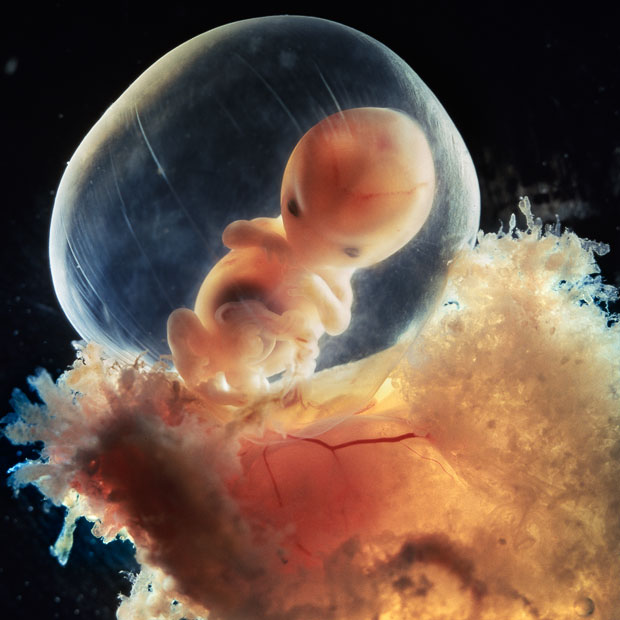
If unborn babies don’t have consciousness or don’t feel pain, may we kill them?

Unborn baby scheming about pro-life apologetics

Was having a conversation by e-mail yesterday with a pro-abortion atheist, and he gave two reasons why he supported abortion in the first and second trimester. First, he said that unborn babies can’t feel pain, so it’s OK to kill them. Second, he said that unborn babies don’t have consciousness, so it’s OK to kill them. I thought it might be useful to link to something that answers both of these objections.

Frank Beckwith is the author of “Defending Life: A Moral and Legal Case Against Abortion Choice“, which was published by Cambridge University Press, a top academic press. But before Cambridge University Press, Beckwith wrote four easy-to-understand essays for the Christian Research Journal. Part IV is the one that has the response to the two questions raised by my atheist friend.

Part I. The Appeal to Pity

Part II. Arguments from Pity, Tolerance, and Ad Hominem

Part III. Is The Unborn Human Less Than Human?

Part IV. When Does a Human Become a Person?

Excerpt:

Some ethicists argue that the unborn becomes fully human sometime after brain development has begun, when it becomes sentient: capable of experiencing sensations such as pain. The reason for choosing sentience as the criterion is that a being that cannot experience anything (i.e., a presentient unborn entity) cannot be harmed. Of course, if this position is correct, then the unborn becomes fully human probably during the second trimester and at least by the third trimester. Therefore, one does not violate anyone’s rights when one aborts a nonsentient unborn entity. [13]

There are several problems with this argument. First, it confuses harm with hurt and the experience of harm with the reality of harm. [14] One can be harmed without experiencing the hurt that sometimes follows from that harm, and which we often mistake for the harm itself. For example, a temporarily comatose person who is suffocated to death “experiences no harm,” but he is nevertheless harmed. Hence, one does not have to experience harm, which is sometimes manifested in hurt, in order to be truly harmed.

Second, if sentience is the criterion of full humanness, then the reversibly comatose, the momentarily unconscious, and the sleeping would all have to be declared nonpersons. Like the presentient unborn, these individuals are all at the moment nonsentient though they have the natural inherent capacity to be sentient. Yet to countenance their executions would be morally reprehensible. Therefore, one cannot countenance the execution of some unborn entities simply because they are not currently sentient.

Someone may reply that while these objections make important points, there is a problem of false analogy in the second objection: the reversibly comatose, the momentarily unconscious, and the sleeping once functioned as sentient beings, though they are now in a temporary state of nonsentience. The presentient unborn, on the other hand, were never sentient. Hence, one is fully human if one was sentient “in the past” and will probably become sentient again in the future, but this cannot be said of the presentient unborn.

There are at least three problems with this response. First, to claim that a person can be sentient, become nonsentient, and then return to sentience is to assume there is some underlying personal unity to this individual that enables us to say that the person who has returned to sentience is the same person who was sentient prior to becoming nonsentient. But this would mean that sentience is not a necessary condition for personhood. (Neither is it a sufficient condition, for that matter, since nonhuman animals are sentient.) Consequently, it does not make sense to say that a person comes into existence when sentience arises, but it does make sense to say that a fully human entity is a person who has the natural inherent capacity to give rise to sentience. A presentient unborn human entity does have this capacity. Therefore, an ordinary unborn human entity is a person, and hence, fully human.

Second, Ray points out that this attempt to exclude many of the unborn from the class of the fully human is “ad hoc and counterintuitive.” He asks us to “consider the treatment of comatose patients. We would not discriminate against one merely for rarely or never having been sentient in the past while another otherwise comparable patient had been sentient….In such cases, potential counts for everything.” [15]

Third, why should sentience “in the past” be the decisive factor in deciding whether an entity is fully human when the presentient human being “is one with a natural, inherent capacity for performing personal acts?” [16] Since we have already seen that one does not have to experience harm in order to be harmed, it seems more consistent with our moral sensibilities to assert that what makes it wrong to kill the reversibly comatose, the sleeping, the momentarily unconscious, and the presentient unborn is that they all possess the natural inherent capacity to perform personal acts. And what makes it morally right to kill plants and to pull the plug on the respirator-dependent brain dead, who were sentient “in the past,” is that their deaths cannot deprive them of their natural inherent capacity to function as persons, since they do not possess such a capacity.

These four essays are a very good introduction to common responses to pro-abortion arguments. I recommend that people get familiar with this, as once you look into it, you will see that the abortion issue can be debated with as much confidence as William Lane Craig defends Christian theism. You will have the same access to scientific evidence and rational arguments on this topic, and so you will have the upper hand. And that’s fun.

The best introductory book on the abortion / right to life issue is “The Case for Life” by pro-life debater Scott Klusendorf. The best comprehensive book is a tie between “The Ethics of Abortion” by Christopher Kaczor, and Frank Beckwith’s “Defending Life: A Moral and Legal Case Against Abortion Choice“.